Shoulder Rehab Challenge · 26
Shoulder injection or exercise: what the evidence shows over time
Subacromial corticosteroid injection delivers an anti-inflammatory steroid (usually with local anaesthetic) into the subacromial space for rotator…
Key points
- Exercise. Make progressive loading the long-term foundation, using light raises, rows and prone work.
- Option. Consider an injection only to enable exercise when pain blocks it; expect relief for weeks, not months.
- Dose. Good advice and a home programme can be enough; review progress at about 3 months.
What it is
Subacromial corticosteroid injection delivers an anti-inflammatory steroid (usually with local anaesthetic) into the subacromial space for rotator cuff-related shoulder pain; progressive exercise is a graded strengthening programme. The question for slides is how their effects compare over weeks versus months.
How we analysed the movement
Three movements relevant to this topic were analysed from illustrated reference figures. Joint centres were located with two-dimensional pose estimation; arm elevation and elbow angles, shoulder level, the whole-body centre of mass and, where relevant, the arm lever (the horizontal distance from the shoulder joint to the centre of mass of the arm, with any hand load) and the resulting shoulder moment were then calculated from standard segment parameters. The figures are educational estimates that show how position changes mechanical demand; they are not measurements of a patient. Every research value quoted below comes from the published source cited beside it.
Movement A: Lateral raise (front view)
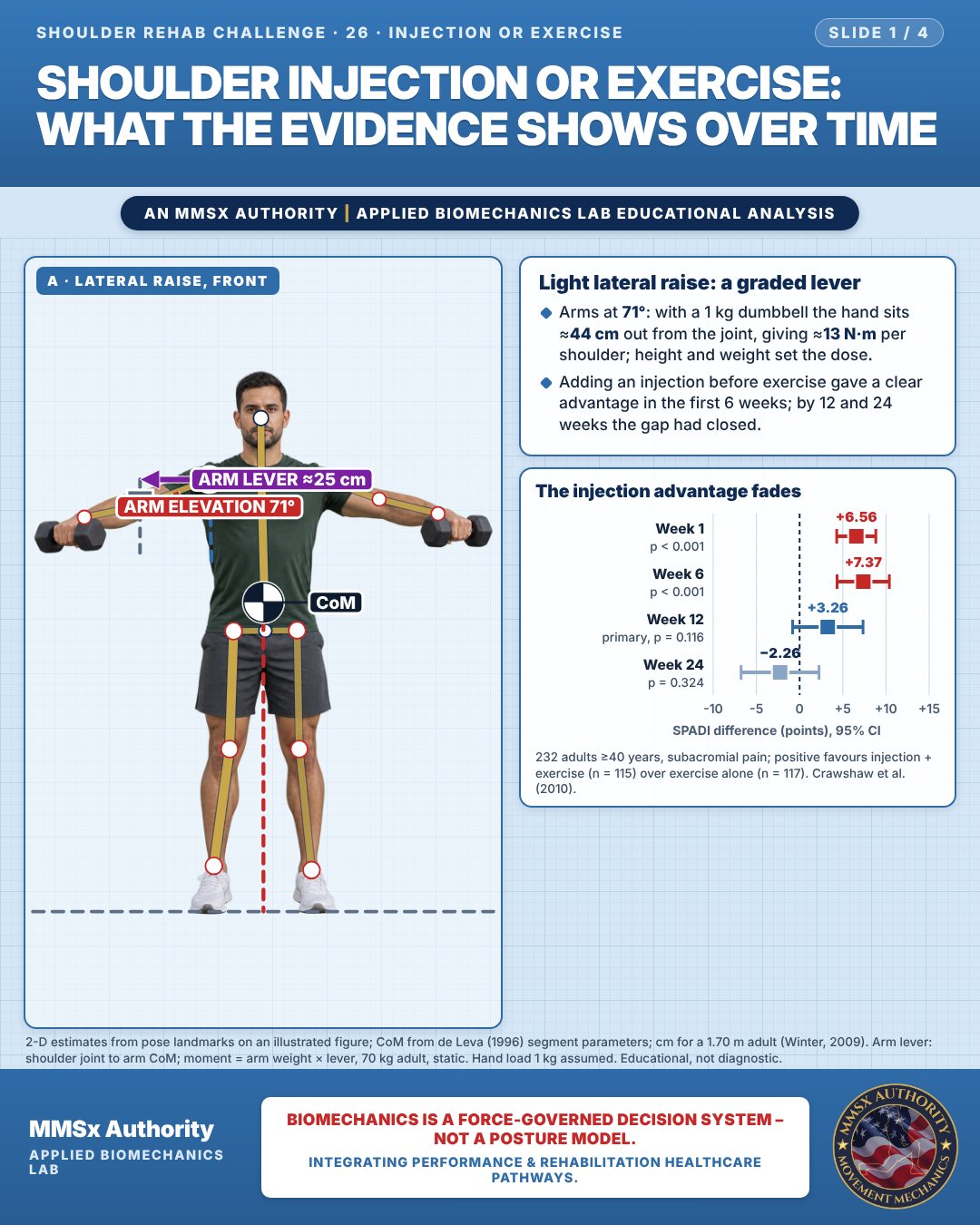
Light lateral raise: a graded lever
Arms at 71°: with a 1 kg dumbbell the hand sits ≈44 cm out from the joint, giving ≈13 N·m per shoulder; height and weight set the dose.
Adding an injection before exercise gave a clear advantage in the first 6 weeks; by 12 and 24 weeks the gap had closed.
The injection advantage fades
Movement B: Band row (side view)
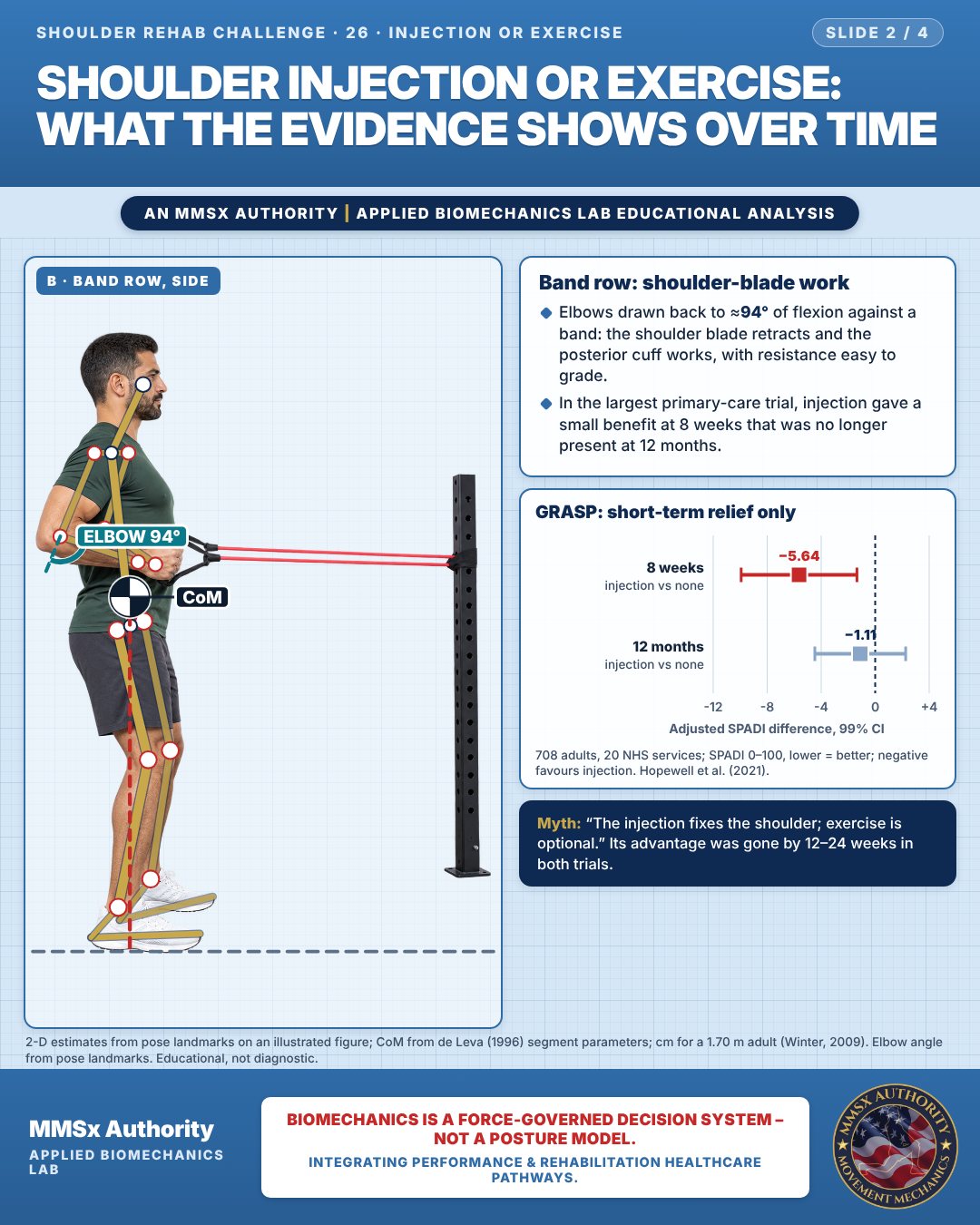
Band row: shoulder-blade work
Elbows drawn back to ≈94° of flexion against a band: the shoulder blade retracts and the posterior cuff works, with resistance easy to grade.
In the largest primary-care trial, injection gave a small benefit at 8 weeks that was no longer present at 12 months.
GRASP: short-term relief only
Movement C: Prone t-raise (rear view)
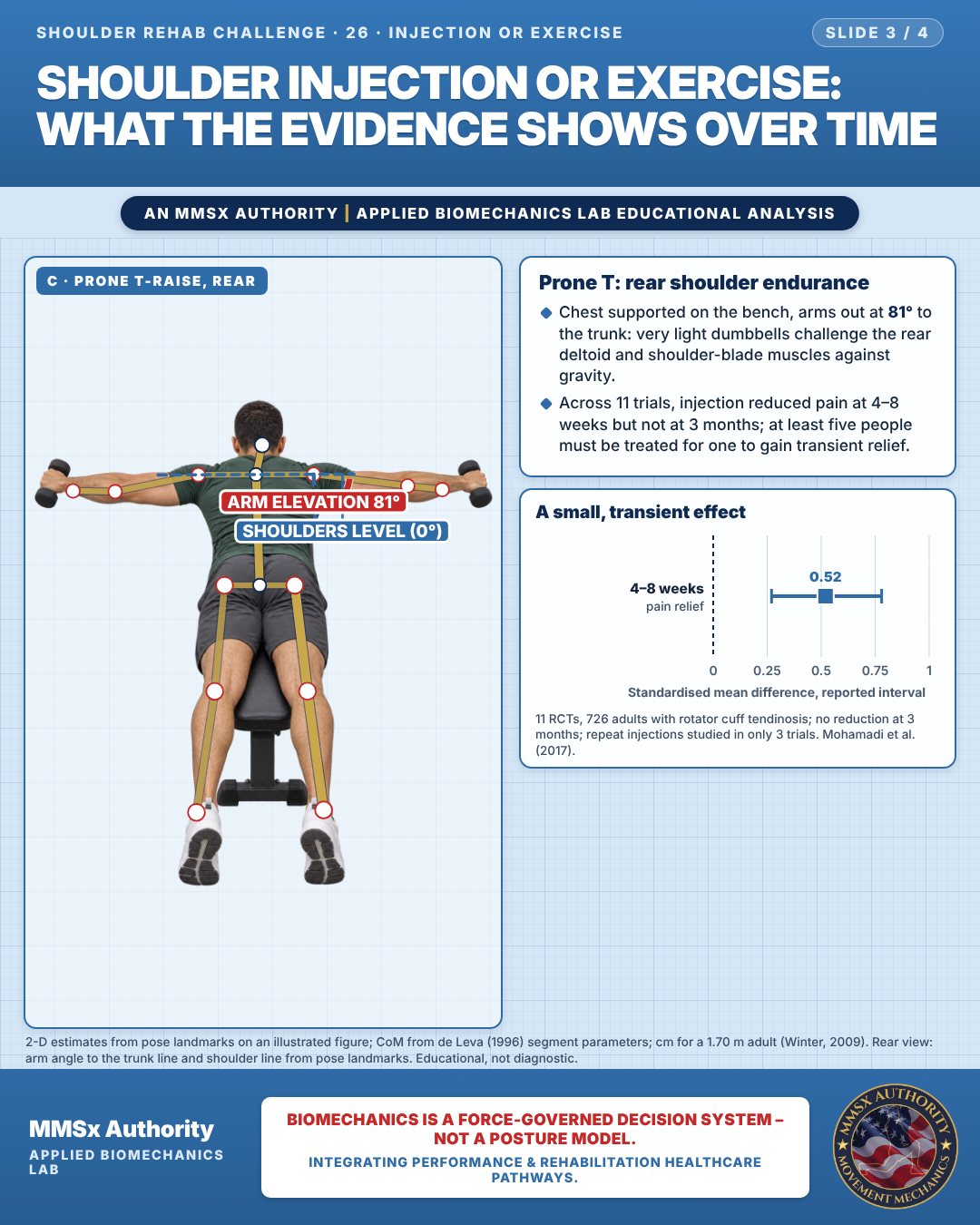
Prone T: rear shoulder endurance
Chest supported on the bench, arms out at 81° to the trunk: very light dumbbells challenge the rear deltoid and shoulder-blade muscles against gravity.
Across 11 trials, injection reduced pain at 4–8 weeks but not at 3 months; at least five people must be treated for one to gain transient relief.
A small, transient effect
Decision pathway
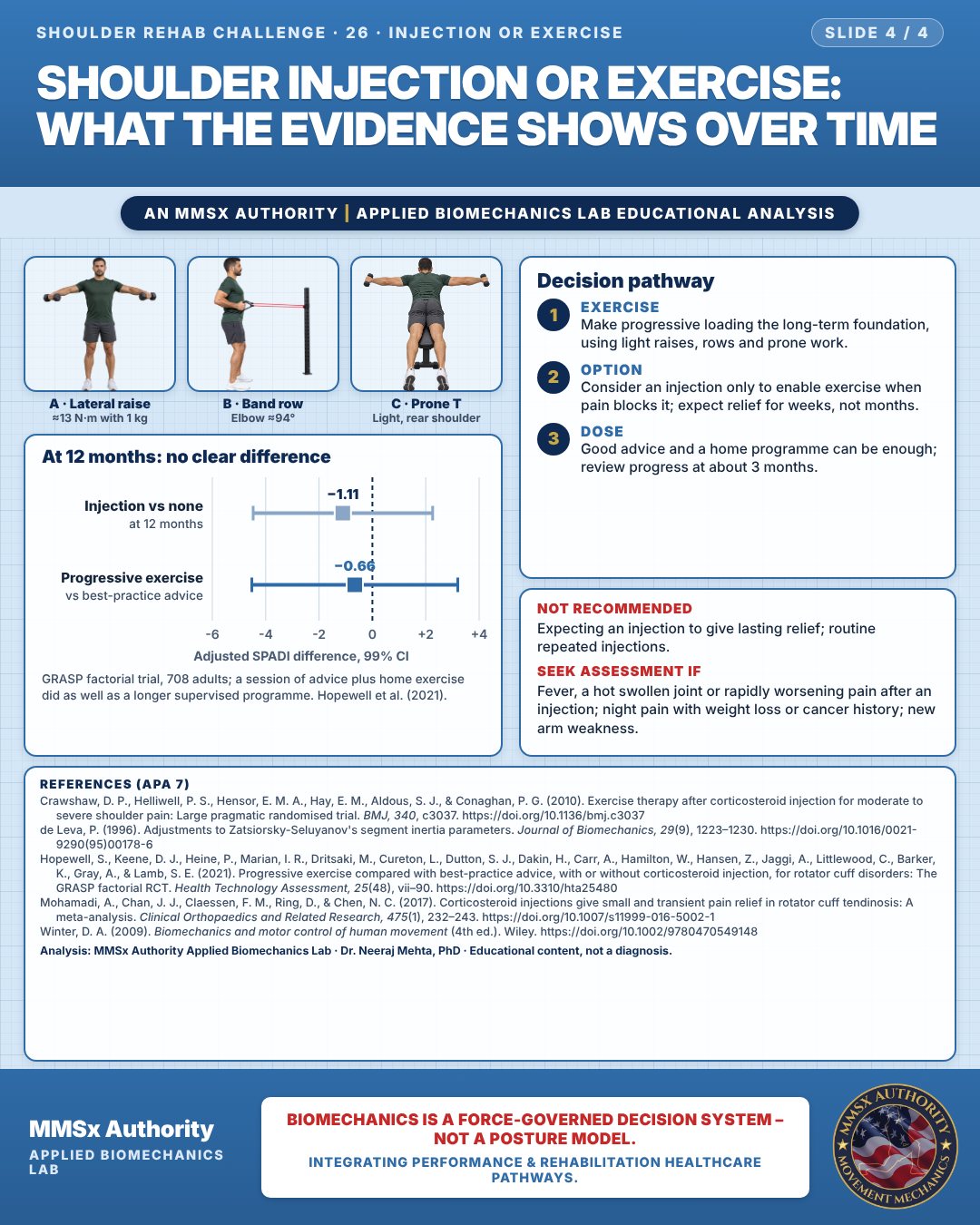
At 12 months: no clear difference
Exercise
Make progressive loading the long-term foundation, using light raises, rows and prone work.
Option
Consider an injection only to enable exercise when pain blocks it; expect relief for weeks, not months.
Dose
Good advice and a home programme can be enough; review progress at about 3 months.
What the evidence supports
- Supported: exercise-based care as the long-term foundation; corticosteroid injection as an optional short-term adjunct for pain that limits rehabilitation (Crawshaw et al., 2010; Hopewell et al., 2021; Mohamadi et al., 2017).
- Not supported: expecting an injection to give lasting (beyond about 3 months) improvement (Mohamadi et al., 2017); routine repeated injections (evidence thin: only 3 studies, 292 patients, used repeat injections — Mohamadi et al., 2017); assuming more physiotherapy sessions are always better than good advice plus home exercise (Hopewell et al., 2021).
Myth and evidence
Myth“The injection fixes the shoulder; exercise is optional.”
EvidenceInjection advantages of about 6–7 SPADI points at 1–6 weeks were gone by 12–24 weeks (Crawshaw et al., 2010), and the 8-week benefit in GRASP was no longer present at 12 months (Hopewell et al., 2021).
Cautions
Not recommended
Expecting an injection to give lasting relief; routine repeated injections.
Seek assessment if
Fever, a hot swollen joint or rapidly worsening pain after an injection; night pain with weight loss or cancer history; new arm weakness.
Methods note
2-D estimates from pose landmarks on an illustrated figure; CoM from de Leva (1996) segment parameters; cm for a 1.70 m adult (Winter, 2009). Arm lever: shoulder joint to arm CoM; moment = arm weight × lever, 70 kg adult, static. Hand load 1 kg assumed. Elbow angle from pose landmarks. Rear view: arm angle to the trunk line and shoulder line from pose landmarks. These are educational estimates, not a diagnosis.
References
- Crawshaw, D. P., Helliwell, P. S., Hensor, E. M. A., Hay, E. M., Aldous, S. J., & Conaghan, P. G. (2010). Exercise therapy after corticosteroid injection for moderate to severe shoulder pain: Large pragmatic randomised trial. BMJ, 340, c3037. https://doi.org/10.1136/bmj.c3037
- de Leva, P. (1996). Adjustments to Zatsiorsky-Seluyanov's segment inertia parameters. Journal of Biomechanics, 29(9), 1223–1230. https://doi.org/10.1016/0021-9290(95)00178-6
- Hopewell, S., Keene, D. J., Heine, P., Marian, I. R., Dritsaki, M., Cureton, L., Dutton, S. J., Dakin, H., Carr, A., Hamilton, W., Hansen, Z., Jaggi, A., Littlewood, C., Barker, K., Gray, A., & Lamb, S. E. (2021). Progressive exercise compared with best-practice advice, with or without corticosteroid injection, for rotator cuff disorders: The GRASP factorial RCT. Health Technology Assessment, 25(48), vii–90. https://doi.org/10.3310/hta25480
- Mohamadi, A., Chan, J. J., Claessen, F. M., Ring, D., & Chen, N. C. (2017). Corticosteroid injections give small and transient pain relief in rotator cuff tendinosis: A meta-analysis. Clinical Orthopaedics and Related Research, 475(1), 232–243. https://doi.org/10.1007/s11999-016-5002-1
- Winter, D. A. (2009). Biomechanics and motor control of human movement (4th ed.). Wiley. https://doi.org/10.1002/9780470549148
Cite this article
Mehta, N. (2026, October 24). Shoulder injection or exercise: what the evidence shows over time. MMSx Authority Applied Biomechanics Lab. https://mmsxauthority.org/edu/analysis/shoulder/26-shoulder-injection-or-exercise-what-the-evidence-shows-over-time/
Part of the collection
Mehta, N. (2026). Shoulder Rehabilitation: 50 Evidence-Based Biomechanics Analyses [Collection]. MMSx Authority Applied Biomechanics Lab. Zenodo. https://doi.org/10.5281/zenodo.23735725
All Shoulder Rehab Challenge articles · Rehabilitation Library