Shoulder Rehab Challenge · 25
Weakness lifting the arm: when to suspect a large cuff tear
A large or massive rotator cuff tear is a full-thickness tear involving more than one tendon or a large retracted defect.
Key points
- Test. Check strength and lag signs; a positive lag sign makes a full-thickness tear more likely than pain alone.
- Refer. Suspected full-thickness tear: imaging and specialist review; repairable tears may do better with repair.
- Retrain. If repair is not an option, graded deltoid training from lying to upright can restore elevation.
What it is
A large or massive rotator cuff tear is a full-thickness tear involving more than one tendon or a large retracted defect; it may cause marked weakness, an inability to hold the arm elevated or rotated (lag signs), and a shoulder-hitch pattern when lifting, although pain and function vary widely between people.
How we analysed the movement
Three movements relevant to this topic were analysed from illustrated reference figures. Joint centres were located with two-dimensional pose estimation; arm elevation and elbow angles, shoulder level, the whole-body centre of mass and, where relevant, the arm lever (the horizontal distance from the shoulder joint to the centre of mass of the arm, with any hand load) and the resulting shoulder moment were then calculated from standard segment parameters. The figures are educational estimates that show how position changes mechanical demand; they are not measurements of a patient. Every research value quoted below comes from the published source cited beside it.
Movement A: Side raise attempt (front view)
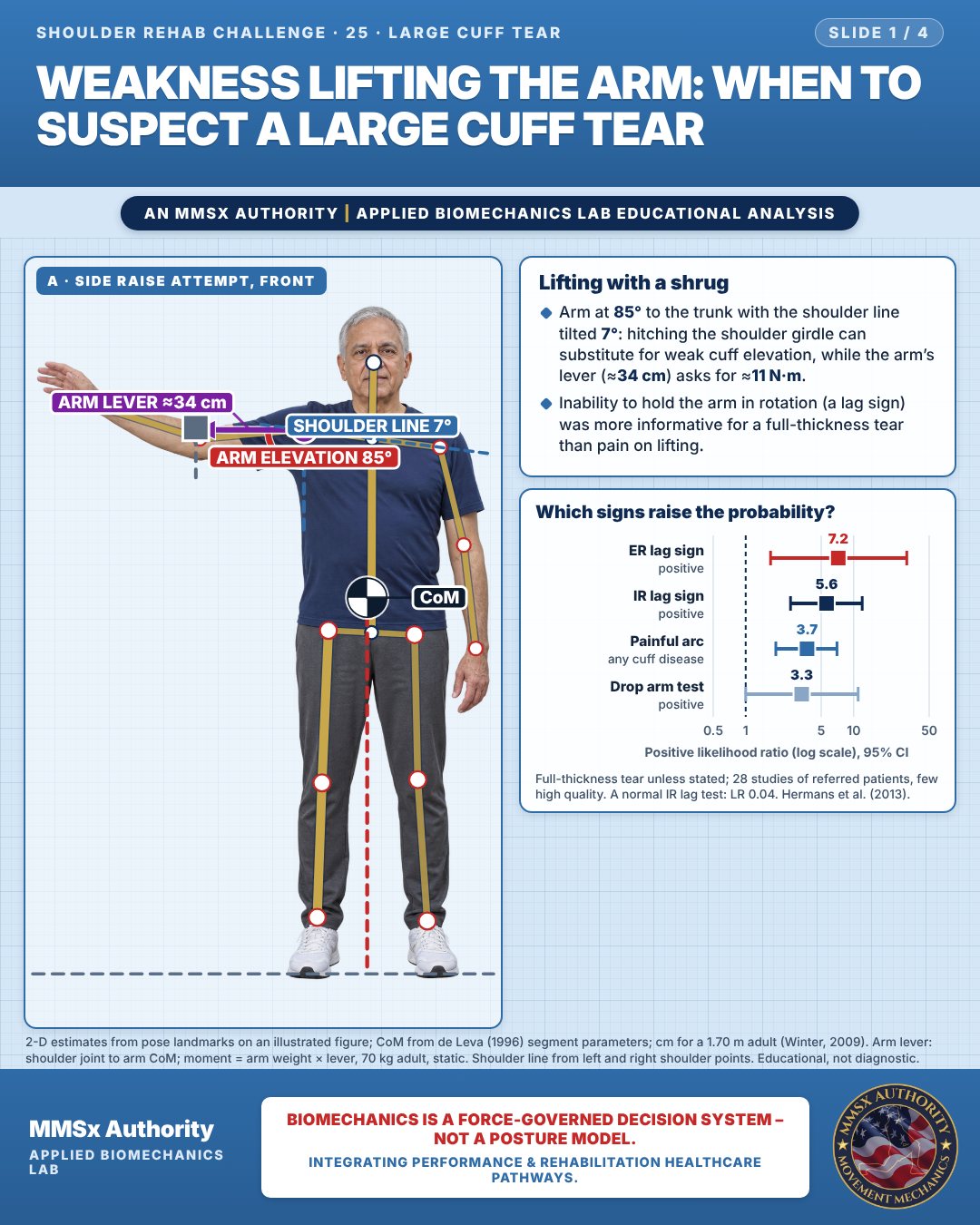
Lifting with a shrug
Arm at 85° to the trunk with the shoulder line tilted 7°: hitching the shoulder girdle can substitute for weak cuff elevation, while the arm’s lever (≈34 cm) asks for ≈11 N·m.
Inability to hold the arm in rotation (a lag sign) was more informative for a full-thickness tear than pain on lifting.
Which signs raise the probability?
Movement B: Supine arm raise (side view)
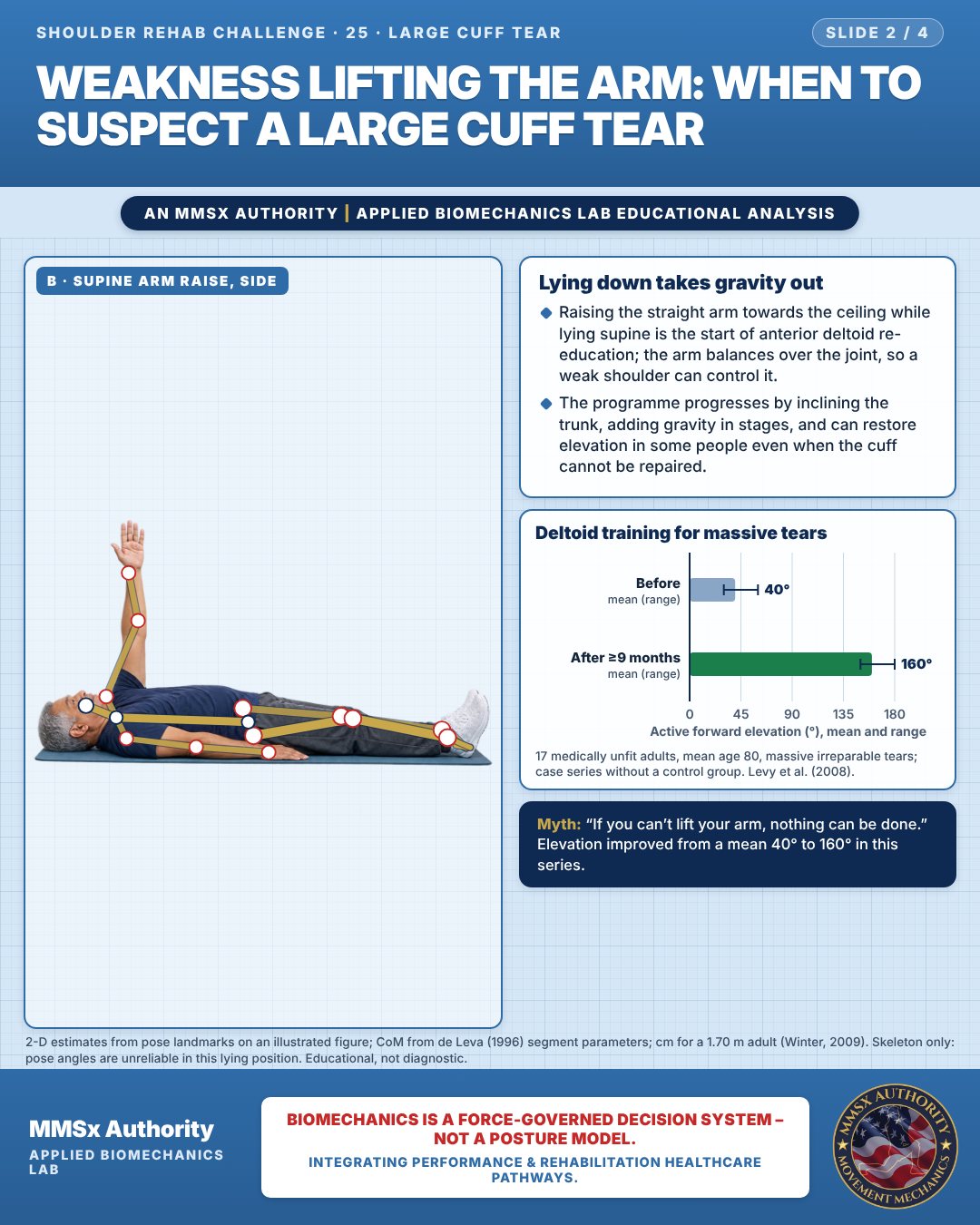
Lying down takes gravity out
Raising the straight arm towards the ceiling while lying supine is the start of anterior deltoid re-education; the arm balances over the joint, so a weak shoulder can control it.
The programme progresses by inclining the trunk, adding gravity in stages, and can restore elevation in some people even when the cuff cannot be repaired.
Deltoid training for massive tears
Movement C: Seated front raise (side view)
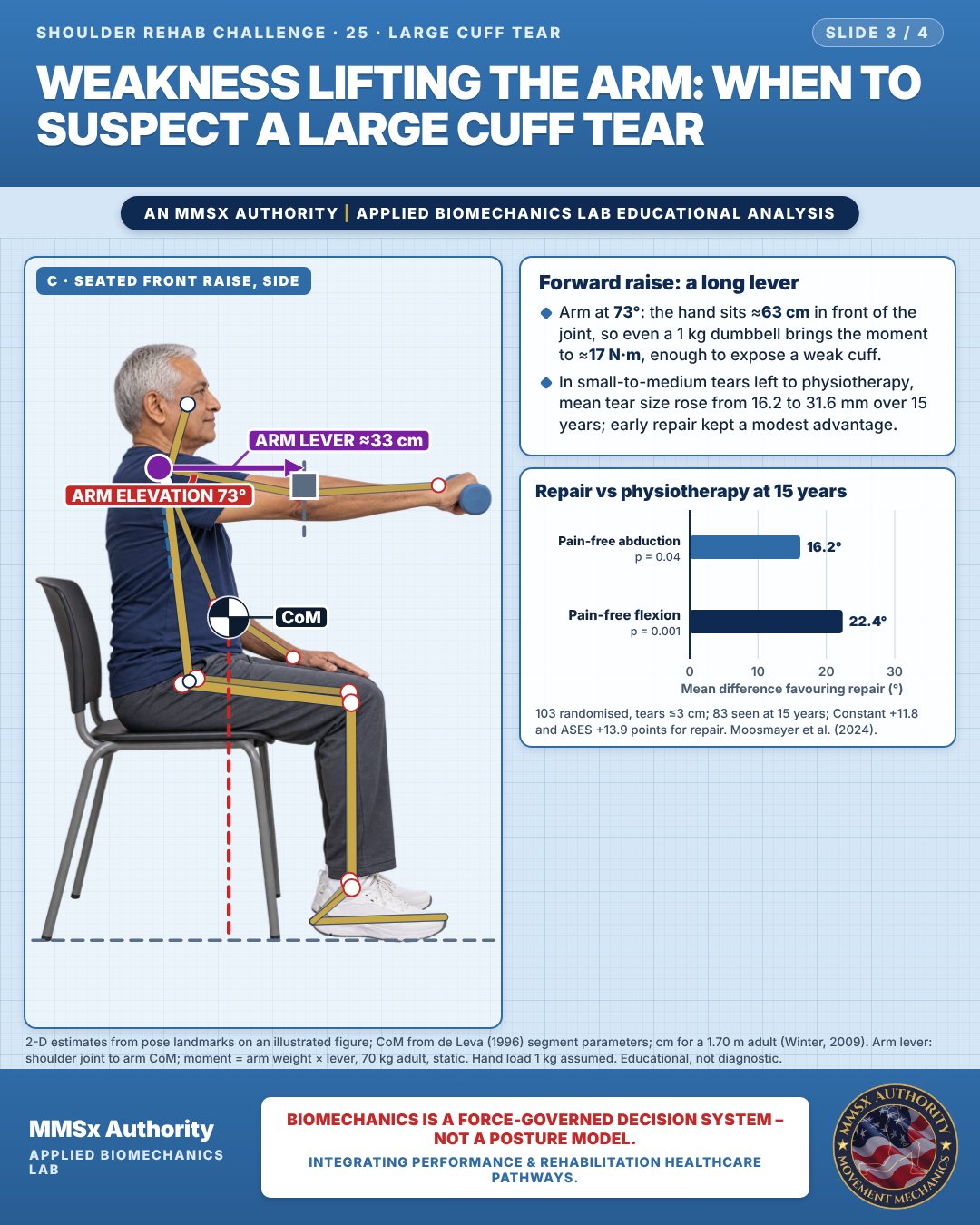
Forward raise: a long lever
Arm at 73°: the hand sits ≈63 cm in front of the joint, so even a 1 kg dumbbell brings the moment to ≈17 N·m, enough to expose a weak cuff.
In small-to-medium tears left to physiotherapy, mean tear size rose from 16.2 to 31.6 mm over 15 years; early repair kept a modest advantage.
Repair vs physiotherapy at 15 years
Decision pathway
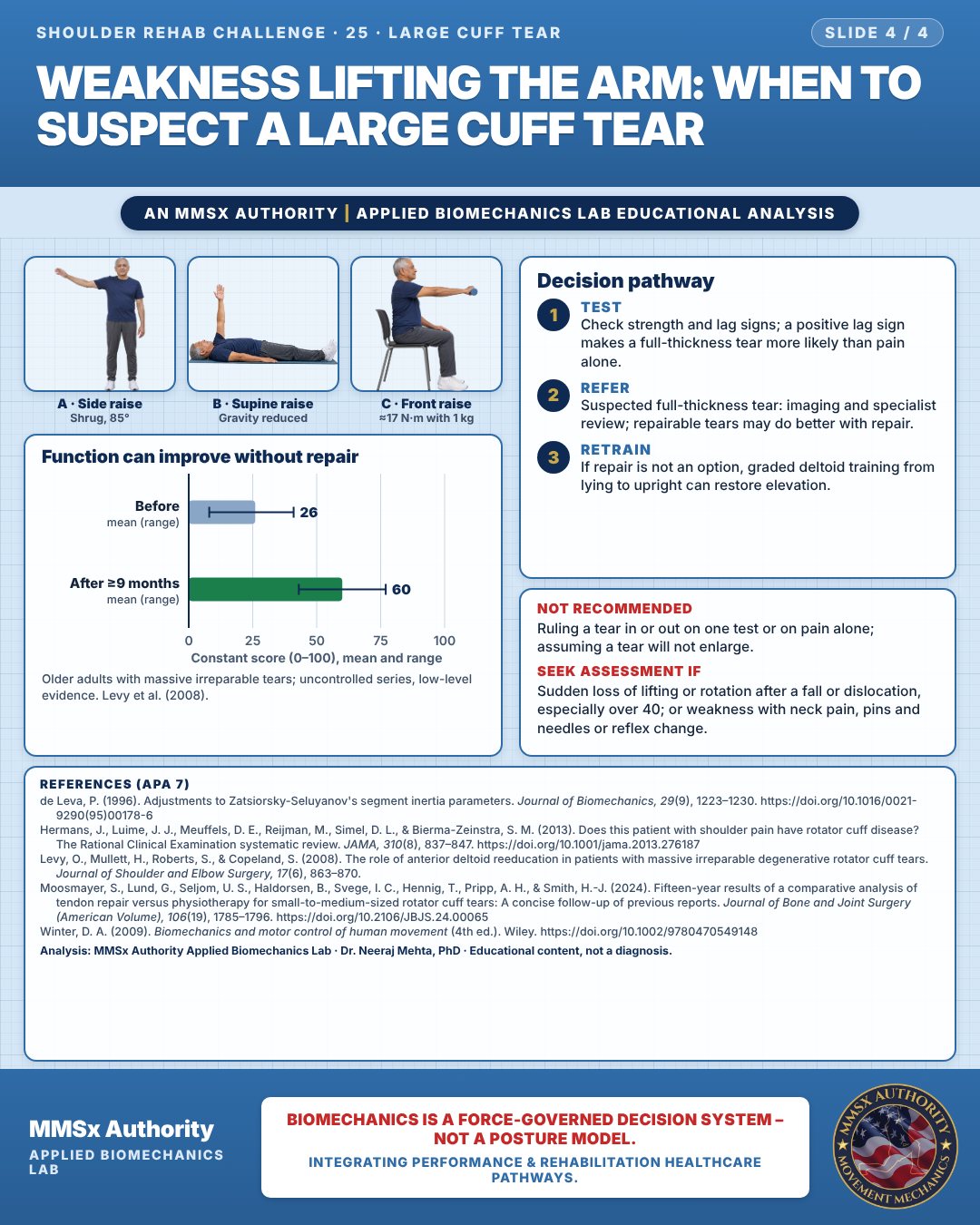
Function can improve without repair
Test
Check strength and lag signs; a positive lag sign makes a full-thickness tear more likely than pain alone.
Refer
Suspected full-thickness tear: imaging and specialist review; repairable tears may do better with repair.
Retrain
If repair is not an option, graded deltoid training from lying to upright can restore elevation.
What the evidence supports
- Supported: careful assessment of lag signs and strength; imaging and specialist review when a full-thickness tear is suspected (Hermans et al., 2013); consideration of repair for repairable small-to-medium tears (Moosmayer et al., 2024); deltoid-based rehabilitation for older or medically unfit people with massive irreparable tears (Levy et al., 2008 — low-level evidence, case series).
- Not supported: relying on a single test or on pain alone to rule a tear in (Hermans et al., 2013); assuming all tears stay the same size without monitoring (Moosmayer et al., 2024).
Myth and evidence
Myth“If you can't lift your arm, the cuff is gone and nothing can be done.”
EvidenceIn 17 older adults with massive irreparable tears, an anterior deltoid programme improved mean forward elevation from 40° to 160° and Constant score from 26 to 60 (Levy et al., 2008, uncontrolled series); and repairable tears respond to timely repair (Moosmayer et al., 2024).
Cautions
Not recommended
Ruling a tear in or out on one test or on pain alone; assuming a tear will not enlarge.
Seek assessment if
Sudden loss of lifting or rotation after a fall or dislocation, especially over 40; or weakness with neck pain, pins and needles or reflex change.
Methods note
2-D estimates from pose landmarks on an illustrated figure; CoM from de Leva (1996) segment parameters; cm for a 1.70 m adult (Winter, 2009). Arm lever: shoulder joint to arm CoM; moment = arm weight × lever, 70 kg adult, static. Shoulder line from left and right shoulder points. Skeleton only: pose angles are unreliable in this lying position. Hand load 1 kg assumed. These are educational estimates, not a diagnosis.
References
- de Leva, P. (1996). Adjustments to Zatsiorsky-Seluyanov's segment inertia parameters. Journal of Biomechanics, 29(9), 1223–1230. https://doi.org/10.1016/0021-9290(95)00178-6
- Hermans, J., Luime, J. J., Meuffels, D. E., Reijman, M., Simel, D. L., & Bierma-Zeinstra, S. M. (2013). Does this patient with shoulder pain have rotator cuff disease? The Rational Clinical Examination systematic review. JAMA, 310(8), 837–847. https://doi.org/10.1001/jama.2013.276187
- Levy, O., Mullett, H., Roberts, S., & Copeland, S. (2008). The role of anterior deltoid reeducation in patients with massive irreparable degenerative rotator cuff tears. Journal of Shoulder and Elbow Surgery, 17(6), 863–870.
- Moosmayer, S., Lund, G., Seljom, U. S., Haldorsen, B., Svege, I. C., Hennig, T., Pripp, A. H., & Smith, H.-J. (2024). Fifteen-year results of a comparative analysis of tendon repair versus physiotherapy for small-to-medium-sized rotator cuff tears: A concise follow-up of previous reports. Journal of Bone and Joint Surgery (American Volume), 106(19), 1785–1796. https://doi.org/10.2106/JBJS.24.00065
- Winter, D. A. (2009). Biomechanics and motor control of human movement (4th ed.). Wiley. https://doi.org/10.1002/9780470549148
Cite this article
Mehta, N. (2026, October 24). Weakness lifting the arm: when to suspect a large cuff tear. MMSx Authority Applied Biomechanics Lab. https://mmsxauthority.org/edu/analysis/shoulder/25-weakness-lifting-the-arm-when-to-suspect-a-large-cuff-tear/
Part of the collection
Mehta, N. (2026). Shoulder Rehabilitation: 50 Evidence-Based Biomechanics Analyses [Collection]. MMSx Authority Applied Biomechanics Lab. Zenodo. https://doi.org/10.5281/zenodo.23735725
All Shoulder Rehab Challenge articles · Rehabilitation Library