Shoulder Rehab Challenge · 24
Shoulder pain or neck pain? Why the source of arm pain matters
Cervical radiculopathy is arm pain and/or neurological change (sensory loss, weakness, reflex change) in a nerve-root distribution caused by…
Key points
- Screen. If pain spreads below the elbow, or with numbness or weakness, examine the neck and nerves.
- Cluster. Combine history, neurological signs and tests; a negative Spurling’s does not exclude the neck.
- Treat. Explain the usually favourable course; active physiotherapy with home exercise speeds early relief.
What it is
Cervical radiculopathy is arm pain and/or neurological change (sensory loss, weakness, reflex change) in a nerve-root distribution caused by compression or irritation of a cervical nerve root; it can mimic shoulder pain, so neck movement, dermatomal pattern and neurological findings are checked when "shoulder" pain spreads below the elbow.
How we analysed the movement
Three movements relevant to this topic were analysed from illustrated reference figures. Joint centres were located with two-dimensional pose estimation; arm elevation and elbow angles, shoulder level, the whole-body centre of mass and, where relevant, the arm lever (the horizontal distance from the shoulder joint to the centre of mass of the arm, with any hand load) and the resulting shoulder moment were then calculated from standard segment parameters. The figures are educational estimates that show how position changes mechanical demand; they are not measurements of a patient. Every research value quoted below comes from the published source cited beside it.
Movement A: Head turn (front view)
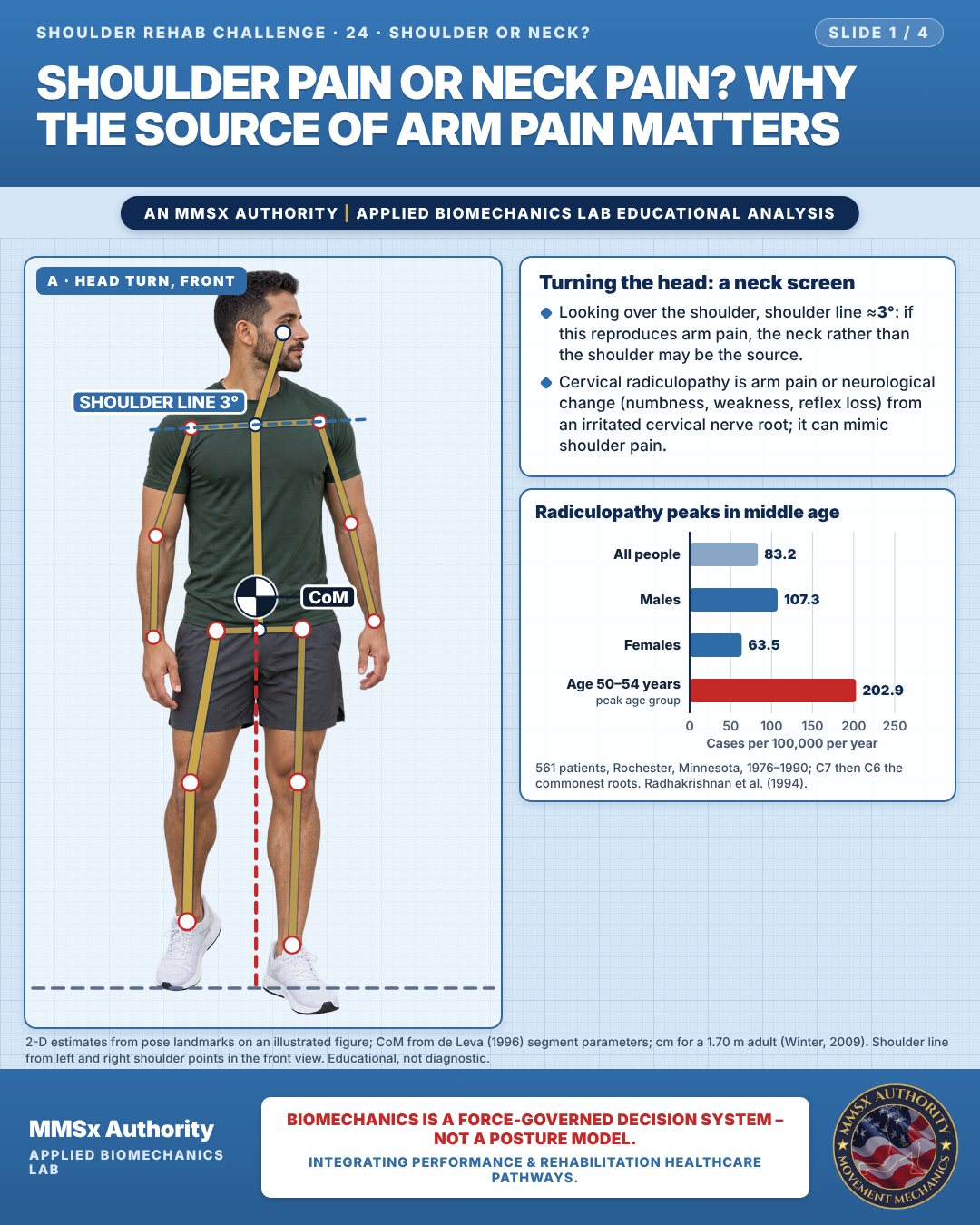
Turning the head: a neck screen
Looking over the shoulder, shoulder line ≈3°: if this reproduces arm pain, the neck rather than the shoulder may be the source.
Cervical radiculopathy is arm pain or neurological change (numbness, weakness, reflex loss) from an irritated cervical nerve root; it can mimic shoulder pain.
Radiculopathy peaks in middle age
Movement B: Hand on head (front view)
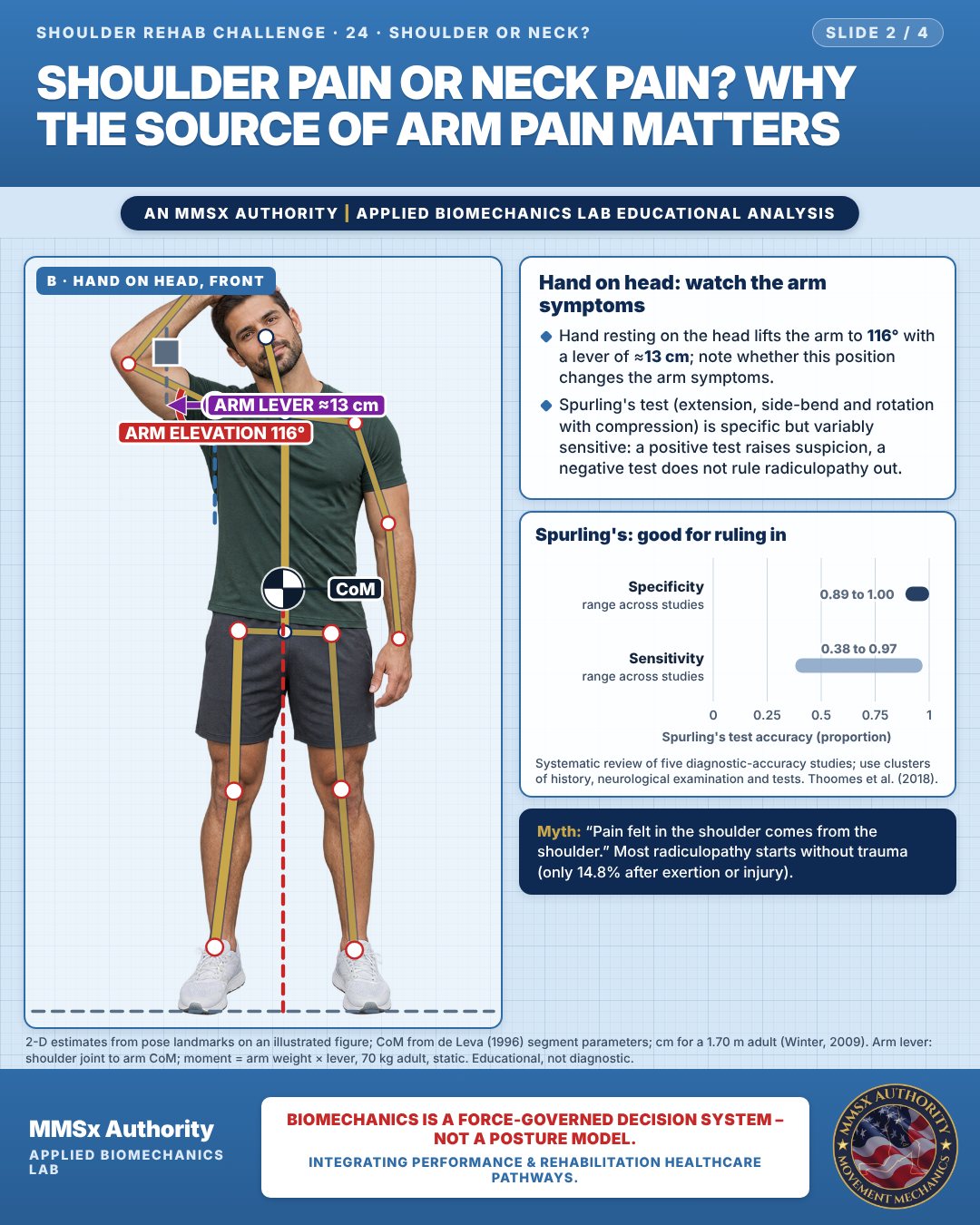
Hand on head: watch the arm symptoms
Hand resting on the head lifts the arm to 116° with a lever of ≈13 cm; note whether this position changes the arm symptoms.
Spurling's test (extension, side-bend and rotation with compression) is specific but variably sensitive: a positive test raises suspicion, a negative test does not rule radiculopathy out.
Spurling's: good for ruling in
Movement C: Head side-tilt (front view)
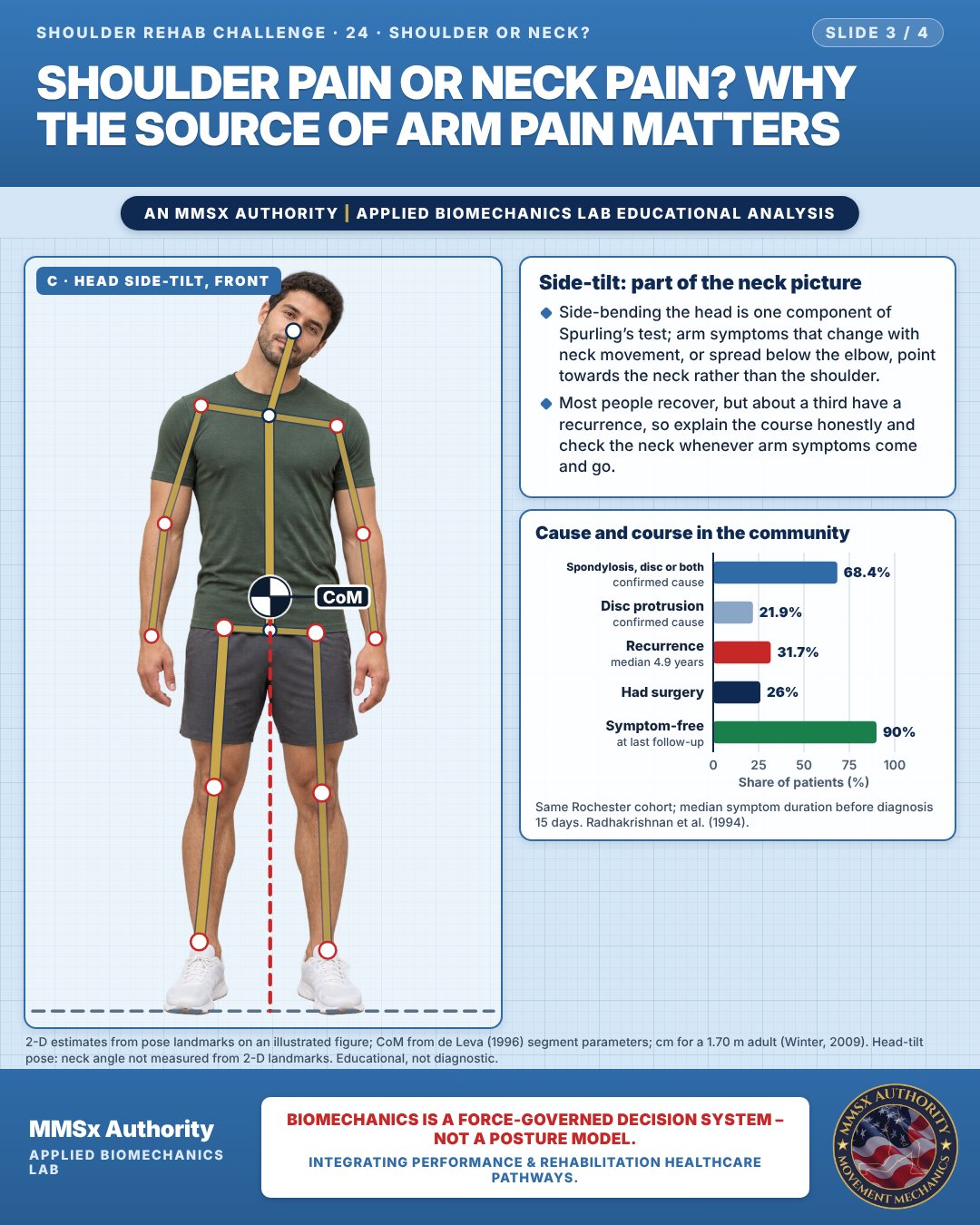
Side-tilt: part of the neck picture
Side-bending the head is one component of Spurling’s test; arm symptoms that change with neck movement, or spread below the elbow, point towards the neck rather than the shoulder.
Most people recover, but about a third have a recurrence, so explain the course honestly and check the neck whenever arm symptoms come and go.
Cause and course in the community
Decision pathway
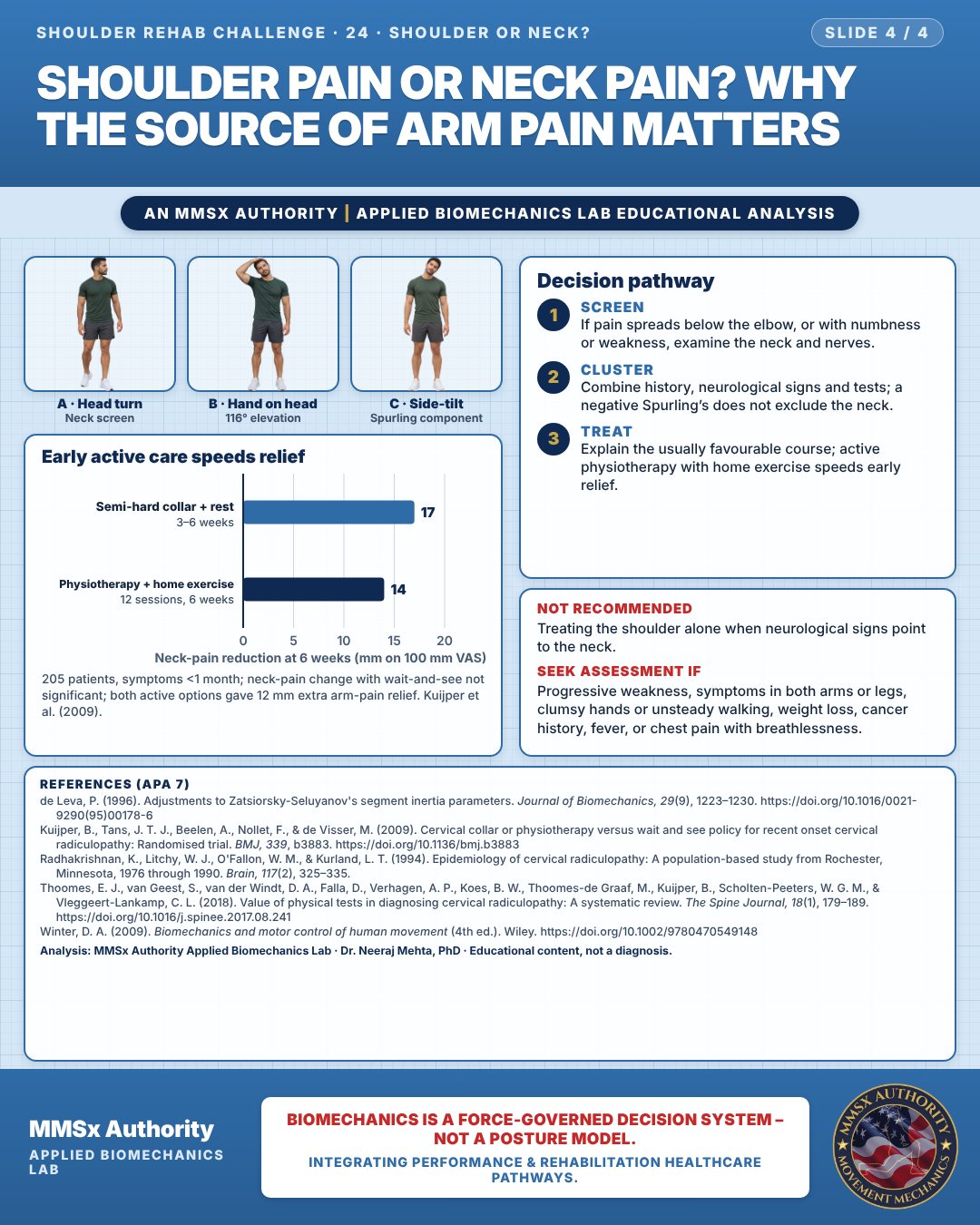
Early active care speeds relief
Screen
If pain spreads below the elbow, or with numbness or weakness, examine the neck and nerves.
Cluster
Combine history, neurological signs and tests; a negative Spurling’s does not exclude the neck.
Treat
Explain the usually favourable course; active physiotherapy with home exercise speeds early relief.
What the evidence supports
- Supported: assess the neck when shoulder-region pain is accompanied by arm pain below the elbow, paraesthesia, weakness or reflex change; use test clusters rather than single tests (Thoomes et al., 2018); early active physiotherapy with home exercise, or a short period of semi-hard collar and rest, shortens early arm-pain duration (Kuijper et al., 2009); reassurance about favourable natural history (Radhakrishnan et al., 1994).
- Not supported: treating the shoulder alone when neurological signs point to the neck; relying on a negative Spurling's test to exclude radiculopathy (Thoomes et al., 2018).
Myth and evidence
Myth“Pain felt in the shoulder always comes from the shoulder.”
EvidenceCervical radiculopathy is common in middle age (peak 202.9 per 100,000 at 50–54 years), usually starts without trauma (85%), and needs neck and neurological assessment (Radhakrishnan et al., 1994).
Cautions
Not recommended
Treating the shoulder alone when neurological signs point to the neck.
Seek assessment if
Progressive weakness, symptoms in both arms or legs, clumsy hands or unsteady walking, weight loss, cancer history, fever, or chest pain with breathlessness.
Methods note
2-D estimates from pose landmarks on an illustrated figure; CoM from de Leva (1996) segment parameters; cm for a 1.70 m adult (Winter, 2009). Shoulder line from left and right shoulder points in the front view. Arm lever: shoulder joint to arm CoM; moment = arm weight × lever, 70 kg adult, static. Head-tilt pose: neck angle not measured from 2-D landmarks. These are educational estimates, not a diagnosis.
References
- de Leva, P. (1996). Adjustments to Zatsiorsky-Seluyanov's segment inertia parameters. Journal of Biomechanics, 29(9), 1223–1230. https://doi.org/10.1016/0021-9290(95)00178-6
- Kuijper, B., Tans, J. T. J., Beelen, A., Nollet, F., & de Visser, M. (2009). Cervical collar or physiotherapy versus wait and see policy for recent onset cervical radiculopathy: Randomised trial. BMJ, 339, b3883. https://doi.org/10.1136/bmj.b3883
- Radhakrishnan, K., Litchy, W. J., O'Fallon, W. M., & Kurland, L. T. (1994). Epidemiology of cervical radiculopathy: A population-based study from Rochester, Minnesota, 1976 through 1990. Brain, 117(2), 325–335.
- Thoomes, E. J., van Geest, S., van der Windt, D. A., Falla, D., Verhagen, A. P., Koes, B. W., Thoomes-de Graaf, M., Kuijper, B., Scholten-Peeters, W. G. M., & Vleggeert-Lankamp, C. L. (2018). Value of physical tests in diagnosing cervical radiculopathy: A systematic review. The Spine Journal, 18(1), 179–189. https://doi.org/10.1016/j.spinee.2017.08.241
- Winter, D. A. (2009). Biomechanics and motor control of human movement (4th ed.). Wiley. https://doi.org/10.1002/9780470549148
Cite this article
Mehta, N. (2026, October 24). Shoulder pain or neck pain? Why the source of arm pain matters. MMSx Authority Applied Biomechanics Lab. https://mmsxauthority.org/edu/analysis/shoulder/24-shoulder-pain-or-neck-pain-why-the-source-of-arm-pain-matters/
Part of the collection
Mehta, N. (2026). Shoulder Rehabilitation: 50 Evidence-Based Biomechanics Analyses [Collection]. MMSx Authority Applied Biomechanics Lab. Zenodo. https://doi.org/10.5281/zenodo.23735725
All Shoulder Rehab Challenge articles · Rehabilitation Library