Shoulder Rehab Challenge · 23
AC joint pain: pain on top of the shoulder
Acromioclavicular (AC) joint pain is pain arising from the joint between the lateral clavicle and the acromion, usually felt on top of the shoulder.
Key points
- Screen. Combine tenderness, cross-body and provocation tests with history; one positive test is not enough.
- Modify. Reduce compressive end-range tasks such as deep dips, cross-body pulls and heavy straps while symptoms settle.
- Load. Keep the shoulder strong; for acute type III and V injuries, try structured physiotherapy first.
What it is
Acromioclavicular (AC) joint pain is pain arising from the joint between the lateral clavicle and the acromion, usually felt on top of the shoulder; acute injuries are graded from sprain (Rockwood type I) to dislocation (types II–VI), while chronic pain is often degenerative.
How we analysed the movement
Three movements relevant to this topic were analysed from illustrated reference figures. Joint centres were located with two-dimensional pose estimation; arm elevation and elbow angles, shoulder level, the whole-body centre of mass and, where relevant, the arm lever (the horizontal distance from the shoulder joint to the centre of mass of the arm, with any hand load) and the resulting shoulder moment were then calculated from standard segment parameters. The figures are educational estimates that show how position changes mechanical demand; they are not measurements of a patient. Every research value quoted below comes from the published source cited beside it.
Movement A: Cross-body pull (front view)
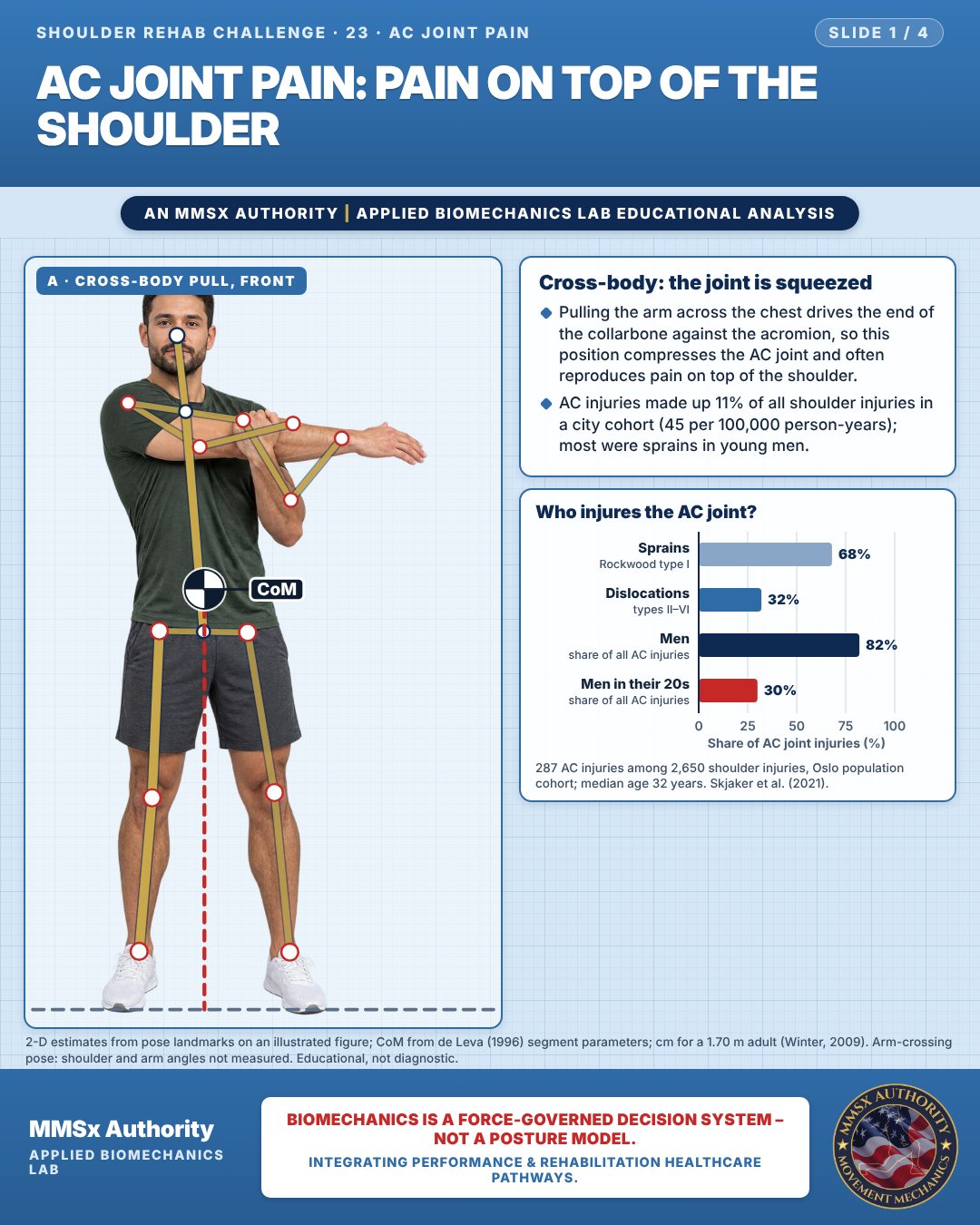
Cross-body: the joint is squeezed
Pulling the arm across the chest drives the end of the collarbone against the acromion, so this position compresses the AC joint and often reproduces pain on top of the shoulder.
AC injuries made up 11% of all shoulder injuries in a city cohort (45 per 100,000 person-years); most were sprains in young men.
Who injures the AC joint?
Movement B: Bench dip (side view)
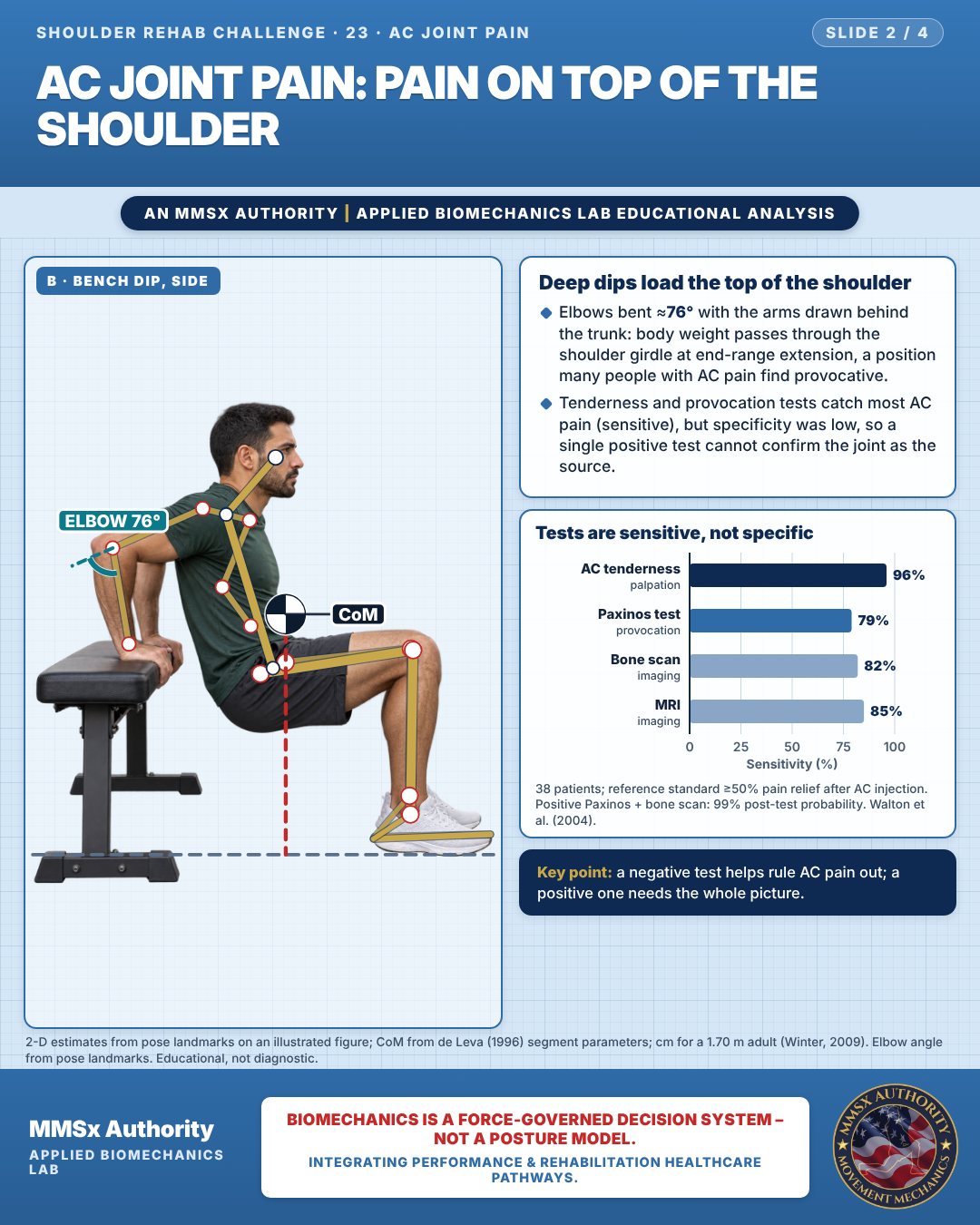
Deep dips load the top of the shoulder
Elbows bent ≈76° with the arms drawn behind the trunk: body weight passes through the shoulder girdle at end-range extension, a position many people with AC pain find provocative.
Tenderness and provocation tests catch most AC pain (sensitive), but specificity was low, so a single positive test cannot confirm the joint as the source.
Tests are sensitive, not specific
Movement C: Heavy bag strap (front view)
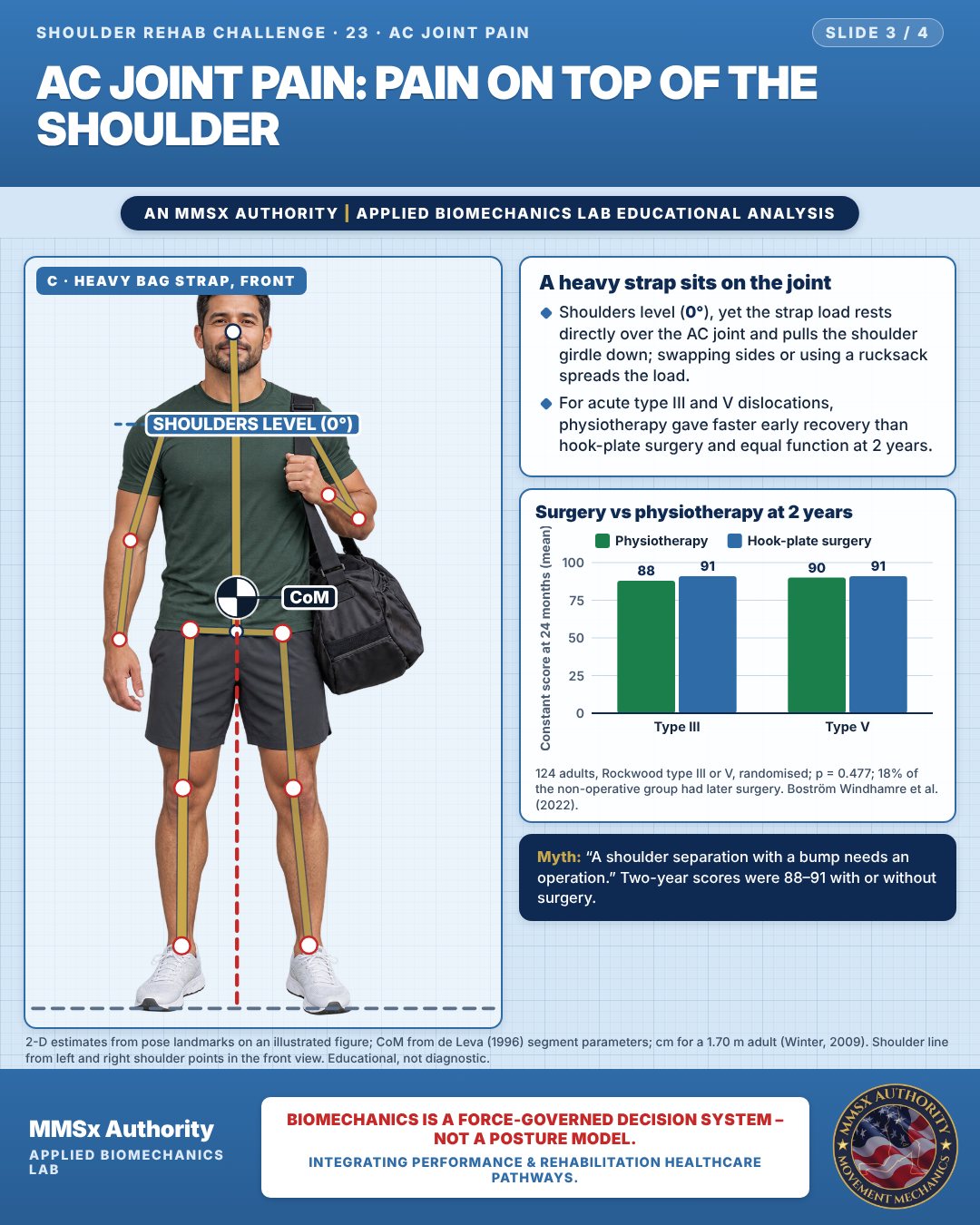
A heavy strap sits on the joint
Shoulders level (0°), yet the strap load rests directly over the AC joint and pulls the shoulder girdle down; swapping sides or using a rucksack spreads the load.
For acute type III and V dislocations, physiotherapy gave faster early recovery than hook-plate surgery and equal function at 2 years.
Surgery vs physiotherapy at 2 years
Decision pathway
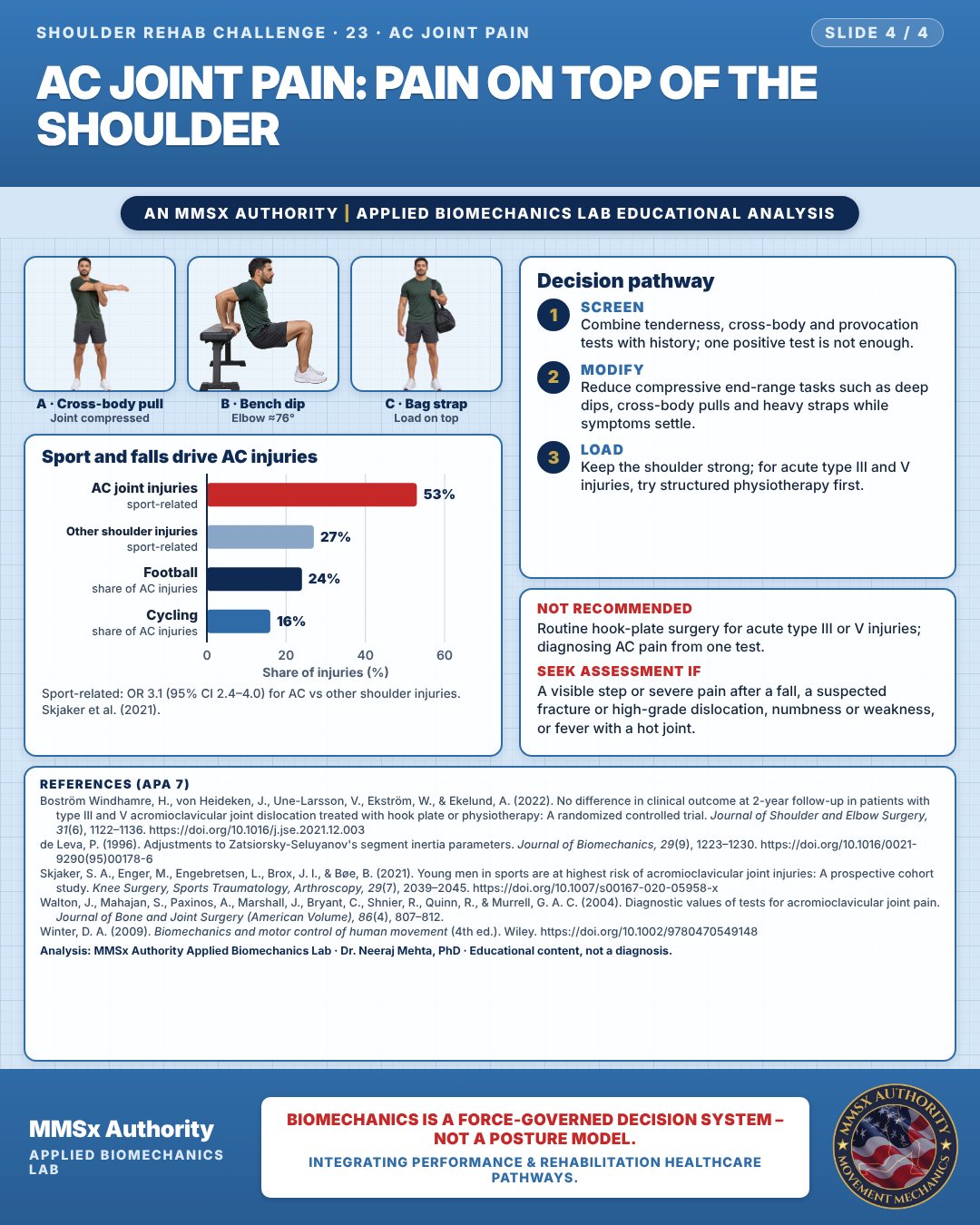
Sport and falls drive AC injuries
Screen
Combine tenderness, cross-body and provocation tests with history; one positive test is not enough.
Modify
Reduce compressive end-range tasks such as deep dips, cross-body pulls and heavy straps while symptoms settle.
Load
Keep the shoulder strong; for acute type III and V injuries, try structured physiotherapy first.
What the evidence supports
- Supported: non-operative care with structured rehabilitation as the first option for acute type III and V dislocations (Boström Windhamre et al., 2022); for chronic AC pain, load modification of compressive/end-range tasks while maintaining strength.
- Not supported by this evidence: routine hook-plate surgery for acute type III/V injuries (Boström Windhamre et al., 2022); diagnosing AC pain from a single positive provocation test (Walton et al., 2004).
Myth and evidence
Myth“A shoulder separation with a bump needs an operation to work properly again.”
EvidenceIn a randomised trial of type III and V dislocations, 2-year Constant scores were 88–91 with or without hook-plate surgery and non-operative patients recovered faster at 3 months (Boström Windhamre et al., 2022).
Cautions
Not recommended
Routine hook-plate surgery for acute type III or V injuries; diagnosing AC pain from one test.
Seek assessment if
A visible step or severe pain after a fall, a suspected fracture or high-grade dislocation, numbness or weakness, or fever with a hot joint.
Methods note
2-D estimates from pose landmarks on an illustrated figure; CoM from de Leva (1996) segment parameters; cm for a 1.70 m adult (Winter, 2009). Arm-crossing pose: shoulder and arm angles not measured. Elbow angle from pose landmarks. Shoulder line from left and right shoulder points in the front view. These are educational estimates, not a diagnosis.
References
- Boström Windhamre, H., von Heideken, J., Une-Larsson, V., Ekström, W., & Ekelund, A. (2022). No difference in clinical outcome at 2-year follow-up in patients with type III and V acromioclavicular joint dislocation treated with hook plate or physiotherapy: A randomized controlled trial. Journal of Shoulder and Elbow Surgery, 31(6), 1122–1136. https://doi.org/10.1016/j.jse.2021.12.003
- de Leva, P. (1996). Adjustments to Zatsiorsky-Seluyanov's segment inertia parameters. Journal of Biomechanics, 29(9), 1223–1230. https://doi.org/10.1016/0021-9290(95)00178-6
- Skjaker, S. A., Enger, M., Engebretsen, L., Brox, J. I., & Bøe, B. (2021). Young men in sports are at highest risk of acromioclavicular joint injuries: A prospective cohort study. Knee Surgery, Sports Traumatology, Arthroscopy, 29(7), 2039–2045. https://doi.org/10.1007/s00167-020-05958-x
- Walton, J., Mahajan, S., Paxinos, A., Marshall, J., Bryant, C., Shnier, R., Quinn, R., & Murrell, G. A. C. (2004). Diagnostic values of tests for acromioclavicular joint pain. Journal of Bone and Joint Surgery (American Volume), 86(4), 807–812.
- Winter, D. A. (2009). Biomechanics and motor control of human movement (4th ed.). Wiley. https://doi.org/10.1002/9780470549148
Cite this article
Mehta, N. (2026, October 24). AC joint pain: pain on top of the shoulder. MMSx Authority Applied Biomechanics Lab. https://mmsxauthority.org/edu/analysis/shoulder/23-ac-joint-pain-pain-on-top-of-the-shoulder/
Part of the collection
Mehta, N. (2026). Shoulder Rehabilitation: 50 Evidence-Based Biomechanics Analyses [Collection]. MMSx Authority Applied Biomechanics Lab. Zenodo. https://doi.org/10.5281/zenodo.23735725
All Shoulder Rehab Challenge articles · Rehabilitation Library