Shoulder Rehab Challenge · 22
Hypermobile shoulders: building control without forcing range
Generalised joint hypermobility describes joint range beyond typical limits at multiple joints (commonly screened with the Beighton method, ≥4 of 9…
Key points
- Control. Start with shoulder-blade position and joint control, then progress load and range in stages.
- Load. Supervised, progressive strengthening through full range is safe; expect some short-lived soreness.
- Review. Judge progress on function and confidence over months, not on range gained.
What it is
Generalised joint hypermobility describes joint range beyond typical limits at multiple joints (commonly screened with the Beighton method, ≥4 of 9 positive tests in adults, or Carter and Wilkinson, ≥3 of 5) (Remvig et al., 2007); a symptomatic hypermobile shoulder may present as pain and/or multidirectional instability (MDI) without a single traumatic event.
How we analysed the movement
Three movements relevant to this topic were analysed from illustrated reference figures. Joint centres were located with two-dimensional pose estimation; arm elevation and elbow angles, shoulder level, the whole-body centre of mass and, where relevant, the arm lever (the horizontal distance from the shoulder joint to the centre of mass of the arm, with any hand load) and the resulting shoulder moment were then calculated from standard segment parameters. The figures are educational estimates that show how position changes mechanical demand; they are not measurements of a patient. Every research value quoted below comes from the published source cited beside it.
Movement A: Y-raise (front view)
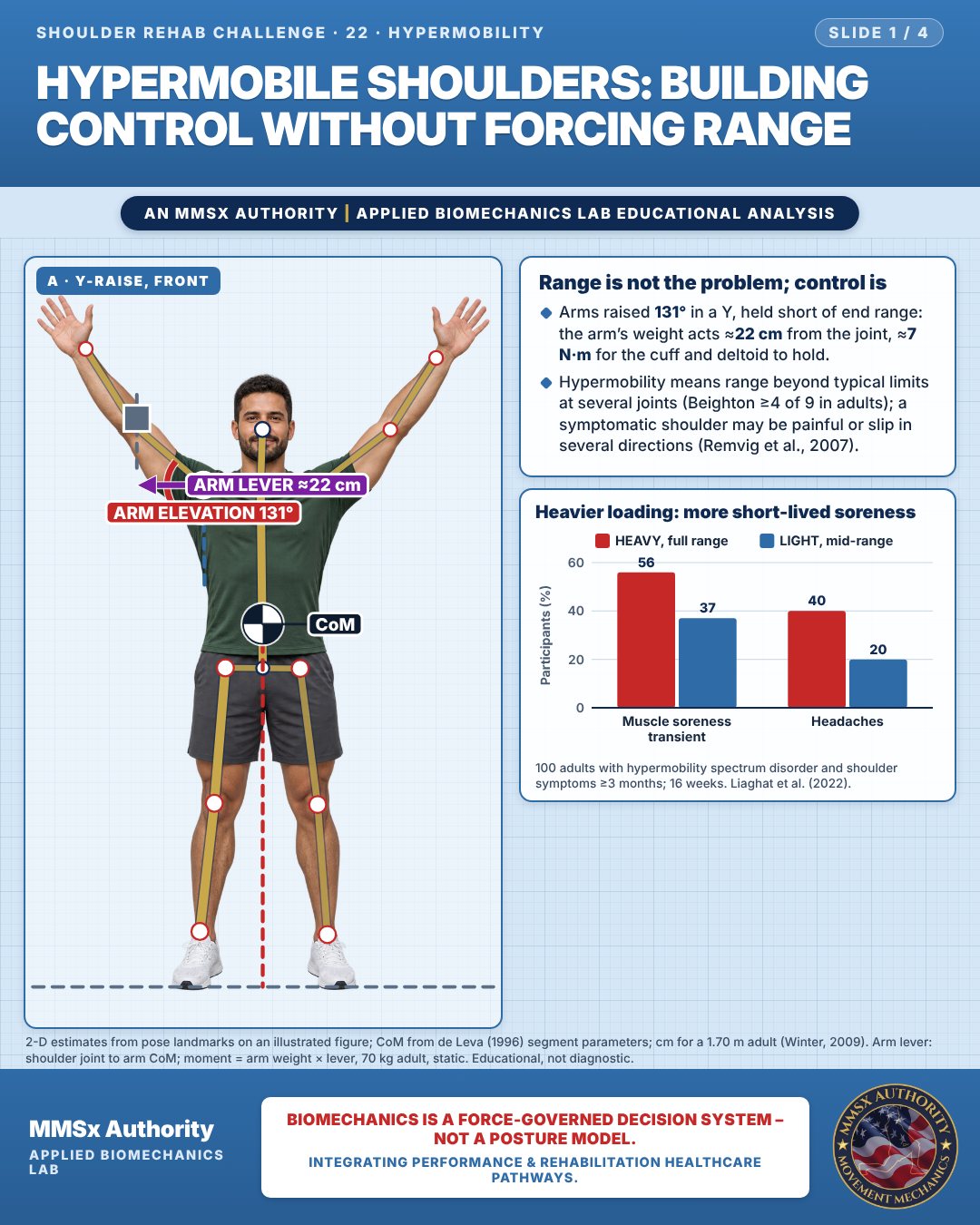
Range is not the problem; control is
Arms raised 131° in a Y, held short of end range: the arm’s weight acts ≈22 cm from the joint, ≈7 N·m for the cuff and deltoid to hold.
Hypermobility means range beyond typical limits at several joints (Beighton ≥4 of 9 in adults); a symptomatic shoulder may be painful or slip in several directions (Remvig et al., 2007).
Heavier loading: more short-lived soreness
Movement B: Plank shoulder tap (side view)
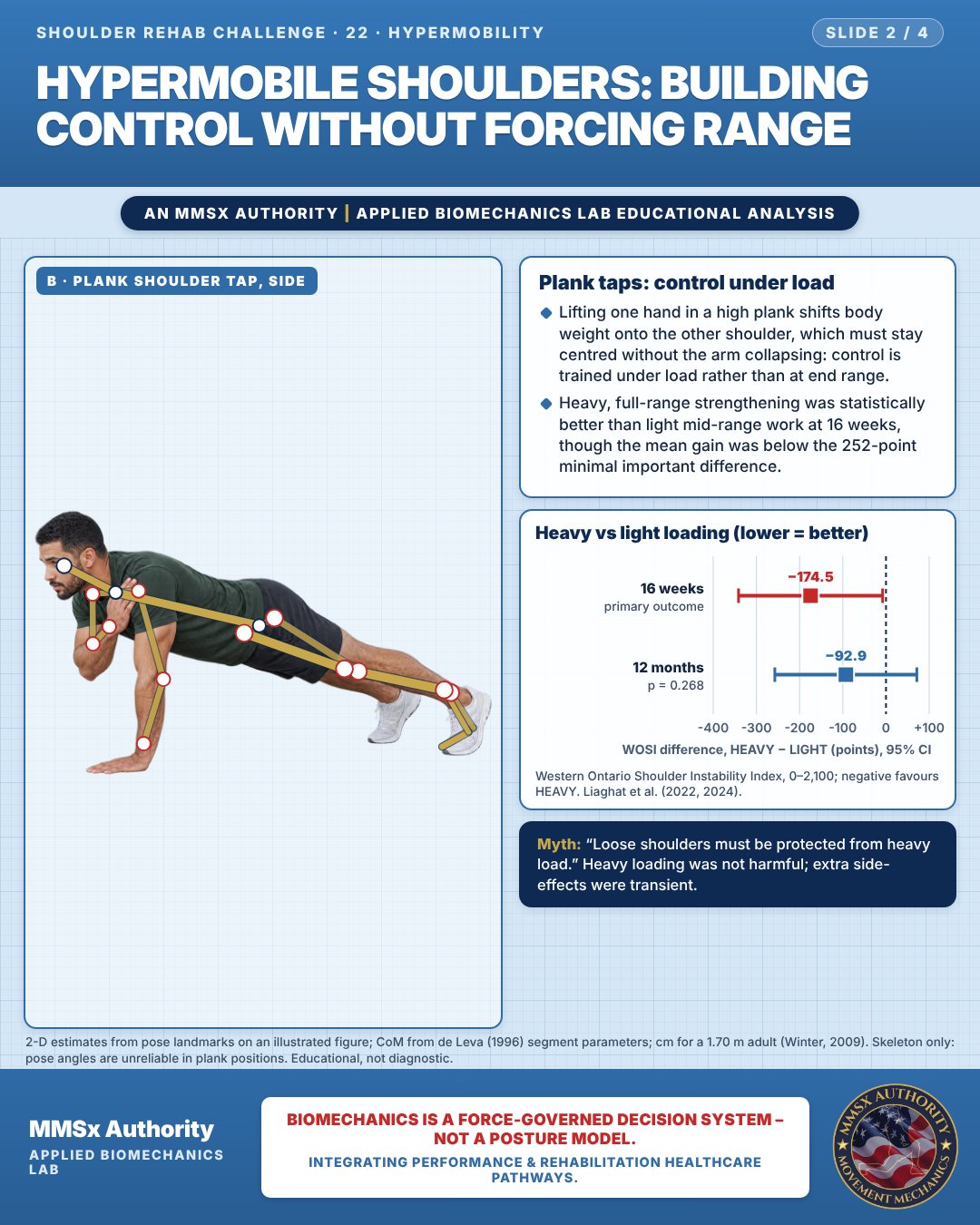
Plank taps: control under load
Lifting one hand in a high plank shifts body weight onto the other shoulder, which must stay centred without the arm collapsing: control is trained under load rather than at end range.
Heavy, full-range strengthening was statistically better than light mid-range work at 16 weeks, though the mean gain was below the 252-point minimal important difference.
Heavy vs light loading (lower = better)
Movement C: Overhead waiter carry (side view)
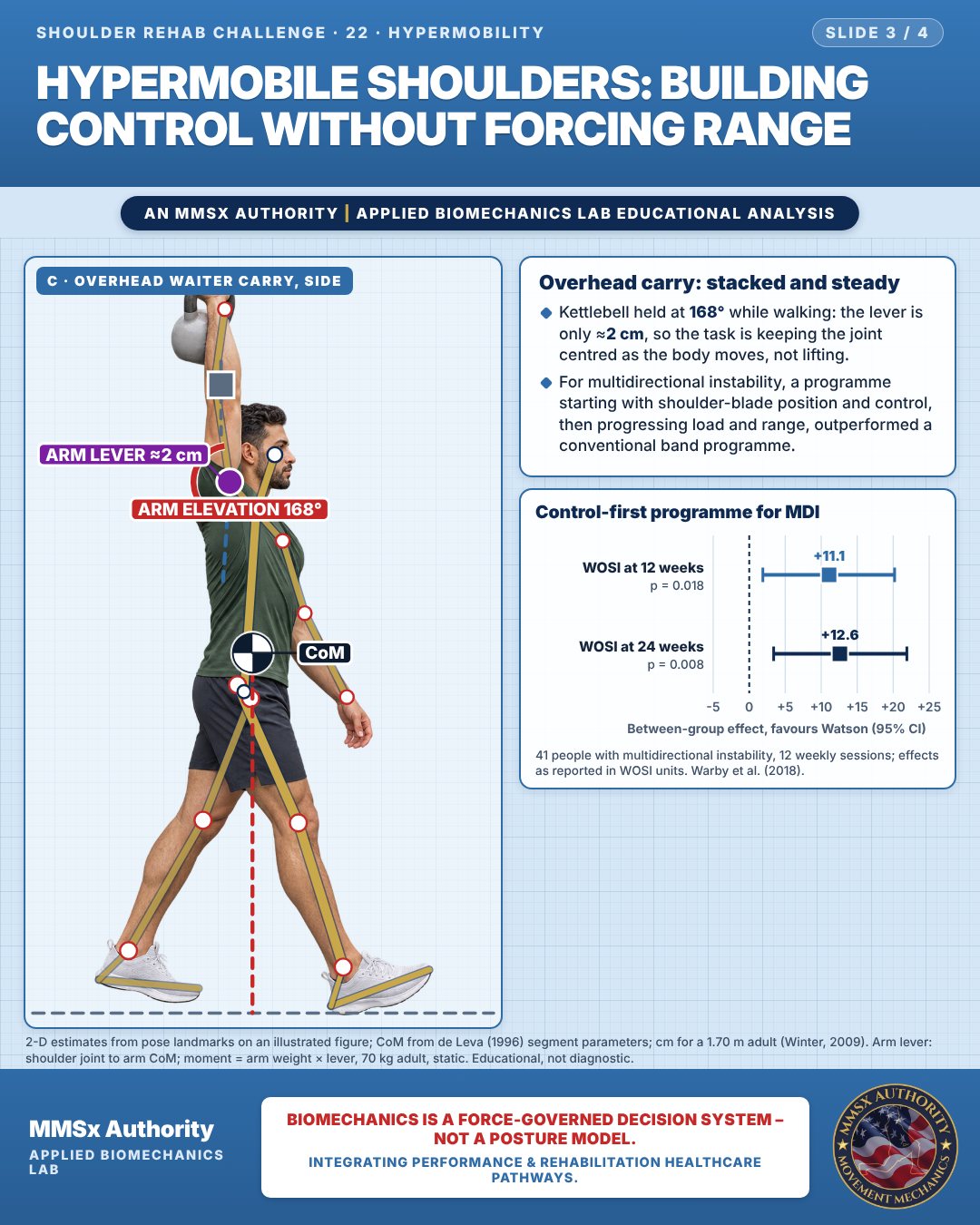
Overhead carry: stacked and steady
Kettlebell held at 168° while walking: the lever is only ≈2 cm, so the task is keeping the joint centred as the body moves, not lifting.
For multidirectional instability, a programme starting with shoulder-blade position and control, then progressing load and range, outperformed a conventional band programme.
Control-first programme for MDI
Decision pathway
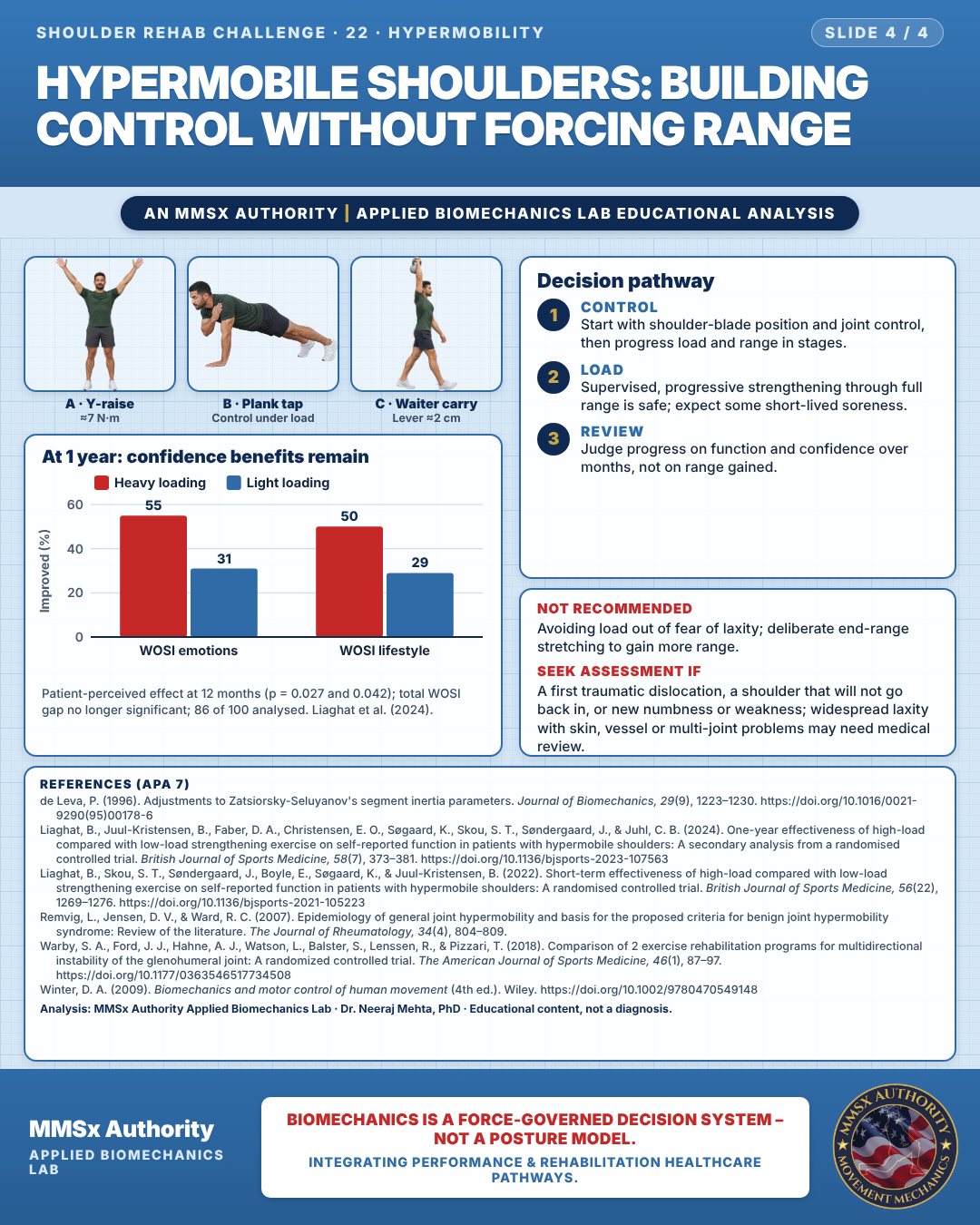
At 1 year: confidence benefits remain
Control
Start with shoulder-blade position and joint control, then progress load and range in stages.
Load
Supervised, progressive strengthening through full range is safe; expect some short-lived soreness.
Review
Judge progress on function and confidence over months, not on range gained.
What the evidence supports
- Supported: supervised, progressive shoulder strengthening; heavy full-range loading is at least as good as and in the short term better than light mid-range work for HSD shoulders (Liaghat et al., 2022, 2024); scapular-control-first, staged programmes for MDI (Warby et al., 2018).
Myth and evidence
Myth“Loose shoulders must be protected from heavy load.”
EvidenceIn 100 adults with HSD, heavy full-range strengthening produced better 16-week function than light mid-range exercise, with only transient soreness and headaches as extra side-effects (Liaghat et al., 2022).
Cautions
Not recommended
Avoiding load out of fear of laxity; deliberate end-range stretching to gain more range.
Seek assessment if
A first traumatic dislocation, a shoulder that will not go back in, or new numbness or weakness; widespread laxity with skin, vessel or multi-joint problems may need medical review.
Methods note
2-D estimates from pose landmarks on an illustrated figure; CoM from de Leva (1996) segment parameters; cm for a 1.70 m adult (Winter, 2009). Arm lever: shoulder joint to arm CoM; moment = arm weight × lever, 70 kg adult, static. Skeleton only: pose angles are unreliable in plank positions. These are educational estimates, not a diagnosis.
References
- de Leva, P. (1996). Adjustments to Zatsiorsky-Seluyanov's segment inertia parameters. Journal of Biomechanics, 29(9), 1223–1230. https://doi.org/10.1016/0021-9290(95)00178-6
- Liaghat, B., Juul-Kristensen, B., Faber, D. A., Christensen, E. O., Søgaard, K., Skou, S. T., Søndergaard, J., & Juhl, C. B. (2024). One-year effectiveness of high-load compared with low-load strengthening exercise on self-reported function in patients with hypermobile shoulders: A secondary analysis from a randomised controlled trial. British Journal of Sports Medicine, 58(7), 373–381. https://doi.org/10.1136/bjsports-2023-107563
- Liaghat, B., Skou, S. T., Søndergaard, J., Boyle, E., Søgaard, K., & Juul-Kristensen, B. (2022). Short-term effectiveness of high-load compared with low-load strengthening exercise on self-reported function in patients with hypermobile shoulders: A randomised controlled trial. British Journal of Sports Medicine, 56(22), 1269–1276. https://doi.org/10.1136/bjsports-2021-105223
- Remvig, L., Jensen, D. V., & Ward, R. C. (2007). Epidemiology of general joint hypermobility and basis for the proposed criteria for benign joint hypermobility syndrome: Review of the literature. The Journal of Rheumatology, 34(4), 804–809.
- Warby, S. A., Ford, J. J., Hahne, A. J., Watson, L., Balster, S., Lenssen, R., & Pizzari, T. (2018). Comparison of 2 exercise rehabilitation programs for multidirectional instability of the glenohumeral joint: A randomized controlled trial. The American Journal of Sports Medicine, 46(1), 87–97. https://doi.org/10.1177/0363546517734508
- Winter, D. A. (2009). Biomechanics and motor control of human movement (4th ed.). Wiley. https://doi.org/10.1002/9780470549148
Cite this article
Mehta, N. (2026, October 24). Hypermobile shoulders: building control without forcing range. MMSx Authority Applied Biomechanics Lab. https://mmsxauthority.org/edu/analysis/shoulder/22-hypermobile-shoulders-building-control-without-forcing-range/
Part of the collection
Mehta, N. (2026). Shoulder Rehabilitation: 50 Evidence-Based Biomechanics Analyses [Collection]. MMSx Authority Applied Biomechanics Lab. Zenodo. https://doi.org/10.5281/zenodo.23735725
All Shoulder Rehab Challenge articles · Rehabilitation Library