Shoulder Rehab Challenge · 21
Shoulder instability: when the shoulder feels loose or slips
Glenohumeral instability is symptomatic excessive translation of the humeral head on the glenoid, ranging from subluxation (partial slip, spontaneous…
Key points
- Decide. Weigh age, sex, sport and laxity in a shared decision; repair is supported for young males in contact or overhead sport.
- Load. Mobilise early; progress cuff and shoulder-blade loading, closed-chain stability, then overhead and catching tasks.
- Review. Repeated slips or apprehension during rehabilitation warrant specialist review of stabilisation.
What it is
Glenohumeral instability is symptomatic excessive translation of the humeral head on the glenoid, ranging from subluxation (partial slip, spontaneous reduction) to dislocation; after a first traumatic anterior dislocation the main clinical problem is recurrence.
How we analysed the movement
Three movements relevant to this topic were analysed from illustrated reference figures. Joint centres were located with two-dimensional pose estimation; arm elevation and elbow angles, shoulder level, the whole-body centre of mass and, where relevant, the arm lever (the horizontal distance from the shoulder joint to the centre of mass of the arm, with any hand load) and the resulting shoulder moment were then calculated from standard segment parameters. The figures are educational estimates that show how position changes mechanical demand; they are not measurements of a patient. Every research value quoted below comes from the published source cited beside it.
Movement A: Overhead press (side view)
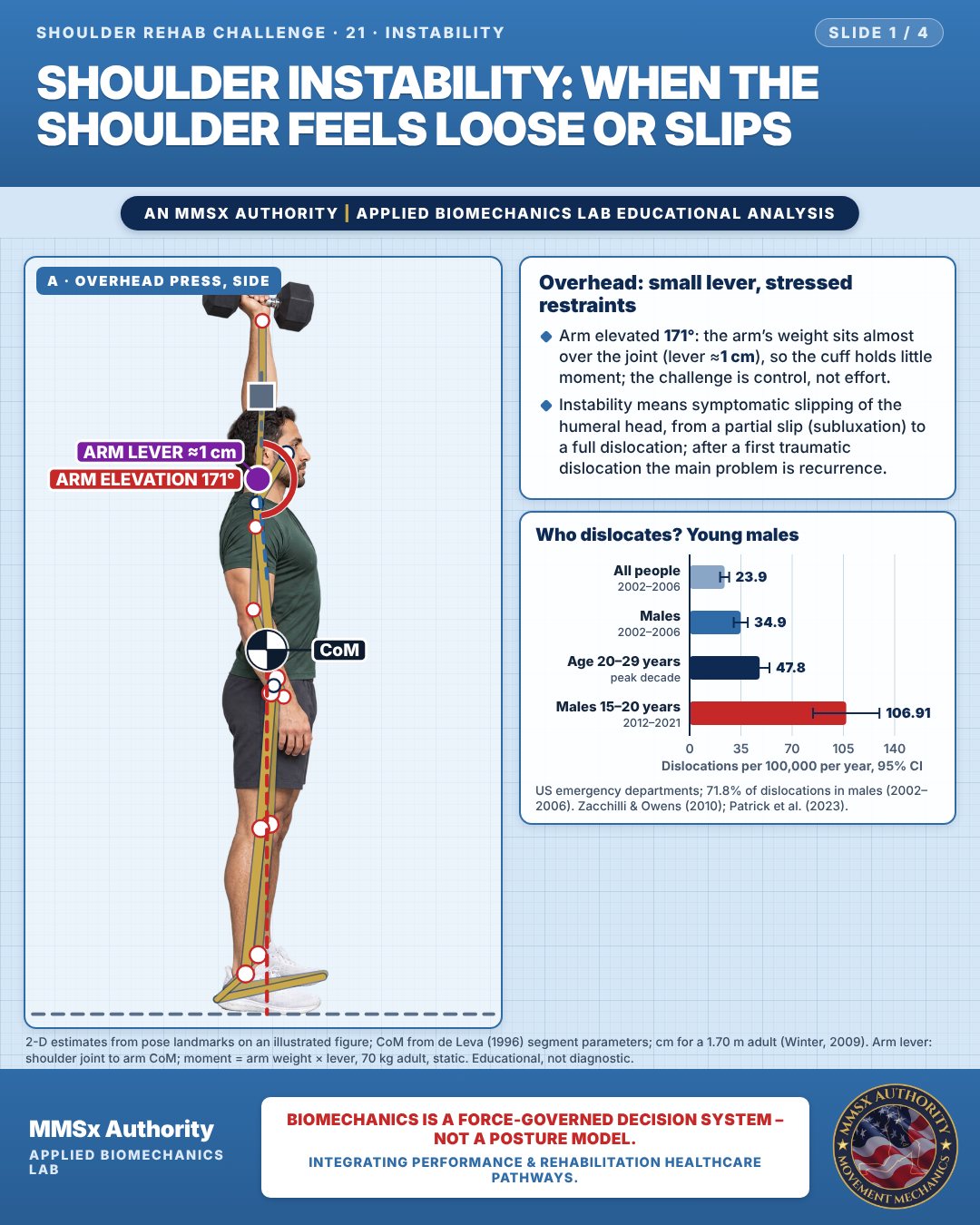
Overhead: small lever, stressed restraints
Arm elevated 171°: the arm’s weight sits almost over the joint (lever ≈1 cm), so the cuff holds little moment; the challenge is control, not effort.
Instability means symptomatic slipping of the humeral head, from a partial slip (subluxation) to a full dislocation; after a first traumatic dislocation the main problem is recurrence.
Who dislocates? Young males
Movement B: Overhead catch (front view)
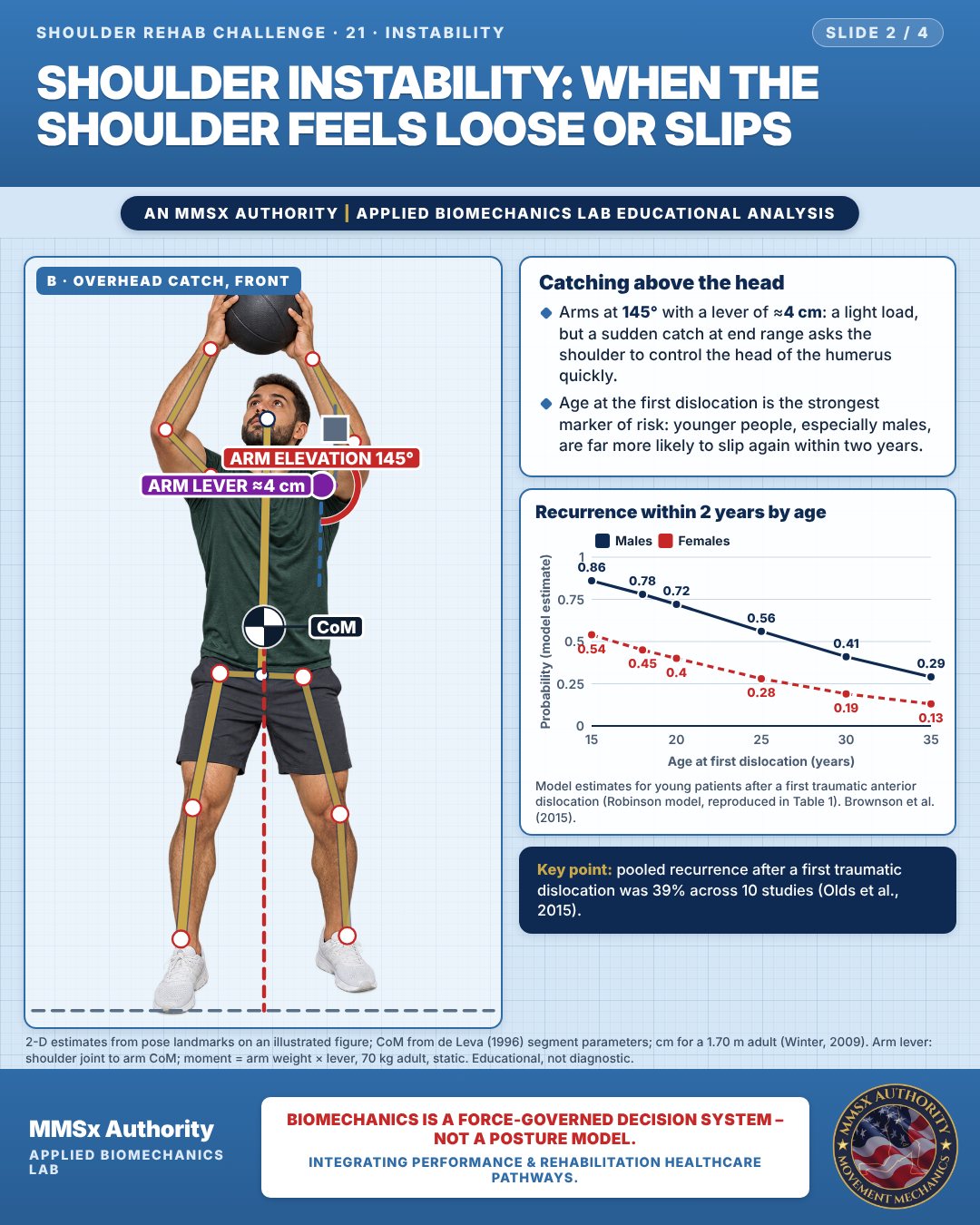
Catching above the head
Arms at 145° with a lever of ≈4 cm: a light load, but a sudden catch at end range asks the shoulder to control the head of the humerus quickly.
Age at the first dislocation is the strongest marker of risk: younger people, especially males, are far more likely to slip again within two years.
Recurrence within 2 years by age
Movement C: Side plank (front view)
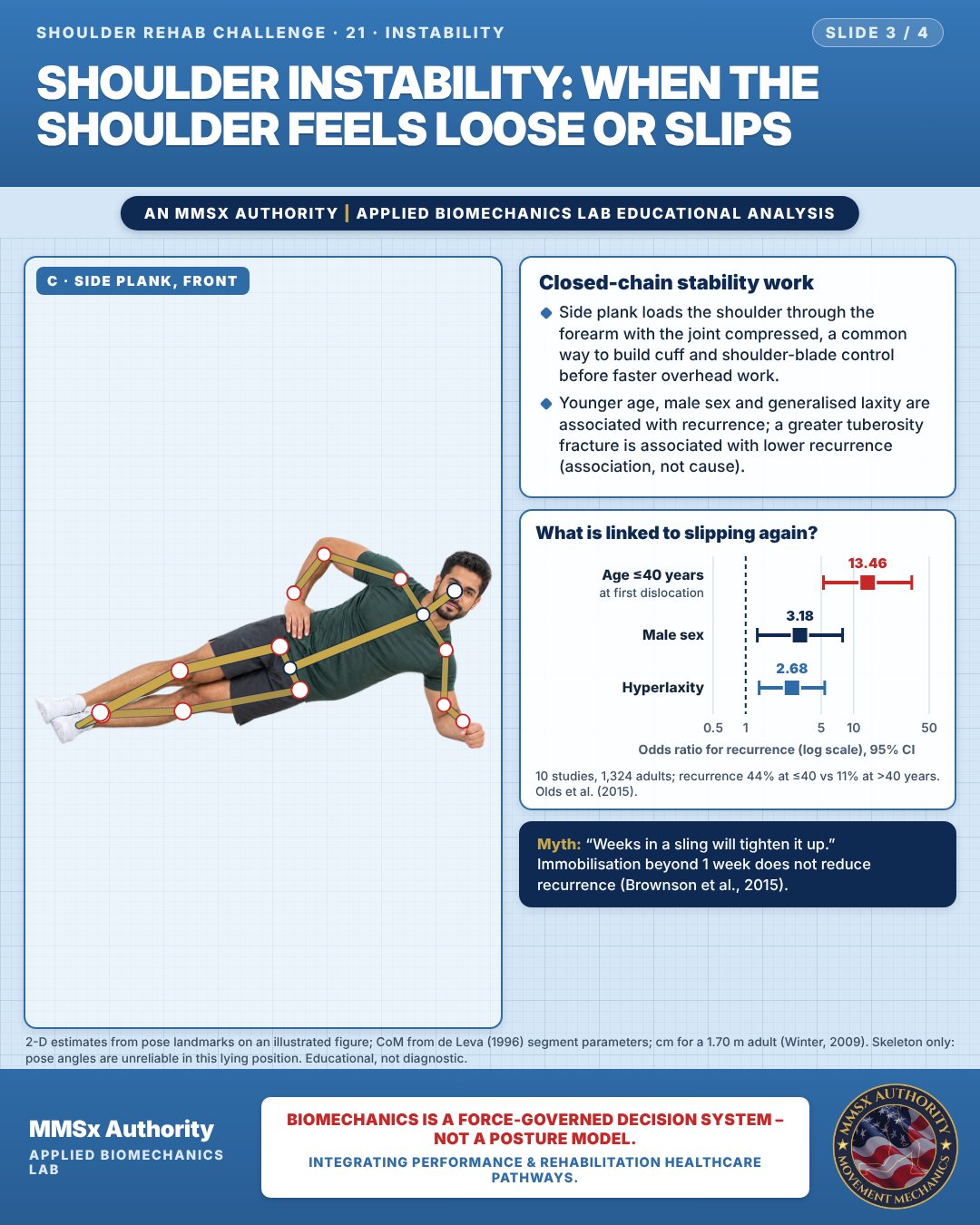
Closed-chain stability work
Side plank loads the shoulder through the forearm with the joint compressed, a common way to build cuff and shoulder-blade control before faster overhead work.
Younger age, male sex and generalised laxity are associated with recurrence; a greater tuberosity fracture is associated with lower recurrence (association, not cause).
What is linked to slipping again?
Decision pathway
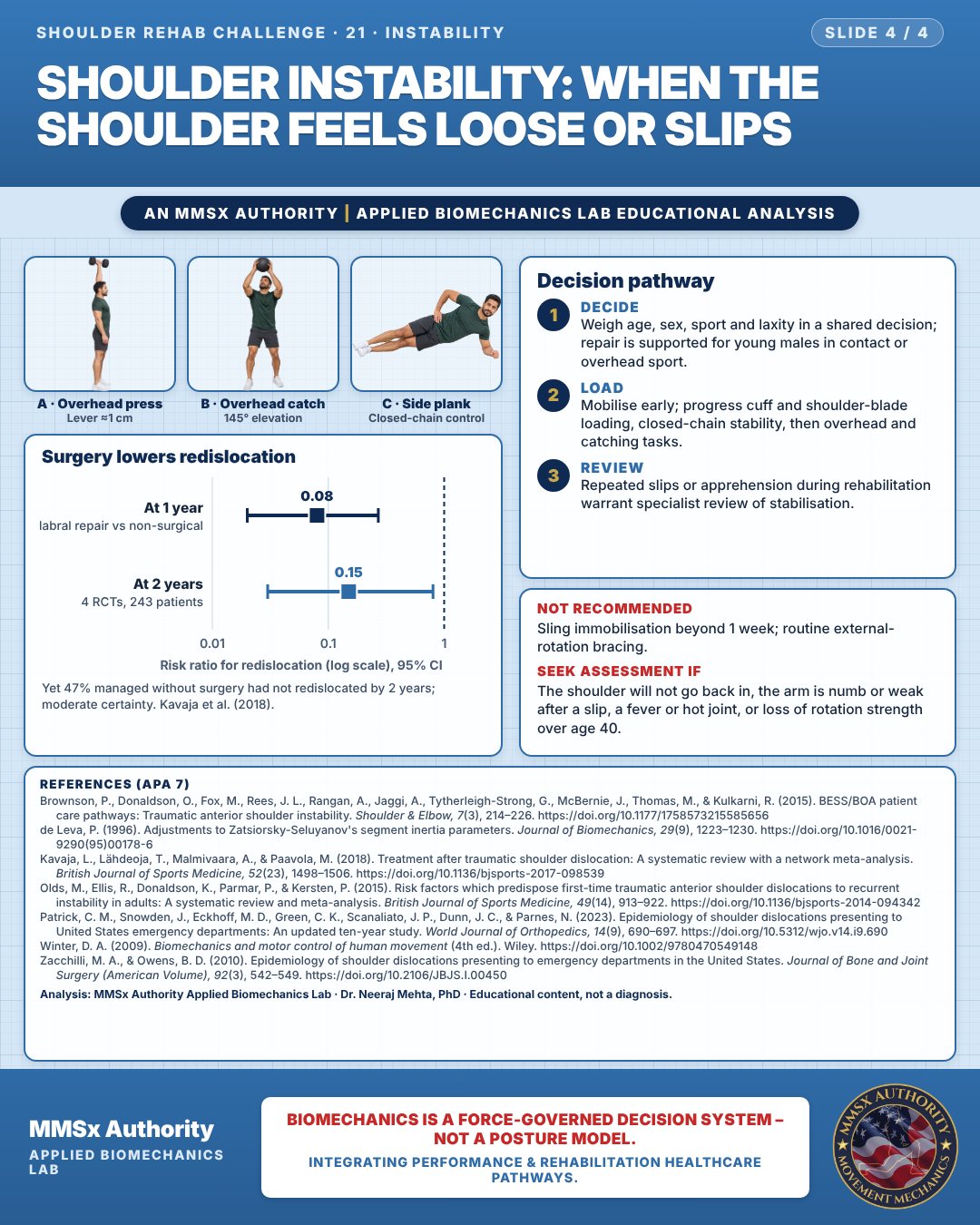
Surgery lowers redislocation
Decide
Weigh age, sex, sport and laxity in a shared decision; repair is supported for young males in contact or overhead sport.
Load
Mobilise early; progress cuff and shoulder-blade loading, closed-chain stability, then overhead and catching tasks.
Review
Repeated slips or apprehension during rehabilitation warrant specialist review of stabilisation.
What the evidence supports
- Recommended (BESS/BOA pathway, Brownson et al., 2015): shared decision-making; neurovascular examination documented before reduction and two-view radiographs; early mobilisation and physiotherapy for non-operative care; primary arthroscopic Bankart repair supported for young males, especially in contact sport or overhead work; anatomic repair preferred; Latarjet for significant glenoid bone loss or failed soft-tissue repair.
- Not recommended: immobilisation beyond 1 week (does not reduce recurrence); routine external-rotation bracing (equivocal evidence); transglenoid sutures or bioabsorbable tacks (Brownson et al., 2015). External- vs internal-rotation immobilisation showed no advantage (very low to low certainty) (Kavaja et al., 2018).
Myth and evidence
Myth“Keep the arm in a sling for several weeks and it will tighten up.”
EvidenceImmobilisation beyond 1 week does not reduce recurrence, and immobilisation position (external vs internal rotation) has shown no clear advantage (Brownson et al., 2015; Kavaja et al., 2018). Recurrence risk is driven mainly by age, sex and laxity (Olds et al., 2015).
Cautions
Not recommended
Sling immobilisation beyond 1 week; routine external-rotation bracing.
Seek assessment if
The shoulder will not go back in, the arm is numb or weak after a slip, a fever or hot joint, or loss of rotation strength over age 40.
Methods note
2-D estimates from pose landmarks on an illustrated figure; CoM from de Leva (1996) segment parameters; cm for a 1.70 m adult (Winter, 2009). Arm lever: shoulder joint to arm CoM; moment = arm weight × lever, 70 kg adult, static. Skeleton only: pose angles are unreliable in this lying position. These are educational estimates, not a diagnosis.
References
- Brownson, P., Donaldson, O., Fox, M., Rees, J. L., Rangan, A., Jaggi, A., Tytherleigh-Strong, G., McBernie, J., Thomas, M., & Kulkarni, R. (2015). BESS/BOA patient care pathways: Traumatic anterior shoulder instability. Shoulder & Elbow, 7(3), 214–226. https://doi.org/10.1177/1758573215585656
- de Leva, P. (1996). Adjustments to Zatsiorsky-Seluyanov's segment inertia parameters. Journal of Biomechanics, 29(9), 1223–1230. https://doi.org/10.1016/0021-9290(95)00178-6
- Kavaja, L., Lähdeoja, T., Malmivaara, A., & Paavola, M. (2018). Treatment after traumatic shoulder dislocation: A systematic review with a network meta-analysis. British Journal of Sports Medicine, 52(23), 1498–1506. https://doi.org/10.1136/bjsports-2017-098539
- Olds, M., Ellis, R., Donaldson, K., Parmar, P., & Kersten, P. (2015). Risk factors which predispose first-time traumatic anterior shoulder dislocations to recurrent instability in adults: A systematic review and meta-analysis. British Journal of Sports Medicine, 49(14), 913–922. https://doi.org/10.1136/bjsports-2014-094342
- Patrick, C. M., Snowden, J., Eckhoff, M. D., Green, C. K., Scanaliato, J. P., Dunn, J. C., & Parnes, N. (2023). Epidemiology of shoulder dislocations presenting to United States emergency departments: An updated ten-year study. World Journal of Orthopedics, 14(9), 690–697. https://doi.org/10.5312/wjo.v14.i9.690
- Winter, D. A. (2009). Biomechanics and motor control of human movement (4th ed.). Wiley. https://doi.org/10.1002/9780470549148
- Zacchilli, M. A., & Owens, B. D. (2010). Epidemiology of shoulder dislocations presenting to emergency departments in the United States. Journal of Bone and Joint Surgery (American Volume), 92(3), 542–549. https://doi.org/10.2106/JBJS.I.00450
Cite this article
Mehta, N. (2026, October 24). Shoulder instability: when the shoulder feels loose or slips. MMSx Authority Applied Biomechanics Lab. https://mmsxauthority.org/edu/analysis/shoulder/21-shoulder-instability-when-the-shoulder-feels-loose-or-slips/
Part of the collection
Mehta, N. (2026). Shoulder Rehabilitation: 50 Evidence-Based Biomechanics Analyses [Collection]. MMSx Authority Applied Biomechanics Lab. Zenodo. https://doi.org/10.5281/zenodo.23735725
All Shoulder Rehab Challenge articles · Rehabilitation Library