Shoulder Rehab Challenge · 20
Shoulder dislocation: what happens to the joint, and the risk of it happening again
A traumatic anterior shoulder dislocation is complete displacement of the humeral head out of the glenoid, usually forward and down.
Key points
- Reduce. Urgent care: x-ray before and after reduction, with a nerve and circulation check.
- Rehab. Progress from protected range to cuff and shoulder-blade strength, plank control and 90/90 work.
- Decide. Discuss early repair with young people in contact or overhead sport, weighing laxity and bone loss.
What it is
A traumatic anterior shoulder dislocation is complete displacement of the humeral head out of the glenoid, usually forward and down. It typically happens with the arm abducted and externally rotated (the 90/90 position, Movement A). It almost always injures the anterior capsulolabral complex (Bankart lesion) and often dents the back of the humeral head (Hill-Sachs lesion). The main long-term problem is recurrence.
How we analysed the movement
Three movements relevant to this topic were analysed from illustrated reference figures. Joint centres were located with two-dimensional pose estimation; arm elevation and elbow angles, shoulder level, the whole-body centre of mass and, where relevant, the arm lever (the horizontal distance from the shoulder joint to the centre of mass of the arm, with any hand load) and the resulting shoulder moment were then calculated from standard segment parameters. The figures are educational estimates that show how position changes mechanical demand; they are not measurements of a patient. Every research value quoted below comes from the published source cited beside it.
Movement A: 90/90 position (front view)
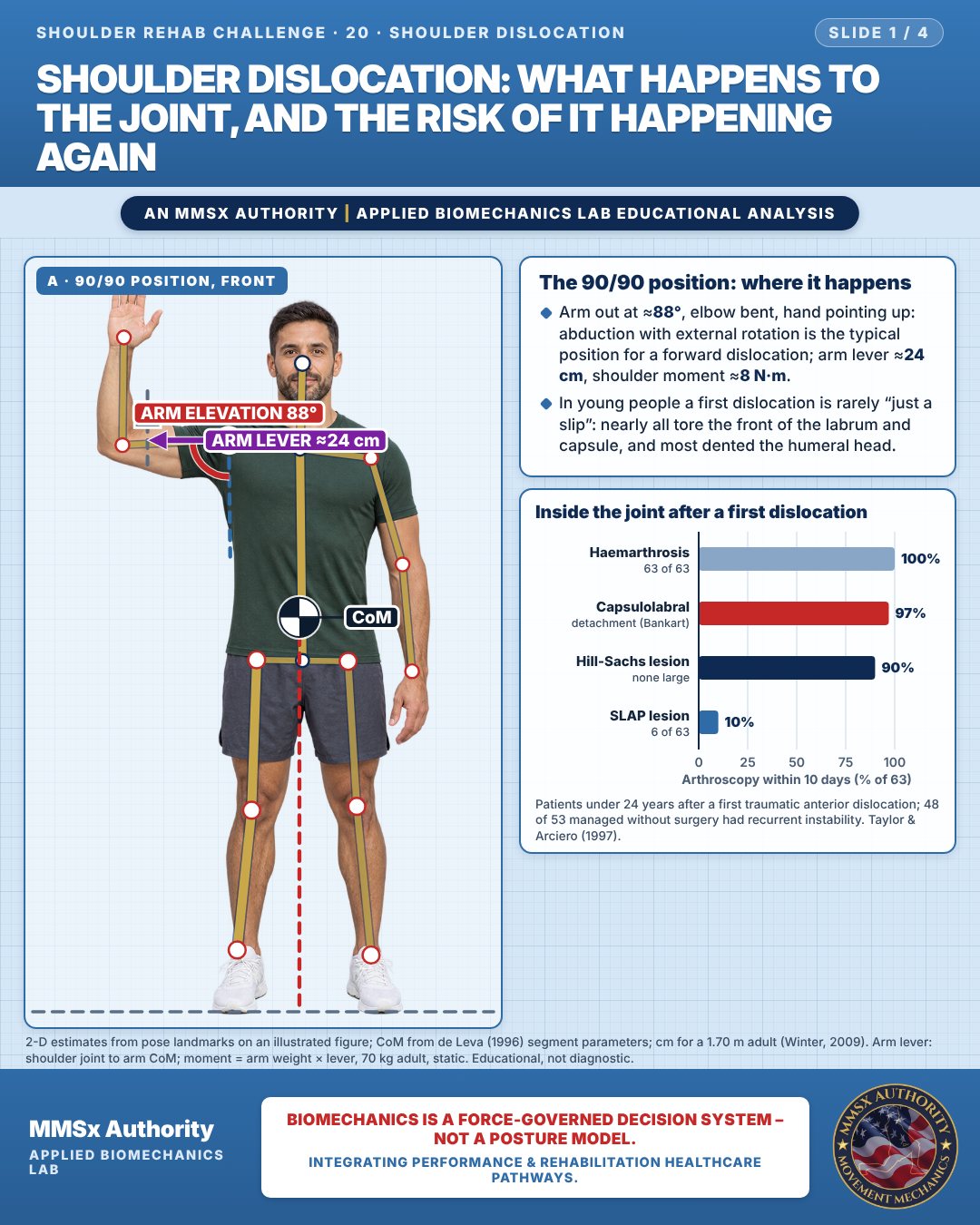
The 90/90 position: where it happens
Arm out at ≈88°, elbow bent, hand pointing up: abduction with external rotation is the typical position for a forward dislocation; arm lever ≈24 cm, shoulder moment ≈8 N·m.
In young people a first dislocation is rarely “just a slip”: nearly all tore the front of the labrum and capsule, and most dented the humeral head.
Inside the joint after a first dislocation
Movement B: High plank (side view)
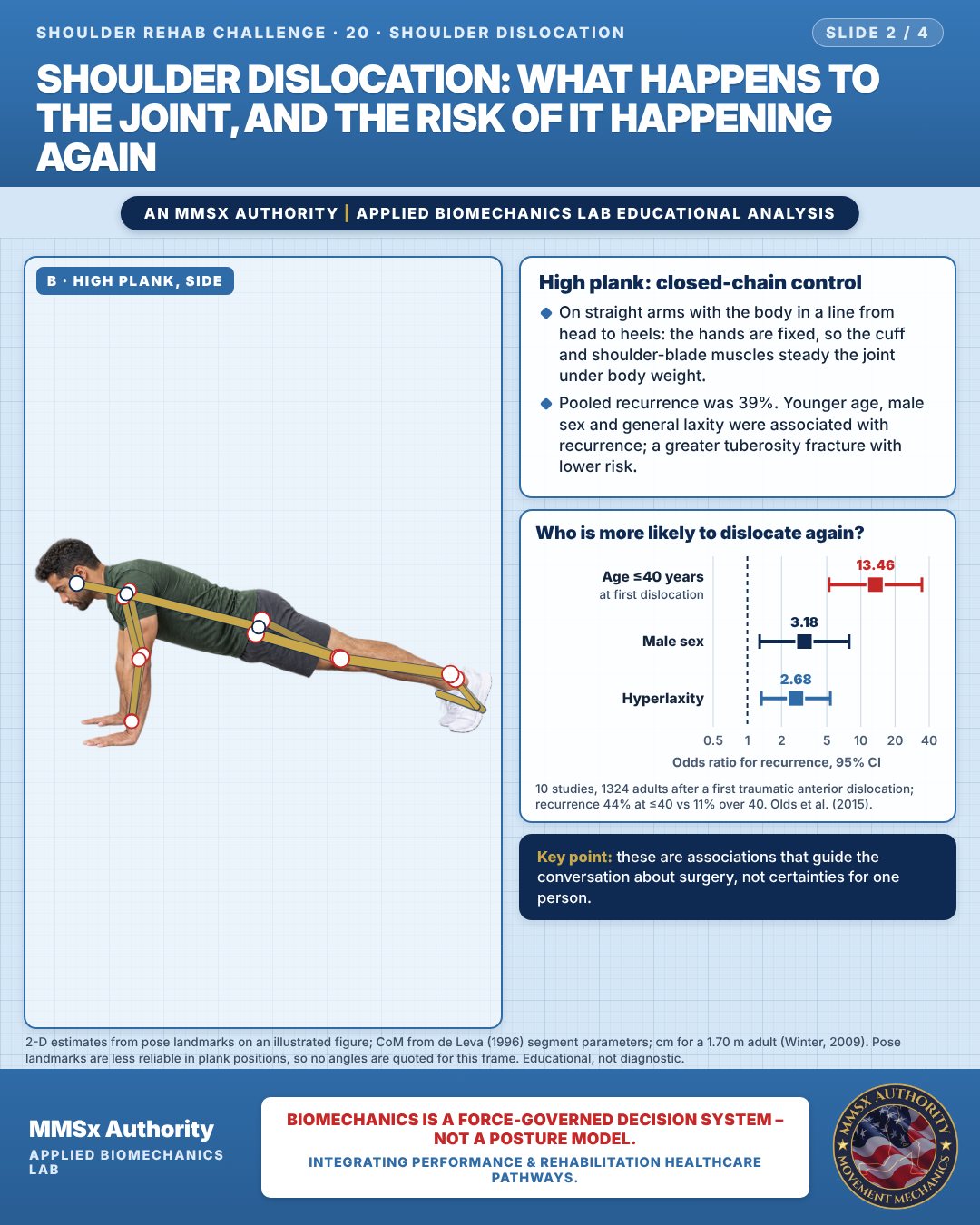
High plank: closed-chain control
On straight arms with the body in a line from head to heels: the hands are fixed, so the cuff and shoulder-blade muscles steady the joint under body weight.
Pooled recurrence was 39%. Younger age, male sex and general laxity were associated with recurrence; a greater tuberosity fracture with lower risk.
Who is more likely to dislocate again?
Movement C: Band rotation 90/90 (front view)
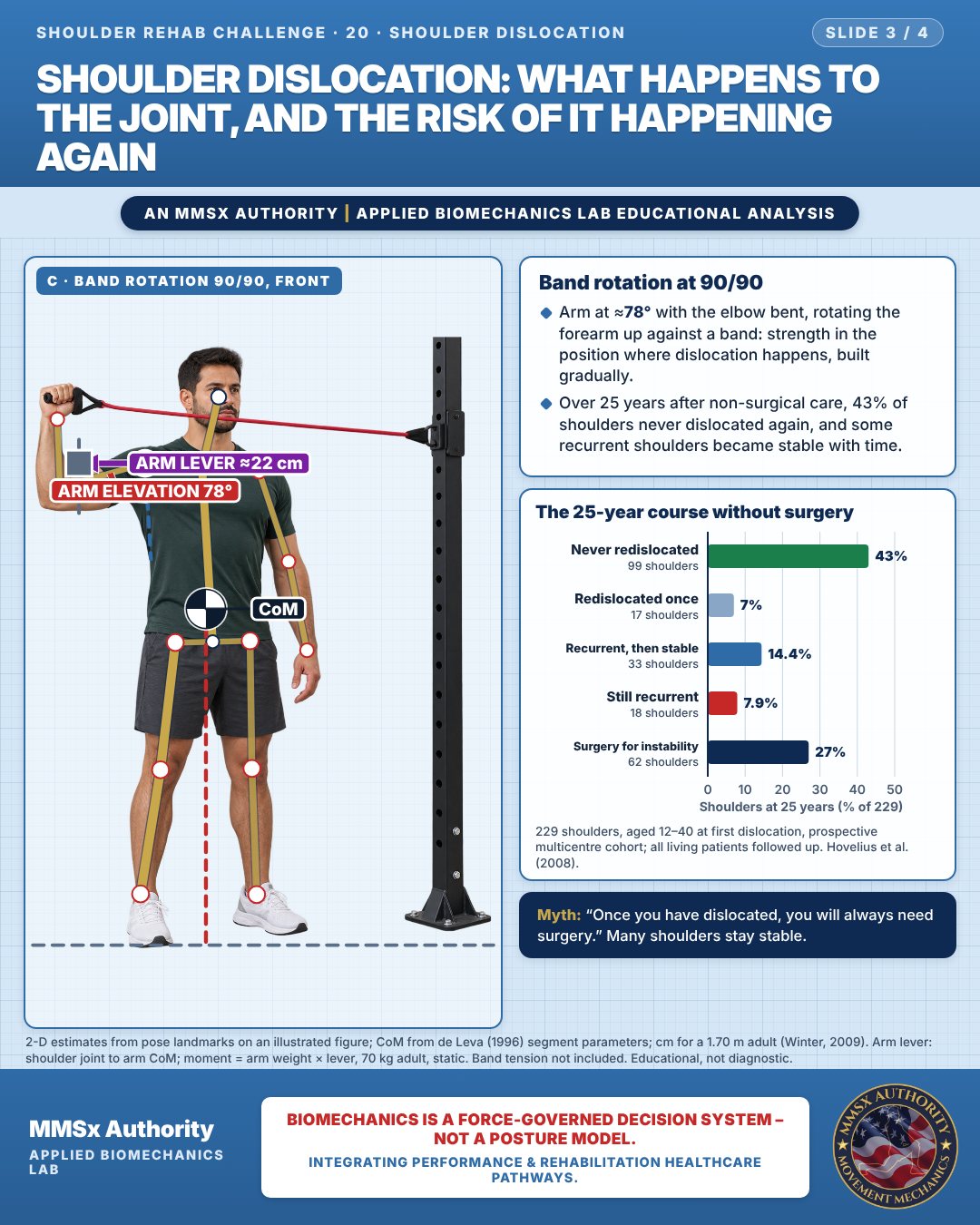
Band rotation at 90/90
Arm at ≈78° with the elbow bent, rotating the forearm up against a band: strength in the position where dislocation happens, built gradually.
Over 25 years after non-surgical care, 43% of shoulders never dislocated again, and some recurrent shoulders became stable with time.
The 25-year course without surgery
Decision pathway
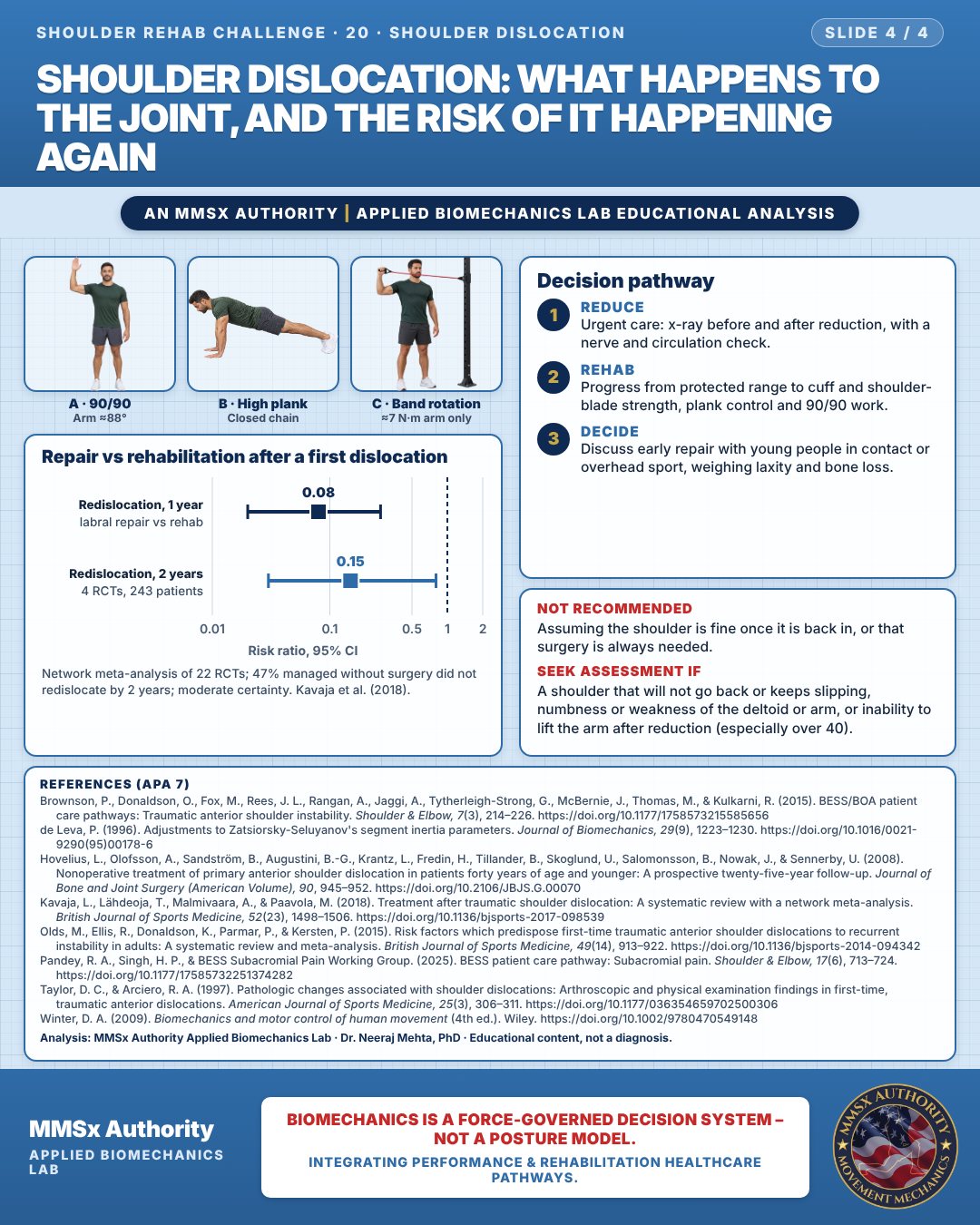
Repair vs rehabilitation after a first dislocation
Reduce
Urgent care: x-ray before and after reduction, with a nerve and circulation check.
Rehab
Progress from protected range to cuff and shoulder-blade strength, plank control and 90/90 work.
Decide
Discuss early repair with young people in contact or overhead sport, weighing laxity and bone loss.
Myth and evidence
Myth“Once it's back in, the shoulder is fine — and once you've dislocated, you'll always need surgery.”
EvidenceBoth are wrong. In young people, 97% had a Bankart lesion at arthroscopy (Taylor & Arciero, 1997). Yet over 25 years, 43% of shoulders treated without surgery never redislocated (Hovelius et al., 2008), and about half of rehabilitated patients stayed stable at 2 years (Kavaja et al., 2018).
Cautions
Not recommended
Assuming the shoulder is fine once it is back in, or that surgery is always needed.
Seek assessment if
A shoulder that will not go back or keeps slipping, numbness or weakness of the deltoid or arm, or inability to lift the arm after reduction (especially over 40).
Methods note
2-D estimates from pose landmarks on an illustrated figure; CoM from de Leva (1996) segment parameters; cm for a 1.70 m adult (Winter, 2009). Arm lever: shoulder joint to arm CoM; moment = arm weight × lever, 70 kg adult, static. Pose landmarks are less reliable in plank positions, so no angles are quoted for this frame. Band tension not included. These are educational estimates, not a diagnosis.
References
- Brownson, P., Donaldson, O., Fox, M., Rees, J. L., Rangan, A., Jaggi, A., Tytherleigh-Strong, G., McBernie, J., Thomas, M., & Kulkarni, R. (2015). BESS/BOA patient care pathways: Traumatic anterior shoulder instability. Shoulder & Elbow, 7(3), 214–226. https://doi.org/10.1177/1758573215585656
- de Leva, P. (1996). Adjustments to Zatsiorsky-Seluyanov's segment inertia parameters. Journal of Biomechanics, 29(9), 1223–1230. https://doi.org/10.1016/0021-9290(95)00178-6
- Hovelius, L., Olofsson, A., Sandström, B., Augustini, B.-G., Krantz, L., Fredin, H., Tillander, B., Skoglund, U., Salomonsson, B., Nowak, J., & Sennerby, U. (2008). Nonoperative treatment of primary anterior shoulder dislocation in patients forty years of age and younger: A prospective twenty-five-year follow-up. Journal of Bone and Joint Surgery (American Volume), 90, 945–952. https://doi.org/10.2106/JBJS.G.00070
- Kavaja, L., Lähdeoja, T., Malmivaara, A., & Paavola, M. (2018). Treatment after traumatic shoulder dislocation: A systematic review with a network meta-analysis. British Journal of Sports Medicine, 52(23), 1498–1506. https://doi.org/10.1136/bjsports-2017-098539
- Olds, M., Ellis, R., Donaldson, K., Parmar, P., & Kersten, P. (2015). Risk factors which predispose first-time traumatic anterior shoulder dislocations to recurrent instability in adults: A systematic review and meta-analysis. British Journal of Sports Medicine, 49(14), 913–922. https://doi.org/10.1136/bjsports-2014-094342
- Pandey, R. A., Singh, H. P., & BESS Subacromial Pain Working Group. (2025). BESS patient care pathway: Subacromial pain. Shoulder & Elbow, 17(6), 713–724. https://doi.org/10.1177/17585732251374282
- Taylor, D. C., & Arciero, R. A. (1997). Pathologic changes associated with shoulder dislocations: Arthroscopic and physical examination findings in first-time, traumatic anterior dislocations. American Journal of Sports Medicine, 25(3), 306–311. https://doi.org/10.1177/036354659702500306
- Winter, D. A. (2009). Biomechanics and motor control of human movement (4th ed.). Wiley. https://doi.org/10.1002/9780470549148
Cite this article
Mehta, N. (2026, October 24). Shoulder dislocation: what happens to the joint, and the risk of it happening again. MMSx Authority Applied Biomechanics Lab. https://mmsxauthority.org/edu/analysis/shoulder/20-shoulder-dislocation-what-happens-to-the-joint-and-the-risk-of-it/
Part of the collection
Mehta, N. (2026). Shoulder Rehabilitation: 50 Evidence-Based Biomechanics Analyses [Collection]. MMSx Authority Applied Biomechanics Lab. Zenodo. https://doi.org/10.5281/zenodo.23735725
All Shoulder Rehab Challenge articles · Rehabilitation Library