Shoulder Rehab Challenge · 19
Labral tear (SLAP): clicking, catching and deep shoulder pain
A SLAP (superior labrum anterior to posterior) lesion is a tear of the superior glenoid labrum at the attachment of the long head of biceps.
Key points
- Match. Match a scan finding to the history and examination, as labral changes often coexist with other damage.
- Rehab. Start with cuff and shoulder-blade strength, range including the back of the shoulder, then graded throwing.
- Discuss. If surgery is considered, set realistic return-to-sport expectations, especially for throwers.
What it is
A SLAP (superior labrum anterior to posterior) lesion is a tear of the superior glenoid labrum at the attachment of the long head of biceps. It is classified at arthroscopy (types I–IV and complex), with type II, a detachment of the labrum–biceps anchor, the most common. It typically causes deep shoulder pain, sometimes with mechanical catching, particularly in overhead and throwing athletes. Labral changes are also common with age, so clinical relevance must be judged case by case.
How we analysed the movement
Three movements relevant to this topic were analysed from illustrated reference figures. Joint centres were located with two-dimensional pose estimation; arm elevation and elbow angles, shoulder level, the whole-body centre of mass and, where relevant, the arm lever (the horizontal distance from the shoulder joint to the centre of mass of the arm, with any hand load) and the resulting shoulder moment were then calculated from standard segment parameters. The figures are educational estimates that show how position changes mechanical demand; they are not measurements of a patient. Every research value quoted below comes from the published source cited beside it.
Movement A: Throwing arm cocked (side view)
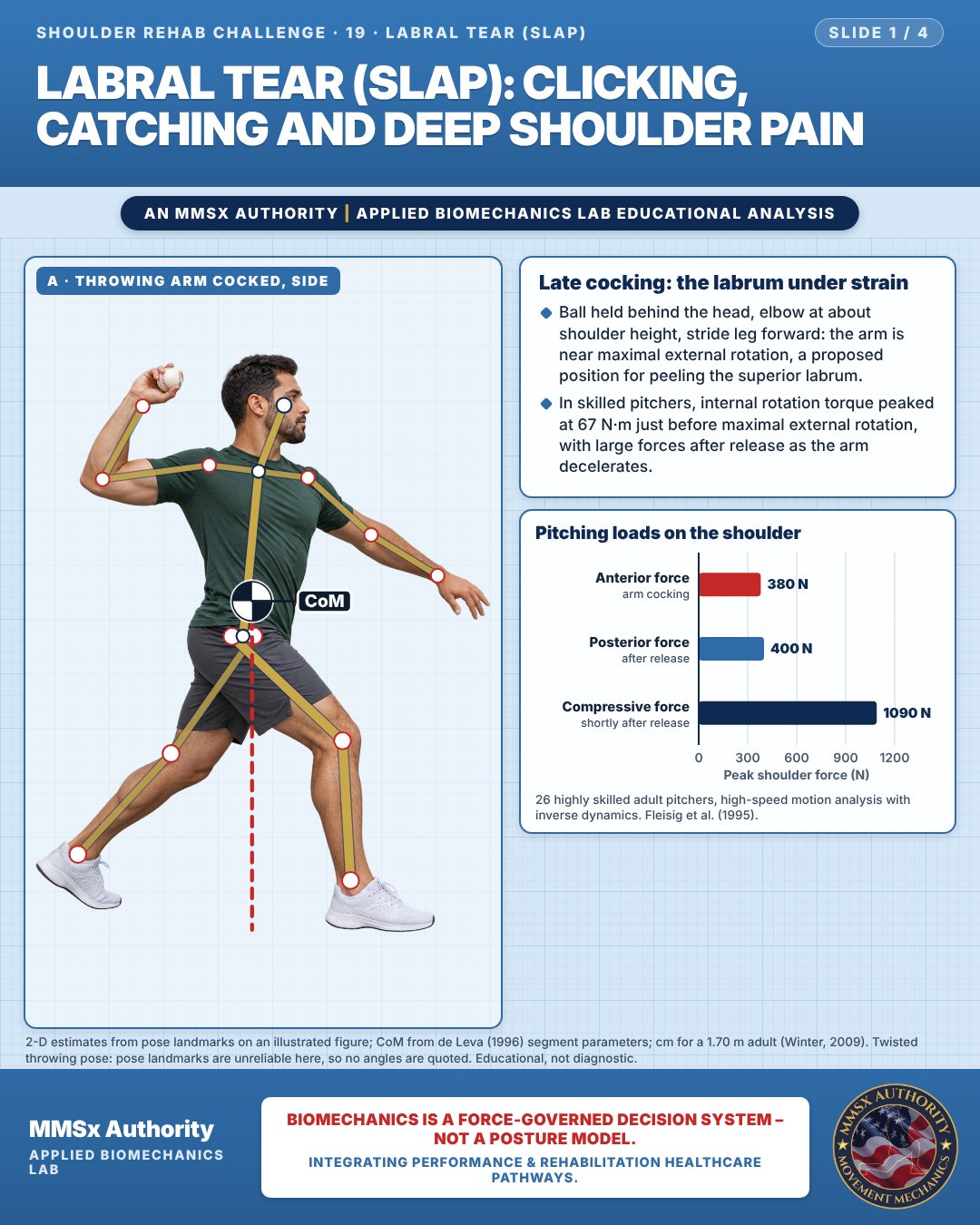
Late cocking: the labrum under strain
Ball held behind the head, elbow at about shoulder height, stride leg forward: the arm is near maximal external rotation, a proposed position for peeling the superior labrum.
In skilled pitchers, internal rotation torque peaked at 67 N·m just before maximal external rotation, with large forces after release as the arm decelerates.
Pitching loads on the shoulder
Movement B: Lowering a box (front view)
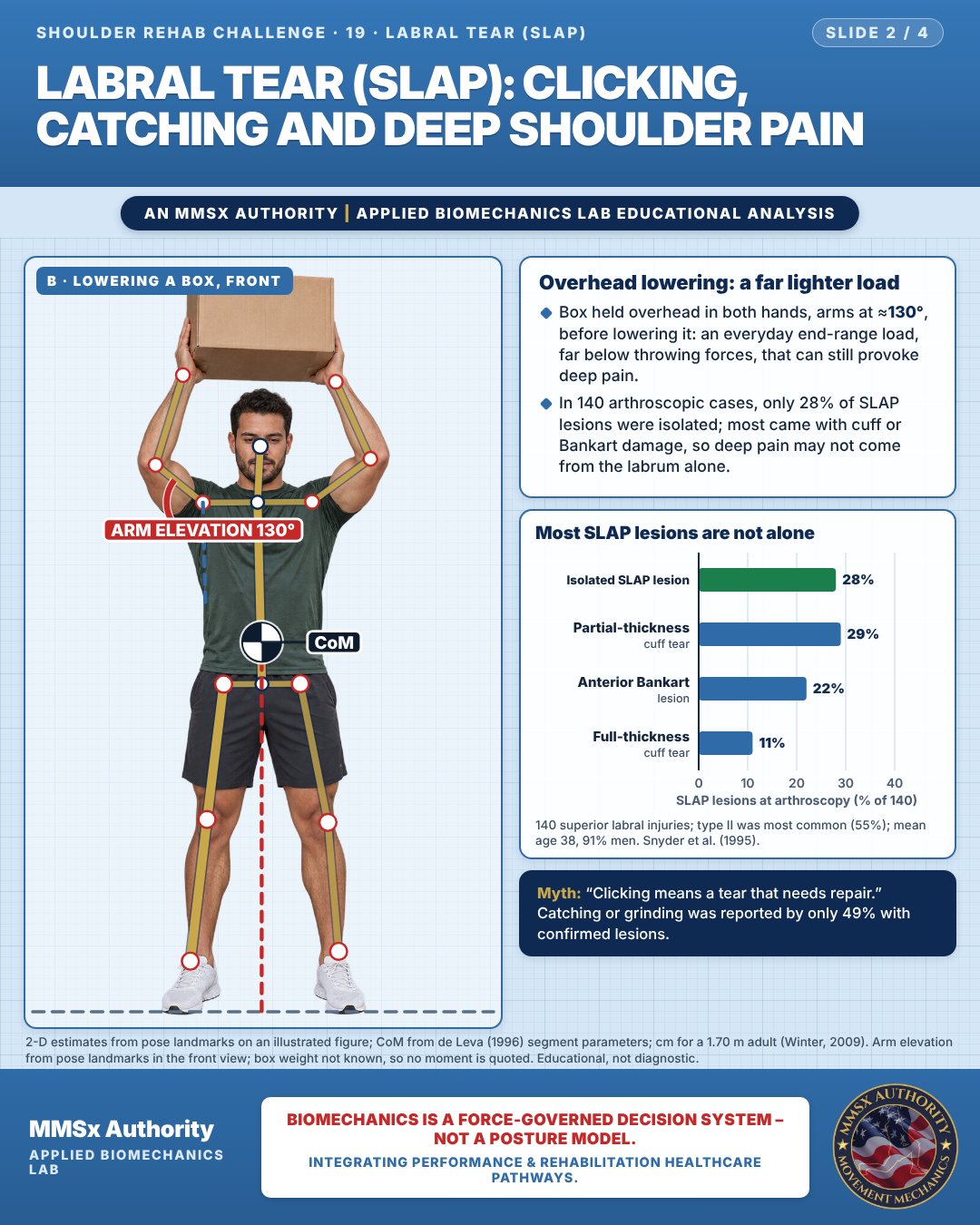
Overhead lowering: a far lighter load
Box held overhead in both hands, arms at ≈130°, before lowering it: an everyday end-range load, far below throwing forces, that can still provoke deep pain.
In 140 arthroscopic cases, only 28% of SLAP lesions were isolated; most came with cuff or Bankart damage, so deep pain may not come from the labrum alone.
Most SLAP lesions are not alone
Movement C: Push-up, lowest point (side view)
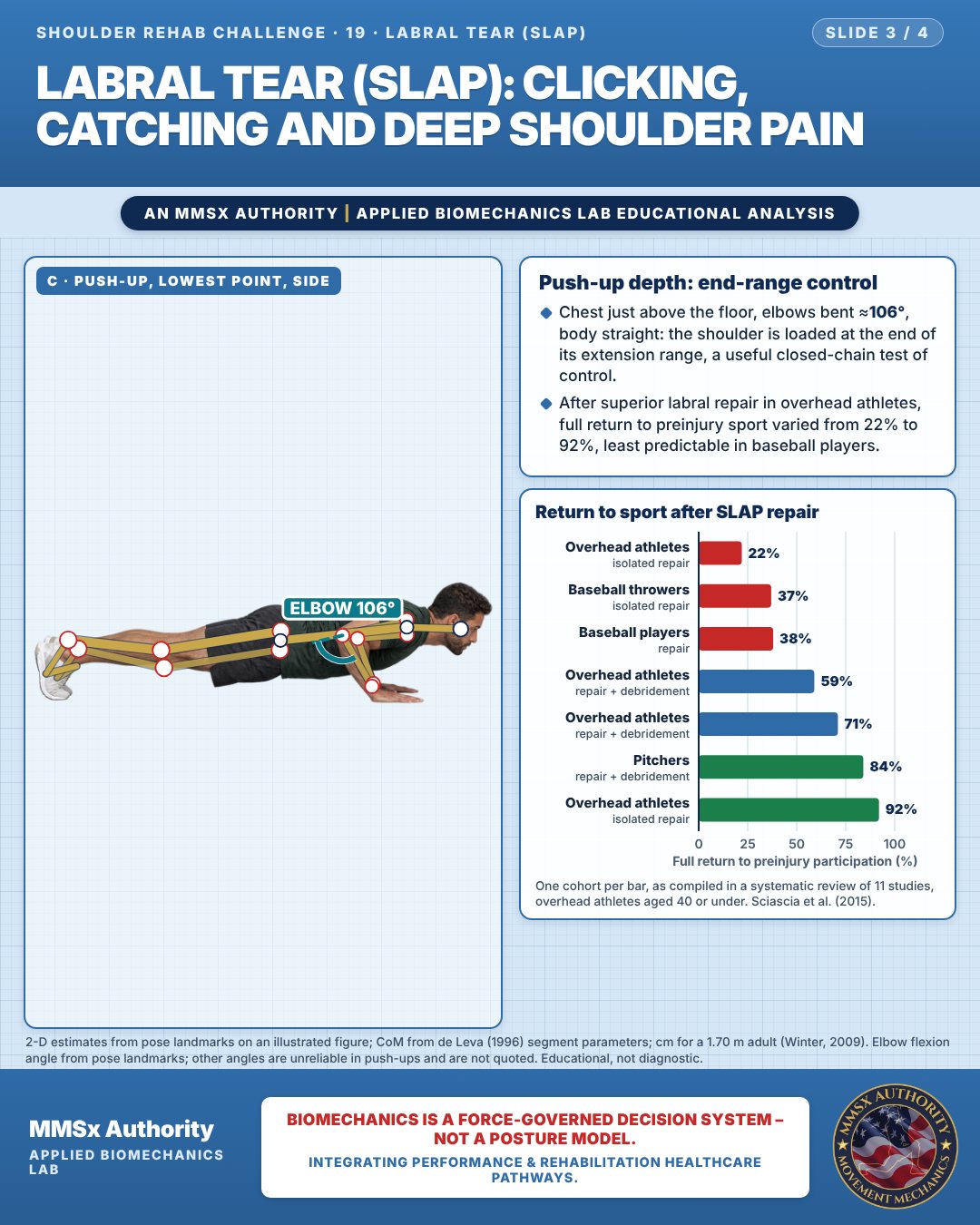
Push-up depth: end-range control
Chest just above the floor, elbows bent ≈106°, body straight: the shoulder is loaded at the end of its extension range, a useful closed-chain test of control.
After superior labral repair in overhead athletes, full return to preinjury sport varied from 22% to 92%, least predictable in baseball players.
Return to sport after SLAP repair
Decision pathway
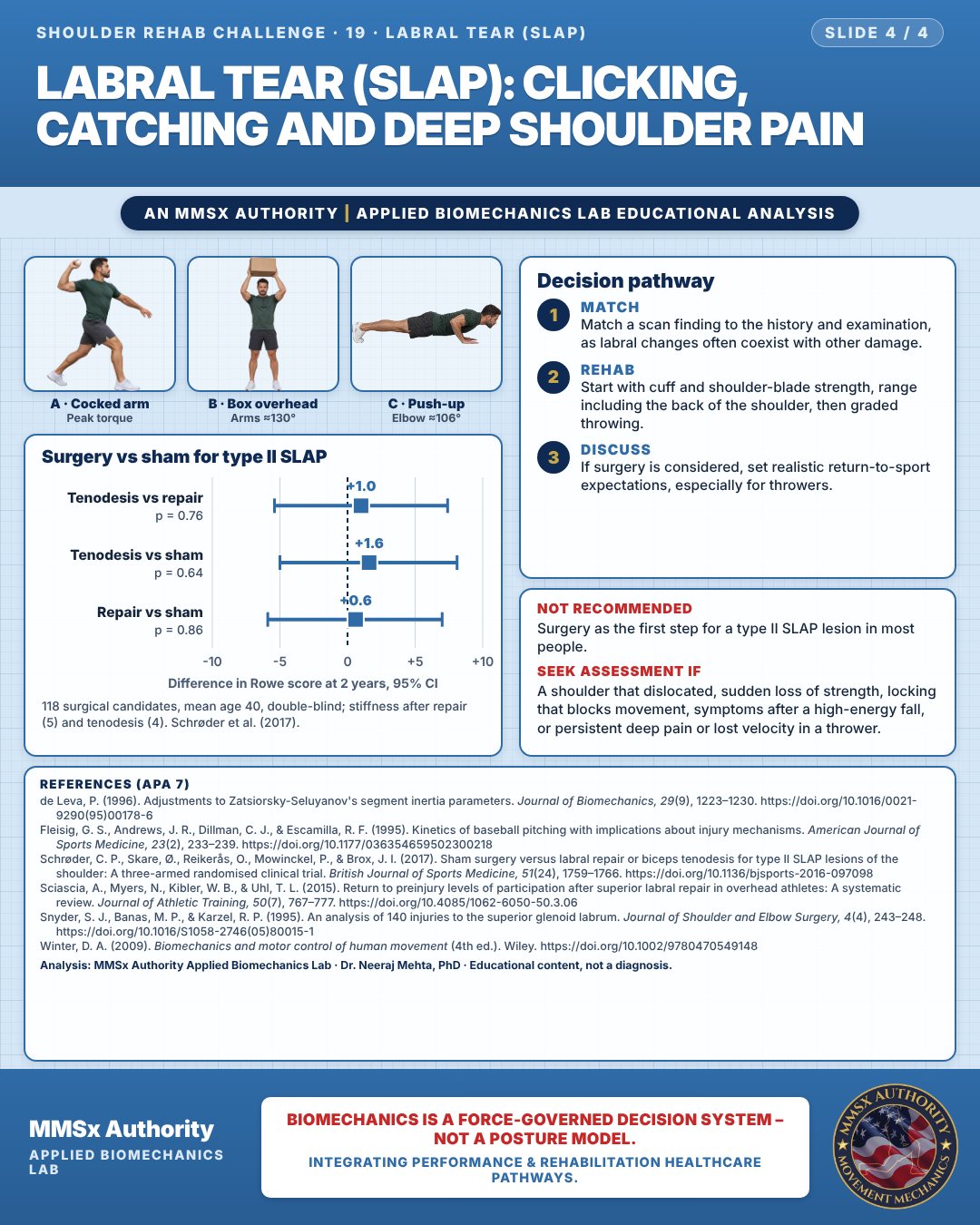
Surgery vs sham for type II SLAP
Match
Match a scan finding to the history and examination, as labral changes often coexist with other damage.
Rehab
Start with cuff and shoulder-blade strength, range including the back of the shoulder, then graded throwing.
Discuss
If surgery is considered, set realistic return-to-sport expectations, especially for throwers.
What the evidence supports
- Start with non-operative rehabilitation for most people: rotator cuff and scapular strengthening, range restoration (including posterior shoulder mobility in throwers), and graded return to overhead and throwing load. The sham-controlled trial found no added benefit from repair or tenodesis over sham surgery (Schrøder et al., 2017).
- If surgery is considered, expectations for overhead athletes must be realistic, because full return rates range from 22% to 92% (Sciascia et al., 2015).
Cautions
Not recommended
Surgery as the first step for a type II SLAP lesion in most people.
Seek assessment if
A shoulder that dislocated, sudden loss of strength, locking that blocks movement, symptoms after a high-energy fall, or persistent deep pain or lost velocity in a thrower.
Methods note
2-D estimates from pose landmarks on an illustrated figure; CoM from de Leva (1996) segment parameters; cm for a 1.70 m adult (Winter, 2009). Twisted throwing pose: pose landmarks are unreliable here, so no angles are quoted. Arm elevation from pose landmarks in the front view; box weight not known, so no moment is quoted. Elbow flexion angle from pose landmarks; other angles are unreliable in push-ups and are not quoted. These are educational estimates, not a diagnosis.
References
- de Leva, P. (1996). Adjustments to Zatsiorsky-Seluyanov's segment inertia parameters. Journal of Biomechanics, 29(9), 1223–1230. https://doi.org/10.1016/0021-9290(95)00178-6
- Fleisig, G. S., Andrews, J. R., Dillman, C. J., & Escamilla, R. F. (1995). Kinetics of baseball pitching with implications about injury mechanisms. American Journal of Sports Medicine, 23(2), 233–239. https://doi.org/10.1177/036354659502300218
- Schrøder, C. P., Skare, Ø., Reikerås, O., Mowinckel, P., & Brox, J. I. (2017). Sham surgery versus labral repair or biceps tenodesis for type II SLAP lesions of the shoulder: A three-armed randomised clinical trial. British Journal of Sports Medicine, 51(24), 1759–1766. https://doi.org/10.1136/bjsports-2016-097098
- Sciascia, A., Myers, N., Kibler, W. B., & Uhl, T. L. (2015). Return to preinjury levels of participation after superior labral repair in overhead athletes: A systematic review. Journal of Athletic Training, 50(7), 767–777. https://doi.org/10.4085/1062-6050-50.3.06
- Snyder, S. J., Banas, M. P., & Karzel, R. P. (1995). An analysis of 140 injuries to the superior glenoid labrum. Journal of Shoulder and Elbow Surgery, 4(4), 243–248. https://doi.org/10.1016/S1058-2746(05)80015-1
- Winter, D. A. (2009). Biomechanics and motor control of human movement (4th ed.). Wiley. https://doi.org/10.1002/9780470549148
Cite this article
Mehta, N. (2026, October 24). Labral tear (SLAP): clicking, catching and deep shoulder pain. MMSx Authority Applied Biomechanics Lab. https://mmsxauthority.org/edu/analysis/shoulder/19-labral-tear-slap-clicking-catching-and-deep-shoulder-pain/
Part of the collection
Mehta, N. (2026). Shoulder Rehabilitation: 50 Evidence-Based Biomechanics Analyses [Collection]. MMSx Authority Applied Biomechanics Lab. Zenodo. https://doi.org/10.5281/zenodo.23735725
All Shoulder Rehab Challenge articles · Rehabilitation Library