Shoulder Rehab Challenge · 18
Long head of biceps pain: pain at the front of the shoulder
Long head of biceps (LHB) tendinopathy is pain arising from the intra-articular and bicipital-groove portion of the tendon.
Key points
- Modify. Reduce provoking bent-elbow carrying, curls and supination while symptoms settle.
- Load. Progress cuff, shoulder-blade and elbow-flexor strength; exercise is first line for cuff-related pain.
- Consider. Injection or surgery only for persistent, function-limiting pain; options differ mainly in appearance.
What it is
Long head of biceps (LHB) tendinopathy is pain arising from the intra-articular and bicipital-groove portion of the tendon. It is felt at the front of the shoulder and often provoked by resisted elbow flexion, forearm supination, carrying with a bent elbow or shoulder extension. It often coexists with rotator cuff disease, and clinical tests alone are unreliable for confirming it (Gill et al., 2007).
How we analysed the movement
Three movements relevant to this topic were analysed from illustrated reference figures. Joint centres were located with two-dimensional pose estimation; arm elevation and elbow angles, shoulder level, the whole-body centre of mass and, where relevant, the arm lever (the horizontal distance from the shoulder joint to the centre of mass of the arm, with any hand load) and the resulting shoulder moment were then calculated from standard segment parameters. The figures are educational estimates that show how position changes mechanical demand; they are not measurements of a patient. Every research value quoted below comes from the published source cited beside it.
Movement A: Bag on bent elbow (side view)
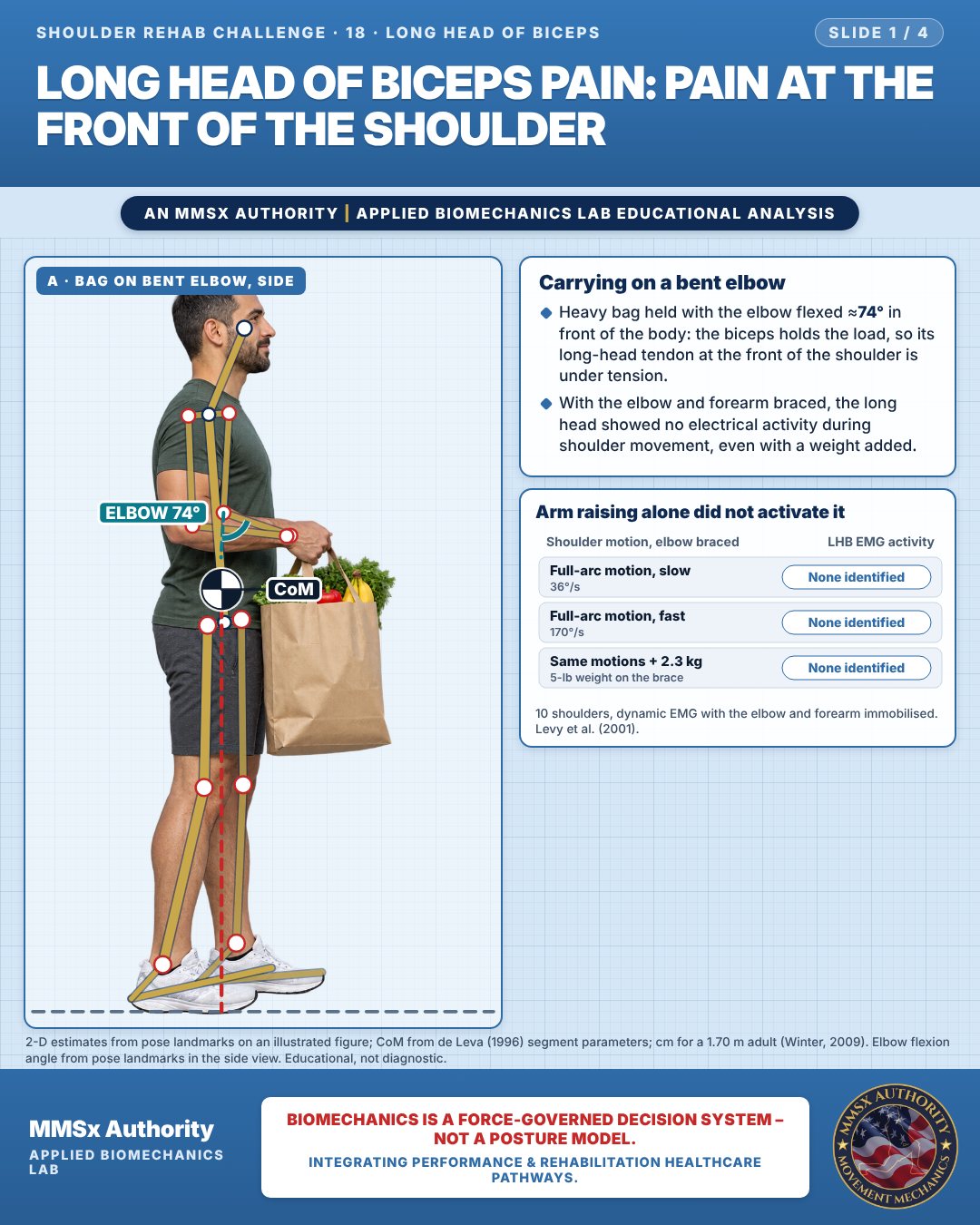
Carrying on a bent elbow
Heavy bag held with the elbow flexed ≈74° in front of the body: the biceps holds the load, so its long-head tendon at the front of the shoulder is under tension.
With the elbow and forearm braced, the long head showed no electrical activity during shoulder movement, even with a weight added.
Arm raising alone did not activate it
Movement B: Top of a curl (side view)
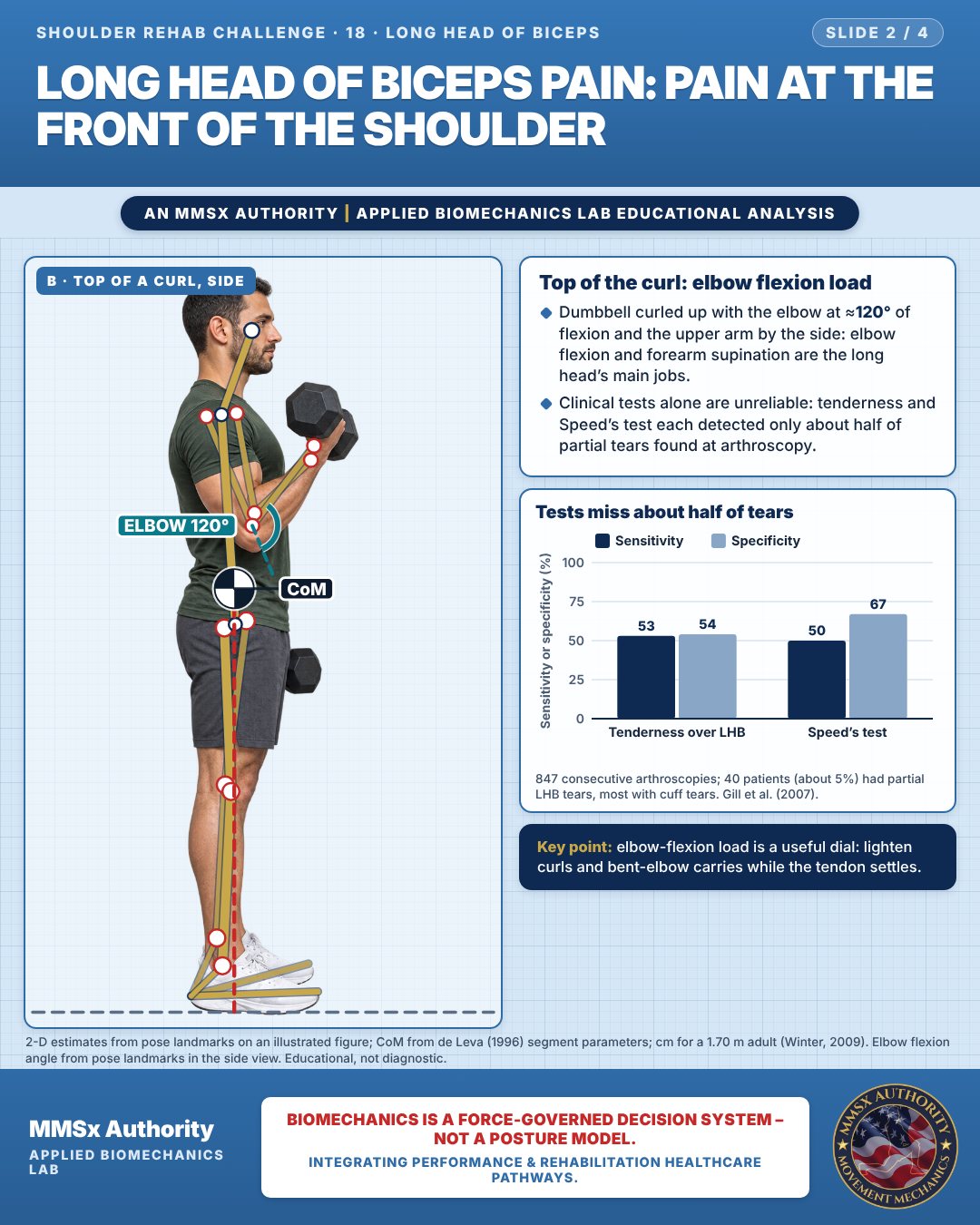
Top of the curl: elbow flexion load
Dumbbell curled up with the elbow at ≈120° of flexion and the upper arm by the side: elbow flexion and forearm supination are the long head’s main jobs.
Clinical tests alone are unreliable: tenderness and Speed’s test each detected only about half of partial tears found at arthroscopy.
Tests miss about half of tears
Movement C: Hands behind back (side view)
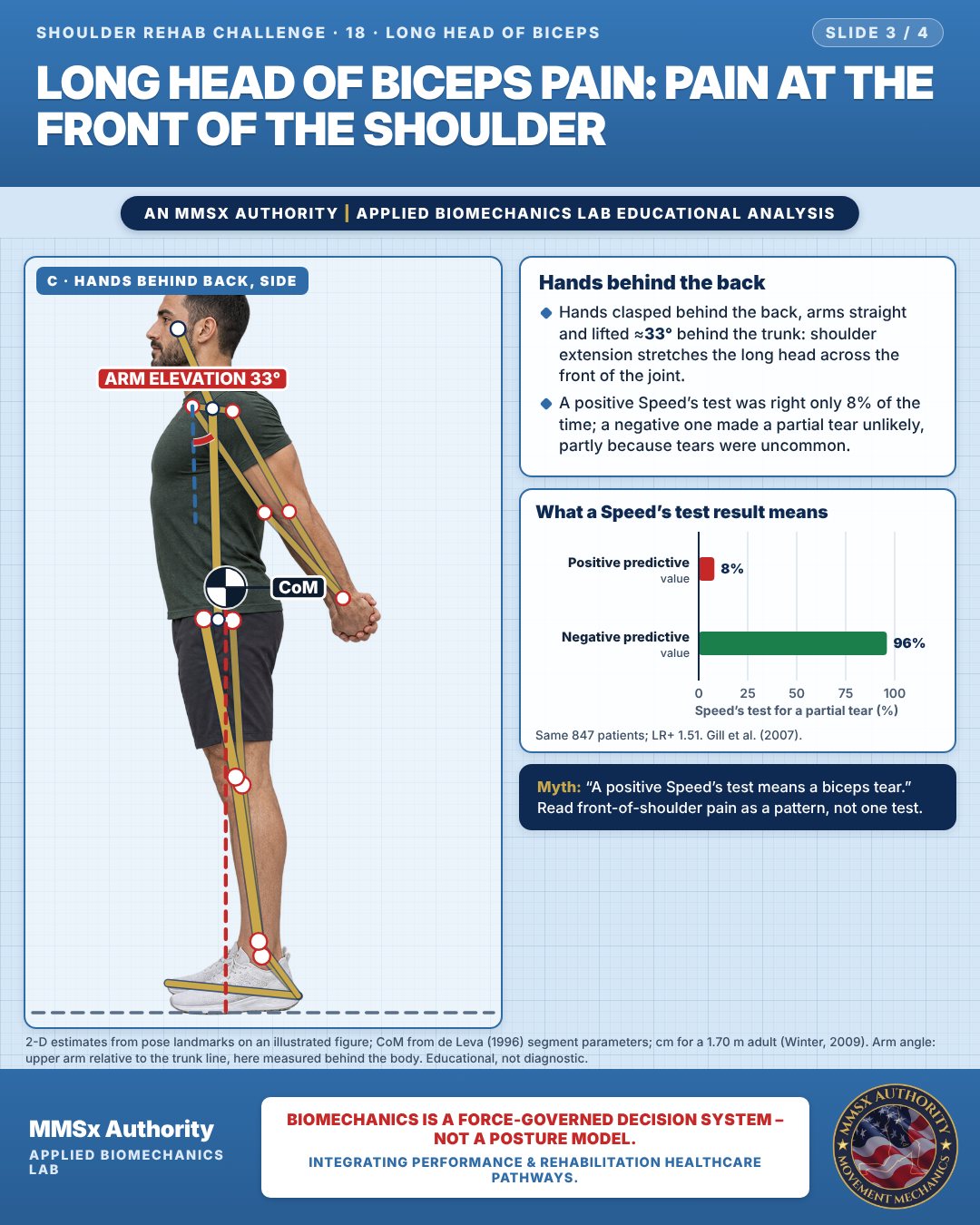
Hands behind the back
Hands clasped behind the back, arms straight and lifted ≈33° behind the trunk: shoulder extension stretches the long head across the front of the joint.
A positive Speed’s test was right only 8% of the time; a negative one made a partial tear unlikely, partly because tears were uncommon.
What a Speed’s test result means
Decision pathway
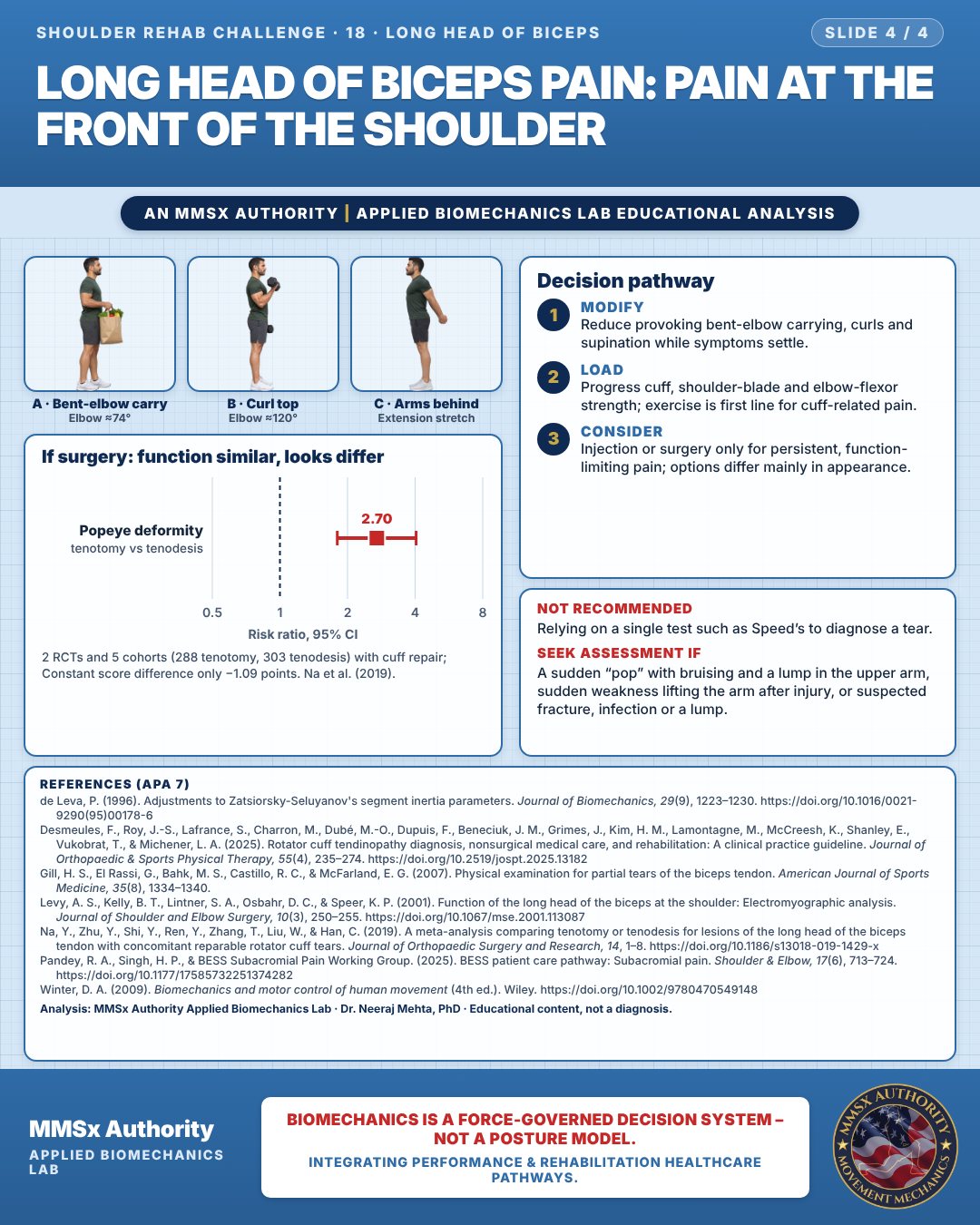
If surgery: function similar, looks differ
Modify
Reduce provoking bent-elbow carrying, curls and supination while symptoms settle.
Load
Progress cuff, shoulder-blade and elbow-flexor strength; exercise is first line for cuff-related pain.
Consider
Injection or surgery only for persistent, function-limiting pain; options differ mainly in appearance.
What the evidence supports
- Injection or surgery (tenotomy or tenodesis, usually alongside cuff surgery) is considered for persistent, function-limiting symptoms. Expected differences between the two surgical options are small, apart from deformity (Na et al., 2019).
Myth and evidence
Myth“A positive Speed's test means you have a biceps tear.”
EvidenceSpeed's test had a positive predictive value of 8% and tenderness had a specificity of 54% (Gill et al., 2007). And when it is torn or released, function is usually little changed (Constant MD −1.09; Na et al., 2019).
Cautions
Not recommended
Relying on a single test such as Speed’s to diagnose a tear.
Seek assessment if
A sudden “pop” with bruising and a lump in the upper arm, sudden weakness lifting the arm after injury, or suspected fracture, infection or a lump.
Methods note
2-D estimates from pose landmarks on an illustrated figure; CoM from de Leva (1996) segment parameters; cm for a 1.70 m adult (Winter, 2009). Elbow flexion angle from pose landmarks in the side view. Arm angle: upper arm relative to the trunk line, here measured behind the body. These are educational estimates, not a diagnosis.
References
- de Leva, P. (1996). Adjustments to Zatsiorsky-Seluyanov's segment inertia parameters. Journal of Biomechanics, 29(9), 1223–1230. https://doi.org/10.1016/0021-9290(95)00178-6
- Desmeules, F., Roy, J.-S., Lafrance, S., Charron, M., Dubé, M.-O., Dupuis, F., Beneciuk, J. M., Grimes, J., Kim, H. M., Lamontagne, M., McCreesh, K., Shanley, E., Vukobrat, T., & Michener, L. A. (2025). Rotator cuff tendinopathy diagnosis, nonsurgical medical care, and rehabilitation: A clinical practice guideline. Journal of Orthopaedic & Sports Physical Therapy, 55(4), 235–274. https://doi.org/10.2519/jospt.2025.13182
- Gill, H. S., El Rassi, G., Bahk, M. S., Castillo, R. C., & McFarland, E. G. (2007). Physical examination for partial tears of the biceps tendon. American Journal of Sports Medicine, 35(8), 1334–1340.
- Levy, A. S., Kelly, B. T., Lintner, S. A., Osbahr, D. C., & Speer, K. P. (2001). Function of the long head of the biceps at the shoulder: Electromyographic analysis. Journal of Shoulder and Elbow Surgery, 10(3), 250–255. https://doi.org/10.1067/mse.2001.113087
- Na, Y., Zhu, Y., Shi, Y., Ren, Y., Zhang, T., Liu, W., & Han, C. (2019). A meta-analysis comparing tenotomy or tenodesis for lesions of the long head of the biceps tendon with concomitant reparable rotator cuff tears. Journal of Orthopaedic Surgery and Research, 14, 1–8. https://doi.org/10.1186/s13018-019-1429-x
- Pandey, R. A., Singh, H. P., & BESS Subacromial Pain Working Group. (2025). BESS patient care pathway: Subacromial pain. Shoulder & Elbow, 17(6), 713–724. https://doi.org/10.1177/17585732251374282
- Winter, D. A. (2009). Biomechanics and motor control of human movement (4th ed.). Wiley. https://doi.org/10.1002/9780470549148
Cite this article
Mehta, N. (2026, October 24). Long head of biceps pain: pain at the front of the shoulder. MMSx Authority Applied Biomechanics Lab. https://mmsxauthority.org/edu/analysis/shoulder/18-long-head-of-biceps-pain-pain-at-the-front-of-the-shoulder/
Part of the collection
Mehta, N. (2026). Shoulder Rehabilitation: 50 Evidence-Based Biomechanics Analyses [Collection]. MMSx Authority Applied Biomechanics Lab. Zenodo. https://doi.org/10.5281/zenodo.23735725
All Shoulder Rehab Challenge articles · Rehabilitation Library