Shoulder Rehab Challenge · 16
Shoulder bursitis: what the inflamed bursa can and cannot explain
Subacromial-subdeltoid bursitis describes thickening, fluid or inflammation of the bursa that lies between the rotator cuff and the acromion and deltoid.
Key points
- Explain. Bursal changes are common in pain-free shoulders; diagnose from the whole clinical picture.
- Load. Start education and progressive exercise; shorten levers on painful reaches meanwhile.
- Option. If no better by 6–8 weeks, consider one injection to enable exercise; refer by 12 weeks.
What it is
Subacromial-subdeltoid bursitis describes thickening, fluid or inflammation of the bursa that lies between the rotator cuff and the acromion and deltoid. In most non-traumatic shoulder pain it is part of the wider rotator cuff related (subacromial) pain picture rather than a separate diagnosis. Bursal changes on ultrasound are also common in pain-free shoulders (Ocguder et al., 2010). Subacromial pain is diagnosed clinically (Pandey et al., 2025).
How we analysed the movement
Three movements relevant to this topic were analysed from illustrated reference figures. Joint centres were located with two-dimensional pose estimation; arm elevation and elbow angles, shoulder level, the whole-body centre of mass and, where relevant, the arm lever (the horizontal distance from the shoulder joint to the centre of mass of the arm, with any hand load) and the resulting shoulder moment were then calculated from standard segment parameters. The figures are educational estimates that show how position changes mechanical demand; they are not measurements of a patient. Every research value quoted below comes from the published source cited beside it.
Movement A: Side raise (front view)
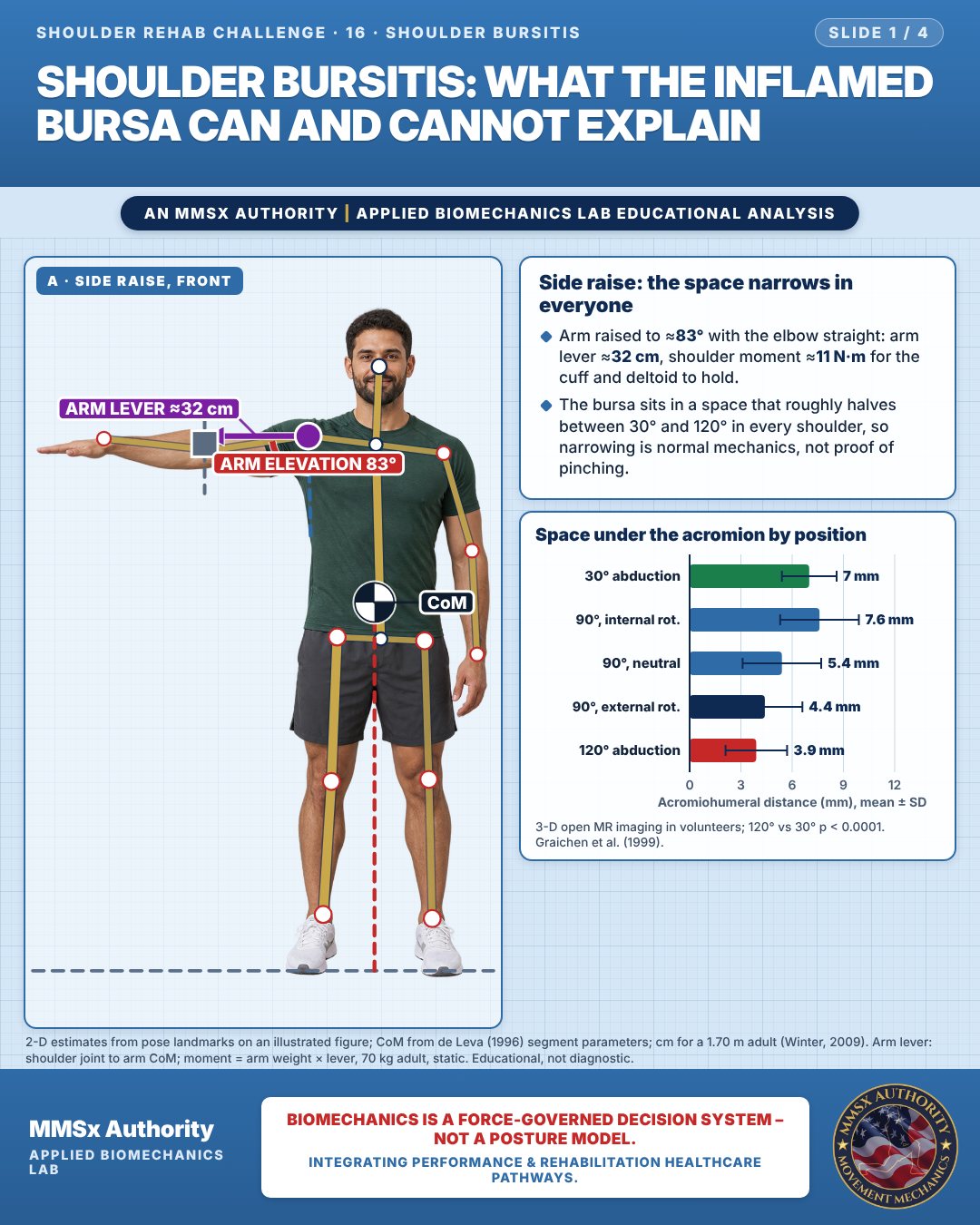
Side raise: the space narrows in everyone
Arm raised to ≈83° with the elbow straight: arm lever ≈32 cm, shoulder moment ≈11 N·m for the cuff and deltoid to hold.
The bursa sits in a space that roughly halves between 30° and 120° in every shoulder, so narrowing is normal mechanics, not proof of pinching.
Space under the acromion by position
Movement B: Kettle at arm’s length (side view)
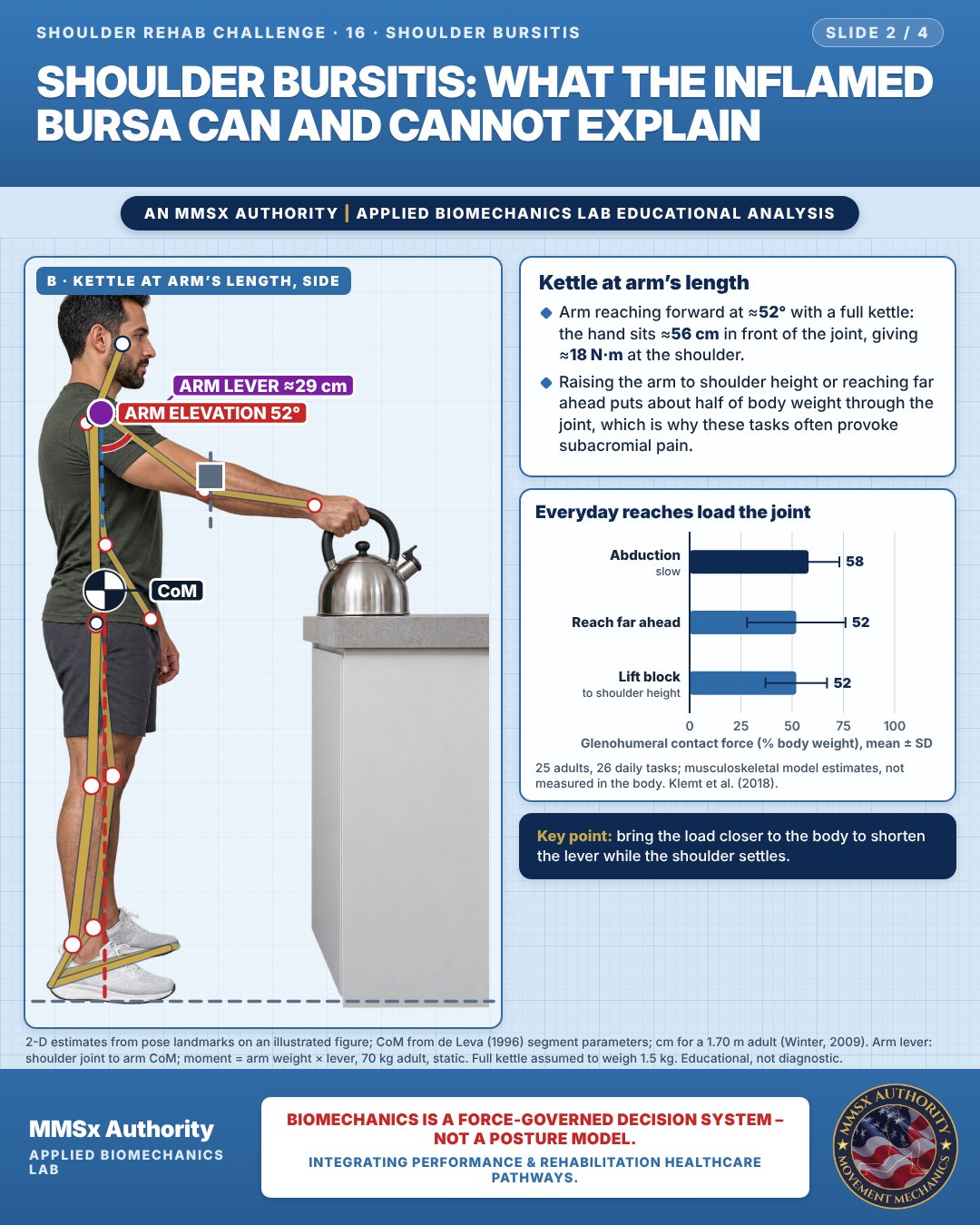
Kettle at arm’s length
Arm reaching forward at ≈52° with a full kettle: the hand sits ≈56 cm in front of the joint, giving ≈18 N·m at the shoulder.
Raising the arm to shoulder height or reaching far ahead puts about half of body weight through the joint, which is why these tasks often provoke subacromial pain.
Everyday reaches load the joint
Movement C: Seat-belt reach (front view)
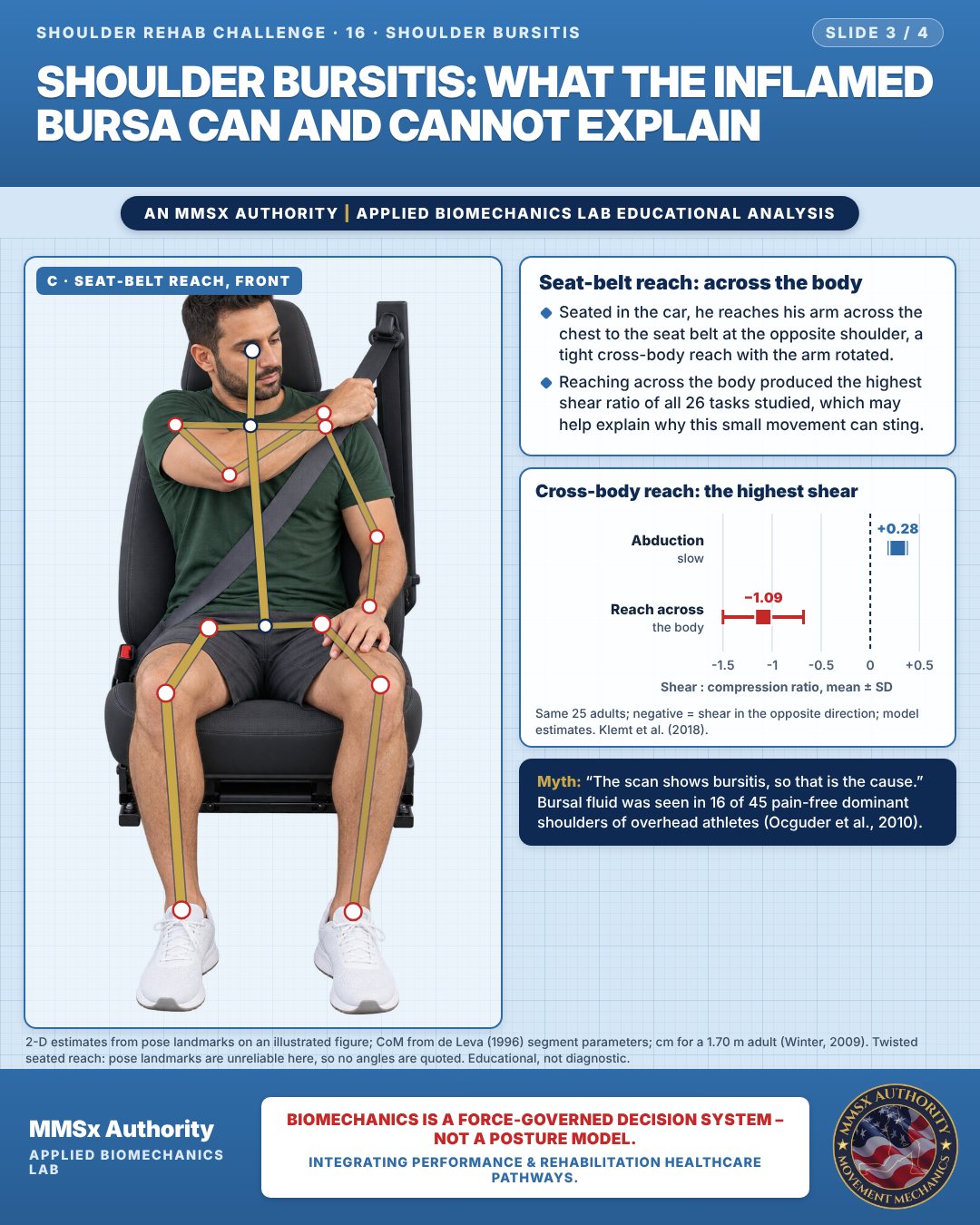
Seat-belt reach: across the body
Seated in the car, he reaches his arm across the chest to the seat belt at the opposite shoulder, a tight cross-body reach with the arm rotated.
Reaching across the body produced the highest shear ratio of all 26 tasks studied, which may help explain why this small movement can sting.
Cross-body reach: the highest shear
Decision pathway
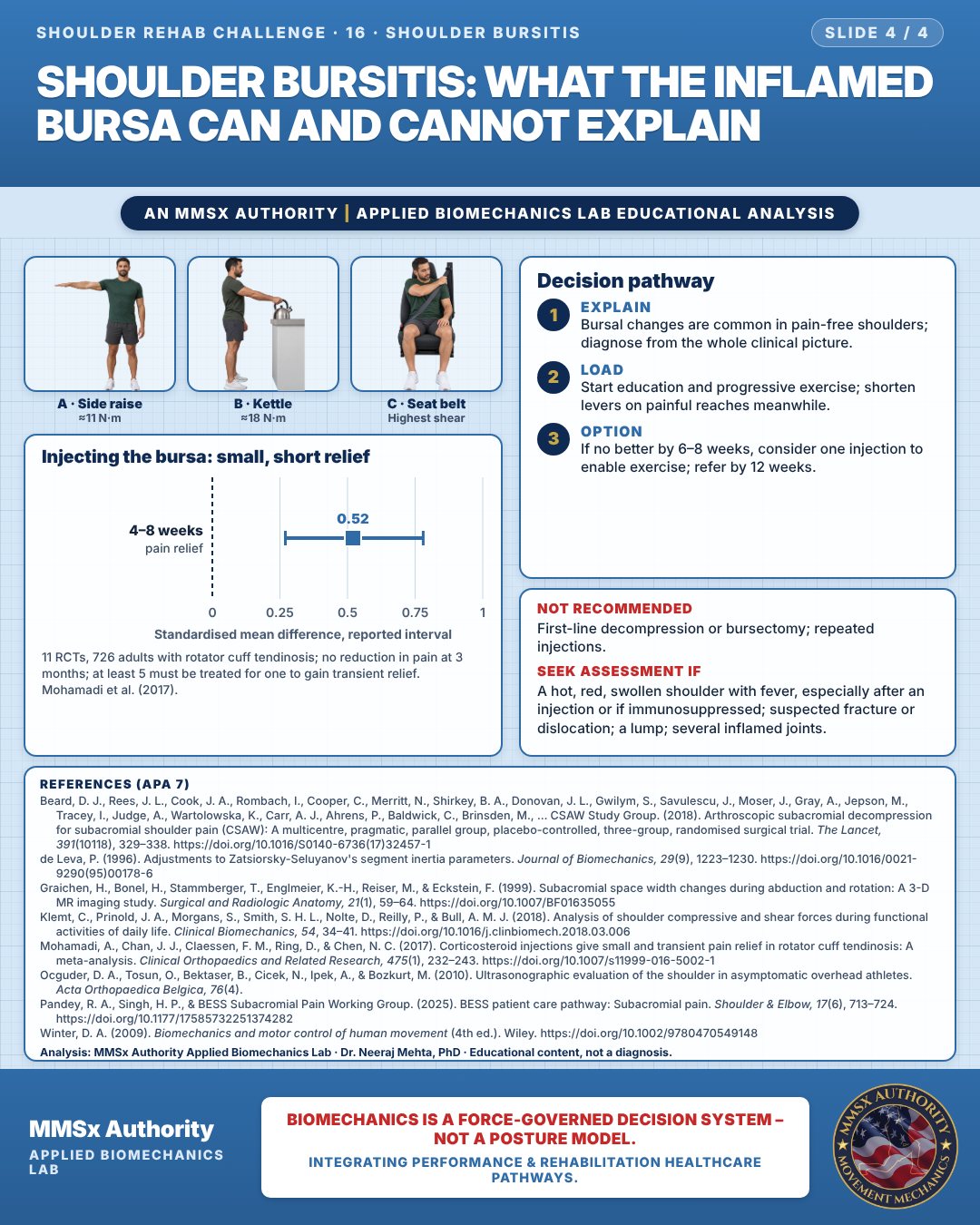
Injecting the bursa: small, short relief
Explain
Bursal changes are common in pain-free shoulders; diagnose from the whole clinical picture.
Load
Start education and progressive exercise; shorten levers on painful reaches meanwhile.
Option
If no better by 6–8 weeks, consider one injection to enable exercise; refer by 12 weeks.
Myth and evidence
Myth“The scan shows bursitis, so that is the cause of my pain.”
EvidenceBursal fluid was present in about a third of pain-free dominant shoulders in overhead athletes (Ocguder et al., 2010), and the subacromial space narrows in every shoulder during elevation (Graichen et al., 1999). Injections aimed at the bursa give only short-term relief (Mohamadi et al., 2017).
Cautions
Not recommended
First-line decompression or bursectomy; repeated injections.
Seek assessment if
A hot, red, swollen shoulder with fever, especially after an injection or if immunosuppressed; suspected fracture or dislocation; a lump; several inflamed joints.
Methods note
2-D estimates from pose landmarks on an illustrated figure; CoM from de Leva (1996) segment parameters; cm for a 1.70 m adult (Winter, 2009). Arm lever: shoulder joint to arm CoM; moment = arm weight × lever, 70 kg adult, static. Full kettle assumed to weigh 1.5 kg. Twisted seated reach: pose landmarks are unreliable here, so no angles are quoted. These are educational estimates, not a diagnosis.
References
- Beard, D. J., Rees, J. L., Cook, J. A., Rombach, I., Cooper, C., Merritt, N., Shirkey, B. A., Donovan, J. L., Gwilym, S., Savulescu, J., Moser, J., Gray, A., Jepson, M., Tracey, I., Judge, A., Wartolowska, K., Carr, A. J., Ahrens, P., Baldwick, C., Brinsden, M., … CSAW Study Group. (2018). Arthroscopic subacromial decompression for subacromial shoulder pain (CSAW): A multicentre, pragmatic, parallel group, placebo-controlled, three-group, randomised surgical trial. The Lancet, 391(10118), 329–338. https://doi.org/10.1016/S0140-6736(17)32457-1
- de Leva, P. (1996). Adjustments to Zatsiorsky-Seluyanov's segment inertia parameters. Journal of Biomechanics, 29(9), 1223–1230. https://doi.org/10.1016/0021-9290(95)00178-6
- Graichen, H., Bonel, H., Stammberger, T., Englmeier, K.-H., Reiser, M., & Eckstein, F. (1999). Subacromial space width changes during abduction and rotation: A 3-D MR imaging study. Surgical and Radiologic Anatomy, 21(1), 59–64. https://doi.org/10.1007/BF01635055
- Klemt, C., Prinold, J. A., Morgans, S., Smith, S. H. L., Nolte, D., Reilly, P., & Bull, A. M. J. (2018). Analysis of shoulder compressive and shear forces during functional activities of daily life. Clinical Biomechanics, 54, 34–41. https://doi.org/10.1016/j.clinbiomech.2018.03.006
- Mohamadi, A., Chan, J. J., Claessen, F. M., Ring, D., & Chen, N. C. (2017). Corticosteroid injections give small and transient pain relief in rotator cuff tendinosis: A meta-analysis. Clinical Orthopaedics and Related Research, 475(1), 232–243. https://doi.org/10.1007/s11999-016-5002-1
- Ocguder, D. A., Tosun, O., Bektaser, B., Cicek, N., Ipek, A., & Bozkurt, M. (2010). Ultrasonographic evaluation of the shoulder in asymptomatic overhead athletes. Acta Orthopaedica Belgica, 76(4).
- Pandey, R. A., Singh, H. P., & BESS Subacromial Pain Working Group. (2025). BESS patient care pathway: Subacromial pain. Shoulder & Elbow, 17(6), 713–724. https://doi.org/10.1177/17585732251374282
- Winter, D. A. (2009). Biomechanics and motor control of human movement (4th ed.). Wiley. https://doi.org/10.1002/9780470549148
Cite this article
Mehta, N. (2026, October 24). Shoulder bursitis: what the inflamed bursa can and cannot explain. MMSx Authority Applied Biomechanics Lab. https://mmsxauthority.org/edu/analysis/shoulder/16-shoulder-bursitis-what-the-inflamed-bursa-can-and-cannot-explain/
Part of the collection
Mehta, N. (2026). Shoulder Rehabilitation: 50 Evidence-Based Biomechanics Analyses [Collection]. MMSx Authority Applied Biomechanics Lab. Zenodo. https://doi.org/10.5281/zenodo.23735725
All Shoulder Rehab Challenge articles · Rehabilitation Library