Shoulder Rehab Challenge · 15
Thoracic spine stiffness: can the upper back change shoulder loading?
Thoracic spine stiffness means reduced extension or rotation mobility of the upper back. Movement analysis, verified research data and a decision pathway.
Key points
- Assess. Check upper-back extension and rotation as part of overhead range, not as the cause of pain.
- Add. Use thoracic mobility work or manual therapy as a short-term adjunct for comfort and range.
- Load. Keep progressive shoulder exercise as the core; refer if no improvement by 12 weeks.
What it is
Thoracic spine stiffness means reduced extension or rotation mobility of the upper back. Full bilateral arm elevation normally includes some thoracic extension. A stiff or habitually flexed thoracic spine can therefore reduce the range available to the shoulder. Whether it causes shoulder pain is not established (Barrett et al., 2016).
How we analysed the movement
Three movements relevant to this topic were analysed from illustrated reference figures. Joint centres were located with two-dimensional pose estimation; arm elevation and elbow angles, shoulder level, the whole-body centre of mass and, where relevant, the arm lever (the horizontal distance from the shoulder joint to the centre of mass of the arm, with any hand load) and the resulting shoulder moment were then calculated from standard segment parameters. The figures are educational estimates that show how position changes mechanical demand; they are not measurements of a patient. Every research value quoted below comes from the published source cited beside it.
Movement A: Seated rotation (front view)
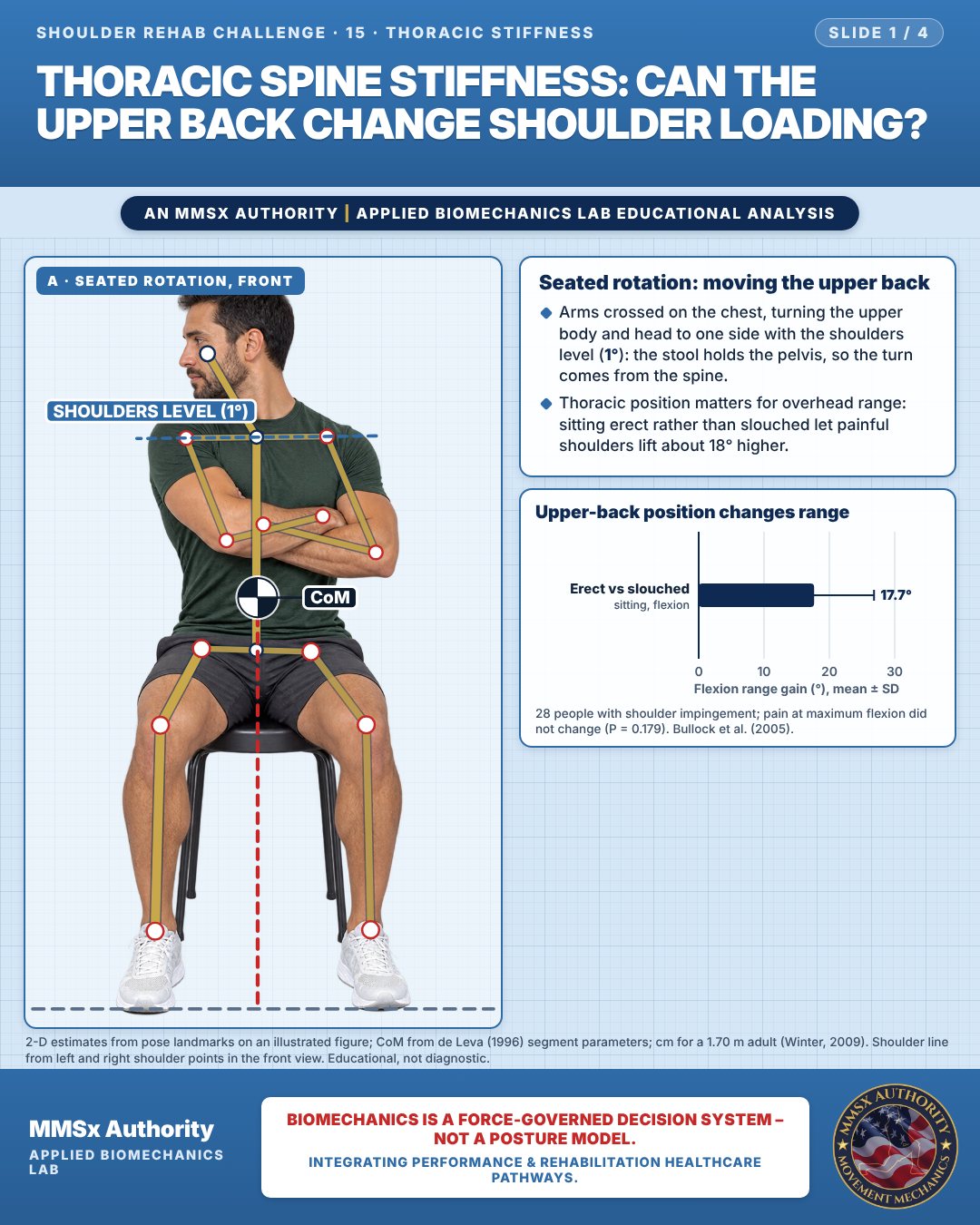
Seated rotation: moving the upper back
Arms crossed on the chest, turning the upper body and head to one side with the shoulders level (1°): the stool holds the pelvis, so the turn comes from the spine.
Thoracic position matters for overhead range: sitting erect rather than slouched let painful shoulders lift about 18° higher.
Upper-back position changes range
Movement B: Foam-roller extension (side view)
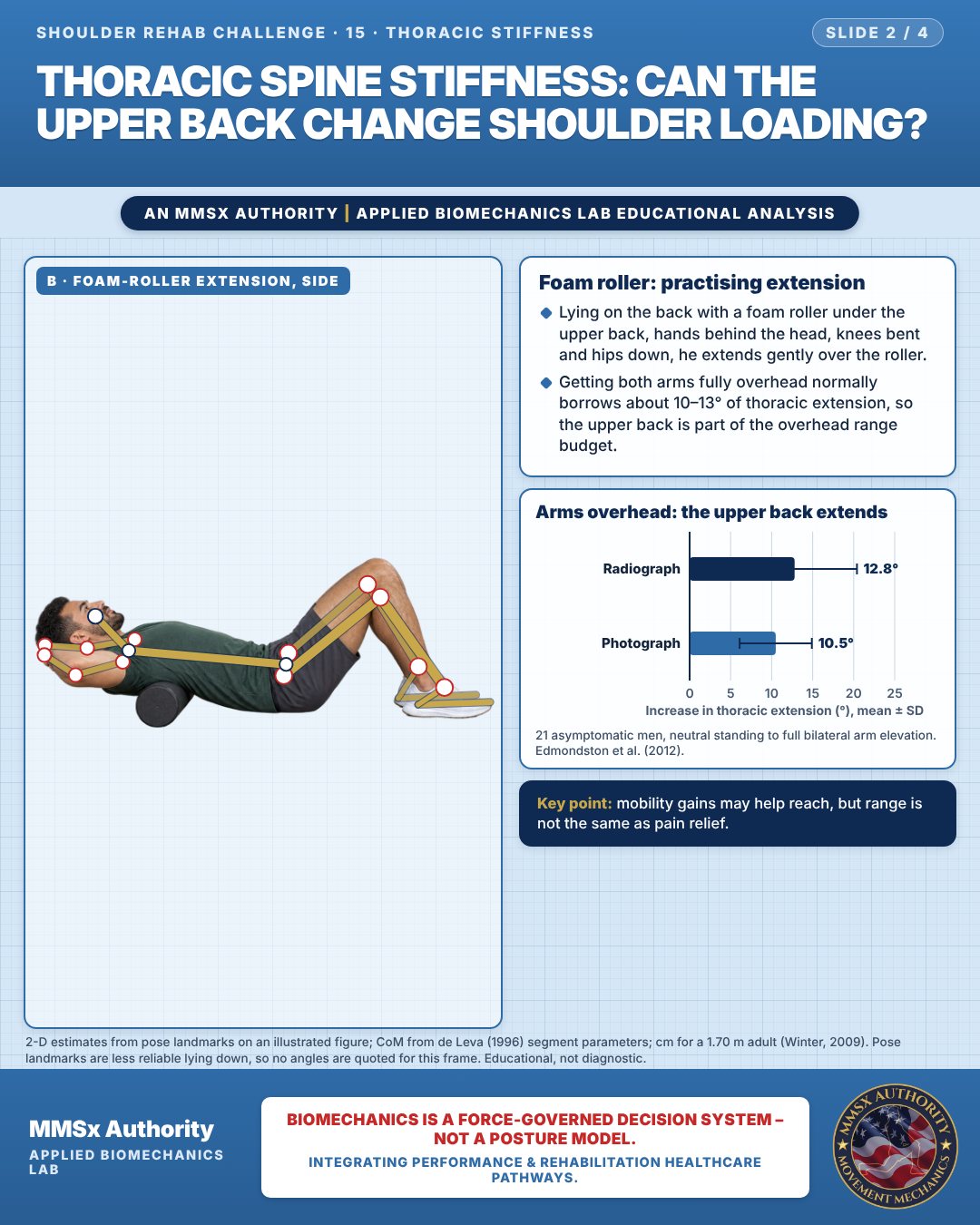
Foam roller: practising extension
Lying on the back with a foam roller under the upper back, hands behind the head, knees bent and hips down, he extends gently over the roller.
Getting both arms fully overhead normally borrows about 10–13° of thoracic extension, so the upper back is part of the overhead range budget.
Arms overhead: the upper back extends
Movement C: Seated arms overhead (side view)
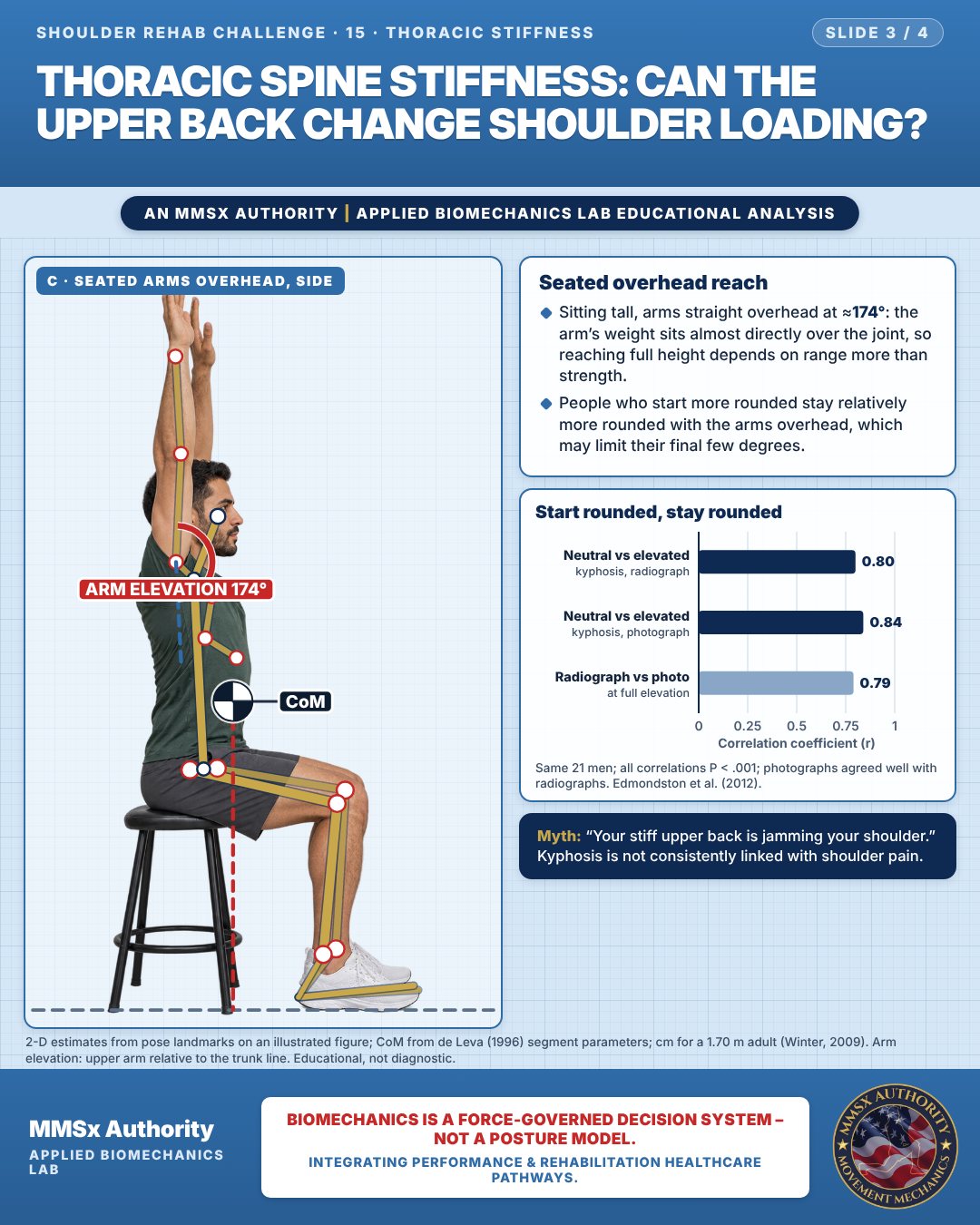
Seated overhead reach
Sitting tall, arms straight overhead at ≈174°: the arm’s weight sits almost directly over the joint, so reaching full height depends on range more than strength.
People who start more rounded stay relatively more rounded with the arms overhead, which may limit their final few degrees.
Start rounded, stay rounded
Decision pathway
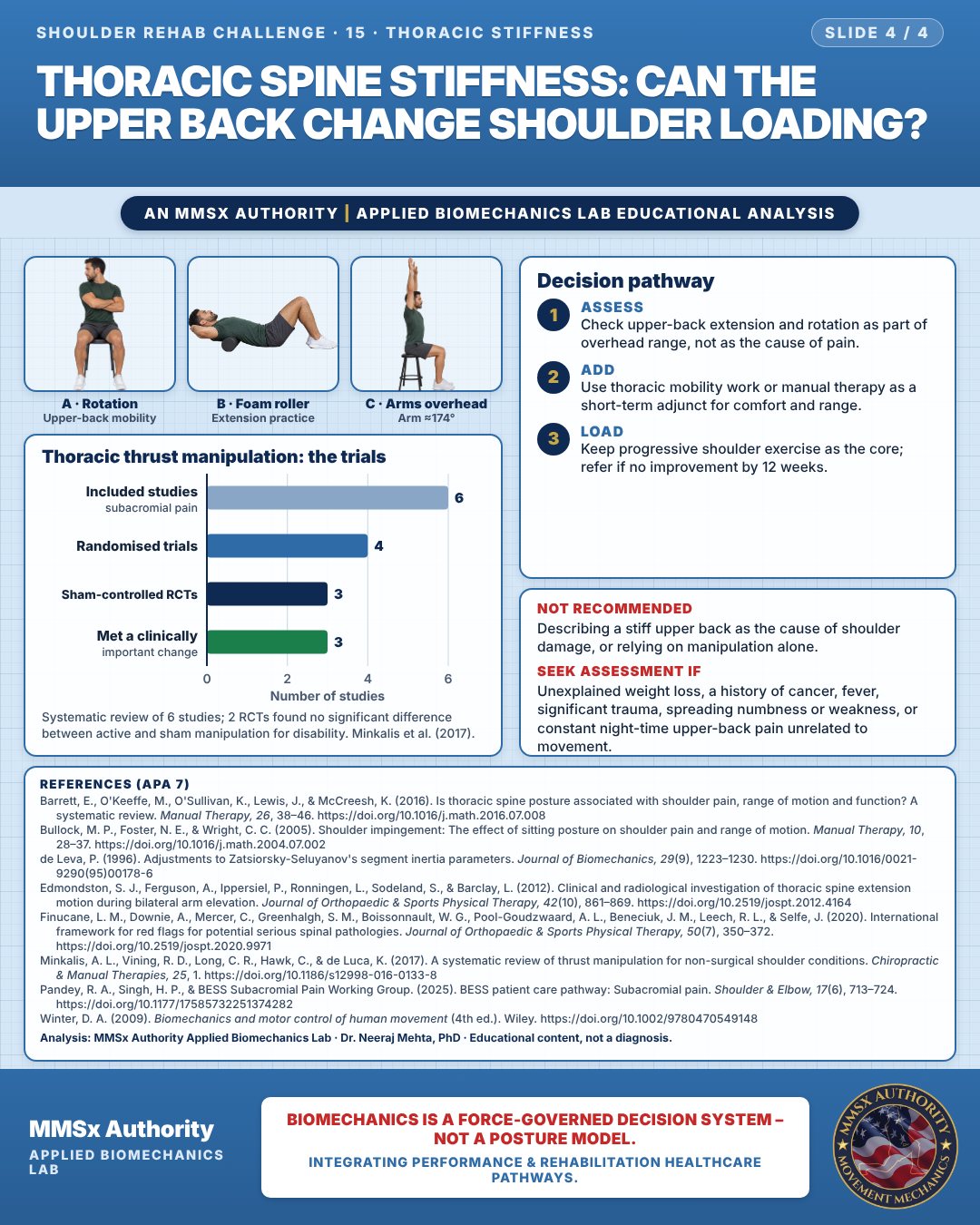
Thoracic thrust manipulation: the trials
Assess
Check upper-back extension and rotation as part of overhead range, not as the cause of pain.
Add
Use thoracic mobility work or manual therapy as a short-term adjunct for comfort and range.
Load
Keep progressive shoulder exercise as the core; refer if no improvement by 12 weeks.
What the evidence supports
- Thoracic mobility exercise or manual therapy can be added for short-term comfort and range. Sham-controlled evidence for a specific benefit is limited (Minkalis et al., 2017), and range gains are single-session findings of unclear long-term relevance (Barrett et al., 2016).
Myth and evidence
Myth“Your stiff upper back is jamming your shoulder, so it must be cracked or mobilised first.”
EvidenceThoracic extension contributes about 10–13° to full bilateral elevation (Edmondston et al., 2012), and posture changes range (Bullock et al., 2005). However, kyphosis is not consistently linked with shoulder pain (Barrett et al., 2016), and manipulation was not superior to sham for disability in the RCTs reviewed (Minkalis et al., 2017).
Cautions
Not recommended
Describing a stiff upper back as the cause of shoulder damage, or relying on manipulation alone.
Seek assessment if
Unexplained weight loss, a history of cancer, fever, significant trauma, spreading numbness or weakness, or constant night-time upper-back pain unrelated to movement.
Methods note
2-D estimates from pose landmarks on an illustrated figure; CoM from de Leva (1996) segment parameters; cm for a 1.70 m adult (Winter, 2009). Shoulder line from left and right shoulder points in the front view. Pose landmarks are less reliable lying down, so no angles are quoted for this frame. Arm elevation: upper arm relative to the trunk line. These are educational estimates, not a diagnosis.
References
- Barrett, E., O'Keeffe, M., O'Sullivan, K., Lewis, J., & McCreesh, K. (2016). Is thoracic spine posture associated with shoulder pain, range of motion and function? A systematic review. Manual Therapy, 26, 38–46. https://doi.org/10.1016/j.math.2016.07.008
- Bullock, M. P., Foster, N. E., & Wright, C. C. (2005). Shoulder impingement: The effect of sitting posture on shoulder pain and range of motion. Manual Therapy, 10, 28–37. https://doi.org/10.1016/j.math.2004.07.002
- de Leva, P. (1996). Adjustments to Zatsiorsky-Seluyanov's segment inertia parameters. Journal of Biomechanics, 29(9), 1223–1230. https://doi.org/10.1016/0021-9290(95)00178-6
- Edmondston, S. J., Ferguson, A., Ippersiel, P., Ronningen, L., Sodeland, S., & Barclay, L. (2012). Clinical and radiological investigation of thoracic spine extension motion during bilateral arm elevation. Journal of Orthopaedic & Sports Physical Therapy, 42(10), 861–869. https://doi.org/10.2519/jospt.2012.4164
- Finucane, L. M., Downie, A., Mercer, C., Greenhalgh, S. M., Boissonnault, W. G., Pool-Goudzwaard, A. L., Beneciuk, J. M., Leech, R. L., & Selfe, J. (2020). International framework for red flags for potential serious spinal pathologies. Journal of Orthopaedic & Sports Physical Therapy, 50(7), 350–372. https://doi.org/10.2519/jospt.2020.9971
- Minkalis, A. L., Vining, R. D., Long, C. R., Hawk, C., & de Luca, K. (2017). A systematic review of thrust manipulation for non-surgical shoulder conditions. Chiropractic & Manual Therapies, 25, 1. https://doi.org/10.1186/s12998-016-0133-8
- Pandey, R. A., Singh, H. P., & BESS Subacromial Pain Working Group. (2025). BESS patient care pathway: Subacromial pain. Shoulder & Elbow, 17(6), 713–724. https://doi.org/10.1177/17585732251374282
- Winter, D. A. (2009). Biomechanics and motor control of human movement (4th ed.). Wiley. https://doi.org/10.1002/9780470549148
Cite this article
Mehta, N. (2026, October 24). Thoracic spine stiffness: can the upper back change shoulder loading? MMSx Authority Applied Biomechanics Lab. https://mmsxauthority.org/edu/analysis/shoulder/15-thoracic-spine-stiffness-can-the-upper-back-change-shoulder-loading/
Part of the collection
Mehta, N. (2026). Shoulder Rehabilitation: 50 Evidence-Based Biomechanics Analyses [Collection]. MMSx Authority Applied Biomechanics Lab. Zenodo. https://doi.org/10.5281/zenodo.23735725
All Shoulder Rehab Challenge articles · Rehabilitation Library