Shoulder Rehab Challenge · 14
Rounded shoulders and posture: does correcting it reduce pain?
"Rounded shoulders" describes a standing or sitting posture with increased thoracic kyphosis, forward head position and protracted, anteriorly tilted…
Key points
- Reassure. Explain that posture varies widely in people without pain and is not damaging the shoulder.
- Use. Try sitting or standing taller, or taping, as a short-term way to make lifting the arm easier.
- Load. Keep progressive exercise as the core; refer if there is no improvement by 12 weeks.
What it is
"Rounded shoulders" describes a standing or sitting posture with increased thoracic kyphosis, forward head position and protracted, anteriorly tilted shoulder blades. It is a description of posture, not a diagnosis. Posture varies widely between people without pain, and the link between static posture and shoulder pain is weak (Barrett et al., 2016).
How we analysed the movement
Three movements relevant to this topic were analysed from illustrated reference figures. Joint centres were located with two-dimensional pose estimation; arm elevation and elbow angles, shoulder level, the whole-body centre of mass and, where relevant, the arm lever (the horizontal distance from the shoulder joint to the centre of mass of the arm, with any hand load) and the resulting shoulder moment were then calculated from standard segment parameters. The figures are educational estimates that show how position changes mechanical demand; they are not measurements of a patient. Every research value quoted below comes from the published source cited beside it.
Movement A: Rounded standing (side view)
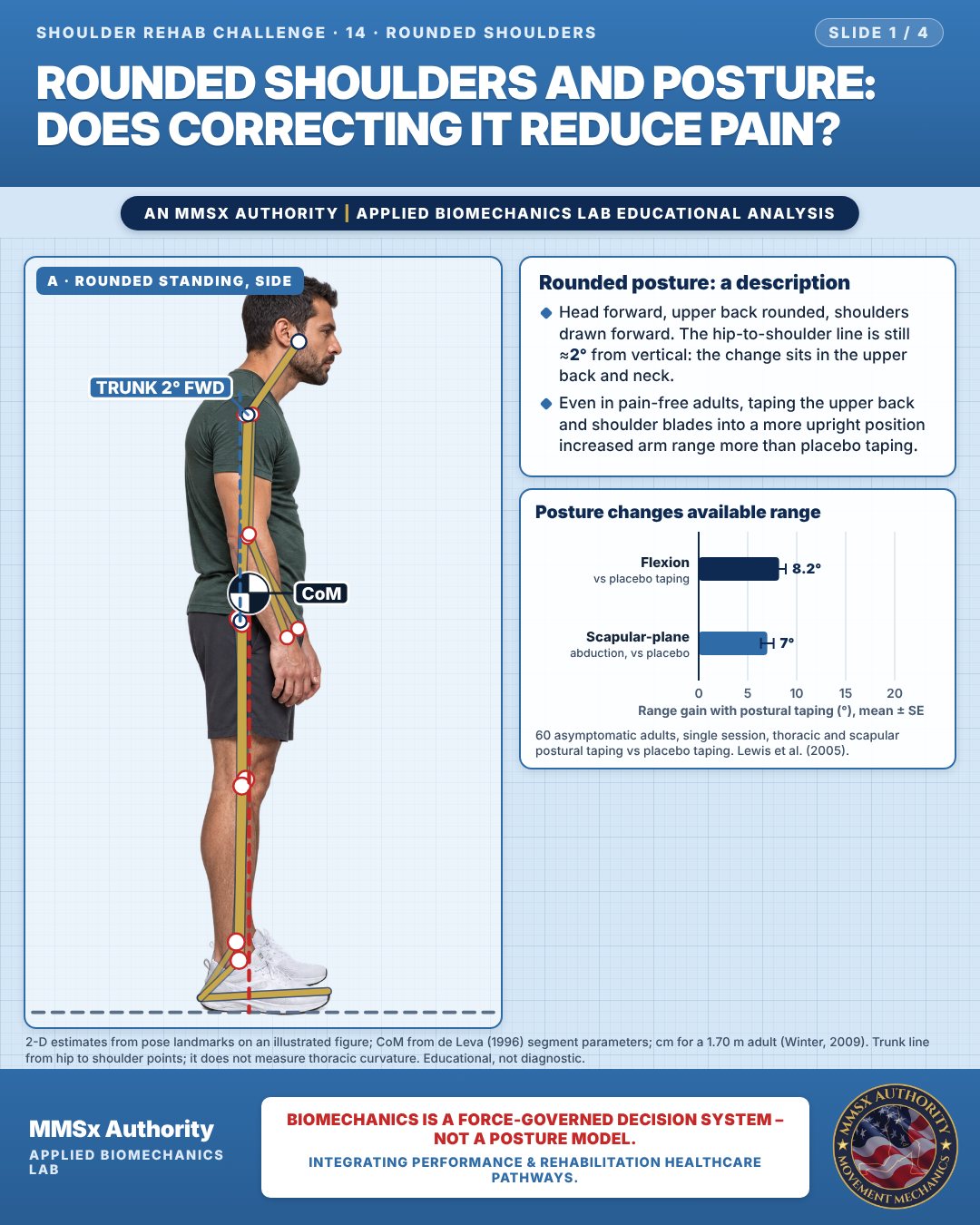
Rounded posture: a description
Head forward, upper back rounded, shoulders drawn forward. The hip-to-shoulder line is still ≈2° from vertical: the change sits in the upper back and neck.
Even in pain-free adults, taping the upper back and shoulder blades into a more upright position increased arm range more than placebo taping.
Posture changes available range
Movement B: Upright standing (side view)
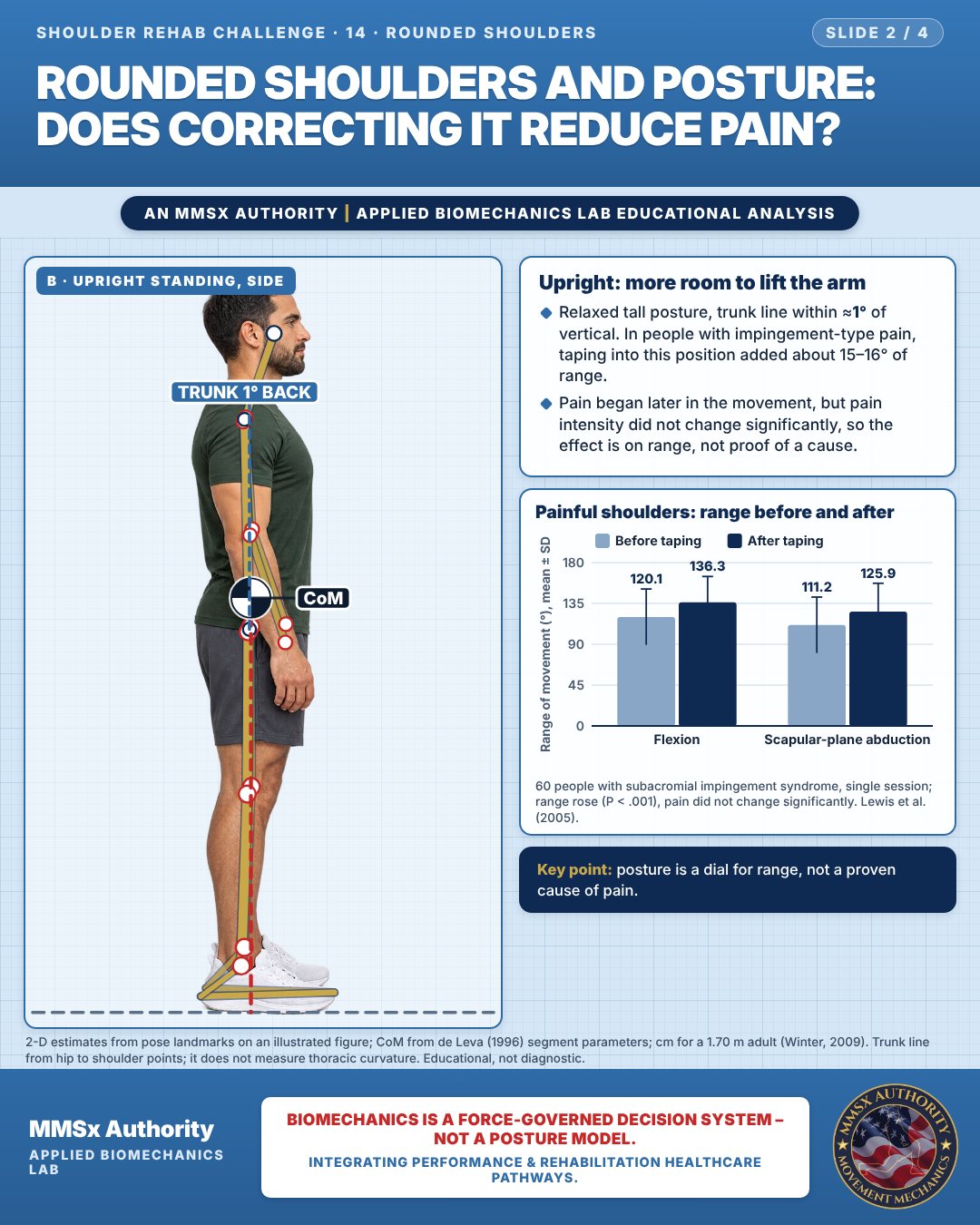
Upright: more room to lift the arm
Relaxed tall posture, trunk line within ≈1° of vertical. In people with impingement-type pain, taping into this position added about 15–16° of range.
Pain began later in the movement, but pain intensity did not change significantly, so the effect is on range, not proof of a cause.
Painful shoulders: range before and after
Movement C: Slumped at a desk (side view)
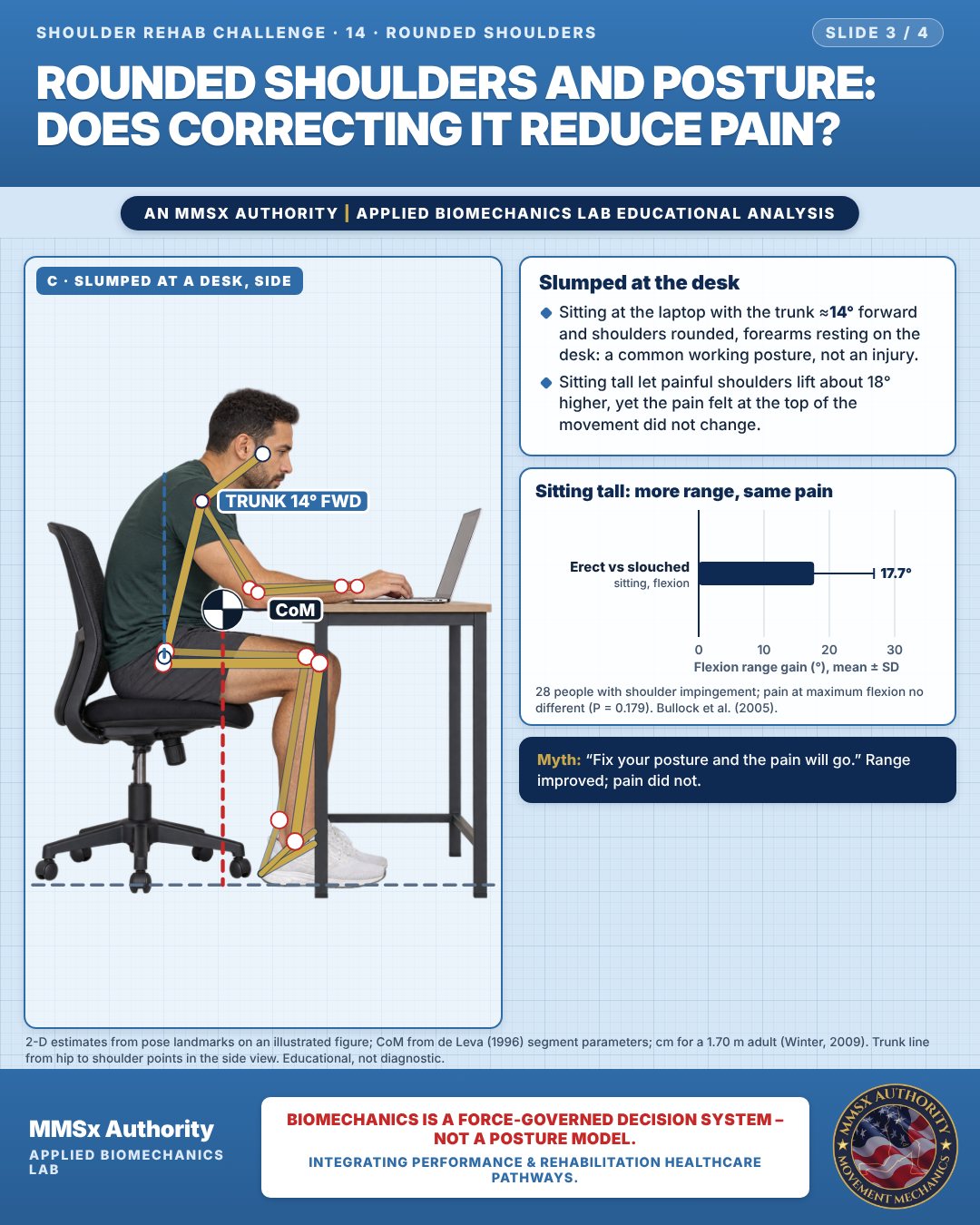
Slumped at the desk
Sitting at the laptop with the trunk ≈14° forward and shoulders rounded, forearms resting on the desk: a common working posture, not an injury.
Sitting tall let painful shoulders lift about 18° higher, yet the pain felt at the top of the movement did not change.
Sitting tall: more range, same pain
Decision pathway
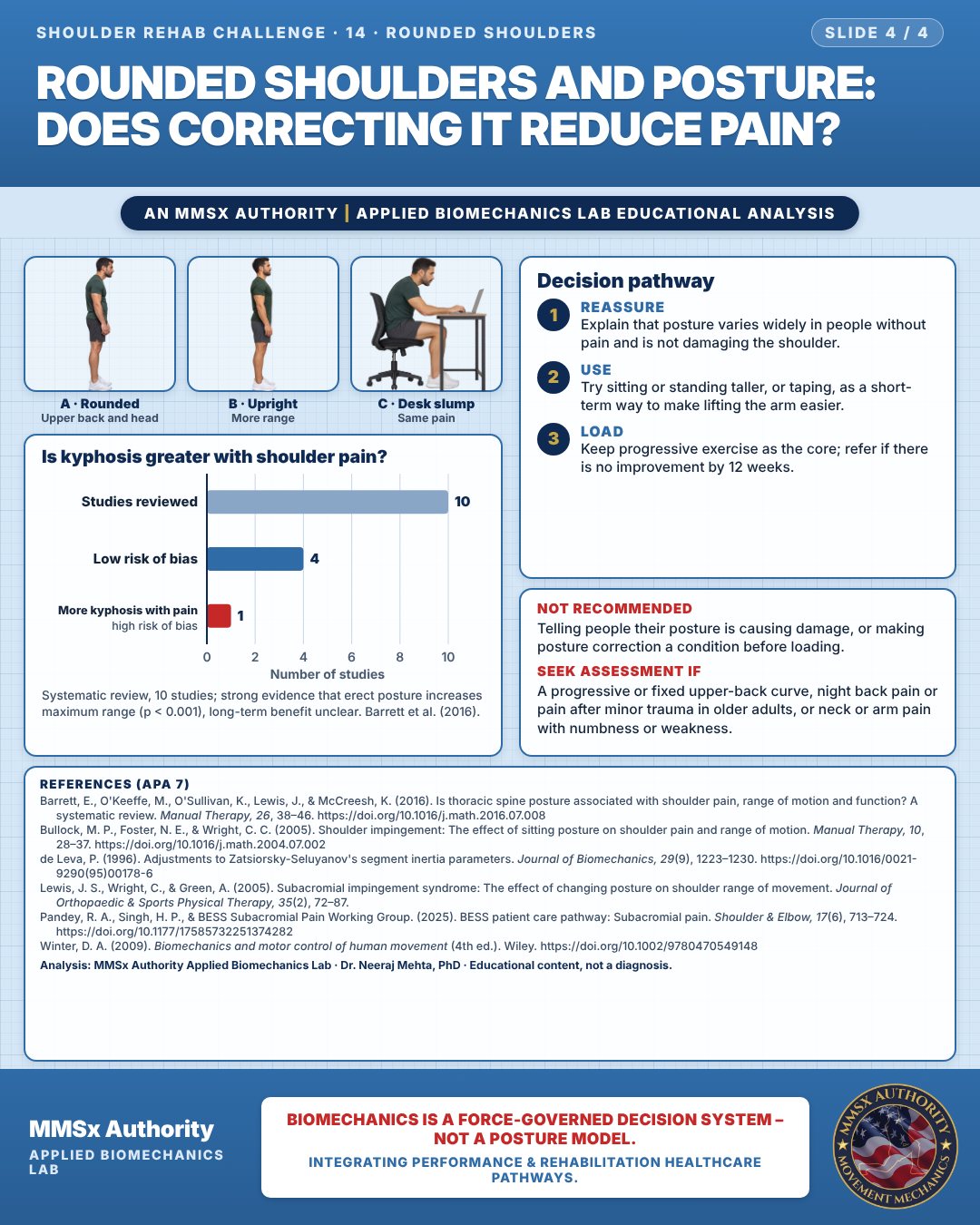
Is kyphosis greater with shoulder pain?
Reassure
Explain that posture varies widely in people without pain and is not damaging the shoulder.
Use
Try sitting or standing taller, or taping, as a short-term way to make lifting the arm easier.
Load
Keep progressive exercise as the core; refer if there is no improvement by 12 weeks.
What the evidence supports
- Postural cueing or taping can be used as a short-term strategy to make arm elevation easier (Lewis et al., 2005; Bullock et al., 2005). However, the evidence for long-term benefit is unclear (Barrett et al., 2016).
Myth and evidence
Myth“Your rounded shoulders are why your shoulder hurts, and fixing your posture will fix the pain.”
EvidenceKyphosis was not shown to be greater in people with shoulder pain (Barrett et al., 2016). Sitting tall gained about 18° of flexion with no change in pain (Bullock et al., 2005), and postural taping increased range without significantly reducing pain intensity (Lewis et al., 2005).
Cautions
Not recommended
Telling people their posture is causing damage, or making posture correction a condition before loading.
Seek assessment if
A progressive or fixed upper-back curve, night back pain or pain after minor trauma in older adults, or neck or arm pain with numbness or weakness.
Methods note
2-D estimates from pose landmarks on an illustrated figure; CoM from de Leva (1996) segment parameters; cm for a 1.70 m adult (Winter, 2009). Trunk line from hip to shoulder points; it does not measure thoracic curvature. Trunk line from hip to shoulder points in the side view. These are educational estimates, not a diagnosis.
References
- Barrett, E., O'Keeffe, M., O'Sullivan, K., Lewis, J., & McCreesh, K. (2016). Is thoracic spine posture associated with shoulder pain, range of motion and function? A systematic review. Manual Therapy, 26, 38–46. https://doi.org/10.1016/j.math.2016.07.008
- Bullock, M. P., Foster, N. E., & Wright, C. C. (2005). Shoulder impingement: The effect of sitting posture on shoulder pain and range of motion. Manual Therapy, 10, 28–37. https://doi.org/10.1016/j.math.2004.07.002
- de Leva, P. (1996). Adjustments to Zatsiorsky-Seluyanov's segment inertia parameters. Journal of Biomechanics, 29(9), 1223–1230. https://doi.org/10.1016/0021-9290(95)00178-6
- Lewis, J. S., Wright, C., & Green, A. (2005). Subacromial impingement syndrome: The effect of changing posture on shoulder range of movement. Journal of Orthopaedic & Sports Physical Therapy, 35(2), 72–87.
- Pandey, R. A., Singh, H. P., & BESS Subacromial Pain Working Group. (2025). BESS patient care pathway: Subacromial pain. Shoulder & Elbow, 17(6), 713–724. https://doi.org/10.1177/17585732251374282
- Winter, D. A. (2009). Biomechanics and motor control of human movement (4th ed.). Wiley. https://doi.org/10.1002/9780470549148
Cite this article
Mehta, N. (2026, October 24). Rounded shoulders and posture: does correcting it reduce pain? MMSx Authority Applied Biomechanics Lab. https://mmsxauthority.org/edu/analysis/shoulder/14-rounded-shoulders-and-posture-does-correcting-it-reduce-pain/
Part of the collection
Mehta, N. (2026). Shoulder Rehabilitation: 50 Evidence-Based Biomechanics Analyses [Collection]. MMSx Authority Applied Biomechanics Lab. Zenodo. https://doi.org/10.5281/zenodo.23735725
All Shoulder Rehab Challenge articles · Rehabilitation Library