Shoulder Rehab Challenge · 13
Winging shoulder blade: muscle weakness or nerve problem?
Scapular winging is prominence of the medial border of the shoulder blade away from the chest wall, at rest or during pushing or arm elevation.
Key points
- History. Ask about pain onset, injury, surgery, heavy carrying and numbness; these separate nerve from muscle.
- Train. For motor-control winging, progress from wall push-up plus to floor push-up plus and overhead work.
- Refer. Suspected nerve palsy needs medical assessment; expect months of recovery and monitor progress.
What it is
Scapular winging is prominence of the medial border of the shoulder blade away from the chest wall, at rest or during pushing or arm elevation. Mild, symmetrical prominence that settles with cueing or strengthening usually reflects poor motor control or muscle deconditioning. Marked winging with weakness is often neurogenic. The classic cause is serratus anterior palsy from long thoracic nerve injury, including neuralgic amyotrophy. Rarer causes are trapezius palsy (spinal accessory nerve) or rhomboid palsy (dorsal scapular nerve).
How we analysed the movement
Three movements relevant to this topic were analysed from illustrated reference figures. Joint centres were located with two-dimensional pose estimation; arm elevation and elbow angles, shoulder level, the whole-body centre of mass and, where relevant, the arm lever (the horizontal distance from the shoulder joint to the centre of mass of the arm, with any hand load) and the resulting shoulder moment were then calculated from standard segment parameters. The figures are educational estimates that show how position changes mechanical demand; they are not measurements of a patient. Every research value quoted below comes from the published source cited beside it.
Movement A: Wall push-up (rear view)
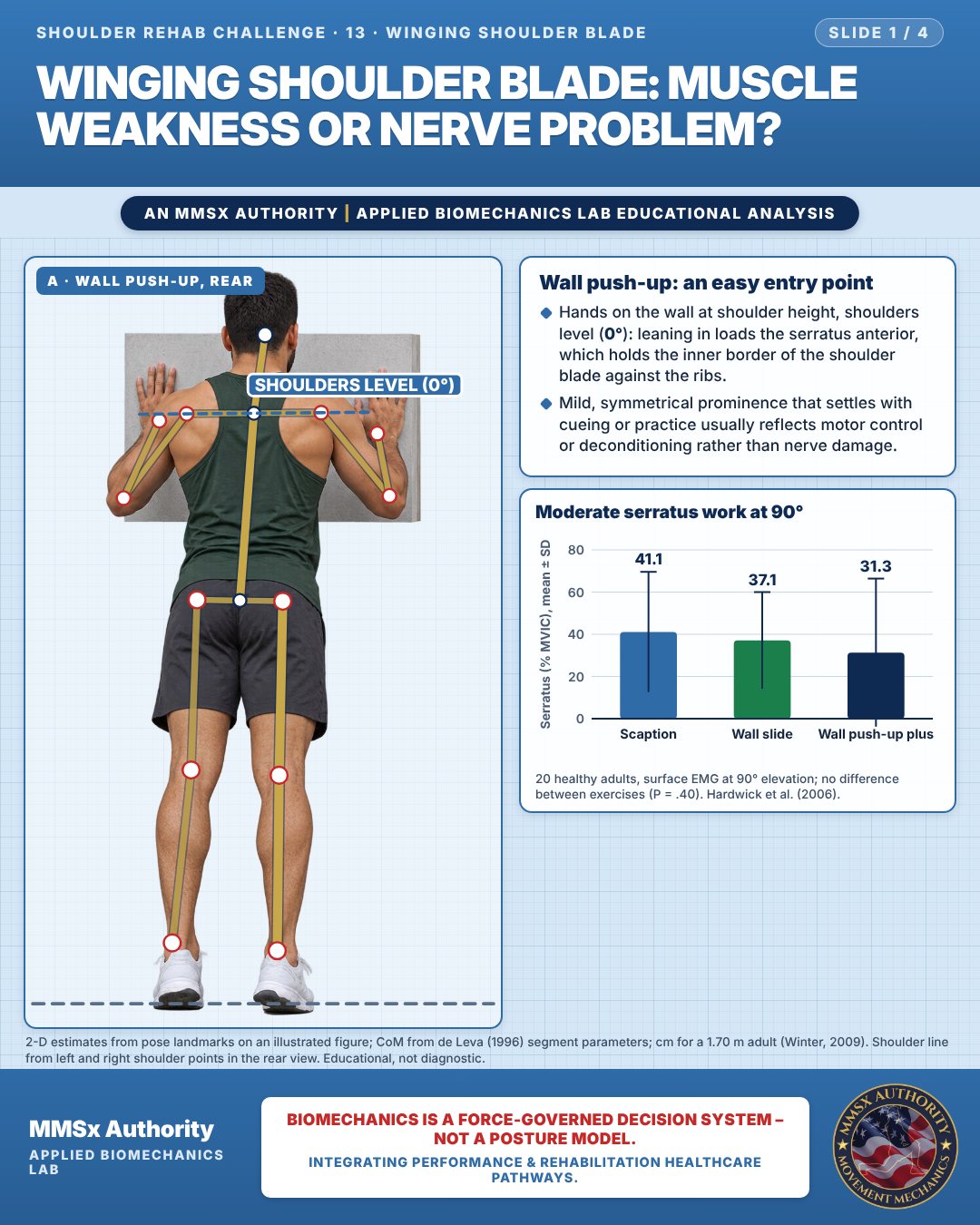
Wall push-up: an easy entry point
Hands on the wall at shoulder height, shoulders level (0°): leaning in loads the serratus anterior, which holds the inner border of the shoulder blade against the ribs.
Mild, symmetrical prominence that settles with cueing or practice usually reflects motor control or deconditioning rather than nerve damage.
Moderate serratus work at 90°
Movement B: Palms into wall (rear view)
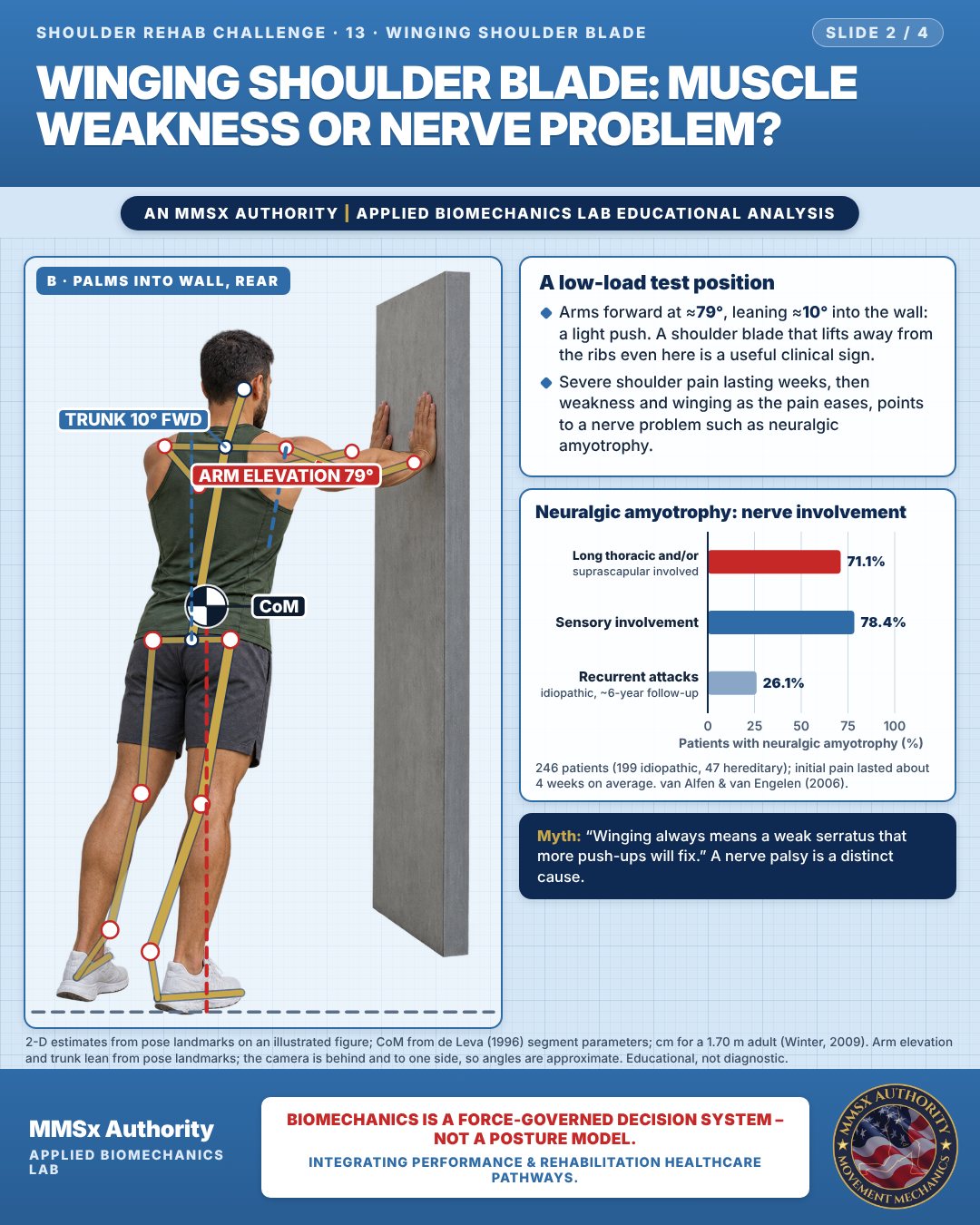
A low-load test position
Arms forward at ≈79°, leaning ≈10° into the wall: a light push. A shoulder blade that lifts away from the ribs even here is a useful clinical sign.
Severe shoulder pain lasting weeks, then weakness and winging as the pain eases, points to a nerve problem such as neuralgic amyotrophy.
Neuralgic amyotrophy: nerve involvement
Movement C: Push-up plus (side view)
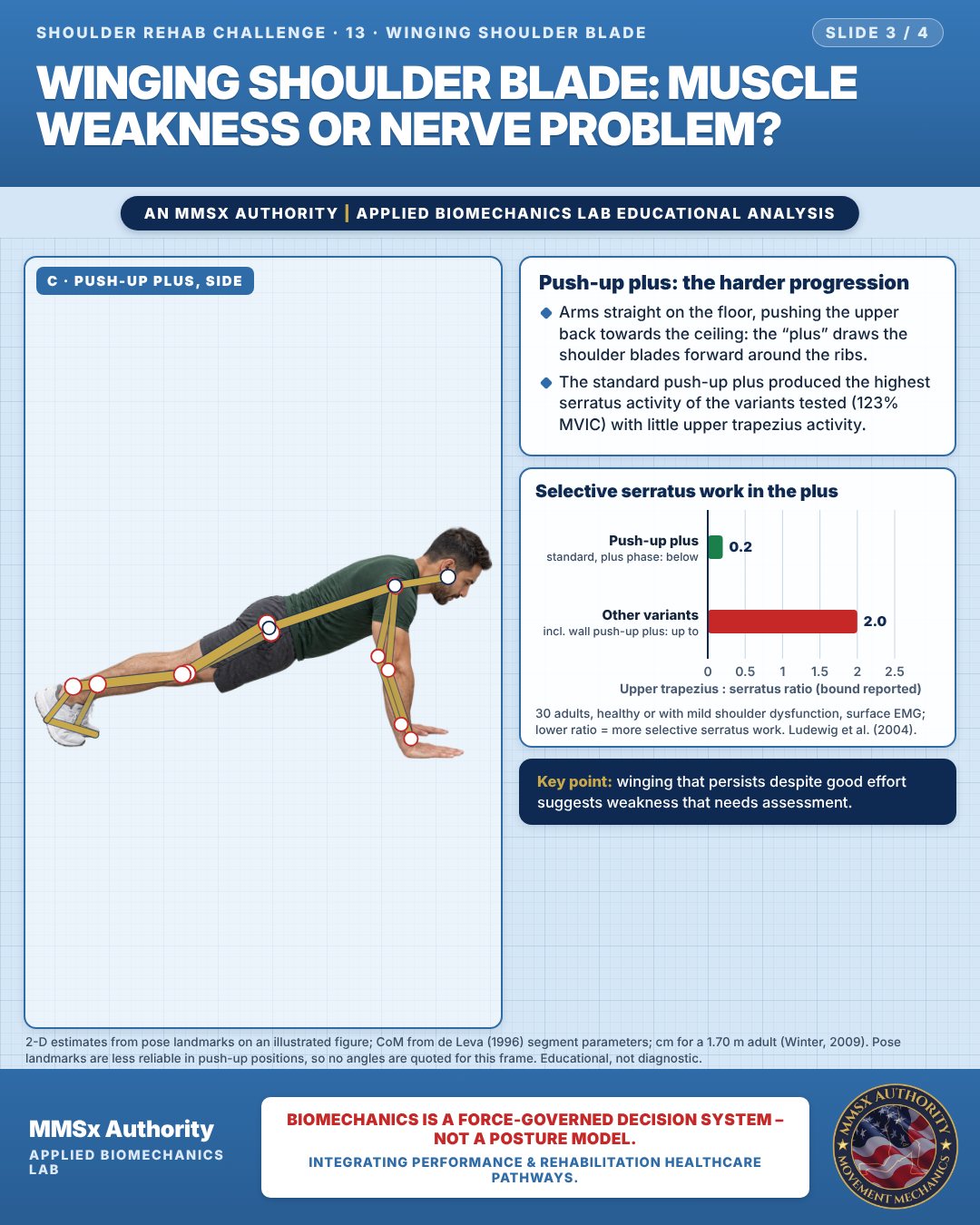
Push-up plus: the harder progression
Arms straight on the floor, pushing the upper back towards the ceiling: the “plus” draws the shoulder blades forward around the ribs.
The standard push-up plus produced the highest serratus activity of the variants tested (123% MVIC) with little upper trapezius activity.
Selective serratus work in the plus
Decision pathway
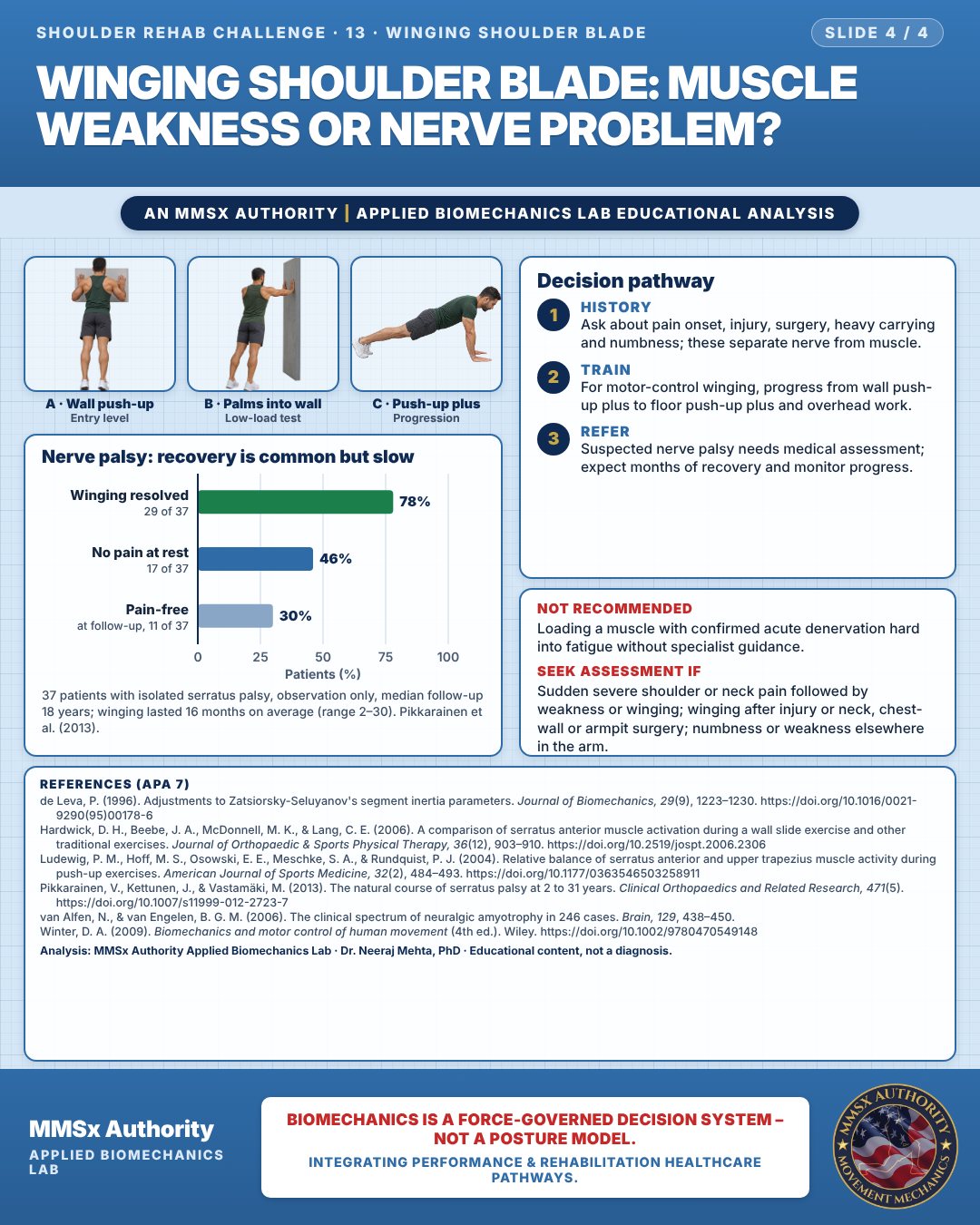
Nerve palsy: recovery is common but slow
History
Ask about pain onset, injury, surgery, heavy carrying and numbness; these separate nerve from muscle.
Train
For motor-control winging, progress from wall push-up plus to floor push-up plus and overhead work.
Refer
Suspected nerve palsy needs medical assessment; expect months of recovery and monitor progress.
Cautions
Not recommended
Loading a muscle with confirmed acute denervation hard into fatigue without specialist guidance.
Seek assessment if
Sudden severe shoulder or neck pain followed by weakness or winging; winging after injury or neck, chest-wall or armpit surgery; numbness or weakness elsewhere in the arm.
Methods note
2-D estimates from pose landmarks on an illustrated figure; CoM from de Leva (1996) segment parameters; cm for a 1.70 m adult (Winter, 2009). Shoulder line from left and right shoulder points in the rear view. Arm elevation and trunk lean from pose landmarks; the camera is behind and to one side, so angles are approximate. Pose landmarks are less reliable in push-up positions, so no angles are quoted for this frame. These are educational estimates, not a diagnosis.
References
- de Leva, P. (1996). Adjustments to Zatsiorsky-Seluyanov's segment inertia parameters. Journal of Biomechanics, 29(9), 1223–1230. https://doi.org/10.1016/0021-9290(95)00178-6
- Hardwick, D. H., Beebe, J. A., McDonnell, M. K., & Lang, C. E. (2006). A comparison of serratus anterior muscle activation during a wall slide exercise and other traditional exercises. Journal of Orthopaedic & Sports Physical Therapy, 36(12), 903–910. https://doi.org/10.2519/jospt.2006.2306
- Ludewig, P. M., Hoff, M. S., Osowski, E. E., Meschke, S. A., & Rundquist, P. J. (2004). Relative balance of serratus anterior and upper trapezius muscle activity during push-up exercises. American Journal of Sports Medicine, 32(2), 484–493. https://doi.org/10.1177/0363546503258911
- Pikkarainen, V., Kettunen, J., & Vastamäki, M. (2013). The natural course of serratus palsy at 2 to 31 years. Clinical Orthopaedics and Related Research, 471(5). https://doi.org/10.1007/s11999-012-2723-7
- van Alfen, N., & van Engelen, B. G. M. (2006). The clinical spectrum of neuralgic amyotrophy in 246 cases. Brain, 129, 438–450.
- Winter, D. A. (2009). Biomechanics and motor control of human movement (4th ed.). Wiley. https://doi.org/10.1002/9780470549148
Cite this article
Mehta, N. (2026, October 24). Winging shoulder blade: muscle weakness or nerve problem? MMSx Authority Applied Biomechanics Lab. https://mmsxauthority.org/edu/analysis/shoulder/13-winging-shoulder-blade-muscle-weakness-or-nerve-problem/
Part of the collection
Mehta, N. (2026). Shoulder Rehabilitation: 50 Evidence-Based Biomechanics Analyses [Collection]. MMSx Authority Applied Biomechanics Lab. Zenodo. https://doi.org/10.5281/zenodo.23735725
All Shoulder Rehab Challenge articles · Rehabilitation Library