Shoulder Rehab Challenge · 12
Shoulder blade movement (scapular dyskinesis): when it matters and when it doesn't
Scapular dyskinesis is an observable alteration in the position or motion of the shoulder blade at rest or during arm movement.
Key points
- Observe. Judge shoulder-blade motion with light weights over repeated raising and lowering, not at rest.
- Interpret. Weigh it within the whole shoulder assessment; on its own it is not a diagnosis.
- Train. Add scapular work inside a progressive cuff and shoulder programme; do not treat a pain-free asymmetry.
What it is
Scapular dyskinesis is an observable alteration in the position or motion of the shoulder blade at rest or during arm movement. Examples are prominence of the medial border or inferior angle, or early, excessive or uneven elevation and rotation. It is best viewed as a potential impairment of shoulder function, not as a diagnosis in itself (Kibler et al., 2013).
How we analysed the movement
Three movements relevant to this topic were analysed from illustrated reference figures. Joint centres were located with two-dimensional pose estimation; arm elevation and elbow angles, shoulder level, the whole-body centre of mass and, where relevant, the arm lever (the horizontal distance from the shoulder joint to the centre of mass of the arm, with any hand load) and the resulting shoulder moment were then calculated from standard segment parameters. The figures are educational estimates that show how position changes mechanical demand; they are not measurements of a patient. Every research value quoted below comes from the published source cited beside it.
Movement A: Standing relaxed (rear view)
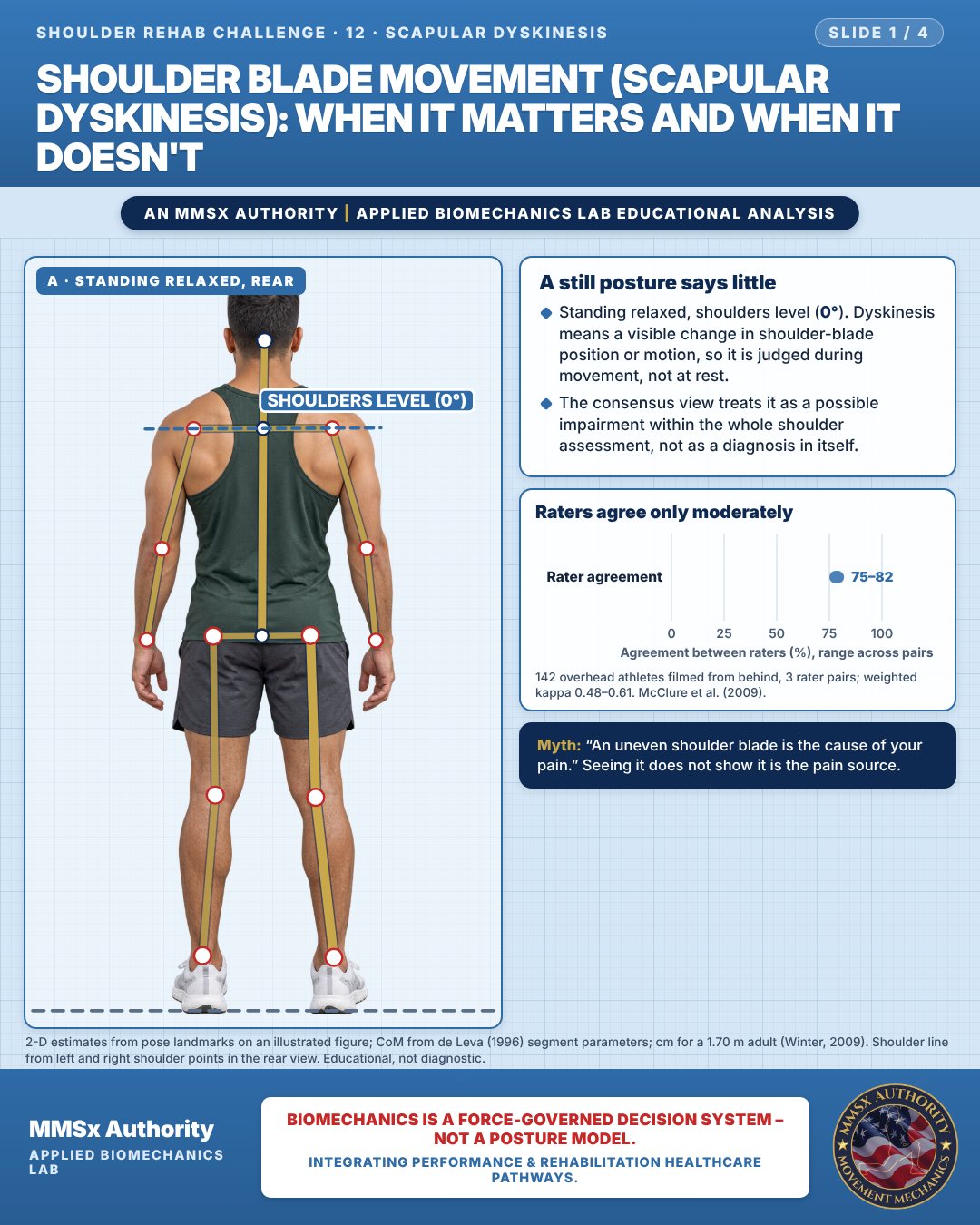
A still posture says little
Standing relaxed, shoulders level (0°). Dyskinesis means a visible change in shoulder-blade position or motion, so it is judged during movement, not at rest.
The consensus view treats it as a possible impairment within the whole shoulder assessment, not as a diagnosis in itself.
Raters agree only moderately
Movement B: Dumbbells out wide (rear view)
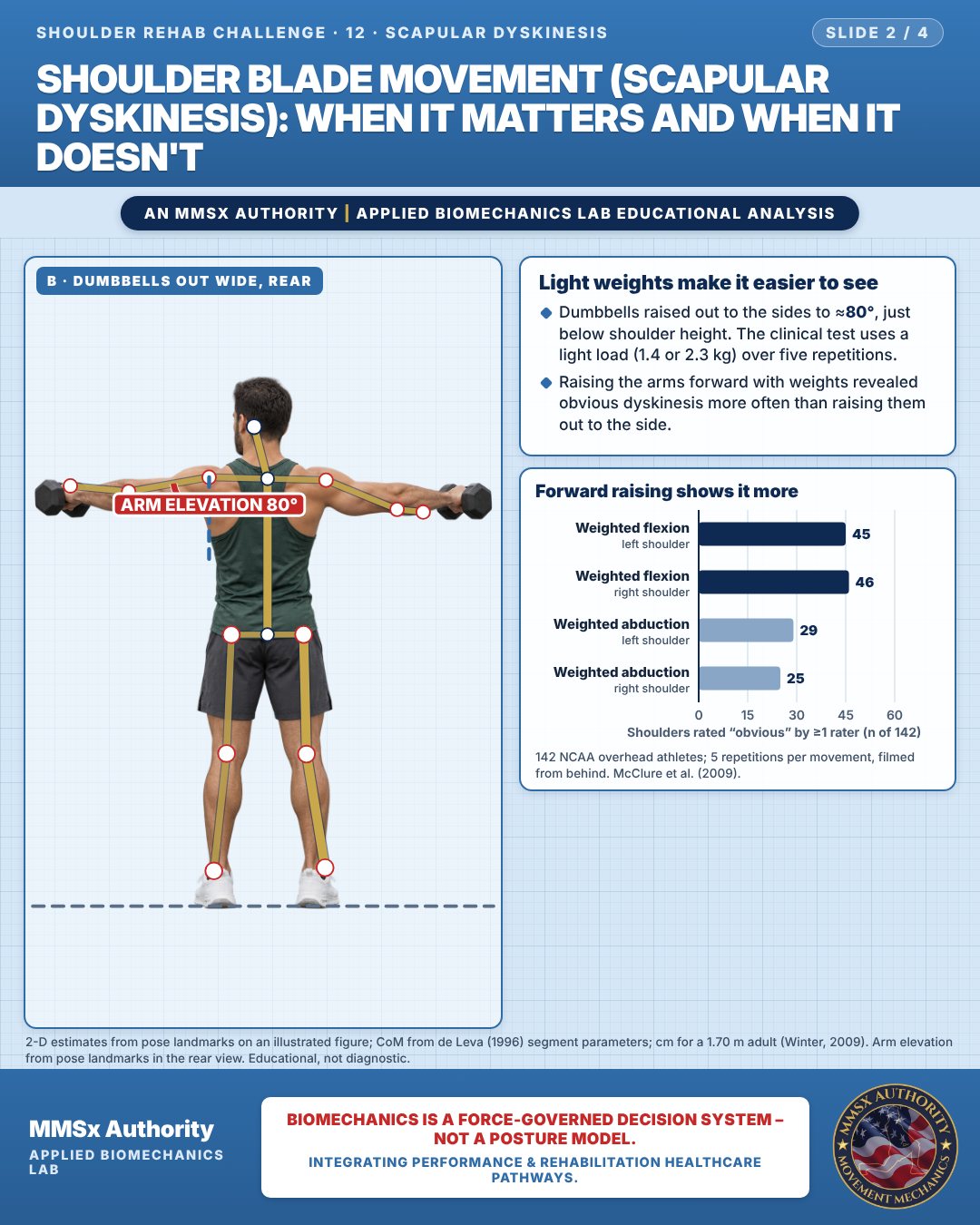
Light weights make it easier to see
Dumbbells raised out to the sides to ≈80°, just below shoulder height. The clinical test uses a light load (1.4 or 2.3 kg) over five repetitions.
Raising the arms forward with weights revealed obvious dyskinesis more often than raising them out to the side.
Forward raising shows it more
Movement C: Lowering the arms (rear view)
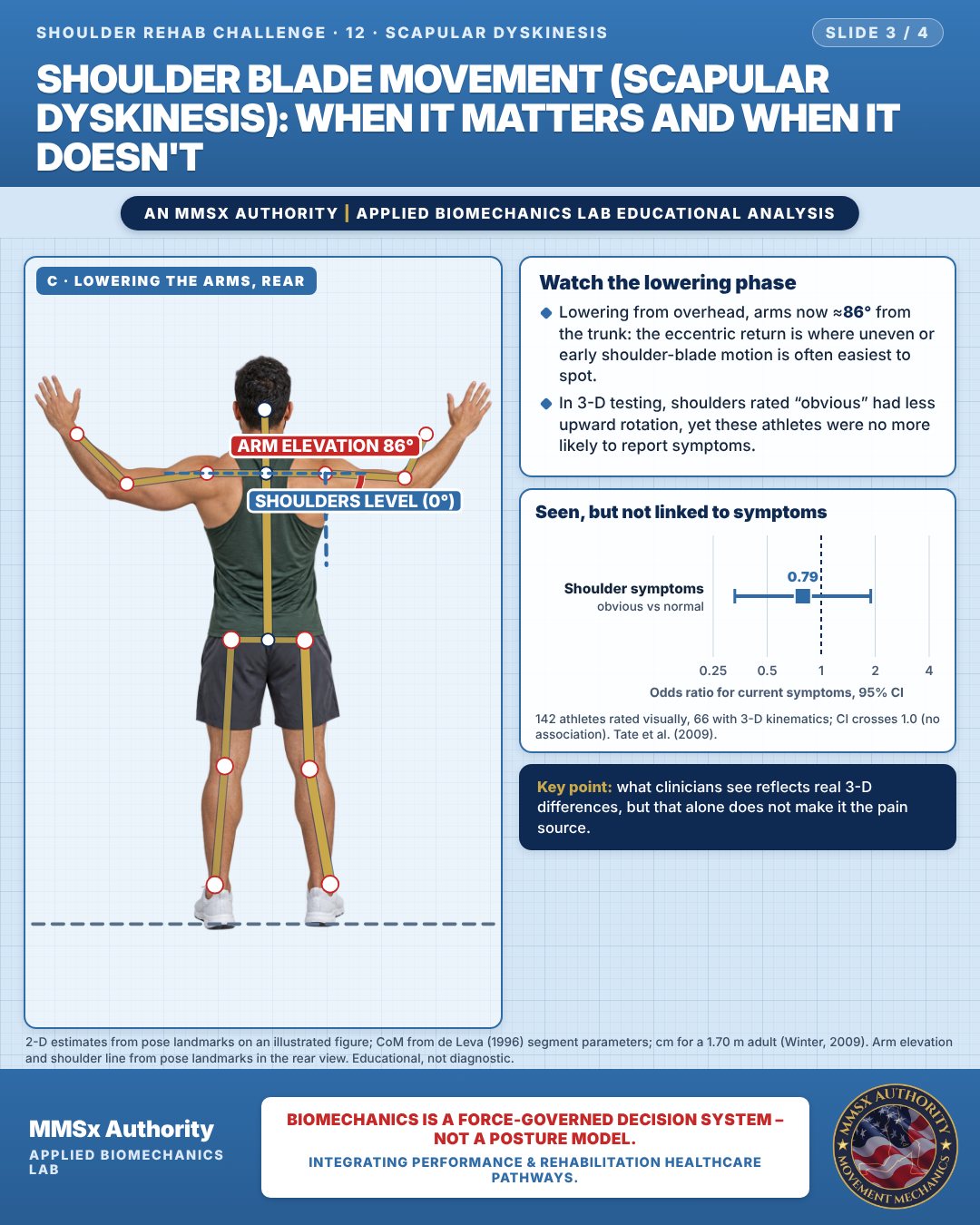
Watch the lowering phase
Lowering from overhead, arms now ≈86° from the trunk: the eccentric return is where uneven or early shoulder-blade motion is often easiest to spot.
In 3-D testing, shoulders rated “obvious” had less upward rotation, yet these athletes were no more likely to report symptoms.
Seen, but not linked to symptoms
Decision pathway
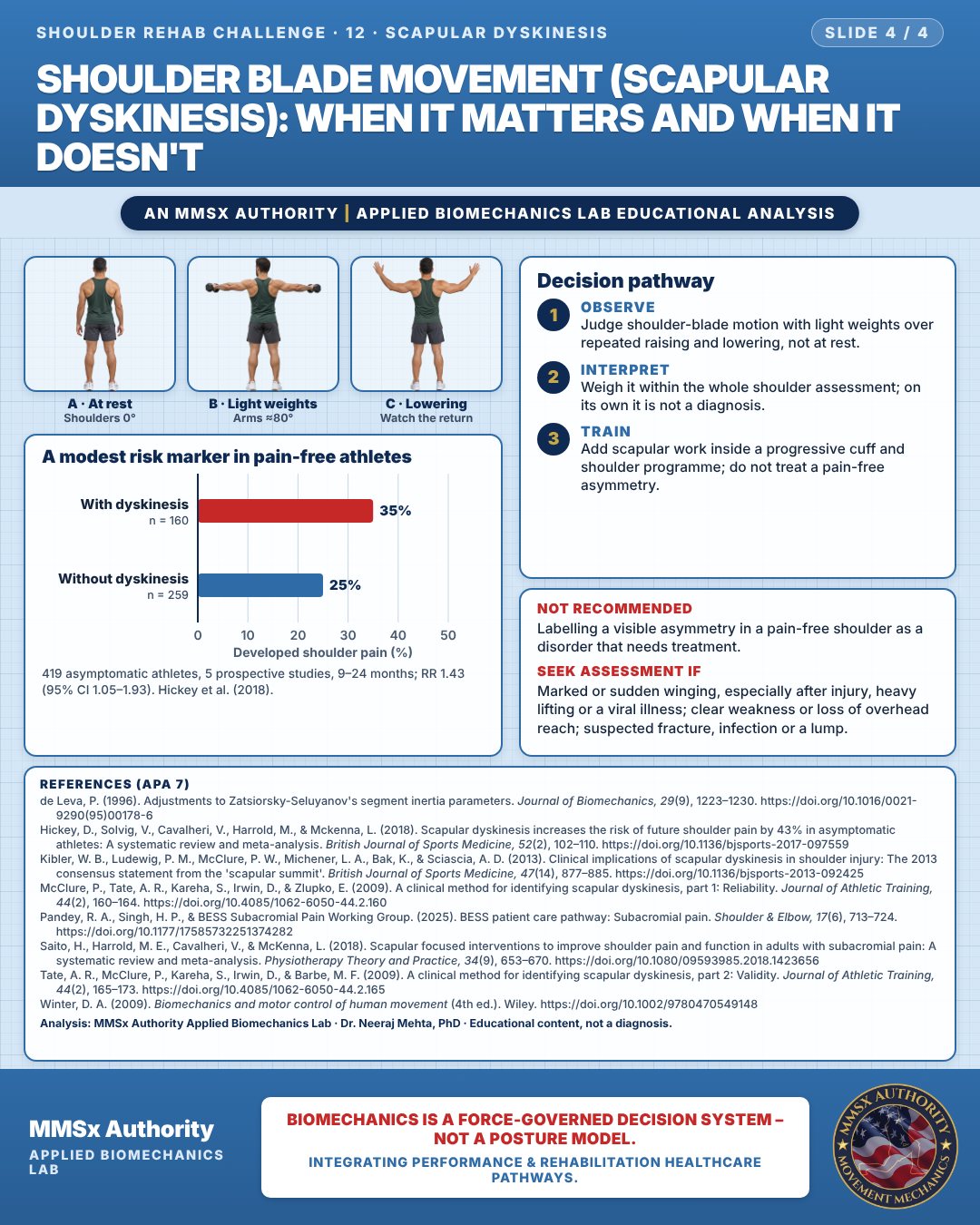
A modest risk marker in pain-free athletes
Observe
Judge shoulder-blade motion with light weights over repeated raising and lowering, not at rest.
Interpret
Weigh it within the whole shoulder assessment; on its own it is not a diagnosis.
Train
Add scapular work inside a progressive cuff and shoulder programme; do not treat a pain-free asymmetry.
What the evidence supports
- Consensus: evaluate dyskinesis as part of the whole shoulder assessment. Rehabilitation to restore scapular position and motion "can be effective" within a broader shoulder rehabilitation programme (Kibler et al., 2013).
Myth and evidence
Myth“An uneven shoulder blade is the cause of your pain.”
EvidenceDyskinesis is common in athletes (McClure et al., 2009). It was not associated with current symptoms (OR 0.79; Tate et al., 2009), and in pain-free athletes it carries only a modest added risk (RR 1.43; Hickey et al., 2018). The consensus calls it a potential impairment, not a diagnosis (Kibler et al., 2013).
Cautions
Not recommended
Labelling a visible asymmetry in a pain-free shoulder as a disorder that needs treatment.
Seek assessment if
Marked or sudden winging, especially after injury, heavy lifting or a viral illness; clear weakness or loss of overhead reach; suspected fracture, infection or a lump.
Methods note
2-D estimates from pose landmarks on an illustrated figure; CoM from de Leva (1996) segment parameters; cm for a 1.70 m adult (Winter, 2009). Shoulder line from left and right shoulder points in the rear view. Arm elevation from pose landmarks in the rear view. Arm elevation and shoulder line from pose landmarks in the rear view. These are educational estimates, not a diagnosis.
References
- de Leva, P. (1996). Adjustments to Zatsiorsky-Seluyanov's segment inertia parameters. Journal of Biomechanics, 29(9), 1223–1230. https://doi.org/10.1016/0021-9290(95)00178-6
- Hickey, D., Solvig, V., Cavalheri, V., Harrold, M., & Mckenna, L. (2018). Scapular dyskinesis increases the risk of future shoulder pain by 43% in asymptomatic athletes: A systematic review and meta-analysis. British Journal of Sports Medicine, 52(2), 102–110. https://doi.org/10.1136/bjsports-2017-097559
- Kibler, W. B., Ludewig, P. M., McClure, P. W., Michener, L. A., Bak, K., & Sciascia, A. D. (2013). Clinical implications of scapular dyskinesis in shoulder injury: The 2013 consensus statement from the 'scapular summit'. British Journal of Sports Medicine, 47(14), 877–885. https://doi.org/10.1136/bjsports-2013-092425
- McClure, P., Tate, A. R., Kareha, S., Irwin, D., & Zlupko, E. (2009). A clinical method for identifying scapular dyskinesis, part 1: Reliability. Journal of Athletic Training, 44(2), 160–164. https://doi.org/10.4085/1062-6050-44.2.160
- Pandey, R. A., Singh, H. P., & BESS Subacromial Pain Working Group. (2025). BESS patient care pathway: Subacromial pain. Shoulder & Elbow, 17(6), 713–724. https://doi.org/10.1177/17585732251374282
- Saito, H., Harrold, M. E., Cavalheri, V., & McKenna, L. (2018). Scapular focused interventions to improve shoulder pain and function in adults with subacromial pain: A systematic review and meta-analysis. Physiotherapy Theory and Practice, 34(9), 653–670. https://doi.org/10.1080/09593985.2018.1423656
- Tate, A. R., McClure, P., Kareha, S., Irwin, D., & Barbe, M. F. (2009). A clinical method for identifying scapular dyskinesis, part 2: Validity. Journal of Athletic Training, 44(2), 165–173. https://doi.org/10.4085/1062-6050-44.2.165
- Winter, D. A. (2009). Biomechanics and motor control of human movement (4th ed.). Wiley. https://doi.org/10.1002/9780470549148
Cite this article
Mehta, N. (2026, October 24). Shoulder blade movement (scapular dyskinesis): when it matters and when it doesn't. MMSx Authority Applied Biomechanics Lab. https://mmsxauthority.org/edu/analysis/shoulder/12-shoulder-blade-movement-scapular-dyskinesis-when-it-matters-and-when/
Part of the collection
Mehta, N. (2026). Shoulder Rehabilitation: 50 Evidence-Based Biomechanics Analyses [Collection]. MMSx Authority Applied Biomechanics Lab. Zenodo. https://doi.org/10.5281/zenodo.23735725
All Shoulder Rehab Challenge articles · Rehabilitation Library