Shoulder Rehab Challenge · 11
Pain reaching overhead: how the shoulder blade shares the load
Overhead reaching pain is shoulder pain provoked by raising the arm above shoulder height.
Key points
- Educate. Explain that overhead reach shares motion between arm and shoulder blade, and that pain is not damage.
- Load. Progress cuff and scapular exercise into overhead range, using supported options such as the wall slide.
- Review. If no better by 6–8 weeks, discuss options; refer if no improvement by 12 weeks.
What it is
Overhead reaching pain is shoulder pain provoked by raising the arm above shoulder height. Full elevation needs coordinated motion of the glenohumeral joint, the scapula (upward rotation, posterior tilt, external rotation) and the clavicle. This coordination is called scapulohumeral rhythm. Overhead pain is most often subacromial (rotator cuff related) and is diagnosed clinically (Pandey et al., 2025).
How we analysed the movement
Three movements relevant to this topic were analysed from illustrated reference figures. Joint centres were located with two-dimensional pose estimation; arm elevation and elbow angles, shoulder level, the whole-body centre of mass and, where relevant, the arm lever (the horizontal distance from the shoulder joint to the centre of mass of the arm, with any hand load) and the resulting shoulder moment were then calculated from standard segment parameters. The figures are educational estimates that show how position changes mechanical demand; they are not measurements of a patient. Every research value quoted below comes from the published source cited beside it.
Movement A: Bar overhead (front view)
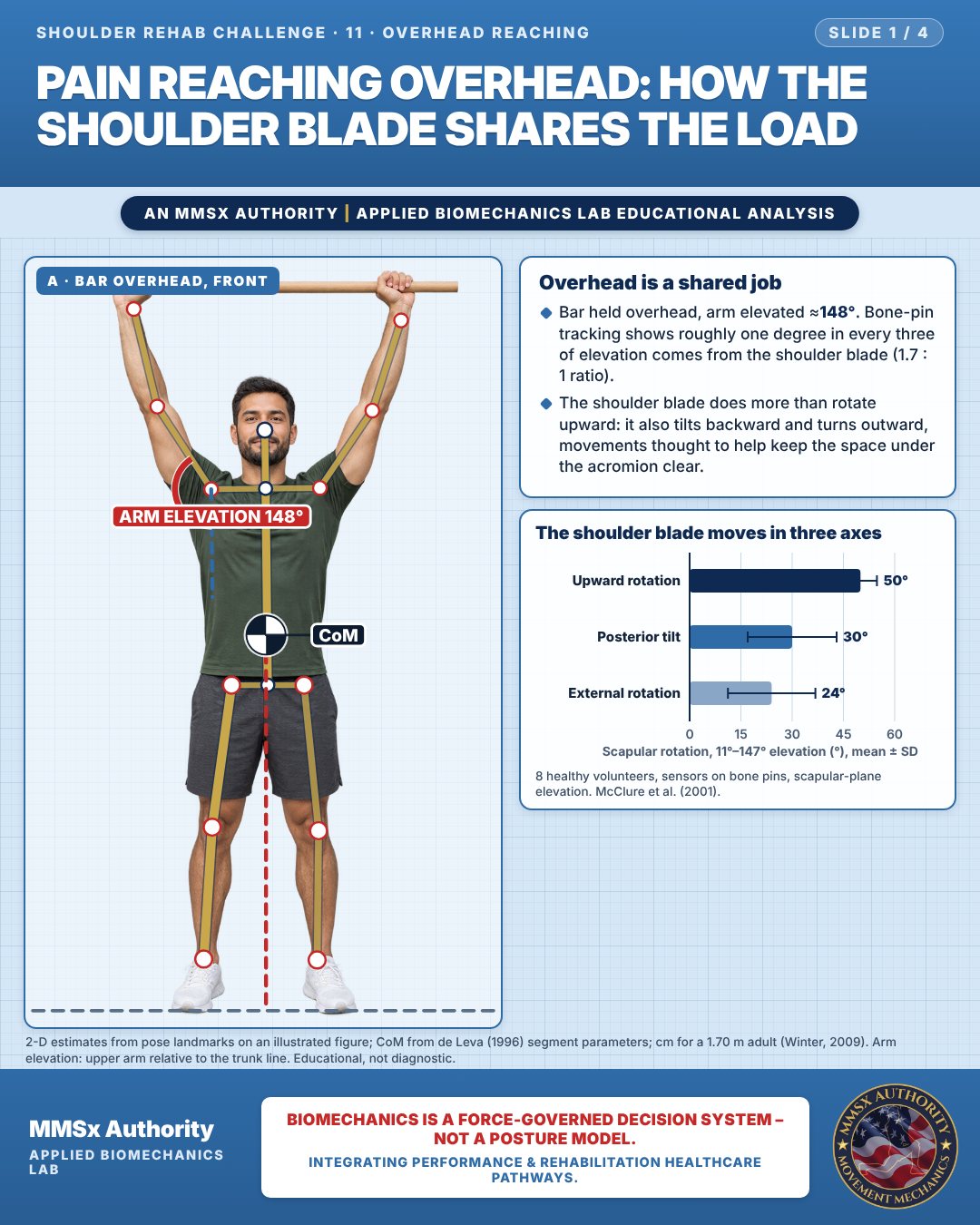
Overhead is a shared job
Bar held overhead, arm elevated ≈148°. Bone-pin tracking shows roughly one degree in every three of elevation comes from the shoulder blade (1.7 : 1 ratio).
The shoulder blade does more than rotate upward: it also tilts backward and turns outward, movements thought to help keep the space under the acromion clear.
The shoulder blade moves in three axes
Movement B: High-shelf reach (rear view)
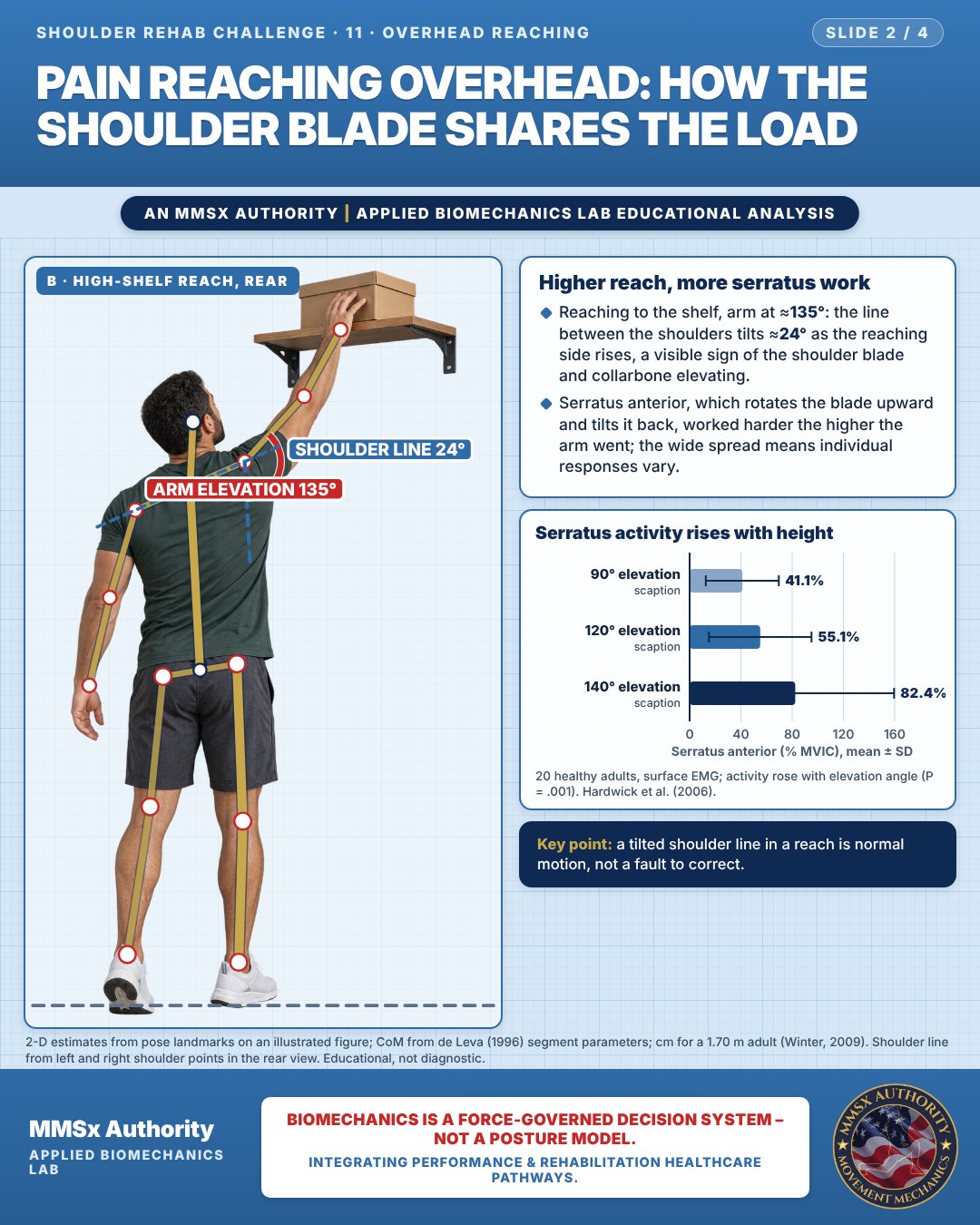
Higher reach, more serratus work
Reaching to the shelf, arm at ≈135°: the line between the shoulders tilts ≈24° as the reaching side rises, a visible sign of the shoulder blade and collarbone elevating.
Serratus anterior, which rotates the blade upward and tilts it back, worked harder the higher the arm went; the wide spread means individual responses vary.
Serratus activity rises with height
Movement C: Wall slide into y (rear view)
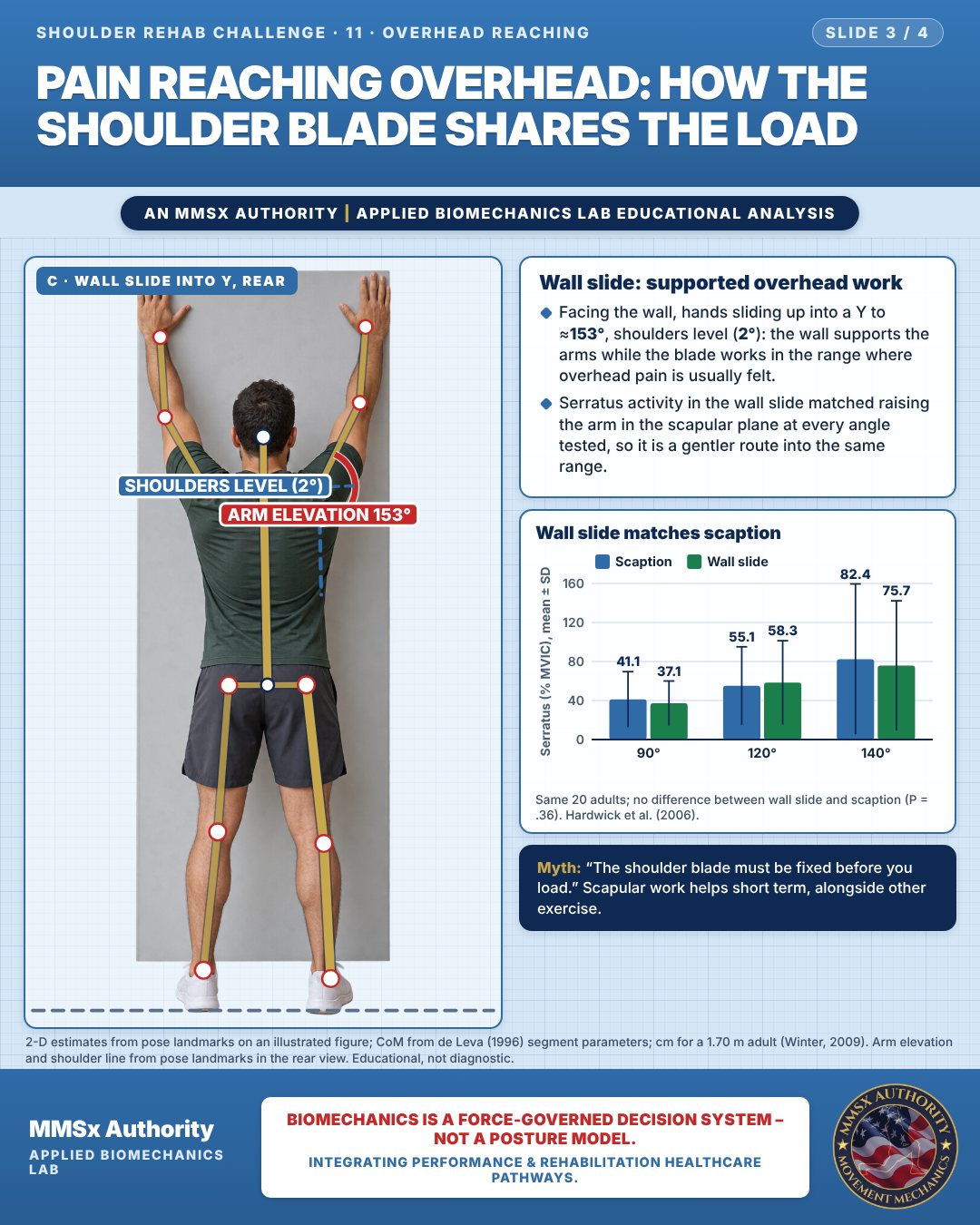
Wall slide: supported overhead work
Facing the wall, hands sliding up into a Y to ≈153°, shoulders level (2°): the wall supports the arms while the blade works in the range where overhead pain is usually felt.
Serratus activity in the wall slide matched raising the arm in the scapular plane at every angle tested, so it is a gentler route into the same range.
Wall slide matches scaption
Decision pathway
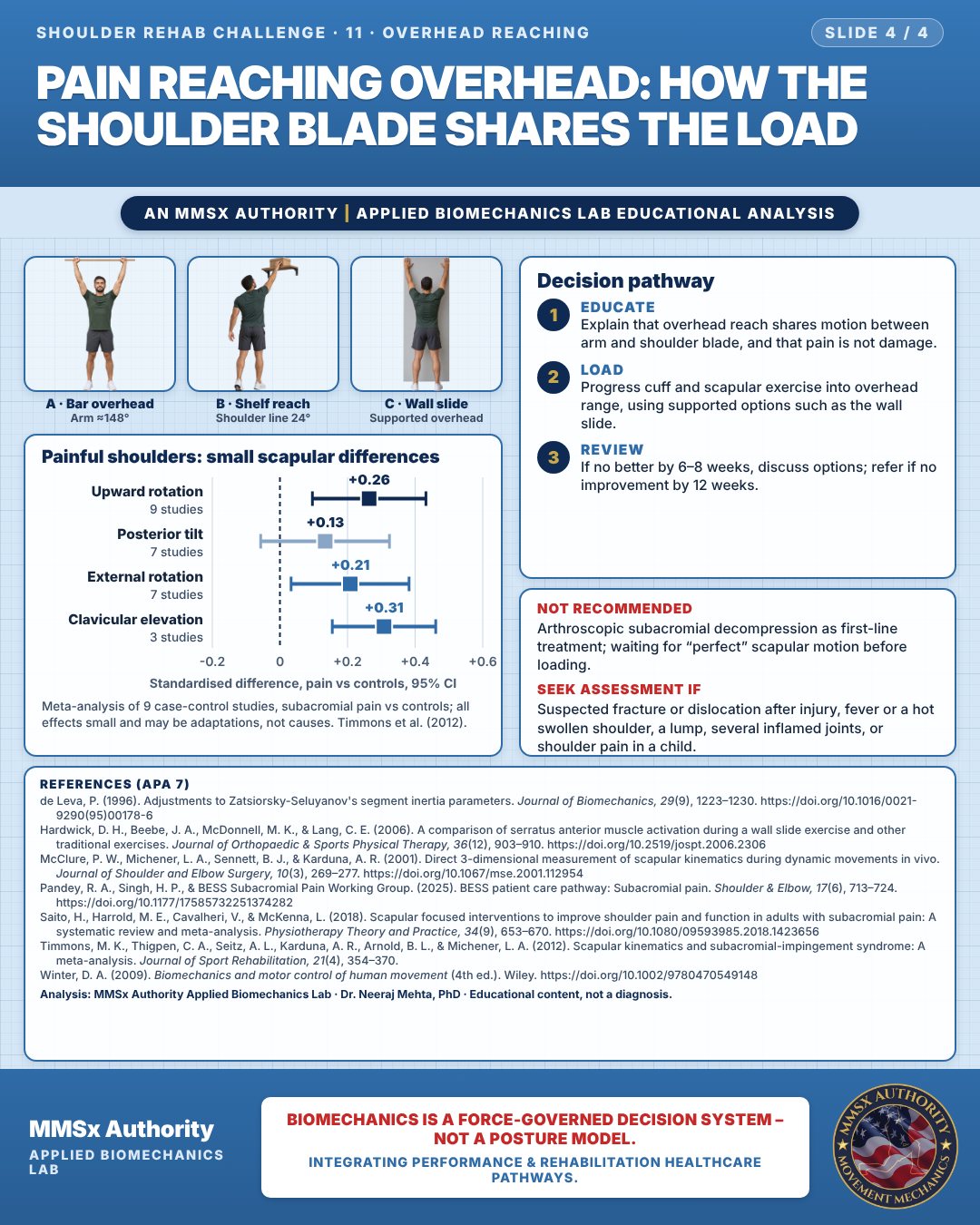
Painful shoulders: small scapular differences
Educate
Explain that overhead reach shares motion between arm and shoulder blade, and that pain is not damage.
Load
Progress cuff and scapular exercise into overhead range, using supported options such as the wall slide.
Review
If no better by 6–8 weeks, discuss options; refer if no improvement by 12 weeks.
What the evidence supports
- Not recommended: arthroscopic subacromial decompression as first-line treatment (Pandey et al., 2025).
Myth and evidence
Myth“Overhead pain means your shoulder blade is moving wrongly and must be fixed first.”
EvidenceNormal overhead reach needs large, three-axis scapular rotations (McClure et al., 2001). In painful shoulders the pooled differences from controls are small (Timmons et al., 2012). Scapular training helps in the short term alongside other exercise (Saito et al., 2018), so it is one tool in the plan, not a prerequisite.
Cautions
Not recommended
Arthroscopic subacromial decompression as first-line treatment; waiting for “perfect” scapular motion before loading.
Seek assessment if
Suspected fracture or dislocation after injury, fever or a hot swollen shoulder, a lump, several inflamed joints, or shoulder pain in a child.
Methods note
2-D estimates from pose landmarks on an illustrated figure; CoM from de Leva (1996) segment parameters; cm for a 1.70 m adult (Winter, 2009). Arm elevation: upper arm relative to the trunk line. Shoulder line from left and right shoulder points in the rear view. Arm elevation and shoulder line from pose landmarks in the rear view. These are educational estimates, not a diagnosis.
References
- de Leva, P. (1996). Adjustments to Zatsiorsky-Seluyanov's segment inertia parameters. Journal of Biomechanics, 29(9), 1223–1230. https://doi.org/10.1016/0021-9290(95)00178-6
- Hardwick, D. H., Beebe, J. A., McDonnell, M. K., & Lang, C. E. (2006). A comparison of serratus anterior muscle activation during a wall slide exercise and other traditional exercises. Journal of Orthopaedic & Sports Physical Therapy, 36(12), 903–910. https://doi.org/10.2519/jospt.2006.2306
- McClure, P. W., Michener, L. A., Sennett, B. J., & Karduna, A. R. (2001). Direct 3-dimensional measurement of scapular kinematics during dynamic movements in vivo. Journal of Shoulder and Elbow Surgery, 10(3), 269–277. https://doi.org/10.1067/mse.2001.112954
- Pandey, R. A., Singh, H. P., & BESS Subacromial Pain Working Group. (2025). BESS patient care pathway: Subacromial pain. Shoulder & Elbow, 17(6), 713–724. https://doi.org/10.1177/17585732251374282
- Saito, H., Harrold, M. E., Cavalheri, V., & McKenna, L. (2018). Scapular focused interventions to improve shoulder pain and function in adults with subacromial pain: A systematic review and meta-analysis. Physiotherapy Theory and Practice, 34(9), 653–670. https://doi.org/10.1080/09593985.2018.1423656
- Timmons, M. K., Thigpen, C. A., Seitz, A. L., Karduna, A. R., Arnold, B. L., & Michener, L. A. (2012). Scapular kinematics and subacromial-impingement syndrome: A meta-analysis. Journal of Sport Rehabilitation, 21(4), 354–370.
- Winter, D. A. (2009). Biomechanics and motor control of human movement (4th ed.). Wiley. https://doi.org/10.1002/9780470549148
Cite this article
Mehta, N. (2026, October 24). Pain reaching overhead: how the shoulder blade shares the load. MMSx Authority Applied Biomechanics Lab. https://mmsxauthority.org/edu/analysis/shoulder/11-pain-reaching-overhead-how-the-shoulder-blade-shares-the-load/
Part of the collection
Mehta, N. (2026). Shoulder Rehabilitation: 50 Evidence-Based Biomechanics Analyses [Collection]. MMSx Authority Applied Biomechanics Lab. Zenodo. https://doi.org/10.5281/zenodo.23735725
All Shoulder Rehab Challenge articles · Rehabilitation Library