Shoulder Rehab Challenge · 10
Pain reaching behind your back: what limited internal rotation means
Limited hand-behind-back reach is reduced functional internal rotation, usually recorded as the highest vertebral level the thumb can reach.
Key points
- Measure. Record active and passive rotation with a goniometer, inclinometer or validated app, and retest.
- Interpret. Passive loss suggests the capsule; full passive range suggests pain or cuff strength.
- Stretch. Stretch the restricted directions at an intensity set by irritability; exercise is core for cuff pain.
What it is
Limited hand-behind-back reach is reduced functional internal rotation, usually recorded as the highest vertebral level the thumb can reach. It is common in frozen shoulder, where passive range is lost (Kelley et al., 2013), and in painful rotator cuff conditions. Clinicians should measure active and passive range (Kelley et al., 2013), with an instrument where possible (Grade A, Desmeules et al., 2025).
How we analysed the movement
Three movements relevant to this topic were analysed from illustrated reference figures. Joint centres were located with two-dimensional pose estimation; arm elevation and elbow angles, shoulder level, the whole-body centre of mass and, where relevant, the arm lever (the horizontal distance from the shoulder joint to the centre of mass of the arm, with any hand load) and the resulting shoulder moment were then calculated from standard segment parameters. The figures are educational estimates that show how position changes mechanical demand; they are not measurements of a patient. Every research value quoted below comes from the published source cited beside it.
Movement A: Hand up the back (rear view)
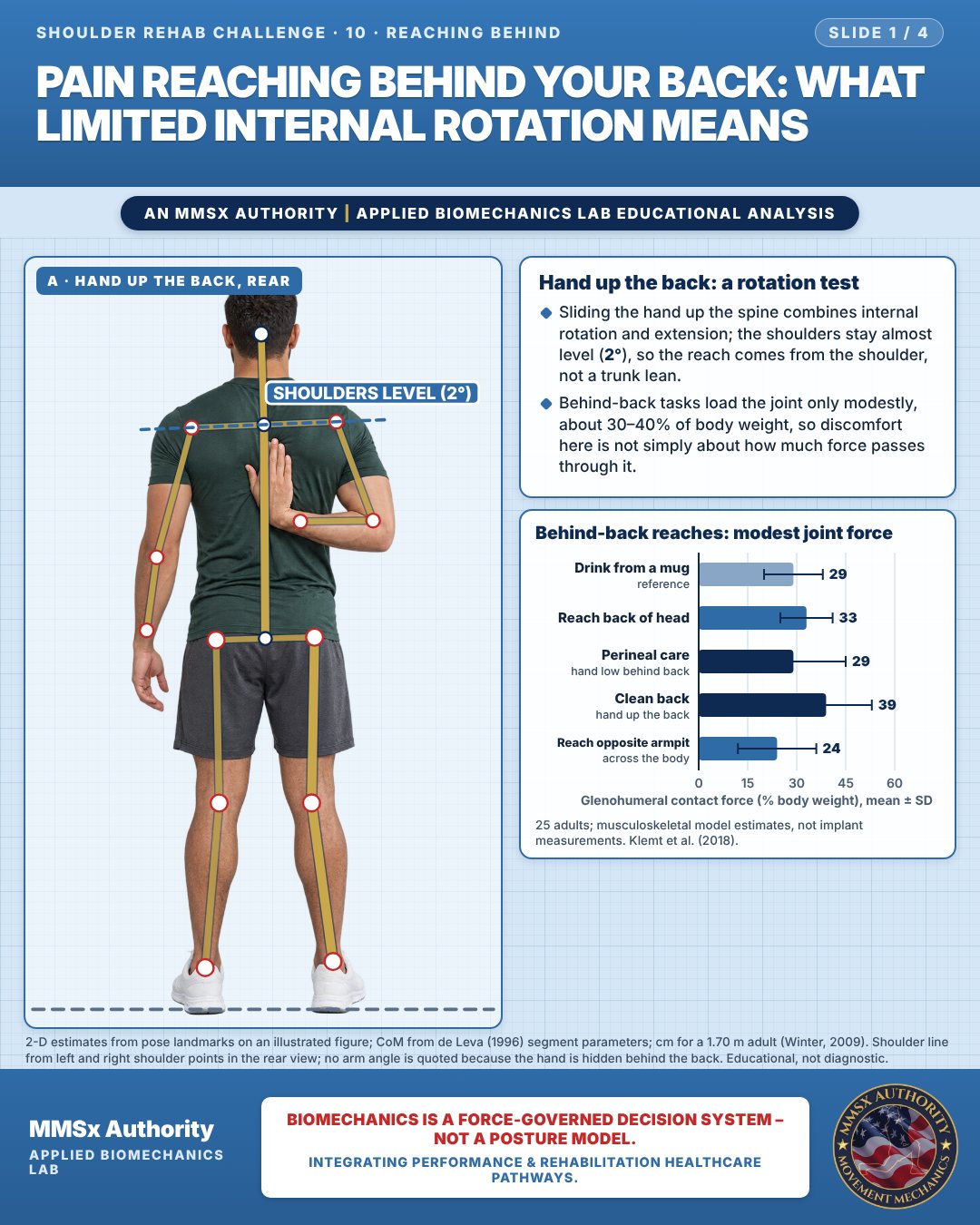
Hand up the back: a rotation test
Sliding the hand up the spine combines internal rotation and extension; the shoulders stay almost level (2°), so the reach comes from the shoulder, not a trunk lean.
Behind-back tasks load the joint only modestly, about 30–40% of body weight, so discomfort here is not simply about how much force passes through it.
Behind-back reaches: modest joint force
Movement B: Back pocket (rear view)
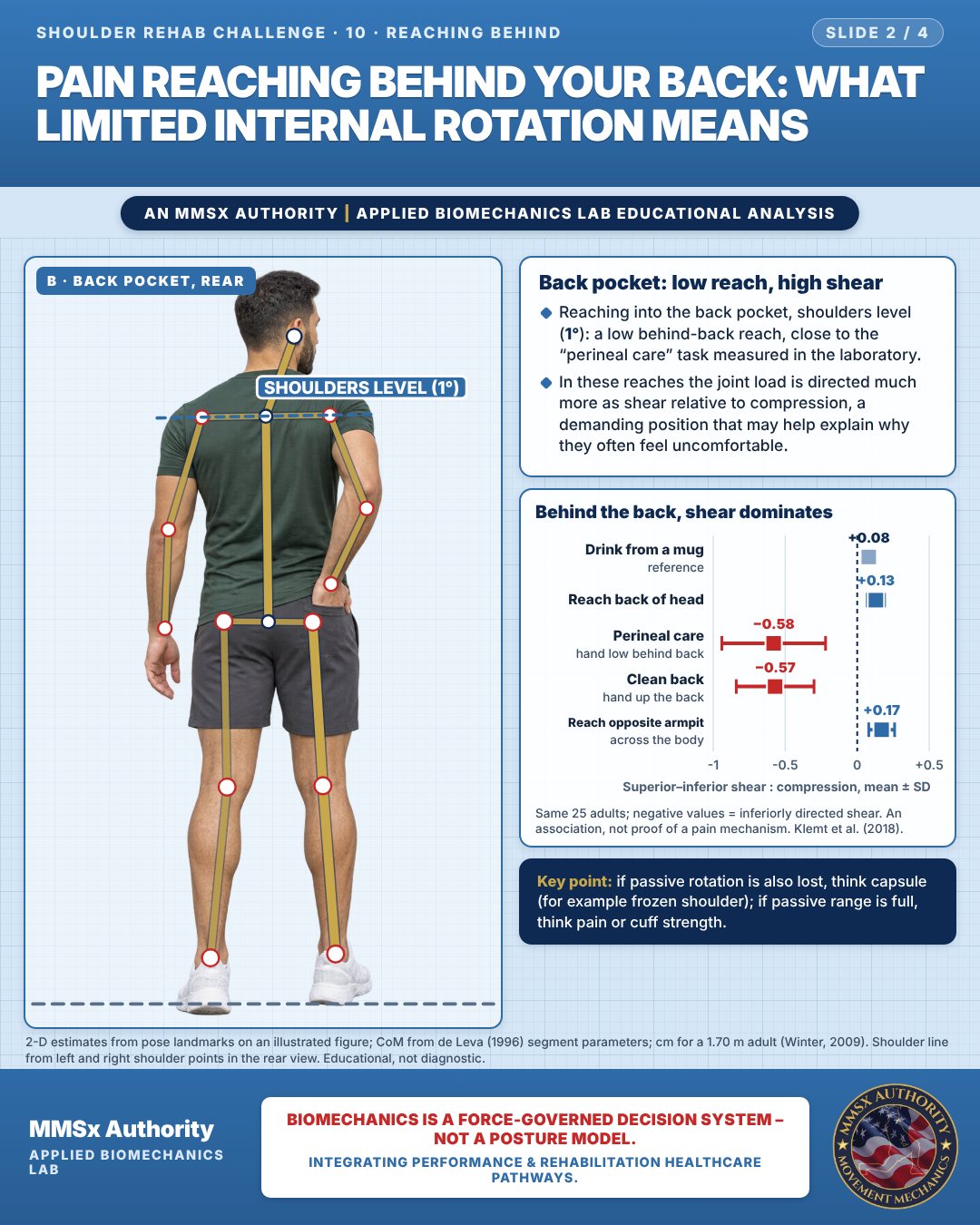
Back pocket: low reach, high shear
Reaching into the back pocket, shoulders level (1°): a low behind-back reach, close to the “perineal care” task measured in the laboratory.
In these reaches the joint load is directed much more as shear relative to compression, a demanding position that may help explain why they often feel uncomfortable.
Behind the back, shear dominates
Movement C: Sleeper stretch (front view)
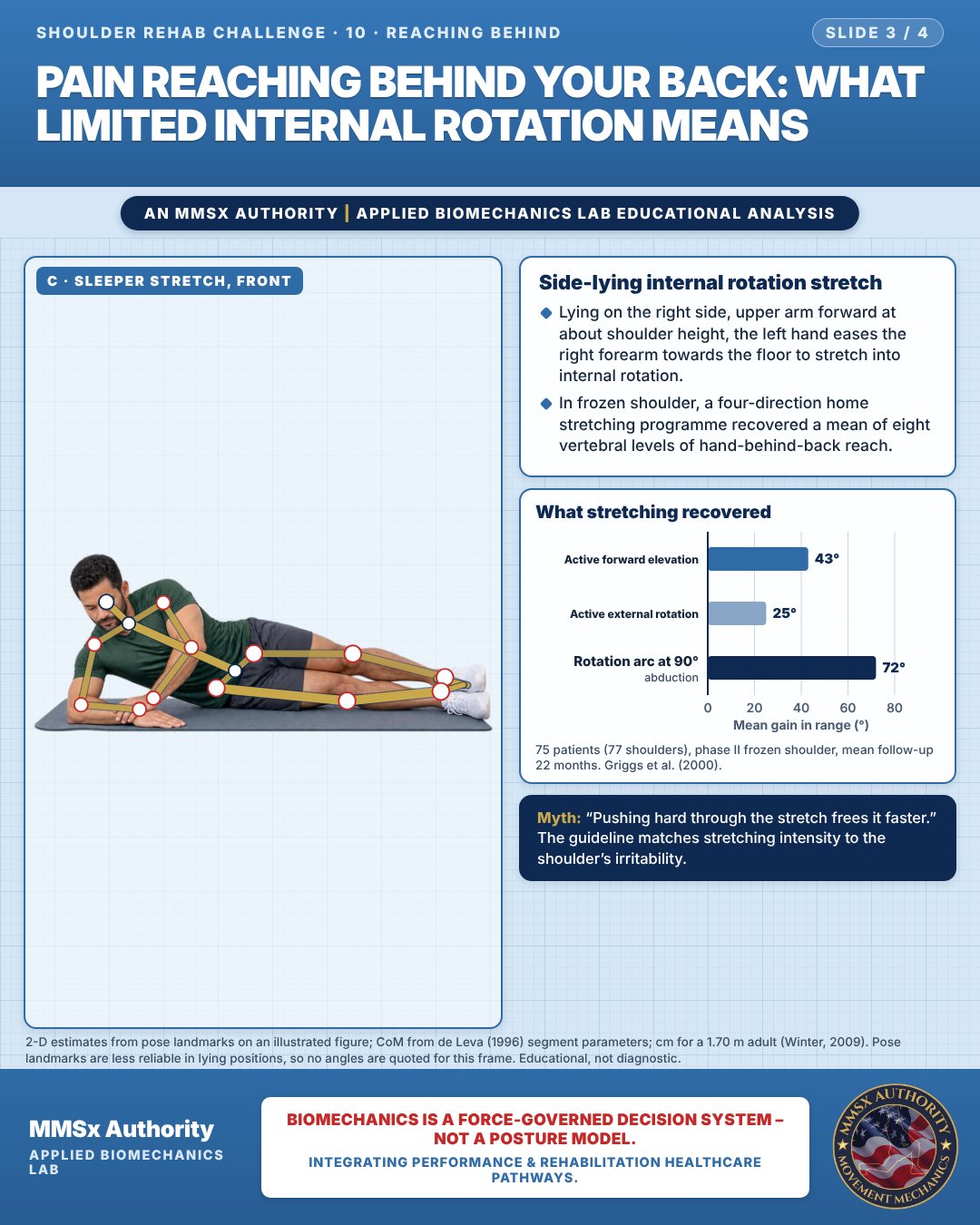
Side-lying internal rotation stretch
Lying on the right side, upper arm forward at about shoulder height, the left hand eases the right forearm towards the floor to stretch into internal rotation.
In frozen shoulder, a four-direction home stretching programme recovered a mean of eight vertebral levels of hand-behind-back reach.
What stretching recovered
Decision pathway
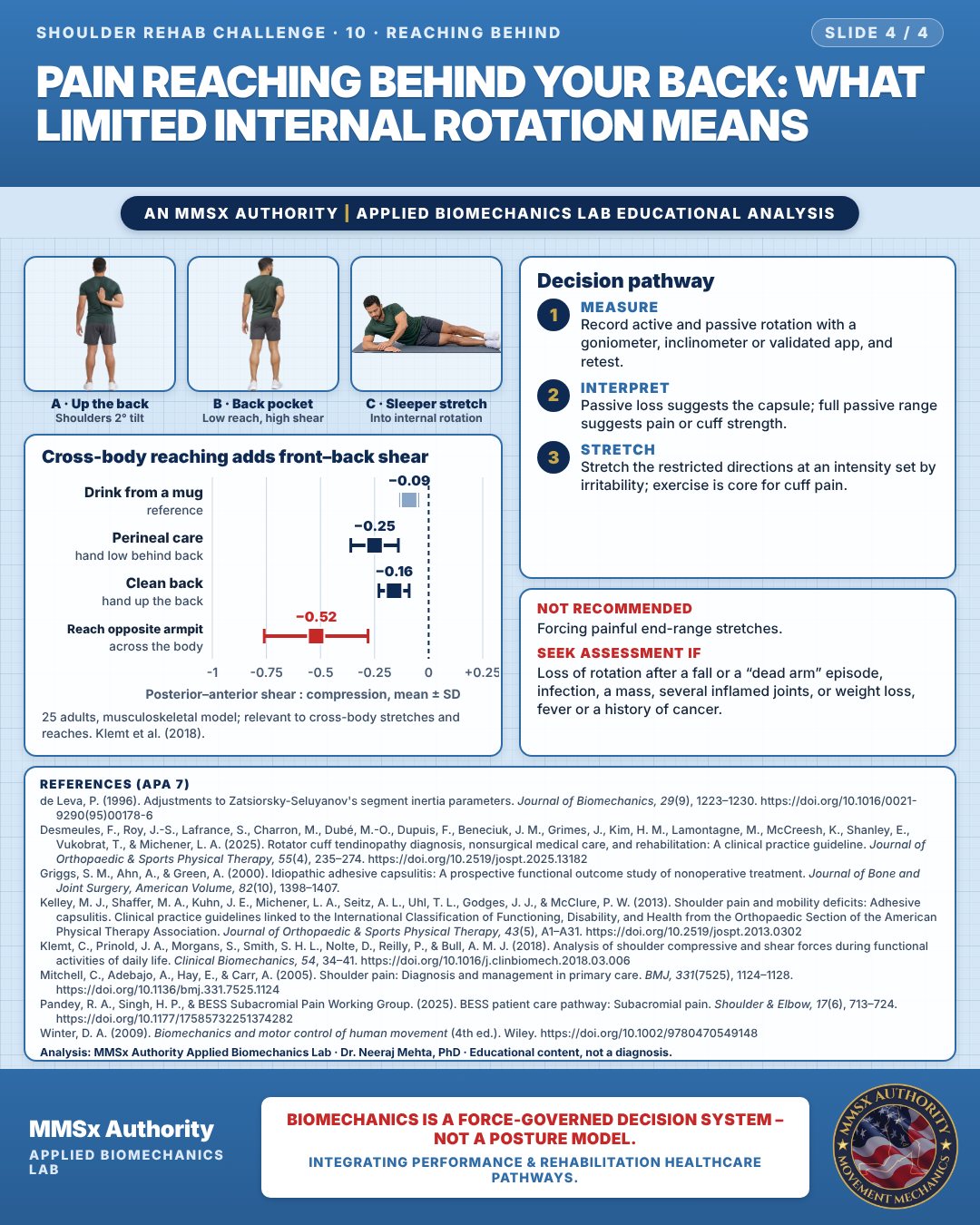
Cross-body reaching adds front–back shear
Measure
Record active and passive rotation with a goniometer, inclinometer or validated app, and retest.
Interpret
Passive loss suggests the capsule; full passive range suggests pain or cuff strength.
Stretch
Stretch the restricted directions at an intensity set by irritability; exercise is core for cuff pain.
What the evidence supports
- Stretching in the restricted directions with intensity matched to irritability (Grade B). In frozen shoulder, add intra-articular steroid with stretching (Grade A) (Kelley et al., 2013).
- For rotator cuff–related pain, exercise therapy is the core treatment (Grade A), and manual therapy alongside exercise can be used for short-term relief (Grade B) (Desmeules et al., 2025).
Myth and evidence
Myth“Pushing hard through the stretch will free it up faster.”
EvidenceThe frozen shoulder guideline recommends matching stretching intensity to the patient's current irritability (Grade B) (Kelley et al., 2013). Well-dosed stretching recovered a mean of eight vertebral levels of internal rotation (Griggs et al., 2000).
Cautions
Not recommended
Forcing painful end-range stretches.
Seek assessment if
Loss of rotation after a fall or a “dead arm” episode, infection, a mass, several inflamed joints, or weight loss, fever or a history of cancer.
Methods note
2-D estimates from pose landmarks on an illustrated figure; CoM from de Leva (1996) segment parameters; cm for a 1.70 m adult (Winter, 2009). Shoulder line from left and right shoulder points in the rear view; no arm angle is quoted because the hand is hidden behind the back. Shoulder line from left and right shoulder points in the rear view. Pose landmarks are less reliable in lying positions, so no angles are quoted for this frame. These are educational estimates, not a diagnosis.
References
- de Leva, P. (1996). Adjustments to Zatsiorsky-Seluyanov's segment inertia parameters. Journal of Biomechanics, 29(9), 1223–1230. https://doi.org/10.1016/0021-9290(95)00178-6
- Desmeules, F., Roy, J.-S., Lafrance, S., Charron, M., Dubé, M.-O., Dupuis, F., Beneciuk, J. M., Grimes, J., Kim, H. M., Lamontagne, M., McCreesh, K., Shanley, E., Vukobrat, T., & Michener, L. A. (2025). Rotator cuff tendinopathy diagnosis, nonsurgical medical care, and rehabilitation: A clinical practice guideline. Journal of Orthopaedic & Sports Physical Therapy, 55(4), 235–274. https://doi.org/10.2519/jospt.2025.13182
- Griggs, S. M., Ahn, A., & Green, A. (2000). Idiopathic adhesive capsulitis: A prospective functional outcome study of nonoperative treatment. Journal of Bone and Joint Surgery, American Volume, 82(10), 1398–1407.
- Kelley, M. J., Shaffer, M. A., Kuhn, J. E., Michener, L. A., Seitz, A. L., Uhl, T. L., Godges, J. J., & McClure, P. W. (2013). Shoulder pain and mobility deficits: Adhesive capsulitis. Clinical practice guidelines linked to the International Classification of Functioning, Disability, and Health from the Orthopaedic Section of the American Physical Therapy Association. Journal of Orthopaedic & Sports Physical Therapy, 43(5), A1–A31. https://doi.org/10.2519/jospt.2013.0302
- Klemt, C., Prinold, J. A., Morgans, S., Smith, S. H. L., Nolte, D., Reilly, P., & Bull, A. M. J. (2018). Analysis of shoulder compressive and shear forces during functional activities of daily life. Clinical Biomechanics, 54, 34–41. https://doi.org/10.1016/j.clinbiomech.2018.03.006
- Mitchell, C., Adebajo, A., Hay, E., & Carr, A. (2005). Shoulder pain: Diagnosis and management in primary care. BMJ, 331(7525), 1124–1128. https://doi.org/10.1136/bmj.331.7525.1124
- Pandey, R. A., Singh, H. P., & BESS Subacromial Pain Working Group. (2025). BESS patient care pathway: Subacromial pain. Shoulder & Elbow, 17(6), 713–724. https://doi.org/10.1177/17585732251374282
- Winter, D. A. (2009). Biomechanics and motor control of human movement (4th ed.). Wiley. https://doi.org/10.1002/9780470549148
Cite this article
Mehta, N. (2026, October 24). Pain reaching behind your back: what limited internal rotation means. MMSx Authority Applied Biomechanics Lab. https://mmsxauthority.org/edu/analysis/shoulder/10-pain-reaching-behind-your-back-what-limited-internal-rotation-means/
Part of the collection
Mehta, N. (2026). Shoulder Rehabilitation: 50 Evidence-Based Biomechanics Analyses [Collection]. MMSx Authority Applied Biomechanics Lab. Zenodo. https://doi.org/10.5281/zenodo.23735725
All Shoulder Rehab Challenge articles · Rehabilitation Library