Shoulder Rehab Challenge · 09
Shoulder pain at night: sleep positions and symptoms worth checking
Night pain is shoulder pain that disturbs sleep or prevents lying on the affected side. Movement analysis, verified research data and a decision pathway.
Key points
- Position. Try lying on the back or the pain-free side with the painful arm supported on a pillow.
- Treat. Exercise is core; short-term pain relief or a single injection can help night pain.
- Check. Constant, unremitting night pain with general symptoms needs medical review.
What it is
Night pain is shoulder pain that disturbs sleep or prevents lying on the affected side. It is very common in rotator cuff disease and frozen shoulder (Khazzam et al., 2018). Constant, unremitting pain at night together with systemic features is a reason for medical review (Mitchell et al., 2005).
How we analysed the movement
Three movements relevant to this topic were analysed from illustrated reference figures. Joint centres were located with two-dimensional pose estimation; arm elevation and elbow angles, shoulder level, the whole-body centre of mass and, where relevant, the arm lever (the horizontal distance from the shoulder joint to the centre of mass of the arm, with any hand load) and the resulting shoulder moment were then calculated from standard segment parameters. The figures are educational estimates that show how position changes mechanical demand; they are not measurements of a patient. Every research value quoted below comes from the published source cited beside it.
Movement A: On the painful side (front view)
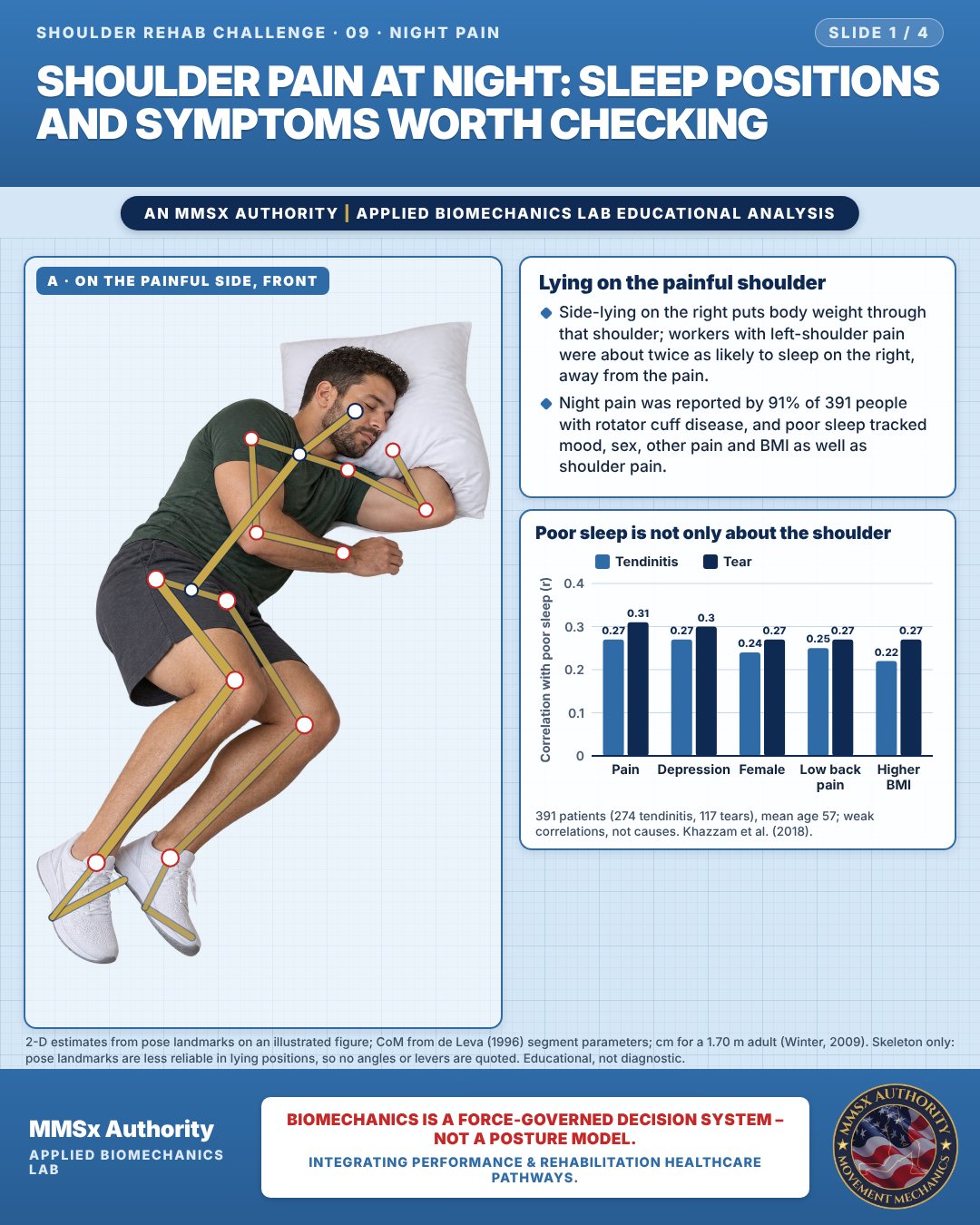
Lying on the painful shoulder
Side-lying on the right puts body weight through that shoulder; workers with left-shoulder pain were about twice as likely to sleep on the right, away from the pain.
Night pain was reported by 91% of 391 people with rotator cuff disease, and poor sleep tracked mood, sex, other pain and BMI as well as shoulder pain.
Poor sleep is not only about the shoulder
Movement B: On the back (side view)
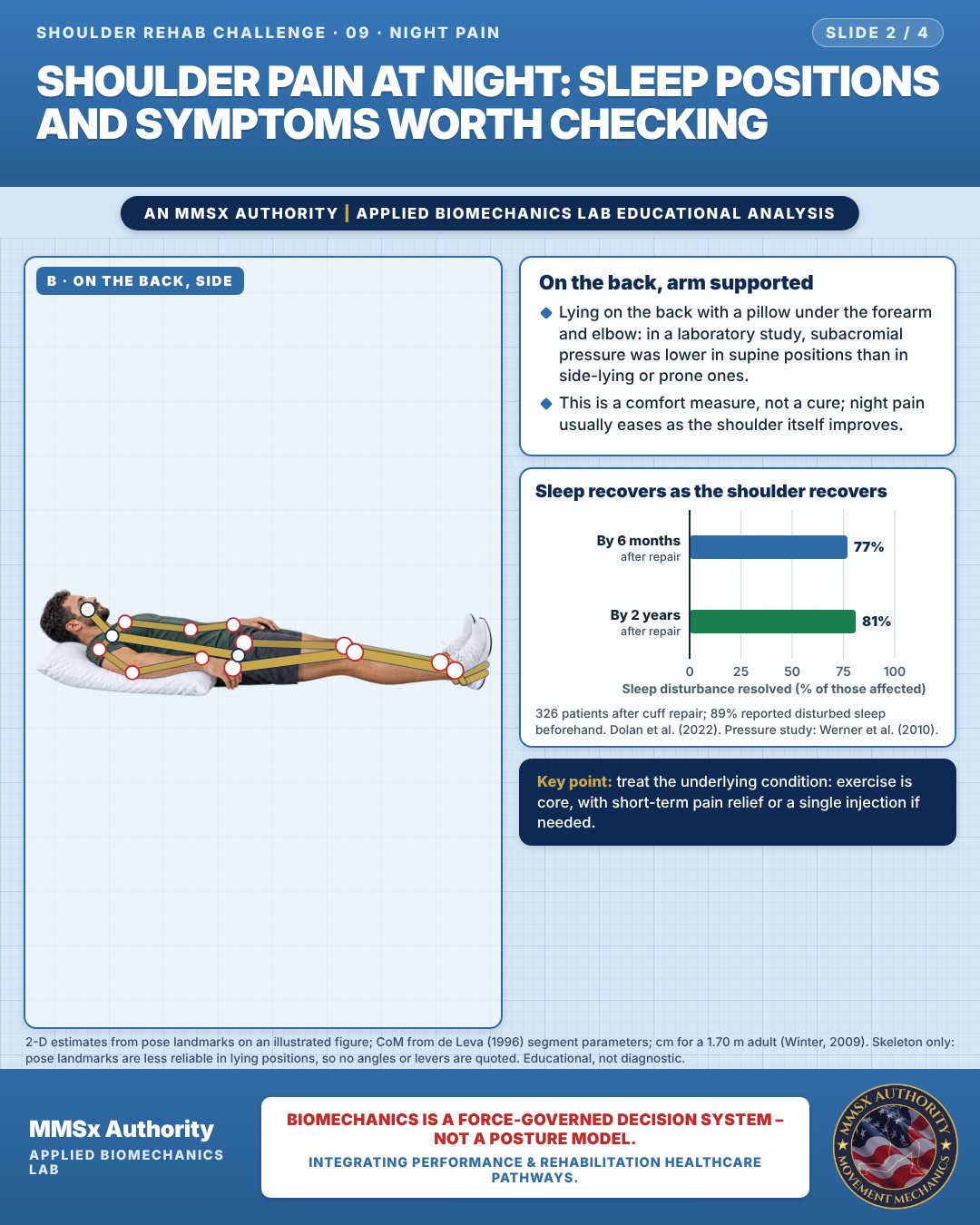
On the back, arm supported
Lying on the back with a pillow under the forearm and elbow: in a laboratory study, subacromial pressure was lower in supine positions than in side-lying or prone ones.
This is a comfort measure, not a cure; night pain usually eases as the shoulder itself improves.
Sleep recovers as the shoulder recovers
Movement C: On the other side (front view)
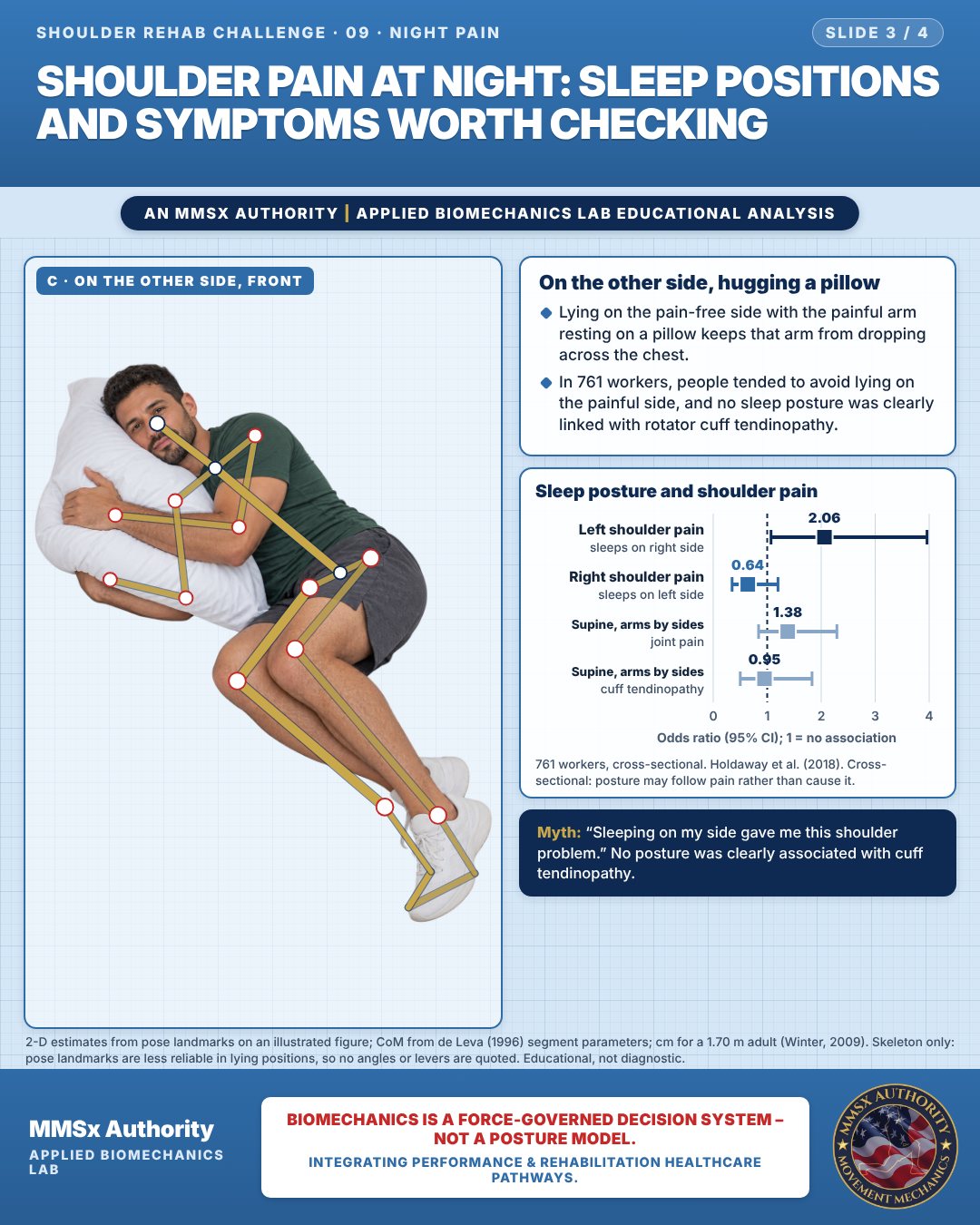
On the other side, hugging a pillow
Lying on the pain-free side with the painful arm resting on a pillow keeps that arm from dropping across the chest.
In 761 workers, people tended to avoid lying on the painful side, and no sleep posture was clearly linked with rotator cuff tendinopathy.
Sleep posture and shoulder pain
Decision pathway
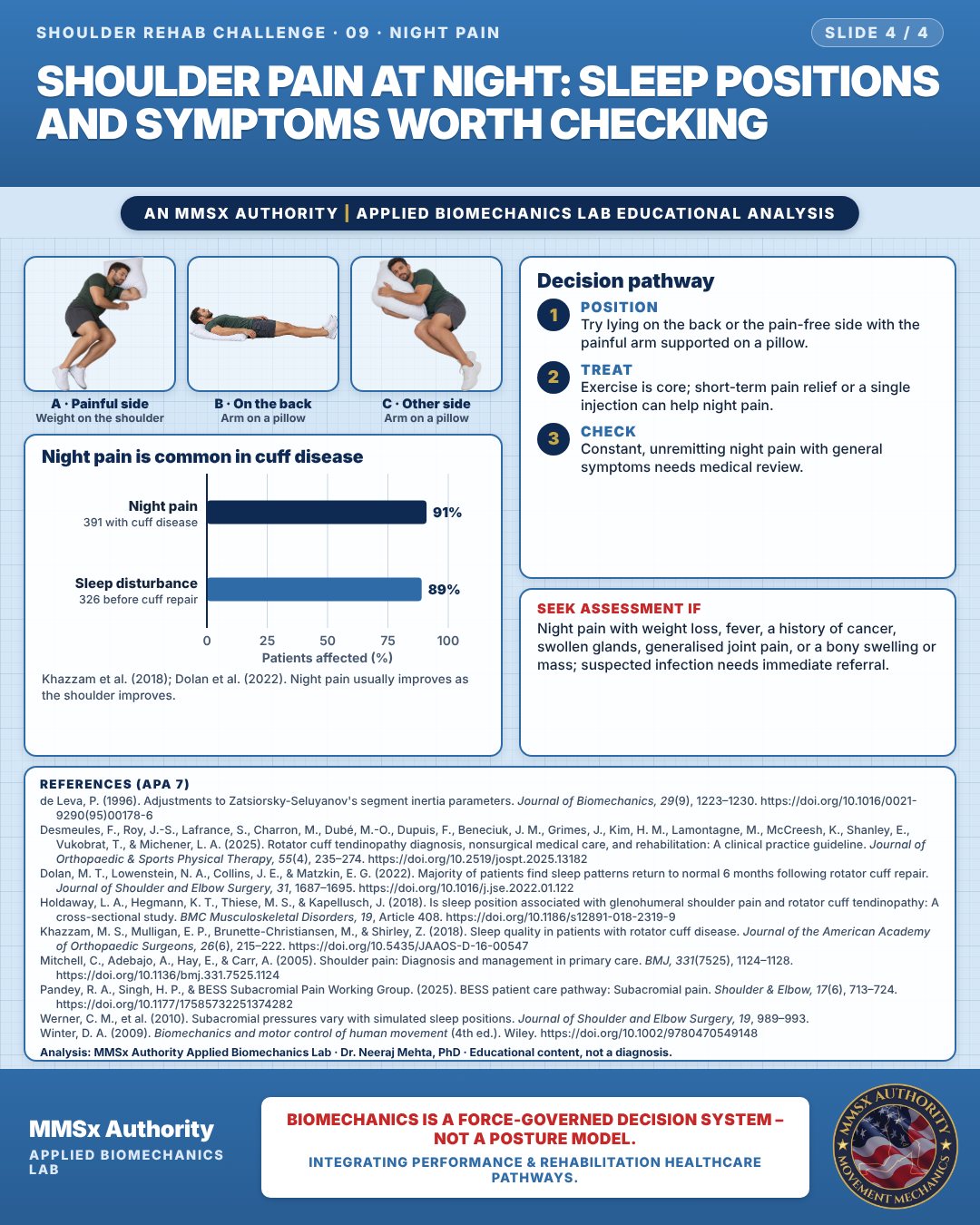
Night pain is common in cuff disease
Position
Try lying on the back or the pain-free side with the painful arm supported on a pillow.
Treat
Exercise is core; short-term pain relief or a single injection can help night pain.
Check
Constant, unremitting night pain with general symptoms needs medical review.
What the evidence supports
- Treat the underlying condition. Exercise is the core of care for rotator cuff tendinopathy (Grade A), and NSAIDs (Grade B) or a corticosteroid injection (Grade B/C) can help short-term pain, including at night (Desmeules et al., 2025). A single subacromial injection can be considered if there is no improvement by 6–8 weeks (Pandey et al., 2025).
- Positioning for comfort: supine with the arm supported, or side-lying on the non-painful side with the arm on a pillow. This is consistent with lower subacromial pressure in supine positions (Werner et al., 2010), but it is a comfort measure, not a cure.
Myth and evidence
Myth“Sleeping on my side gave me this shoulder problem.”
EvidenceIn 761 workers, no sleep posture was clearly associated with rotator cuff tendinopathy (soldier vs others OR 0.95, 0.50–1.83) (Holdaway et al., 2018). Night pain is a feature of the condition itself, reported by 91% of people with cuff disease (Khazzam et al., 2018), and it usually improves as the shoulder improves (Dolan et al., 2022).
Cautions
Seek assessment if
Night pain with weight loss, fever, a history of cancer, swollen glands, generalised joint pain, or a bony swelling or mass; suspected infection needs immediate referral.
Methods note
2-D estimates from pose landmarks on an illustrated figure; CoM from de Leva (1996) segment parameters; cm for a 1.70 m adult (Winter, 2009). Skeleton only: pose landmarks are less reliable in lying positions, so no angles or levers are quoted. These are educational estimates, not a diagnosis.
References
- de Leva, P. (1996). Adjustments to Zatsiorsky-Seluyanov's segment inertia parameters. Journal of Biomechanics, 29(9), 1223–1230. https://doi.org/10.1016/0021-9290(95)00178-6
- Desmeules, F., Roy, J.-S., Lafrance, S., Charron, M., Dubé, M.-O., Dupuis, F., Beneciuk, J. M., Grimes, J., Kim, H. M., Lamontagne, M., McCreesh, K., Shanley, E., Vukobrat, T., & Michener, L. A. (2025). Rotator cuff tendinopathy diagnosis, nonsurgical medical care, and rehabilitation: A clinical practice guideline. Journal of Orthopaedic & Sports Physical Therapy, 55(4), 235–274. https://doi.org/10.2519/jospt.2025.13182
- Dolan, M. T., Lowenstein, N. A., Collins, J. E., & Matzkin, E. G. (2022). Majority of patients find sleep patterns return to normal 6 months following rotator cuff repair. Journal of Shoulder and Elbow Surgery, 31, 1687–1695. https://doi.org/10.1016/j.jse.2022.01.122
- Holdaway, L. A., Hegmann, K. T., Thiese, M. S., & Kapellusch, J. (2018). Is sleep position associated with glenohumeral shoulder pain and rotator cuff tendinopathy: A cross-sectional study. BMC Musculoskeletal Disorders, 19, Article 408. https://doi.org/10.1186/s12891-018-2319-9
- Khazzam, M. S., Mulligan, E. P., Brunette-Christiansen, M., & Shirley, Z. (2018). Sleep quality in patients with rotator cuff disease. Journal of the American Academy of Orthopaedic Surgeons, 26(6), 215–222. https://doi.org/10.5435/JAAOS-D-16-00547
- Mitchell, C., Adebajo, A., Hay, E., & Carr, A. (2005). Shoulder pain: Diagnosis and management in primary care. BMJ, 331(7525), 1124–1128. https://doi.org/10.1136/bmj.331.7525.1124
- Pandey, R. A., Singh, H. P., & BESS Subacromial Pain Working Group. (2025). BESS patient care pathway: Subacromial pain. Shoulder & Elbow, 17(6), 713–724. https://doi.org/10.1177/17585732251374282
- Werner, C. M., et al. (2010). Subacromial pressures vary with simulated sleep positions. Journal of Shoulder and Elbow Surgery, 19, 989–993.
- Winter, D. A. (2009). Biomechanics and motor control of human movement (4th ed.). Wiley. https://doi.org/10.1002/9780470549148
Cite this article
Mehta, N. (2026, October 24). Shoulder pain at night: sleep positions and symptoms worth checking. MMSx Authority Applied Biomechanics Lab. https://mmsxauthority.org/edu/analysis/shoulder/09-shoulder-pain-at-night-sleep-positions-and-symptoms-worth-checking/
Part of the collection
Mehta, N. (2026). Shoulder Rehabilitation: 50 Evidence-Based Biomechanics Analyses [Collection]. MMSx Authority Applied Biomechanics Lab. Zenodo. https://doi.org/10.5281/zenodo.23735725
All Shoulder Rehab Challenge articles · Rehabilitation Library