Shoulder Rehab Challenge · 08
Frozen shoulder and diabetes: why stiffness behaves differently
Frozen shoulder in people with diabetes is adhesive capsulitis occurring with diabetes mellitus, a recognised risk factor (Grade B) (Kelley et al., 2013).
Key points
- Screen. Ask about diabetes and thyroid disease when stiffness has no clear cause.
- Inject + stretch. A joint steroid injection with mobility and stretching exercises; dose stretching to irritability.
- Expect longer. Symptoms may last longer with diabetes; review progress rather than a fixed timetable.
What it is
Frozen shoulder in people with diabetes is adhesive capsulitis occurring with diabetes mellitus, a recognised risk factor (Grade B) (Kelley et al., 2013). It is more common in people with diabetes than in those without, and it is often described as more persistent.
How we analysed the movement
Three movements relevant to this topic were analysed from illustrated reference figures. Joint centres were located with two-dimensional pose estimation; arm elevation and elbow angles, shoulder level, the whole-body centre of mass and, where relevant, the arm lever (the horizontal distance from the shoulder joint to the centre of mass of the arm, with any hand load) and the resulting shoulder moment were then calculated from standard segment parameters. The figures are educational estimates that show how position changes mechanical demand; they are not measurements of a patient. Every research value quoted below comes from the published source cited beside it.
Movement A: Towel stretch (rear view)
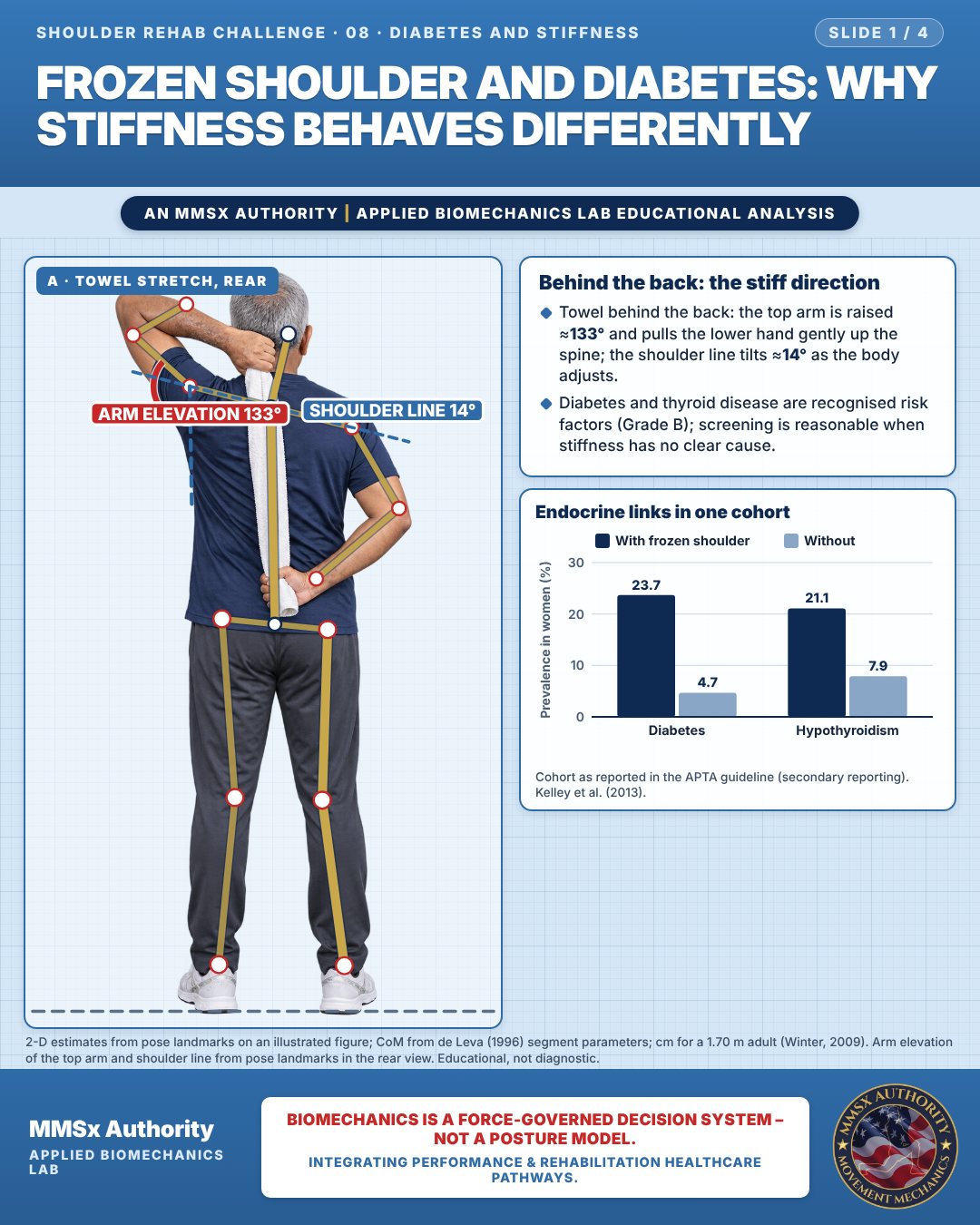
Behind the back: the stiff direction
Towel behind the back: the top arm is raised ≈133° and pulls the lower hand gently up the spine; the shoulder line tilts ≈14° as the body adjusts.
Diabetes and thyroid disease are recognised risk factors (Grade B); screening is reasonable when stiffness has no clear cause.
Endocrine links in one cohort
Movement B: Cross-body stretch (front view)
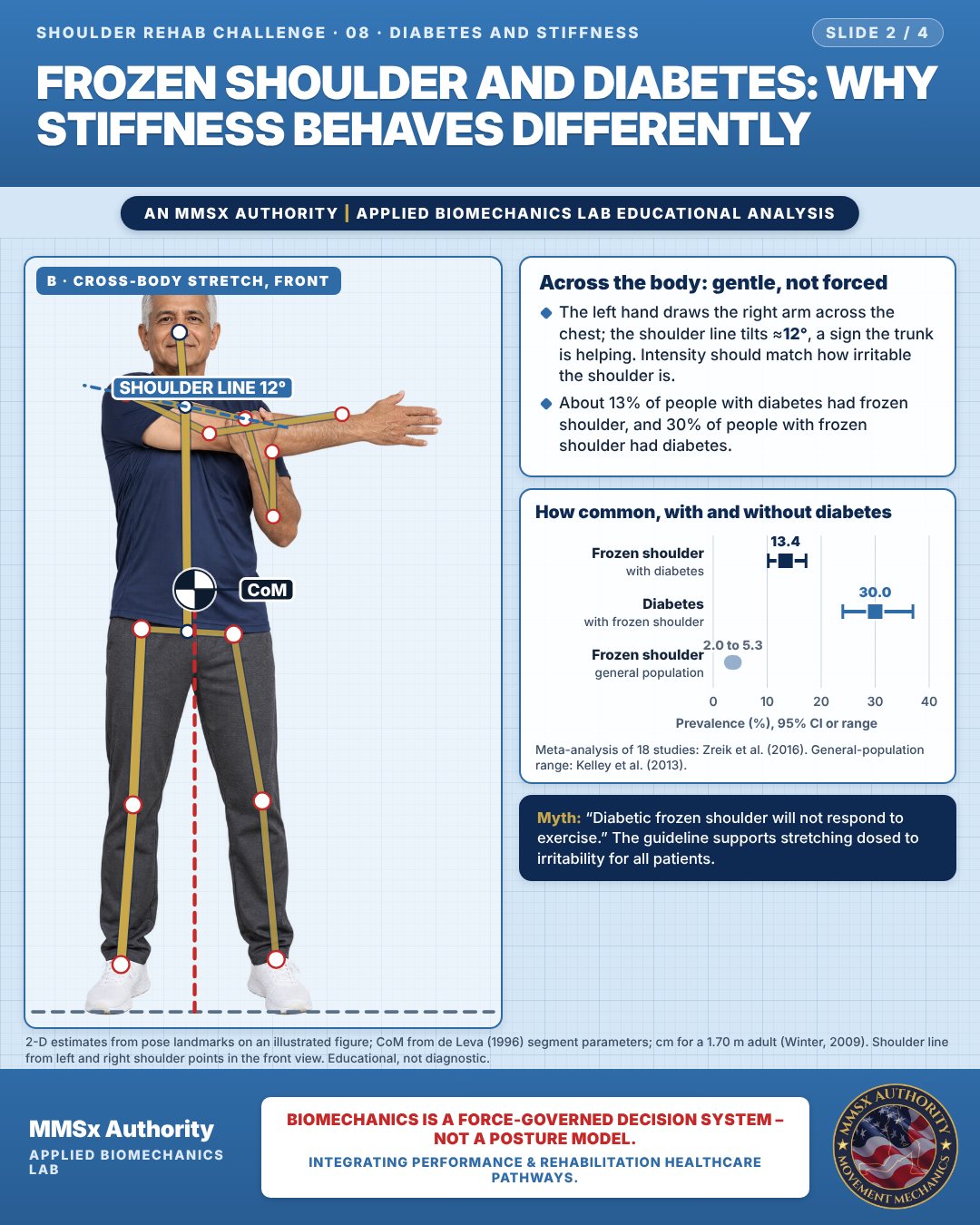
Across the body: gentle, not forced
The left hand draws the right arm across the chest; the shoulder line tilts ≈12°, a sign the trunk is helping. Intensity should match how irritable the shoulder is.
About 13% of people with diabetes had frozen shoulder, and 30% of people with frozen shoulder had diabetes.
How common, with and without diabetes
Movement C: Stick rotation (front view)
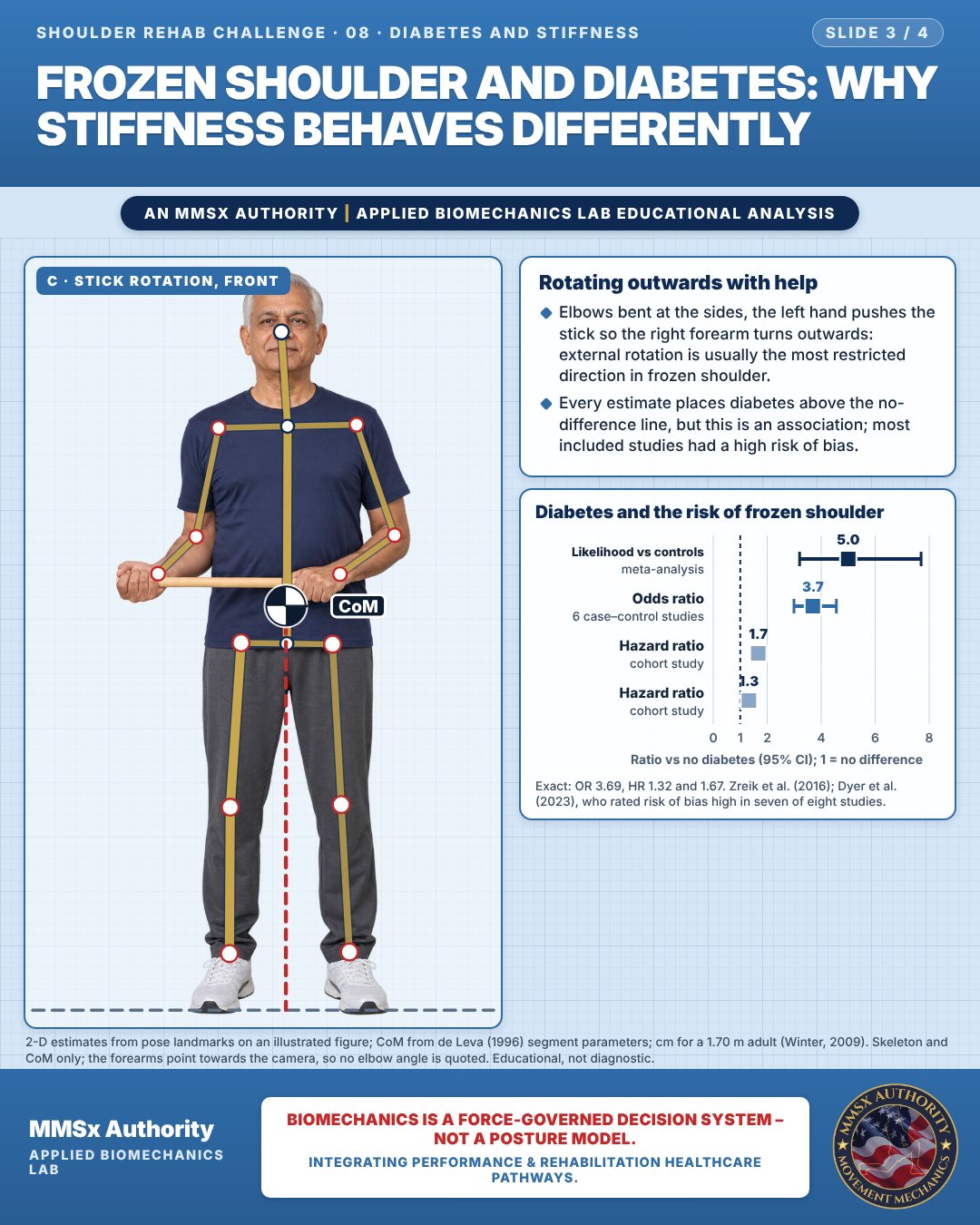
Rotating outwards with help
Elbows bent at the sides, the left hand pushes the stick so the right forearm turns outwards: external rotation is usually the most restricted direction in frozen shoulder.
Every estimate places diabetes above the no-difference line, but this is an association; most included studies had a high risk of bias.
Diabetes and the risk of frozen shoulder
Decision pathway
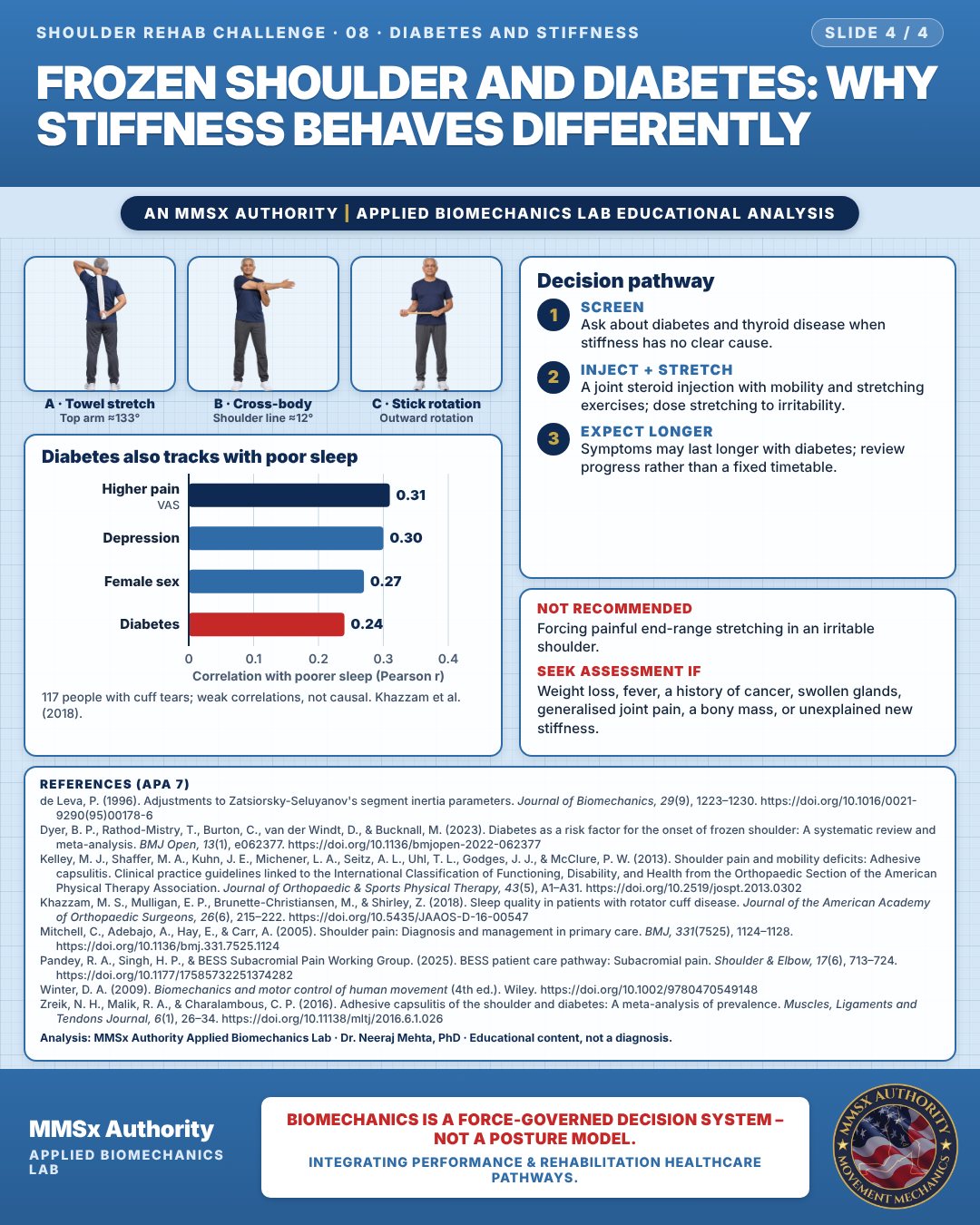
Diabetes also tracks with poor sleep
Screen
Ask about diabetes and thyroid disease when stiffness has no clear cause.
Inject + stretch
A joint steroid injection with mobility and stretching exercises; dose stretching to irritability.
Expect longer
Symptoms may last longer with diabetes; review progress rather than a fixed timetable.
What the evidence supports
- The same graded framework applies: intra-articular corticosteroid combined with mobility and stretching exercises (Grade A), education about the natural course (Grade B), and stretching intensity matched to tissue irritability (Grade B). Clinicians should recognise diabetes and thyroid disease as risk factors (Grade B) (Kelley et al., 2013).
Cautions
Not recommended
Forcing painful end-range stretching in an irritable shoulder.
Seek assessment if
Weight loss, fever, a history of cancer, swollen glands, generalised joint pain, a bony mass, or unexplained new stiffness.
Methods note
2-D estimates from pose landmarks on an illustrated figure; CoM from de Leva (1996) segment parameters; cm for a 1.70 m adult (Winter, 2009). Arm elevation of the top arm and shoulder line from pose landmarks in the rear view. Shoulder line from left and right shoulder points in the front view. Skeleton and CoM only; the forearms point towards the camera, so no elbow angle is quoted. These are educational estimates, not a diagnosis.
References
- de Leva, P. (1996). Adjustments to Zatsiorsky-Seluyanov's segment inertia parameters. Journal of Biomechanics, 29(9), 1223–1230. https://doi.org/10.1016/0021-9290(95)00178-6
- Dyer, B. P., Rathod-Mistry, T., Burton, C., van der Windt, D., & Bucknall, M. (2023). Diabetes as a risk factor for the onset of frozen shoulder: A systematic review and meta-analysis. BMJ Open, 13(1), e062377. https://doi.org/10.1136/bmjopen-2022-062377
- Kelley, M. J., Shaffer, M. A., Kuhn, J. E., Michener, L. A., Seitz, A. L., Uhl, T. L., Godges, J. J., & McClure, P. W. (2013). Shoulder pain and mobility deficits: Adhesive capsulitis. Clinical practice guidelines linked to the International Classification of Functioning, Disability, and Health from the Orthopaedic Section of the American Physical Therapy Association. Journal of Orthopaedic & Sports Physical Therapy, 43(5), A1–A31. https://doi.org/10.2519/jospt.2013.0302
- Khazzam, M. S., Mulligan, E. P., Brunette-Christiansen, M., & Shirley, Z. (2018). Sleep quality in patients with rotator cuff disease. Journal of the American Academy of Orthopaedic Surgeons, 26(6), 215–222. https://doi.org/10.5435/JAAOS-D-16-00547
- Mitchell, C., Adebajo, A., Hay, E., & Carr, A. (2005). Shoulder pain: Diagnosis and management in primary care. BMJ, 331(7525), 1124–1128. https://doi.org/10.1136/bmj.331.7525.1124
- Pandey, R. A., Singh, H. P., & BESS Subacromial Pain Working Group. (2025). BESS patient care pathway: Subacromial pain. Shoulder & Elbow, 17(6), 713–724. https://doi.org/10.1177/17585732251374282
- Winter, D. A. (2009). Biomechanics and motor control of human movement (4th ed.). Wiley. https://doi.org/10.1002/9780470549148
- Zreik, N. H., Malik, R. A., & Charalambous, C. P. (2016). Adhesive capsulitis of the shoulder and diabetes: A meta-analysis of prevalence. Muscles, Ligaments and Tendons Journal, 6(1), 26–34. https://doi.org/10.11138/mltj/2016.6.1.026
Cite this article
Mehta, N. (2026, October 24). Frozen shoulder and diabetes: why stiffness behaves differently. MMSx Authority Applied Biomechanics Lab. https://mmsxauthority.org/edu/analysis/shoulder/08-frozen-shoulder-and-diabetes-why-stiffness-behaves-differently/
Part of the collection
Mehta, N. (2026). Shoulder Rehabilitation: 50 Evidence-Based Biomechanics Analyses [Collection]. MMSx Authority Applied Biomechanics Lab. Zenodo. https://doi.org/10.5281/zenodo.23735725
All Shoulder Rehab Challenge articles · Rehabilitation Library