Shoulder Rehab Challenge · 07
Frozen shoulder: the freezing, frozen and thawing phases explained
Frozen shoulder (adhesive capsulitis) is a condition of the glenohumeral capsule. Movement analysis, verified research data and a decision pathway.
Key points
- Explain. Describe the natural course; match stretching intensity to how irritable the shoulder is.
- Inject + move. A joint steroid injection with mobility and stretching exercises has the strongest grade.
- Review. X-ray with severe pain or stiffness; consider other diagnoses if the picture does not fit.
What it is
Frozen shoulder (adhesive capsulitis) is a condition of the glenohumeral capsule. It has a gradual, progressive onset of pain followed by marked loss of both active and passive motion, especially external rotation (Kelley et al., 2013). UK FROST defined it by a restriction of passive external rotation of 50% or more in the affected shoulder (Rangan et al., 2020).
How we analysed the movement
Three movements relevant to this topic were analysed from illustrated reference figures. Joint centres were located with two-dimensional pose estimation; arm elevation and elbow angles, shoulder level, the whole-body centre of mass and, where relevant, the arm lever (the horizontal distance from the shoulder joint to the centre of mass of the arm, with any hand load) and the resulting shoulder moment were then calculated from standard segment parameters. The figures are educational estimates that show how position changes mechanical demand; they are not measurements of a patient. Every research value quoted below comes from the published source cited beside it.
Movement A: Pendulum swing (side view)
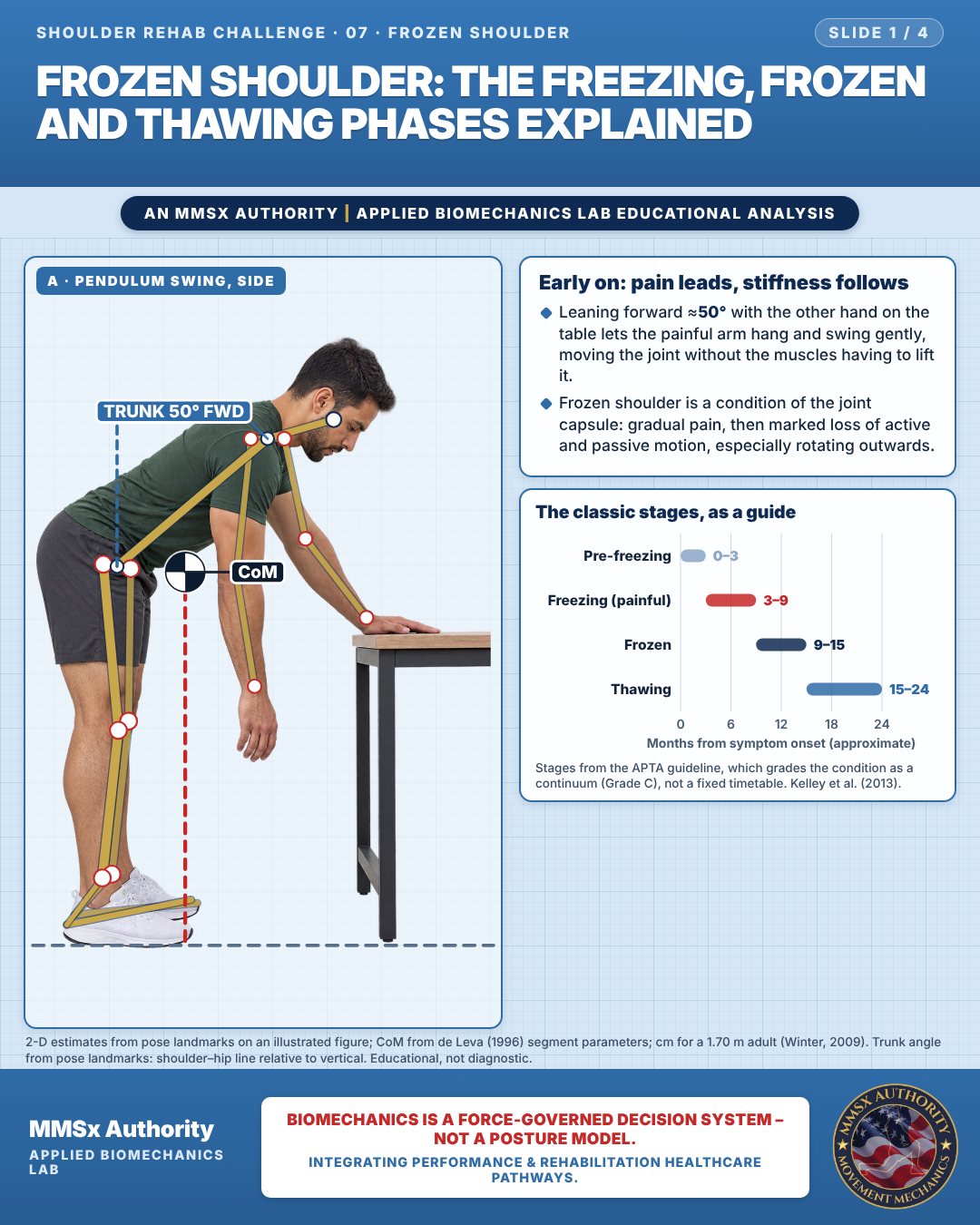
Early on: pain leads, stiffness follows
Leaning forward ≈50° with the other hand on the table lets the painful arm hang and swing gently, moving the joint without the muscles having to lift it.
Frozen shoulder is a condition of the joint capsule: gradual pain, then marked loss of active and passive motion, especially rotating outwards.
The classic stages, as a guide
Movement B: Table slide (side view)
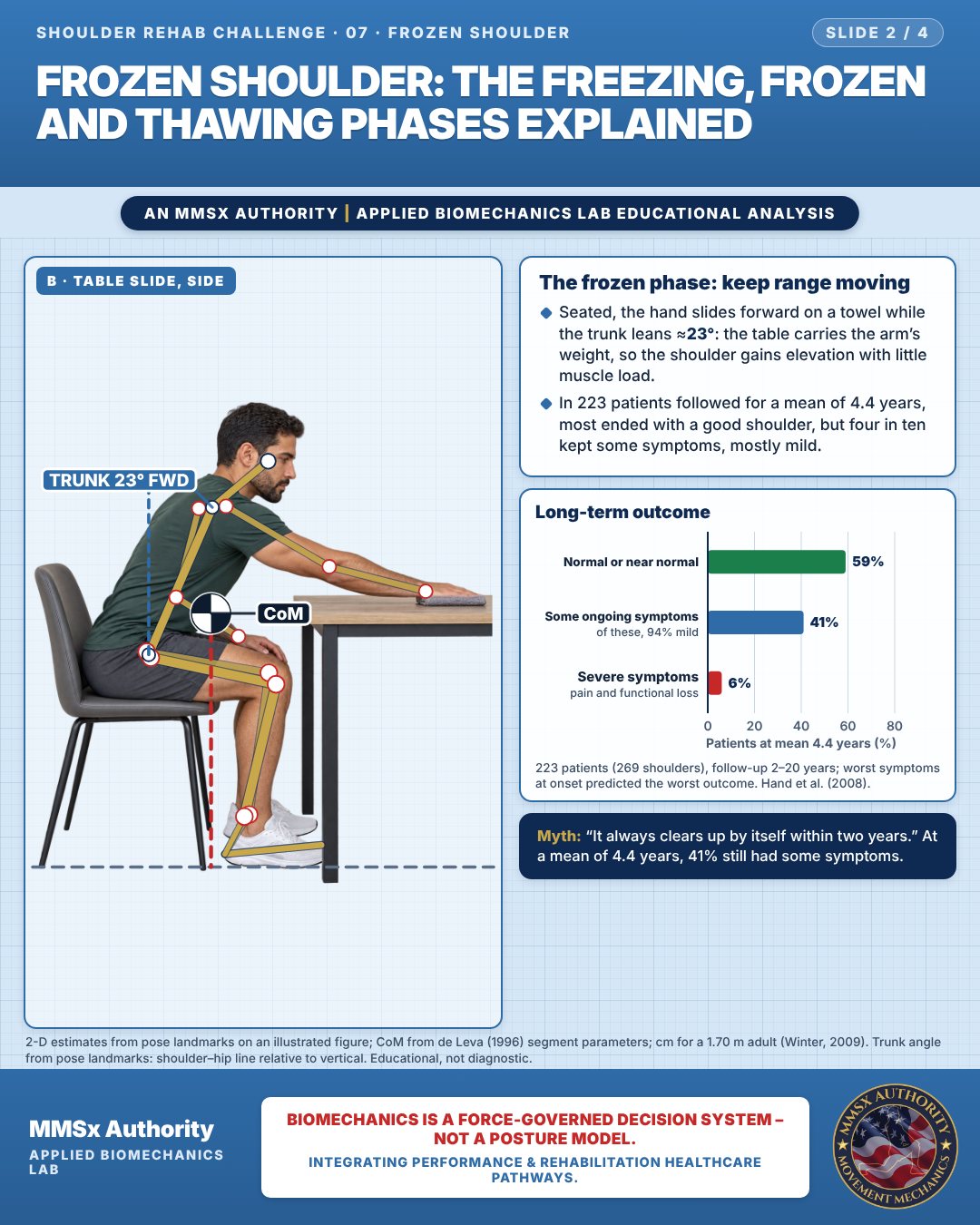
The frozen phase: keep range moving
Seated, the hand slides forward on a towel while the trunk leans ≈23°: the table carries the arm’s weight, so the shoulder gains elevation with little muscle load.
In 223 patients followed for a mean of 4.4 years, most ended with a good shoulder, but four in ten kept some symptoms, mostly mild.
Long-term outcome
Movement C: Stick-assisted raise (side view)
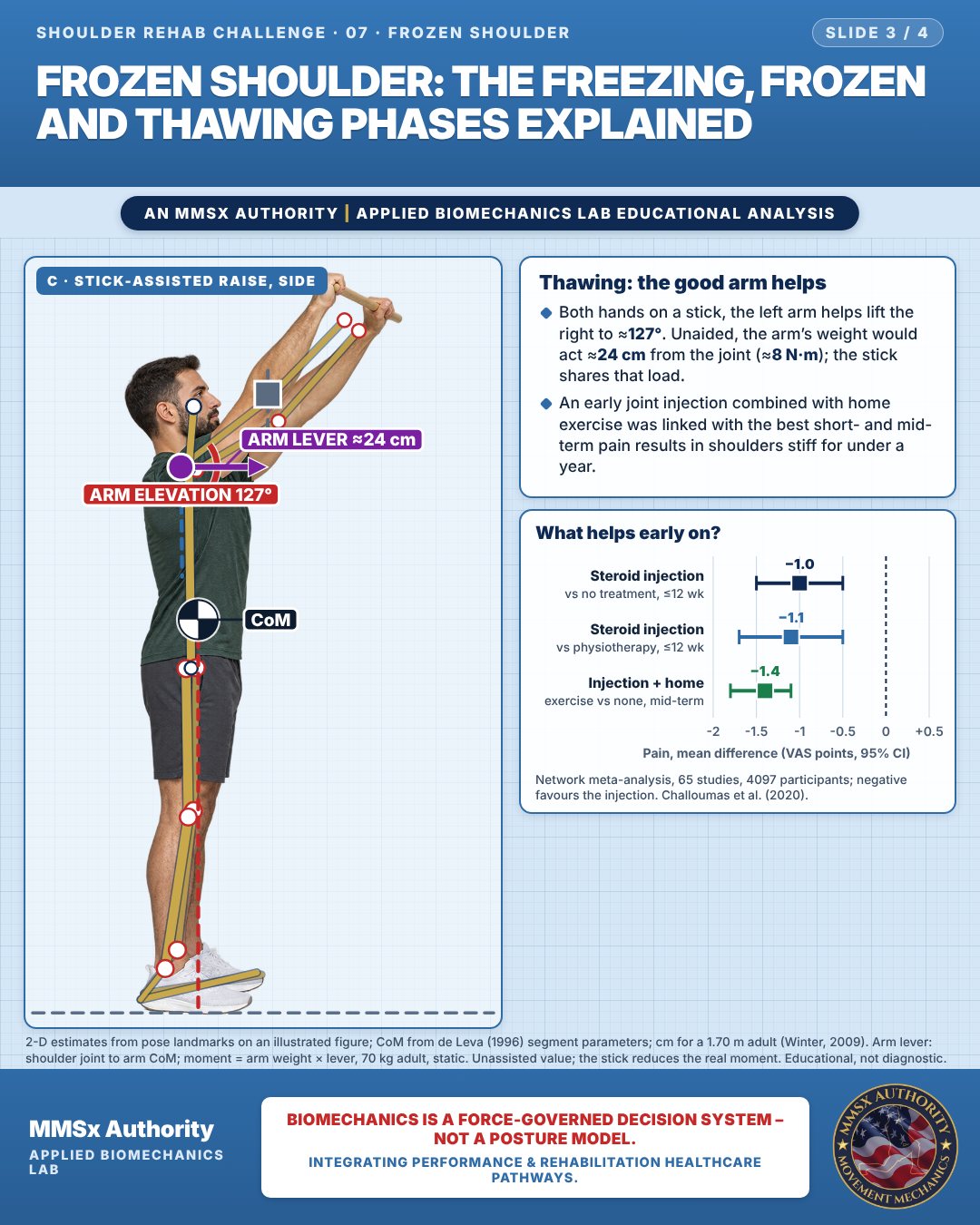
Thawing: the good arm helps
Both hands on a stick, the left arm helps lift the right to ≈127°. Unaided, the arm’s weight would act ≈24 cm from the joint (≈8 N·m); the stick shares that load.
An early joint injection combined with home exercise was linked with the best short- and mid-term pain results in shoulders stiff for under a year.
What helps early on?
Decision pathway
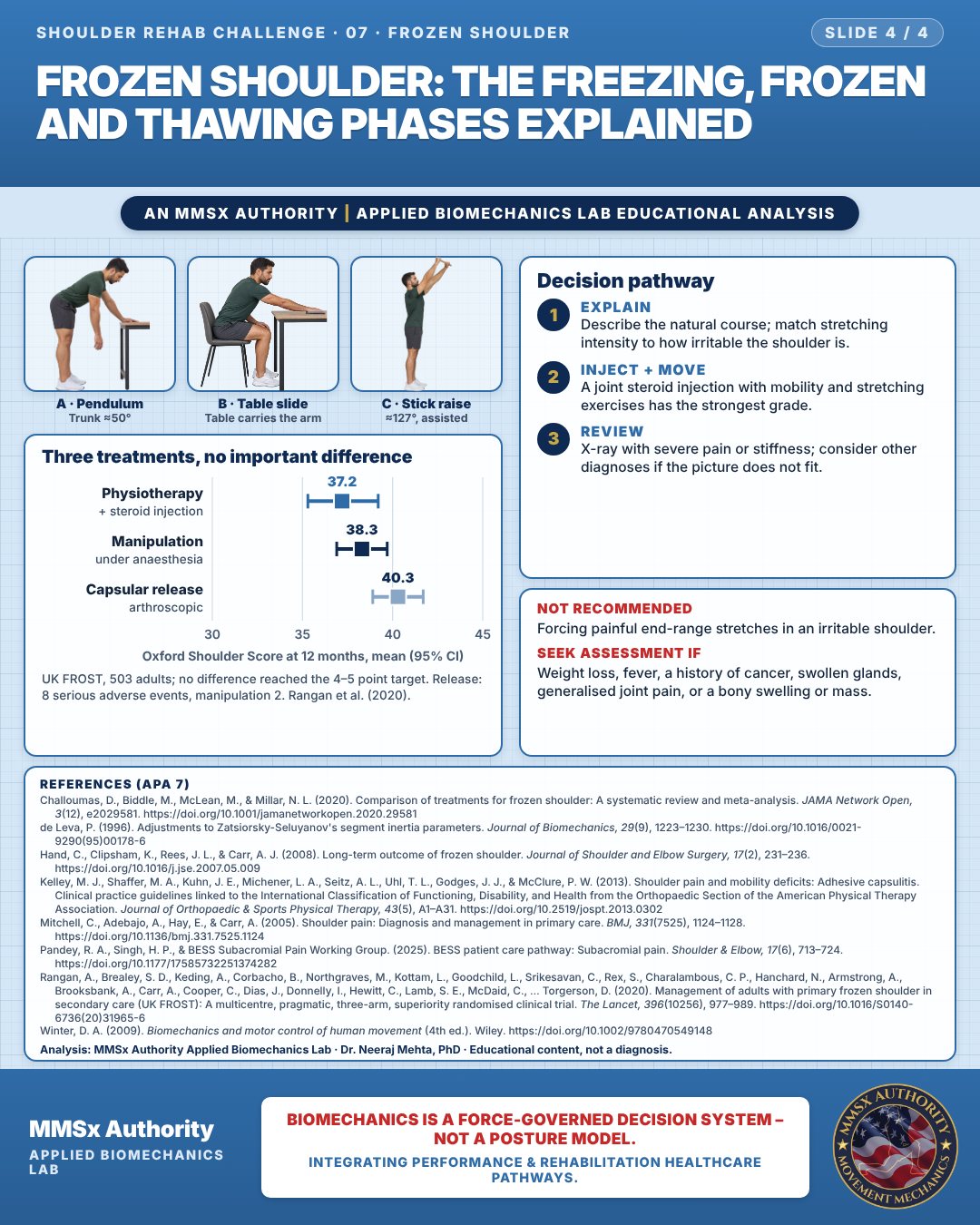
Three treatments, no important difference
Explain
Describe the natural course; match stretching intensity to how irritable the shoulder is.
Inject + move
A joint steroid injection with mobility and stretching exercises has the strongest grade.
Review
X-ray with severe pain or stiffness; consider other diagnoses if the picture does not fit.
What the evidence supports
- Recommended: intra-articular corticosteroid injection combined with shoulder mobility and stretching exercises (Grade A); patient education that describes the natural course and matches stretching intensity to irritability (Grade B); stretching exercises with intensity set by tissue irritability (Grade B). Joint mobilisation, translational manipulation under anaesthesia, and modalities such as shortwave diathermy, ultrasound and electrical stimulation are weaker options (Grade C) (Kelley et al., 2013).
- UK FROST: early structured physiotherapy with steroid injection, manipulation under anaesthesia and capsular release all improved patients, with no clinically important differences at 12 months (Rangan et al., 2020).
Myth and evidence
Myth“Frozen shoulder always clears up by itself within two years.”
EvidenceAt a mean of 4.4 years, 41% still had some symptoms, mostly mild (Hand et al., 2008). The clinical practice guideline describes a continuum rather than fixed phases (Kelley et al., 2013). A systematic review of natural history found improvement in range of motion only after 1 to 4 years of follow-up and questioned the idea of a self-limiting course.
Cautions
Not recommended
Forcing painful end-range stretches in an irritable shoulder.
Seek assessment if
Weight loss, fever, a history of cancer, swollen glands, generalised joint pain, or a bony swelling or mass.
Methods note
2-D estimates from pose landmarks on an illustrated figure; CoM from de Leva (1996) segment parameters; cm for a 1.70 m adult (Winter, 2009). Trunk angle from pose landmarks: shoulder–hip line relative to vertical. Arm lever: shoulder joint to arm CoM; moment = arm weight × lever, 70 kg adult, static. Unassisted value; the stick reduces the real moment. These are educational estimates, not a diagnosis.
References
- Challoumas, D., Biddle, M., McLean, M., & Millar, N. L. (2020). Comparison of treatments for frozen shoulder: A systematic review and meta-analysis. JAMA Network Open, 3(12), e2029581. https://doi.org/10.1001/jamanetworkopen.2020.29581
- de Leva, P. (1996). Adjustments to Zatsiorsky-Seluyanov's segment inertia parameters. Journal of Biomechanics, 29(9), 1223–1230. https://doi.org/10.1016/0021-9290(95)00178-6
- Hand, C., Clipsham, K., Rees, J. L., & Carr, A. J. (2008). Long-term outcome of frozen shoulder. Journal of Shoulder and Elbow Surgery, 17(2), 231–236. https://doi.org/10.1016/j.jse.2007.05.009
- Kelley, M. J., Shaffer, M. A., Kuhn, J. E., Michener, L. A., Seitz, A. L., Uhl, T. L., Godges, J. J., & McClure, P. W. (2013). Shoulder pain and mobility deficits: Adhesive capsulitis. Clinical practice guidelines linked to the International Classification of Functioning, Disability, and Health from the Orthopaedic Section of the American Physical Therapy Association. Journal of Orthopaedic & Sports Physical Therapy, 43(5), A1–A31. https://doi.org/10.2519/jospt.2013.0302
- Mitchell, C., Adebajo, A., Hay, E., & Carr, A. (2005). Shoulder pain: Diagnosis and management in primary care. BMJ, 331(7525), 1124–1128. https://doi.org/10.1136/bmj.331.7525.1124
- Pandey, R. A., Singh, H. P., & BESS Subacromial Pain Working Group. (2025). BESS patient care pathway: Subacromial pain. Shoulder & Elbow, 17(6), 713–724. https://doi.org/10.1177/17585732251374282
- Rangan, A., Brealey, S. D., Keding, A., Corbacho, B., Northgraves, M., Kottam, L., Goodchild, L., Srikesavan, C., Rex, S., Charalambous, C. P., Hanchard, N., Armstrong, A., Brooksbank, A., Carr, A., Cooper, C., Dias, J., Donnelly, I., Hewitt, C., Lamb, S. E., McDaid, C., … Torgerson, D. (2020). Management of adults with primary frozen shoulder in secondary care (UK FROST): A multicentre, pragmatic, three-arm, superiority randomised clinical trial. The Lancet, 396(10256), 977–989. https://doi.org/10.1016/S0140-6736(20)31965-6
- Winter, D. A. (2009). Biomechanics and motor control of human movement (4th ed.). Wiley. https://doi.org/10.1002/9780470549148
Cite this article
Mehta, N. (2026, October 24). Frozen shoulder: the freezing, frozen and thawing phases explained. MMSx Authority Applied Biomechanics Lab. https://mmsxauthority.org/edu/analysis/shoulder/07-frozen-shoulder-the-freezing-frozen-and-thawing-phases-explained/
Part of the collection
Mehta, N. (2026). Shoulder Rehabilitation: 50 Evidence-Based Biomechanics Analyses [Collection]. MMSx Authority Applied Biomechanics Lab. Zenodo. https://doi.org/10.5281/zenodo.23735725
All Shoulder Rehab Challenge articles · Rehabilitation Library