Shoulder Rehab Challenge · 05
Rotator cuff tear: does every tear need surgery?
A rotator cuff tear is a partial- or full-thickness defect in one or more rotator cuff tendons, most often supraspinatus.
Key points
- Try physiotherapy. A structured programme is a reasonable first option for atraumatic tears.
- Review at 12 weeks. Refer if there is no improvement by 12 weeks of non-operative care.
- Discuss surgery. Discuss repair if symptoms persist or a tear enlarges; without surgery, tears may grow over 5–10 years.
What it is
A rotator cuff tear is a partial- or full-thickness defect in one or more rotator cuff tendons, most often supraspinatus. Tears are either degenerative (atraumatic, age-related) or traumatic. Many degenerative tears are managed successfully without surgery (Kuhn et al., 2013; American Academy of Orthopaedic Surgeons [AAOS], 2025).
How we analysed the movement
Three movements relevant to this topic were analysed from illustrated reference figures. Joint centres were located with two-dimensional pose estimation; arm elevation and elbow angles, shoulder level, the whole-body centre of mass and, where relevant, the arm lever (the horizontal distance from the shoulder joint to the centre of mass of the arm, with any hand load) and the resulting shoulder moment were then calculated from standard segment parameters. The figures are educational estimates that show how position changes mechanical demand; they are not measurements of a patient. Every research value quoted below comes from the published source cited beside it.
Movement A: Side raise (front view)
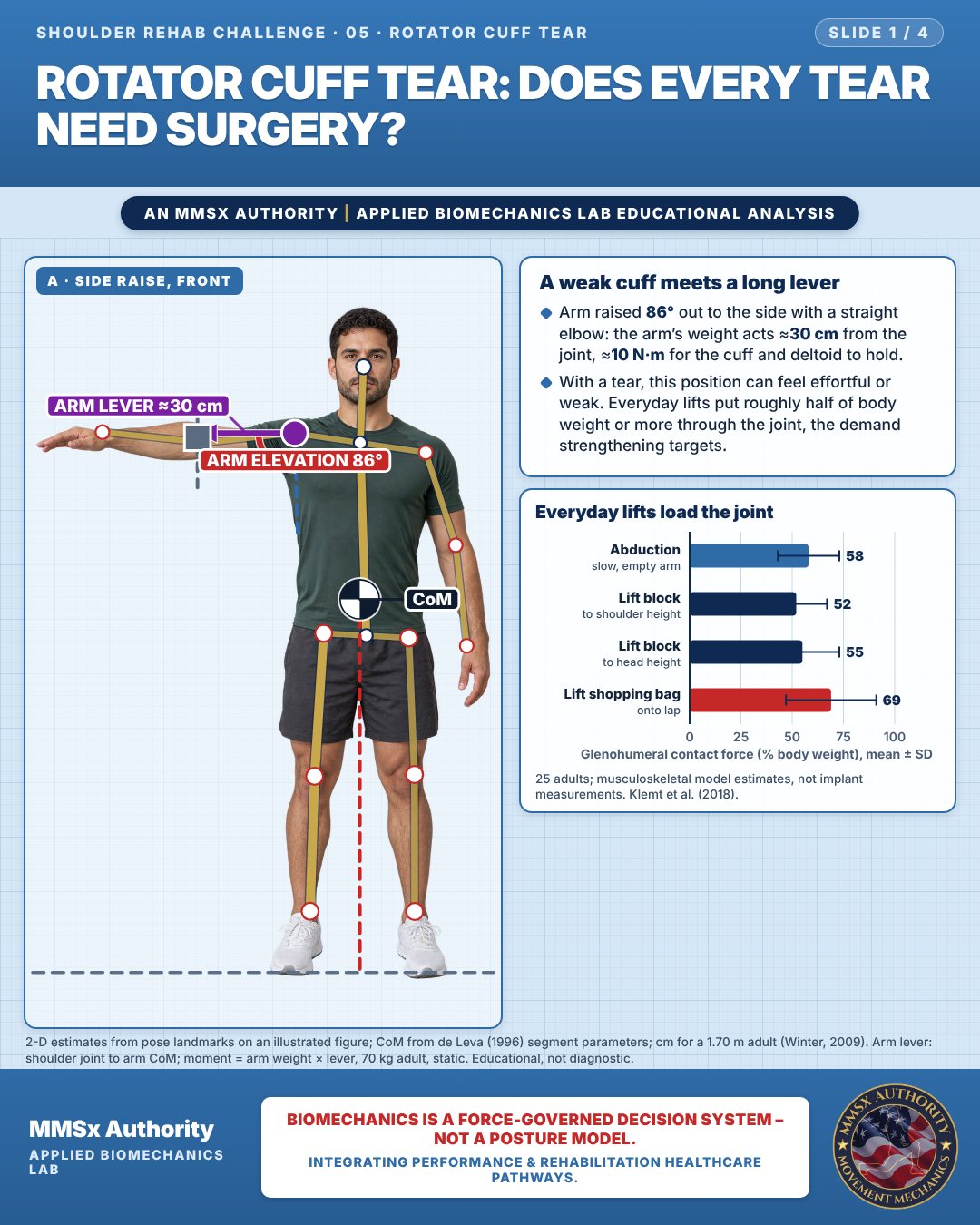
A weak cuff meets a long lever
Arm raised 86° out to the side with a straight elbow: the arm’s weight acts ≈30 cm from the joint, ≈10 N·m for the cuff and deltoid to hold.
With a tear, this position can feel effortful or weak. Everyday lifts put roughly half of body weight or more through the joint, the demand strengthening targets.
Everyday lifts load the joint
Movement B: Box to a shelf (side view)
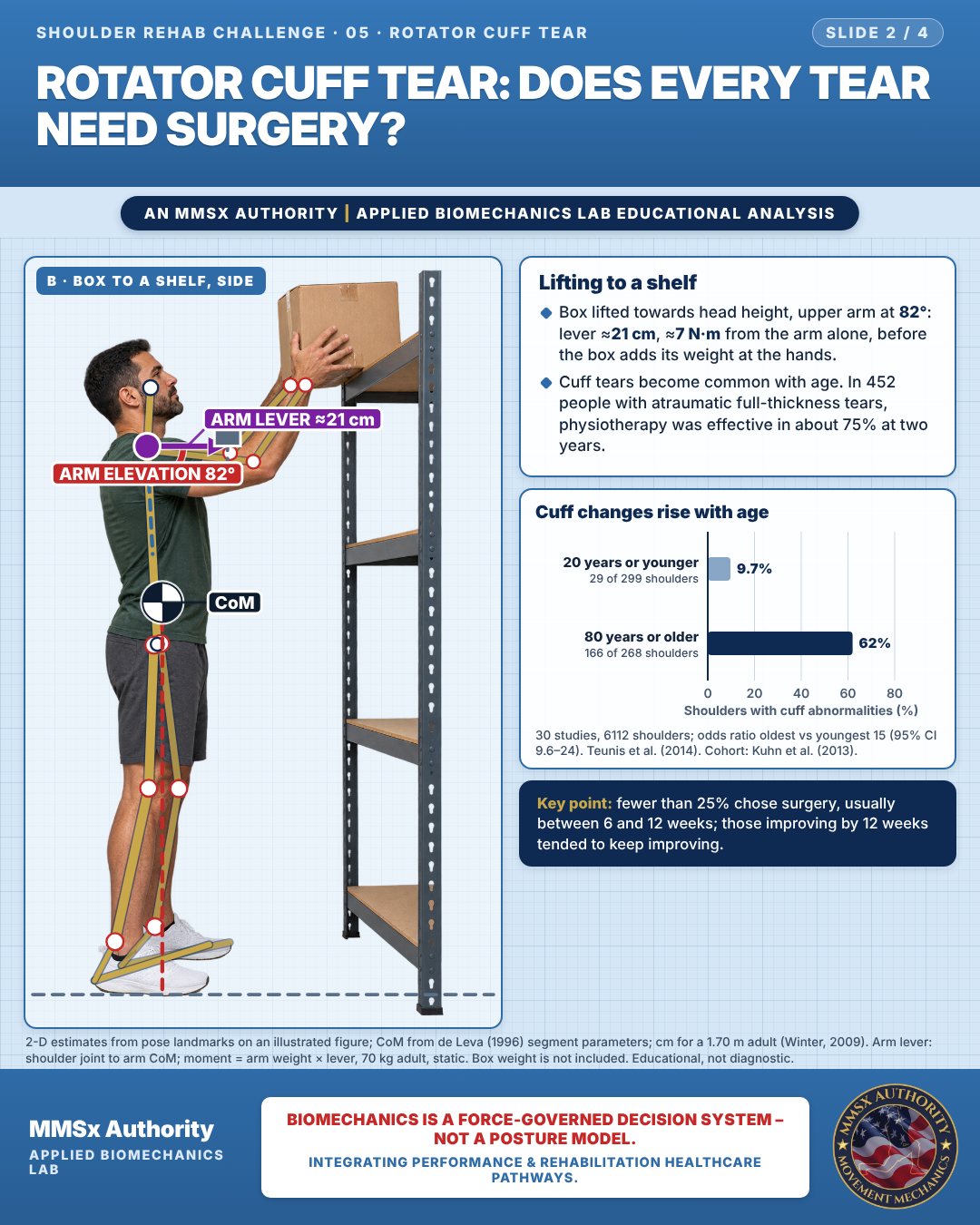
Lifting to a shelf
Box lifted towards head height, upper arm at 82°: lever ≈21 cm, ≈7 N·m from the arm alone, before the box adds its weight at the hands.
Cuff tears become common with age. In 452 people with atraumatic full-thickness tears, physiotherapy was effective in about 75% at two years.
Cuff changes rise with age
Movement C: Prone y raise (side view)
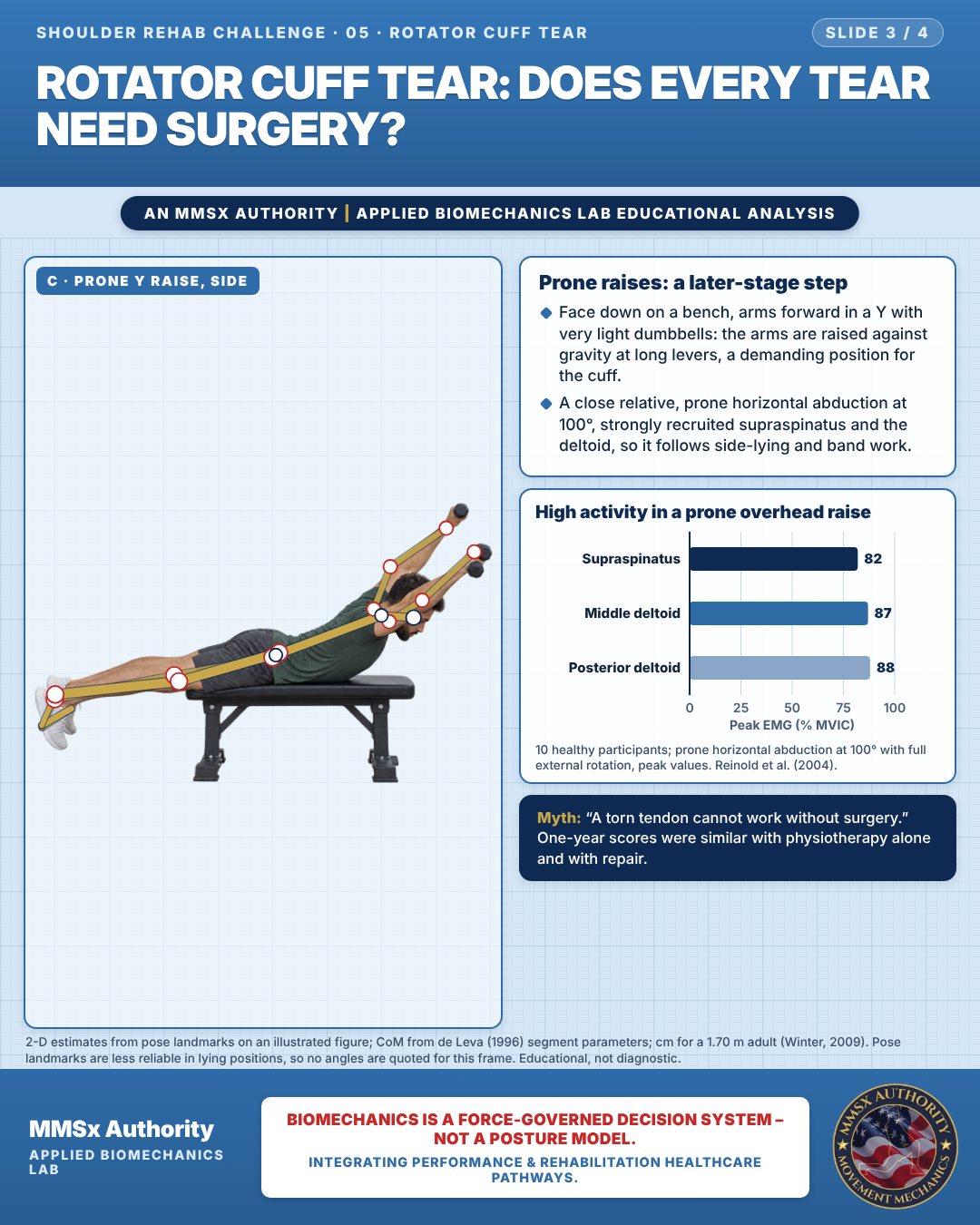
Prone raises: a later-stage step
Face down on a bench, arms forward in a Y with very light dumbbells: the arms are raised against gravity at long levers, a demanding position for the cuff.
A close relative, prone horizontal abduction at 100°, strongly recruited supraspinatus and the deltoid, so it follows side-lying and band work.
High activity in a prone overhead raise
Decision pathway
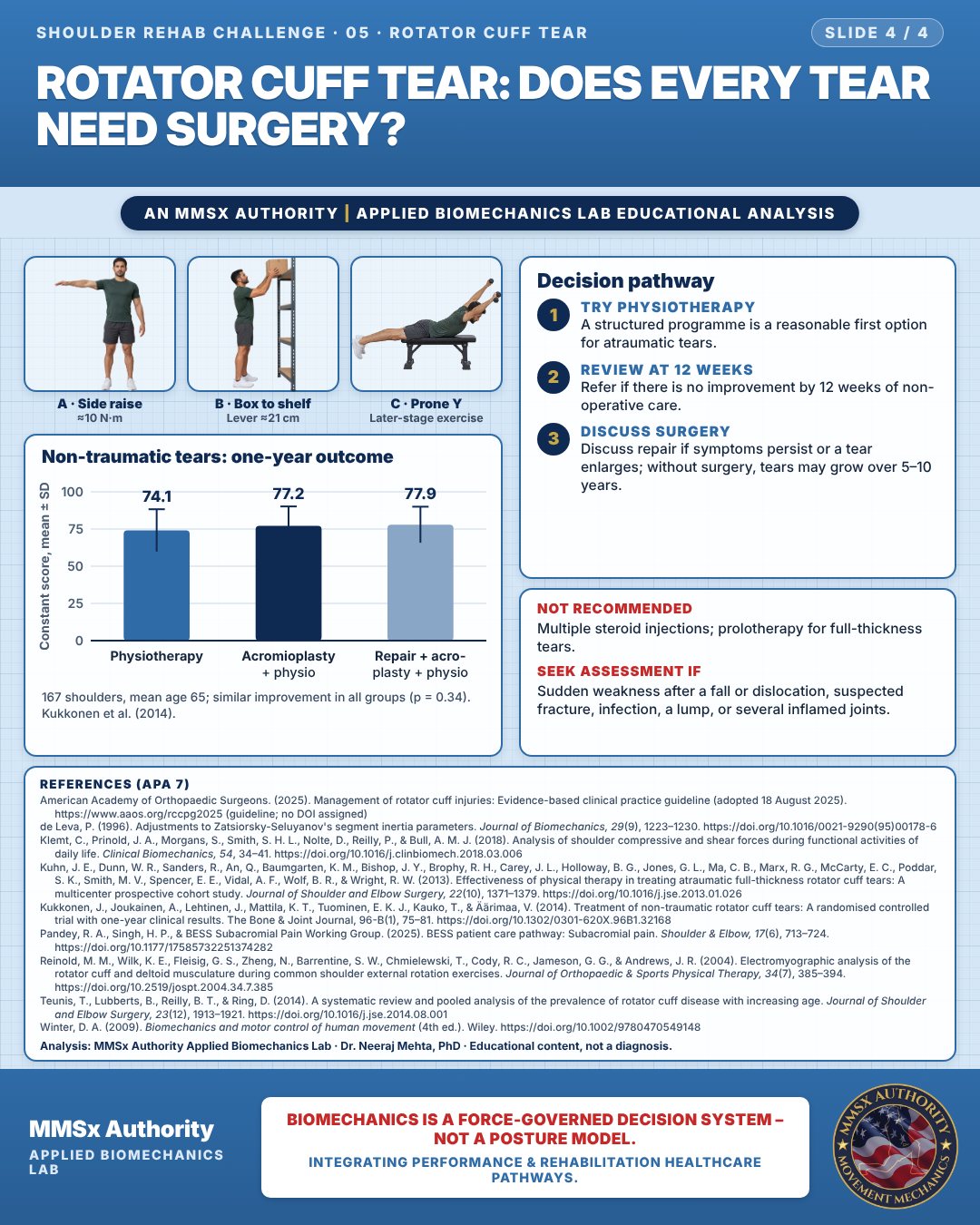
Non-traumatic tears: one-year outcome
Try physiotherapy
A structured programme is a reasonable first option for atraumatic tears.
Review at 12 weeks
Refer if there is no improvement by 12 weeks of non-operative care.
Discuss surgery
Discuss repair if symptoms persist or a tear enlarges; without surgery, tears may grow over 5–10 years.
What the evidence supports
- A structured physiotherapy programme is a reasonable first option for atraumatic tears, with about 75% success at 2 years (Kuhn et al., 2013).
Cautions
Not recommended
Multiple steroid injections; prolotherapy for full-thickness tears.
Seek assessment if
Sudden weakness after a fall or dislocation, suspected fracture, infection, a lump, or several inflamed joints.
Methods note
2-D estimates from pose landmarks on an illustrated figure; CoM from de Leva (1996) segment parameters; cm for a 1.70 m adult (Winter, 2009). Arm lever: shoulder joint to arm CoM; moment = arm weight × lever, 70 kg adult, static. Box weight is not included. Pose landmarks are less reliable in lying positions, so no angles are quoted for this frame. These are educational estimates, not a diagnosis.
References
- American Academy of Orthopaedic Surgeons. (2025). Management of rotator cuff injuries: Evidence-based clinical practice guideline (adopted 18 August 2025). https://www.aaos.org/rccpg2025 (guideline; no DOI assigned)
- de Leva, P. (1996). Adjustments to Zatsiorsky-Seluyanov's segment inertia parameters. Journal of Biomechanics, 29(9), 1223–1230. https://doi.org/10.1016/0021-9290(95)00178-6
- Klemt, C., Prinold, J. A., Morgans, S., Smith, S. H. L., Nolte, D., Reilly, P., & Bull, A. M. J. (2018). Analysis of shoulder compressive and shear forces during functional activities of daily life. Clinical Biomechanics, 54, 34–41. https://doi.org/10.1016/j.clinbiomech.2018.03.006
- Kuhn, J. E., Dunn, W. R., Sanders, R., An, Q., Baumgarten, K. M., Bishop, J. Y., Brophy, R. H., Carey, J. L., Holloway, B. G., Jones, G. L., Ma, C. B., Marx, R. G., McCarty, E. C., Poddar, S. K., Smith, M. V., Spencer, E. E., Vidal, A. F., Wolf, B. R., & Wright, R. W. (2013). Effectiveness of physical therapy in treating atraumatic full-thickness rotator cuff tears: A multicenter prospective cohort study. Journal of Shoulder and Elbow Surgery, 22(10), 1371–1379. https://doi.org/10.1016/j.jse.2013.01.026
- Kukkonen, J., Joukainen, A., Lehtinen, J., Mattila, K. T., Tuominen, E. K. J., Kauko, T., & Äärimaa, V. (2014). Treatment of non-traumatic rotator cuff tears: A randomised controlled trial with one-year clinical results. The Bone & Joint Journal, 96-B(1), 75–81. https://doi.org/10.1302/0301-620X.96B1.32168
- Pandey, R. A., Singh, H. P., & BESS Subacromial Pain Working Group. (2025). BESS patient care pathway: Subacromial pain. Shoulder & Elbow, 17(6), 713–724. https://doi.org/10.1177/17585732251374282
- Reinold, M. M., Wilk, K. E., Fleisig, G. S., Zheng, N., Barrentine, S. W., Chmielewski, T., Cody, R. C., Jameson, G. G., & Andrews, J. R. (2004). Electromyographic analysis of the rotator cuff and deltoid musculature during common shoulder external rotation exercises. Journal of Orthopaedic & Sports Physical Therapy, 34(7), 385–394. https://doi.org/10.2519/jospt.2004.34.7.385
- Teunis, T., Lubberts, B., Reilly, B. T., & Ring, D. (2014). A systematic review and pooled analysis of the prevalence of rotator cuff disease with increasing age. Journal of Shoulder and Elbow Surgery, 23(12), 1913–1921. https://doi.org/10.1016/j.jse.2014.08.001
- Winter, D. A. (2009). Biomechanics and motor control of human movement (4th ed.). Wiley. https://doi.org/10.1002/9780470549148
Cite this article
Mehta, N. (2026, October 24). Rotator cuff tear: does every tear need surgery? MMSx Authority Applied Biomechanics Lab. https://mmsxauthority.org/edu/analysis/shoulder/05-rotator-cuff-tear-does-every-tear-need-surgery/
Part of the collection
Mehta, N. (2026). Shoulder Rehabilitation: 50 Evidence-Based Biomechanics Analyses [Collection]. MMSx Authority Applied Biomechanics Lab. Zenodo. https://doi.org/10.5281/zenodo.23735725
All Shoulder Rehab Challenge articles · Rehabilitation Library