Shoulder Rehab Challenge · 04
Rotator cuff tendinopathy: how load, not rest, guides recovery
Rotator cuff tendinopathy is a painful, load-related condition of the rotator cuff tendons, with or without calcification or partial-thickness tearing.
Key points
- Load. Progressive resistance and motor-control exercise is the core treatment, with education.
- Progress. Turn up range, lever and weight as tolerance improves; return to sport on load tolerance.
- Review. Seek a specialist opinion after 12 weeks of persistent, severe symptoms.
What it is
Rotator cuff tendinopathy is a painful, load-related condition of the rotator cuff tendons, with or without calcification or partial-thickness tearing. It typically causes lateral shoulder pain on elevation and resisted rotation (scope as defined by Desmeules et al., 2025).
How we analysed the movement
Three movements relevant to this topic were analysed from illustrated reference figures. Joint centres were located with two-dimensional pose estimation; arm elevation and elbow angles, shoulder level, the whole-body centre of mass and, where relevant, the arm lever (the horizontal distance from the shoulder joint to the centre of mass of the arm, with any hand load) and the resulting shoulder moment were then calculated from standard segment parameters. The figures are educational estimates that show how position changes mechanical demand; they are not measurements of a patient. Every research value quoted below comes from the published source cited beside it.
Movement A: Band rotation (front view)
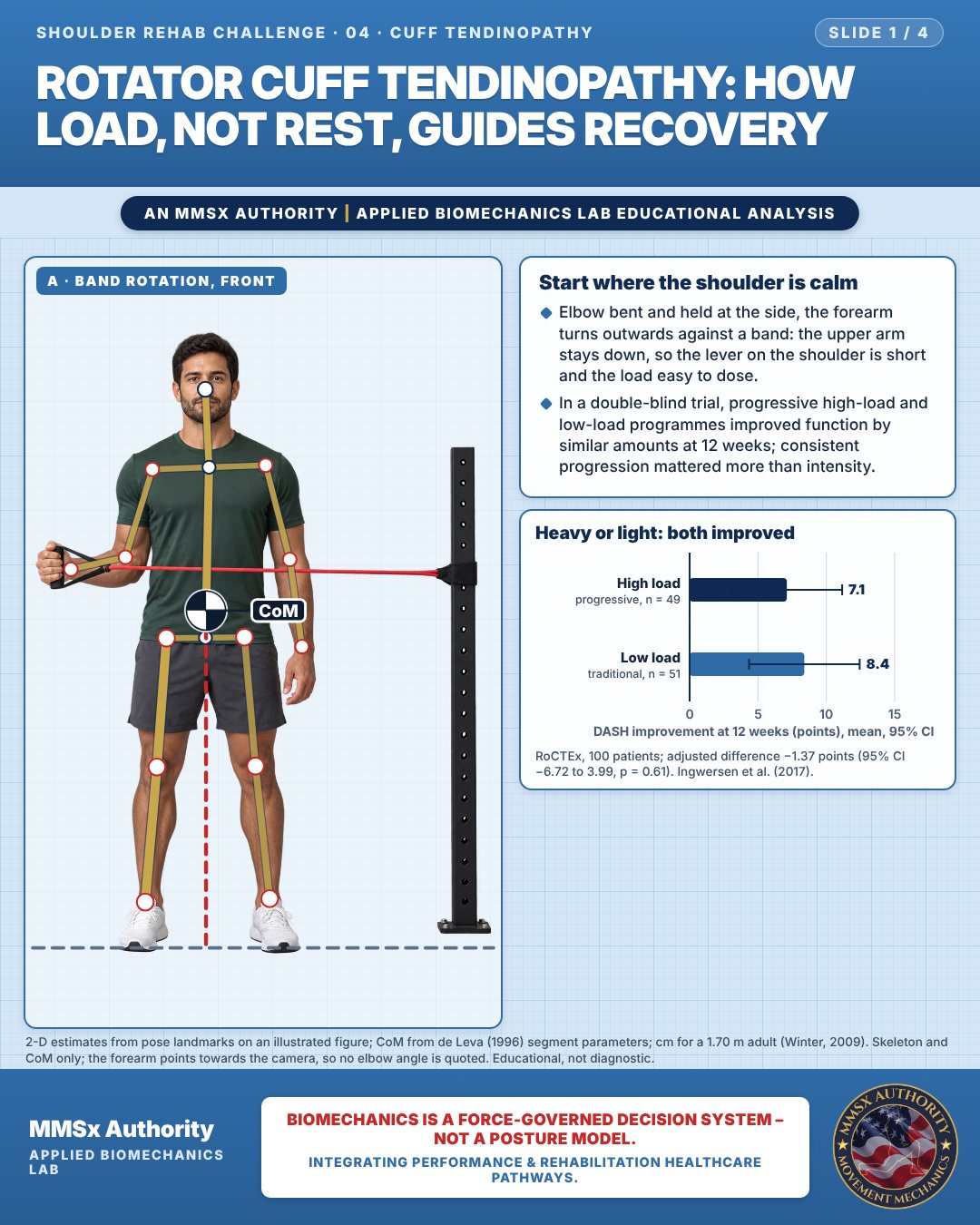
Start where the shoulder is calm
Elbow bent and held at the side, the forearm turns outwards against a band: the upper arm stays down, so the lever on the shoulder is short and the load easy to dose.
In a double-blind trial, progressive high-load and low-load programmes improved function by similar amounts at 12 weeks; consistent progression mattered more than intensity.
Heavy or light: both improved
Movement B: Lateral raise (front view)
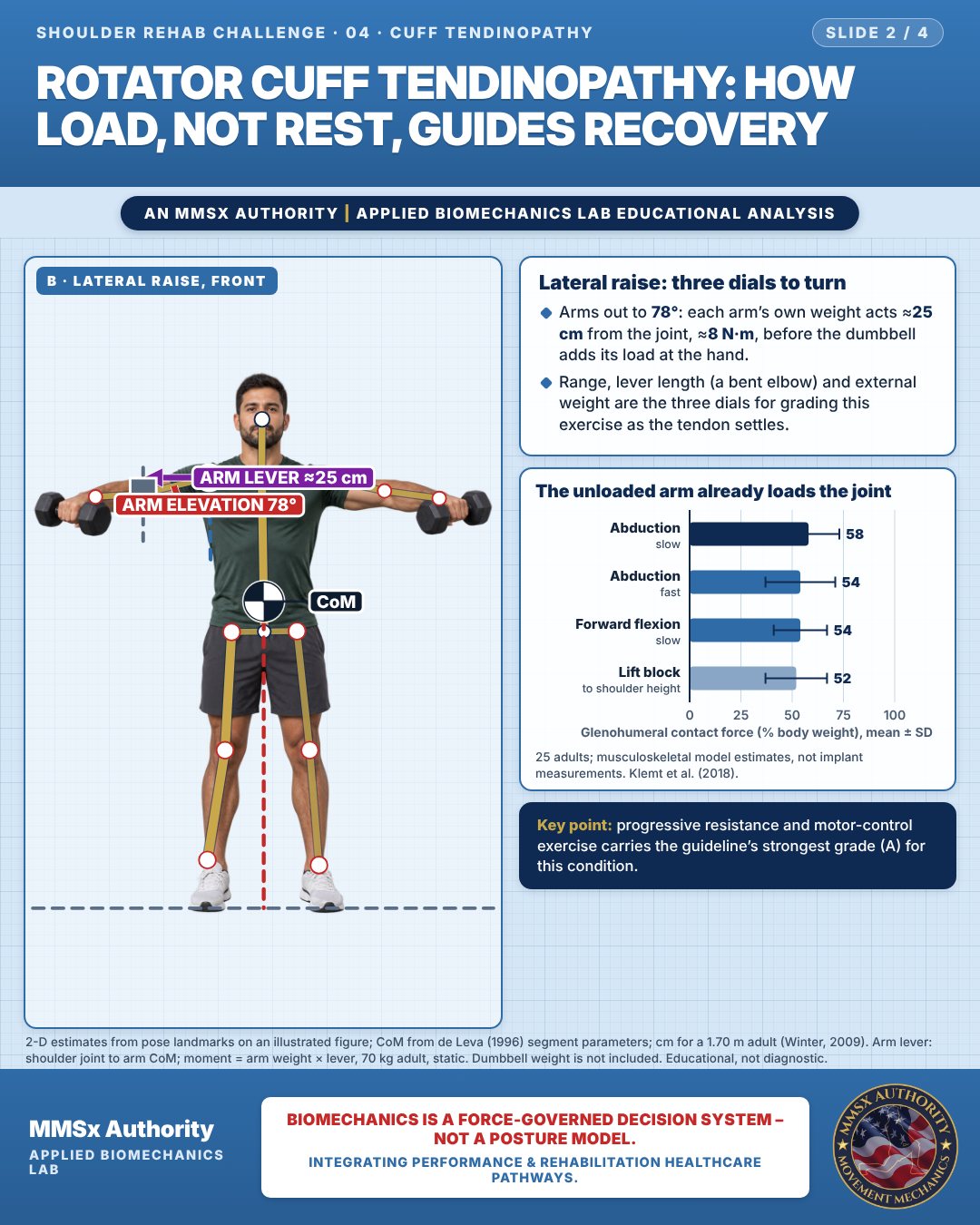
Lateral raise: three dials to turn
Arms out to 78°: each arm’s own weight acts ≈25 cm from the joint, ≈8 N·m, before the dumbbell adds its load at the hand.
Range, lever length (a bent elbow) and external weight are the three dials for grading this exercise as the tendon settles.
The unloaded arm already loads the joint
Movement C: Side-lying rotation (front view)
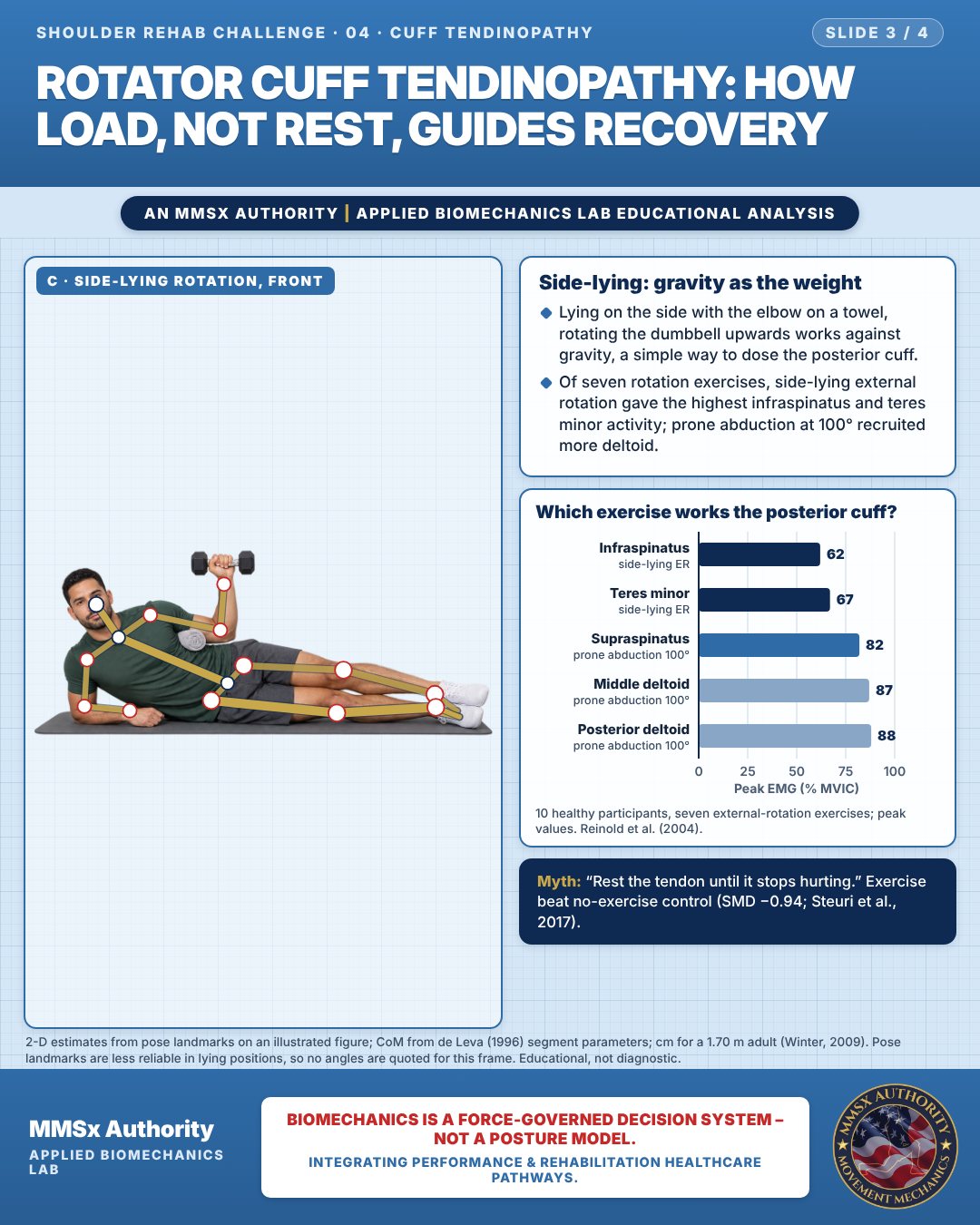
Side-lying: gravity as the weight
Lying on the side with the elbow on a towel, rotating the dumbbell upwards works against gravity, a simple way to dose the posterior cuff.
Of seven rotation exercises, side-lying external rotation gave the highest infraspinatus and teres minor activity; prone abduction at 100° recruited more deltoid.
Which exercise works the posterior cuff?
Decision pathway
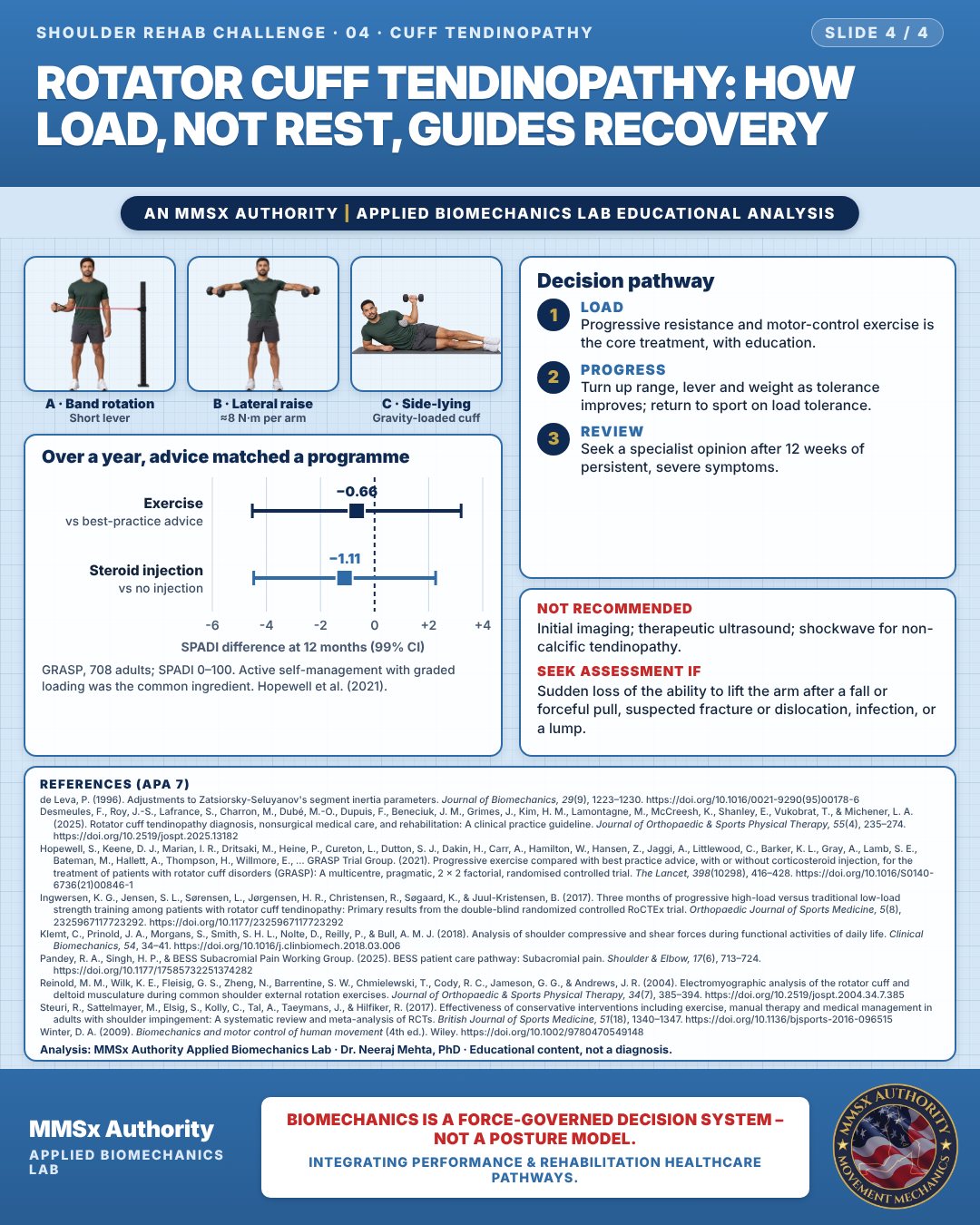
Over a year, advice matched a programme
Load
Progressive resistance and motor-control exercise is the core treatment, with education.
Progress
Turn up range, lever and weight as tolerance improves; return to sport on load tolerance.
Review
Seek a specialist opinion after 12 weeks of persistent, severe symptoms.
What the evidence supports
- Recommended: progressive resistance and motor-control exercise as the core intervention (Grade A); education (Grade C); manual therapy alongside exercise for short-term pain relief (Grade B); NSAIDs for short-term pain (Grade B); corticosteroid injection for short-term pain relief (Grade B/C); return to sport based on the athlete's tolerance of shoulder loading (Grade F) (Desmeules et al., 2025).
- Not recommended: initial imaging (Grade F); therapeutic ultrasound (Grade C/B); shockwave for non-calcific tendinopathy (Desmeules et al., 2025).
- Refer for a specialist opinion after 12 weeks of persistent, severe symptoms (Grade F) (Desmeules et al., 2025; Pandey et al., 2025).
Myth and evidence
Myth“Rest the tendon until it stops hurting.”
EvidenceExercise was superior to non-exercise control (SMD −0.94) (Steuri et al., 2017). High-load and low-load progressive programmes both improved DASH scores by about 7–8 points (Ingwersen et al., 2017). Loading, dosed to tolerance, is the treatment.
Cautions
Not recommended
Initial imaging; therapeutic ultrasound; shockwave for non-calcific tendinopathy.
Seek assessment if
Sudden loss of the ability to lift the arm after a fall or forceful pull, suspected fracture or dislocation, infection, or a lump.
Methods note
2-D estimates from pose landmarks on an illustrated figure; CoM from de Leva (1996) segment parameters; cm for a 1.70 m adult (Winter, 2009). Skeleton and CoM only; the forearm points towards the camera, so no elbow angle is quoted. Arm lever: shoulder joint to arm CoM; moment = arm weight × lever, 70 kg adult, static. Dumbbell weight is not included. Pose landmarks are less reliable in lying positions, so no angles are quoted for this frame. These are educational estimates, not a diagnosis.
References
- de Leva, P. (1996). Adjustments to Zatsiorsky-Seluyanov's segment inertia parameters. Journal of Biomechanics, 29(9), 1223–1230. https://doi.org/10.1016/0021-9290(95)00178-6
- Desmeules, F., Roy, J.-S., Lafrance, S., Charron, M., Dubé, M.-O., Dupuis, F., Beneciuk, J. M., Grimes, J., Kim, H. M., Lamontagne, M., McCreesh, K., Shanley, E., Vukobrat, T., & Michener, L. A. (2025). Rotator cuff tendinopathy diagnosis, nonsurgical medical care, and rehabilitation: A clinical practice guideline. Journal of Orthopaedic & Sports Physical Therapy, 55(4), 235–274. https://doi.org/10.2519/jospt.2025.13182
- Hopewell, S., Keene, D. J., Marian, I. R., Dritsaki, M., Heine, P., Cureton, L., Dutton, S. J., Dakin, H., Carr, A., Hamilton, W., Hansen, Z., Jaggi, A., Littlewood, C., Barker, K. L., Gray, A., Lamb, S. E., Bateman, M., Hallett, A., Thompson, H., Willmore, E., … GRASP Trial Group. (2021). Progressive exercise compared with best practice advice, with or without corticosteroid injection, for the treatment of patients with rotator cuff disorders (GRASP): A multicentre, pragmatic, 2 × 2 factorial, randomised controlled trial. The Lancet, 398(10298), 416–428. https://doi.org/10.1016/S0140-6736(21)00846-1
- Ingwersen, K. G., Jensen, S. L., Sørensen, L., Jørgensen, H. R., Christensen, R., Søgaard, K., & Juul-Kristensen, B. (2017). Three months of progressive high-load versus traditional low-load strength training among patients with rotator cuff tendinopathy: Primary results from the double-blind randomized controlled RoCTEx trial. Orthopaedic Journal of Sports Medicine, 5(8), 2325967117723292. https://doi.org/10.1177/2325967117723292
- Klemt, C., Prinold, J. A., Morgans, S., Smith, S. H. L., Nolte, D., Reilly, P., & Bull, A. M. J. (2018). Analysis of shoulder compressive and shear forces during functional activities of daily life. Clinical Biomechanics, 54, 34–41. https://doi.org/10.1016/j.clinbiomech.2018.03.006
- Pandey, R. A., Singh, H. P., & BESS Subacromial Pain Working Group. (2025). BESS patient care pathway: Subacromial pain. Shoulder & Elbow, 17(6), 713–724. https://doi.org/10.1177/17585732251374282
- Reinold, M. M., Wilk, K. E., Fleisig, G. S., Zheng, N., Barrentine, S. W., Chmielewski, T., Cody, R. C., Jameson, G. G., & Andrews, J. R. (2004). Electromyographic analysis of the rotator cuff and deltoid musculature during common shoulder external rotation exercises. Journal of Orthopaedic & Sports Physical Therapy, 34(7), 385–394. https://doi.org/10.2519/jospt.2004.34.7.385
- Steuri, R., Sattelmayer, M., Elsig, S., Kolly, C., Tal, A., Taeymans, J., & Hilfiker, R. (2017). Effectiveness of conservative interventions including exercise, manual therapy and medical management in adults with shoulder impingement: A systematic review and meta-analysis of RCTs. British Journal of Sports Medicine, 51(18), 1340–1347. https://doi.org/10.1136/bjsports-2016-096515
- Winter, D. A. (2009). Biomechanics and motor control of human movement (4th ed.). Wiley. https://doi.org/10.1002/9780470549148
Cite this article
Mehta, N. (2026, October 24). Rotator cuff tendinopathy: how load, not rest, guides recovery. MMSx Authority Applied Biomechanics Lab. https://mmsxauthority.org/edu/analysis/shoulder/04-rotator-cuff-tendinopathy-how-load-not-rest-guides-recovery/
Part of the collection
Mehta, N. (2026). Shoulder Rehabilitation: 50 Evidence-Based Biomechanics Analyses [Collection]. MMSx Authority Applied Biomechanics Lab. Zenodo. https://doi.org/10.5281/zenodo.23735725
All Shoulder Rehab Challenge articles · Rehabilitation Library