Lower Back Rehab Challenge · 49
Can walking and education reduce lower back pain recurrence? What the WalkBack trial found
Recurrence is a new episode of LBP after a period of recovery. Movement analysis, verified research data and a decision pathway from the MMSx Authority Applie
Key points
- After recovery. Start a progressive walking plan with education once the episode has settled.
- Add support. A few physiotherapist sessions helped individualise and progress the plan.
- Skip the gadgets. Education alone, back belts and insoles did not prevent episodes.
What it is
Recurrence is a new episode of LBP after a period of recovery. In WalkBack, the primary outcome was a recurrence of activity-limiting LBP. The intervention was an individualised, progressive walking programme plus education, facilitated by six physiotherapist sessions over 6 months, compared with no treatment.
How we analysed the movement
Three movements relevant to this topic were analysed from illustrated reference figures. Joint centres were located with two-dimensional pose estimation; joint angles, the whole-body centre of mass and, where relevant, the low-back lever (the horizontal distance from the upper-body centre of mass to the L5/S1 joint) were then calculated from standard segment parameters. The figures are educational estimates that show how position changes mechanical demand; they are not measurements of a patient. Every research value quoted below comes from the published source cited beside it.
Movement A: Regular walk
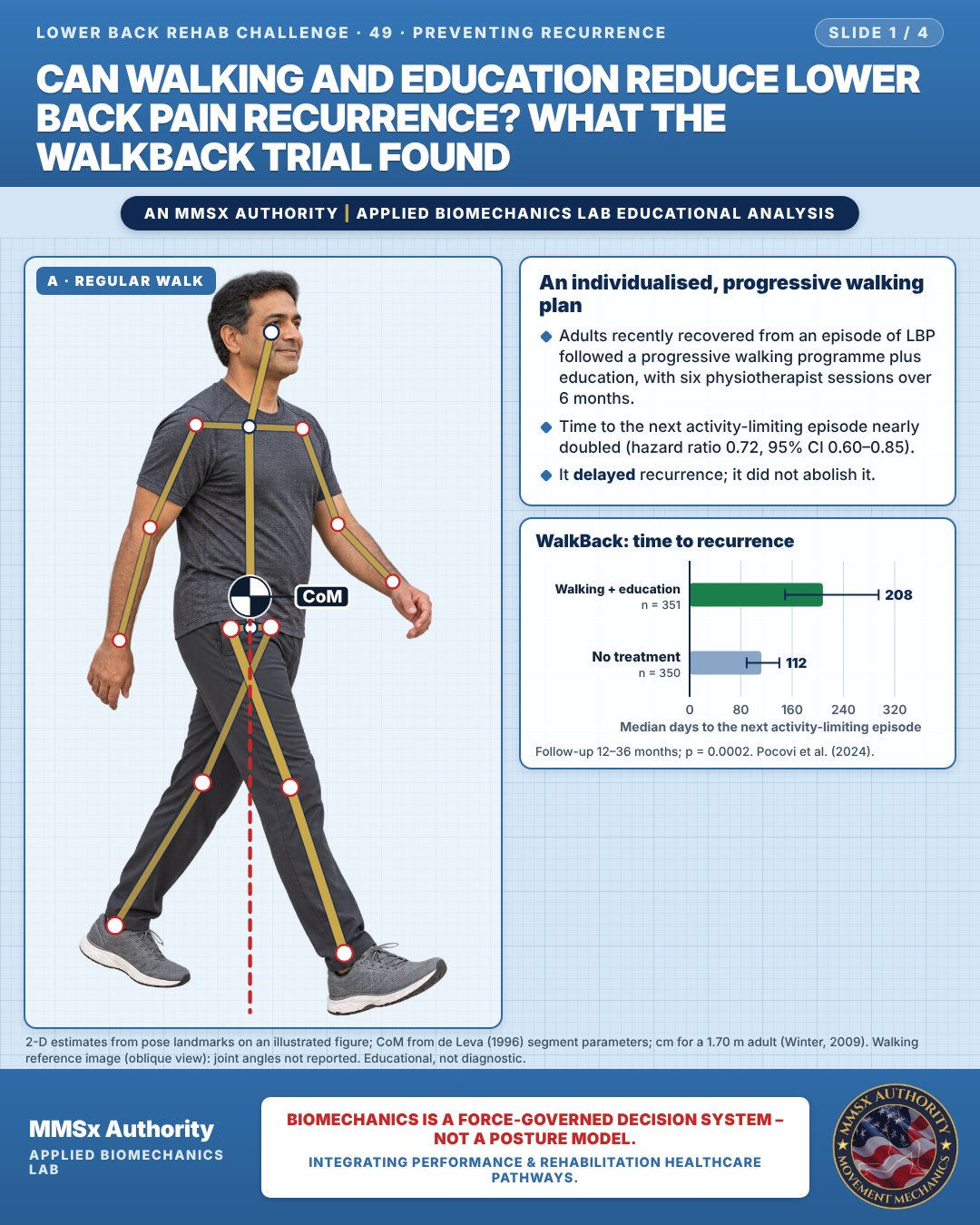
An individualised, progressive walking plan
Adults recently recovered from an episode of LBP followed a progressive walking programme plus education, with six physiotherapist sessions over 6 months.
Time to the next activity-limiting episode nearly doubled (hazard ratio 0.72, 95% CI 0.60–0.85).
It delayed recurrence; it did not abolish it.
WalkBack: time to recurrence
Movement B: Education review
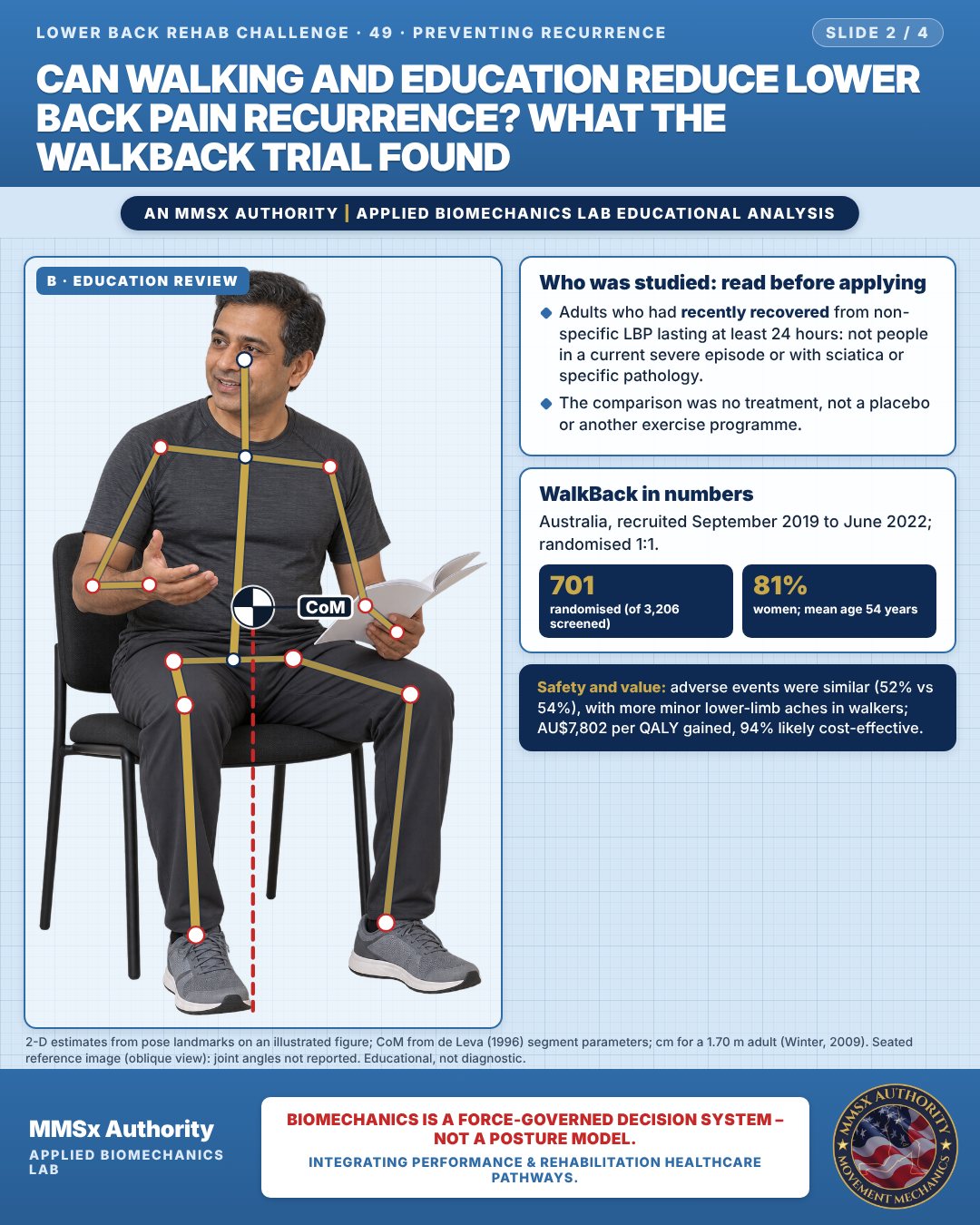
Who was studied: read before applying
Adults who had recently recovered from non-specific LBP lasting at least 24 hours: not people in a current severe episode or with sciatica or specific pathology.
The comparison was no treatment, not a placebo or another exercise programme.
WalkBack in numbers
Australia, recruited September 2019 to June 2022; randomised 1:1.
Movement C: Ongoing strength (front view)
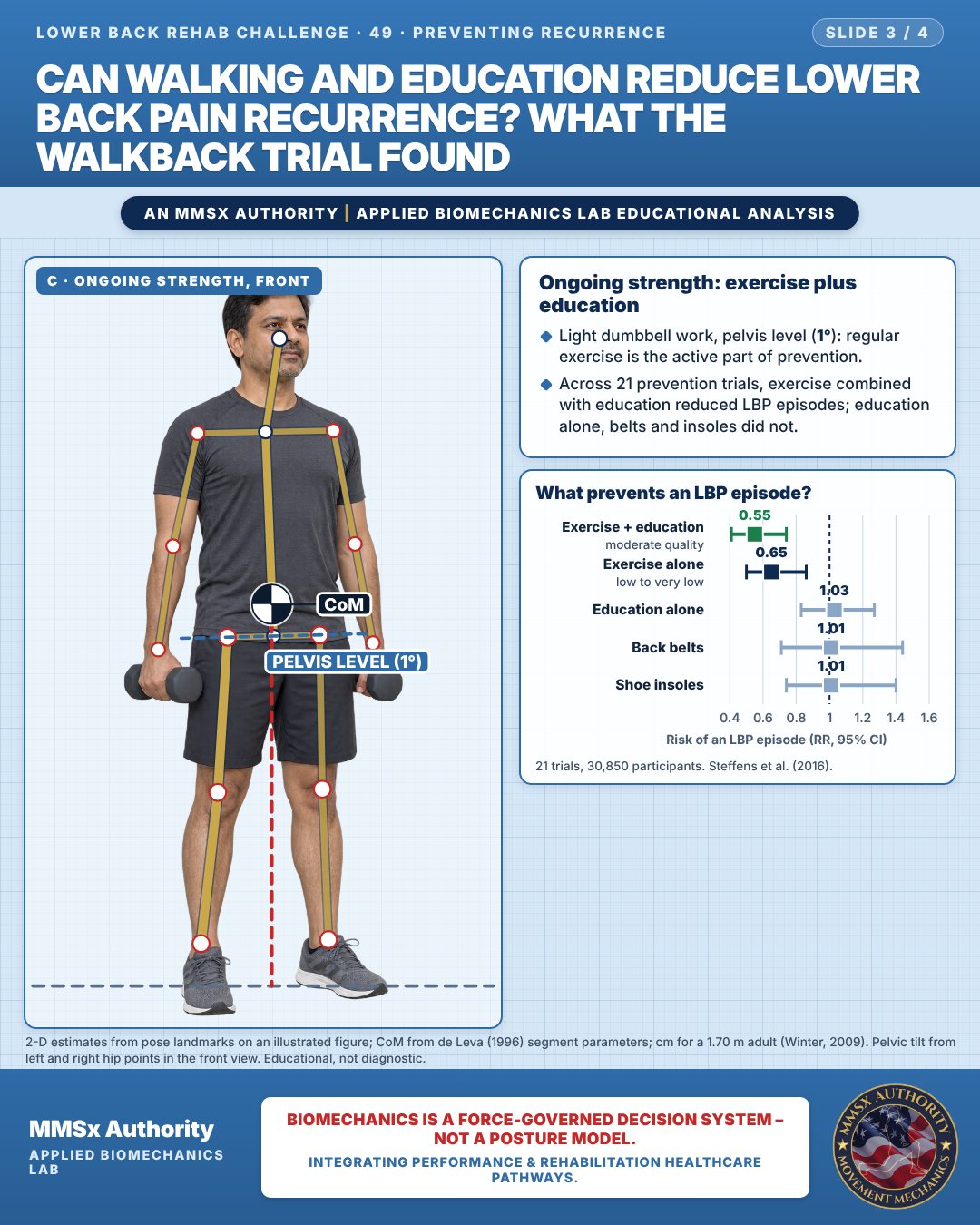
Ongoing strength: exercise plus education
Light dumbbell work, pelvis level (1°): regular exercise is the active part of prevention.
Across 21 prevention trials, exercise combined with education reduced LBP episodes; education alone, belts and insoles did not.
What prevents an LBP episode?
Decision pathway
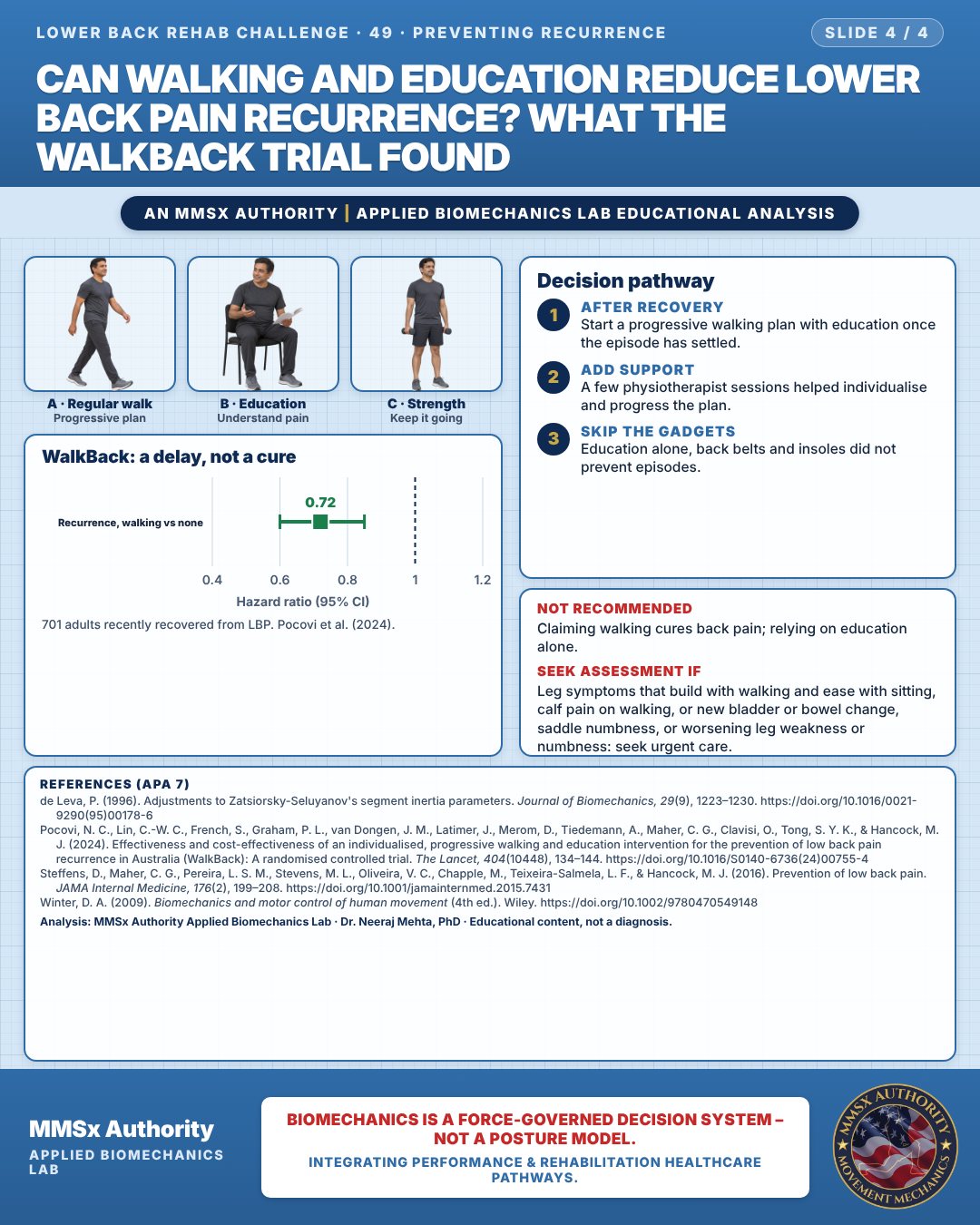
WalkBack: a delay, not a cure
After recovery
Start a progressive walking plan with education once the episode has settled.
Add support
A few physiotherapist sessions helped individualise and progress the plan.
Skip the gadgets
Education alone, back belts and insoles did not prevent episodes.
What the evidence supports
- Recommend: after recovery from an episode, an individualised, progressive walking programme combined with education, with some professional support, for people similar to WalkBack participants (Pocovi et al., 2024); more broadly, exercise with education for prevention (Steffens et al., 2016).
- Do not: rely on education alone, back belts or shoe insoles to prevent LBP (Steffens et al., 2016); claim walking "cures" back pain.
Myth and evidence
Myth“Once your back recovers, nothing can change the chance of it coming back.”
EvidenceIn adults recently recovered from LBP, progressive walking plus education nearly doubled the median time to the next activity-limiting episode (208 vs 112 days; HR 0.72) (Pocovi et al., 2024), and exercise with education reduced LBP episodes in prevention trials (RR 0.55) (Steffens et al., 2016).
Cautions
Not recommended
Claiming walking cures back pain; relying on education alone.
Seek assessment if
Leg symptoms that build with walking and ease with sitting, calf pain on walking, or new bladder or bowel change, saddle numbness, or worsening leg weakness or numbness: seek urgent care.
Methods note
2-D estimates from pose landmarks on an illustrated figure; CoM from de Leva (1996) segment parameters; cm for a 1.70 m adult (Winter, 2009). Walking reference image (oblique view): joint angles not reported. Seated reference image (oblique view): joint angles not reported. Pelvic tilt from left and right hip points in the front view. These are educational estimates, not a diagnosis.
References
- de Leva, P. (1996). Adjustments to Zatsiorsky-Seluyanov's segment inertia parameters. Journal of Biomechanics, 29(9), 1223–1230. https://doi.org/10.1016/0021-9290(95)00178-6
- Pocovi, N. C., Lin, C.-W. C., French, S., Graham, P. L., van Dongen, J. M., Latimer, J., Merom, D., Tiedemann, A., Maher, C. G., Clavisi, O., Tong, S. Y. K., & Hancock, M. J. (2024). Effectiveness and cost-effectiveness of an individualised, progressive walking and education intervention for the prevention of low back pain recurrence in Australia (WalkBack): A randomised controlled trial. The Lancet, 404(10448), 134–144. https://doi.org/10.1016/S0140-6736(24)00755-4
- Steffens, D., Maher, C. G., Pereira, L. S. M., Stevens, M. L., Oliveira, V. C., Chapple, M., Teixeira-Salmela, L. F., & Hancock, M. J. (2016). Prevention of low back pain. JAMA Internal Medicine, 176(2), 199–208. https://doi.org/10.1001/jamainternmed.2015.7431
- Winter, D. A. (2009). Biomechanics and motor control of human movement (4th ed.). Wiley. https://doi.org/10.1002/9780470549148
Cite this article
Mehta, N. (2026, October 23). Can walking and education reduce lower back pain recurrence? What the WalkBack trial found. MMSx Authority Applied Biomechanics Lab. https://mmsxauthority.org/edu/analysis/lower-back/49-can-walking-and-education-reduce-lower-back-pain-recurrence-what-the/
Part of the collection
Mehta, N. (2026). Lower Back Rehabilitation: 50 Evidence-Based Biomechanics Analyses [Collection]. MMSx Authority Applied Biomechanics Lab. Zenodo. https://doi.org/10.5281/zenodo.23735778
All Lower Back Rehab Challenge articles · Rehabilitation Library