Lower Back Rehab Challenge · 48
Is your back rehabilitation working? Track function alongside pain
Progress in back rehabilitation is best judged with several measures: pain intensity (0–10 NRS or 0–100 VAS), physical function/disability (e.g.
Key points
- Set a baseline. One pain scale, one function questionnaire, 2–3 meaningful tasks, before you start.
- Re-test regularly. Every 2–4 weeks; ignore day-to-day swings and changes smaller than the MIC.
- Judge the trend. Function improving with little pain change is still real progress.
What it is
Progress in back rehabilitation is best judged with several measures: pain intensity (0–10 NRS or 0–100 VAS), physical function/disability (e.g. Roland–Morris Disability Questionnaire, RMDQ 0–24; Oswestry Disability Index, ODI 0–100), and personally meaningful tasks and participation (work, care, sport). A change is "meaningful" when it exceeds the minimal important change (MIC) — the smallest change patients perceive as important — and measurement error.
How we analysed the movement
Three movements relevant to this topic were analysed from illustrated reference figures. Joint centres were located with two-dimensional pose estimation; joint angles, the whole-body centre of mass and, where relevant, the low-back lever (the horizontal distance from the upper-body centre of mass to the L5/S1 joint) were then calculated from standard segment parameters. The figures are educational estimates that show how position changes mechanical demand; they are not measurements of a patient. Every research value quoted below comes from the published source cited beside it.
Movement A: Keeping an activity log
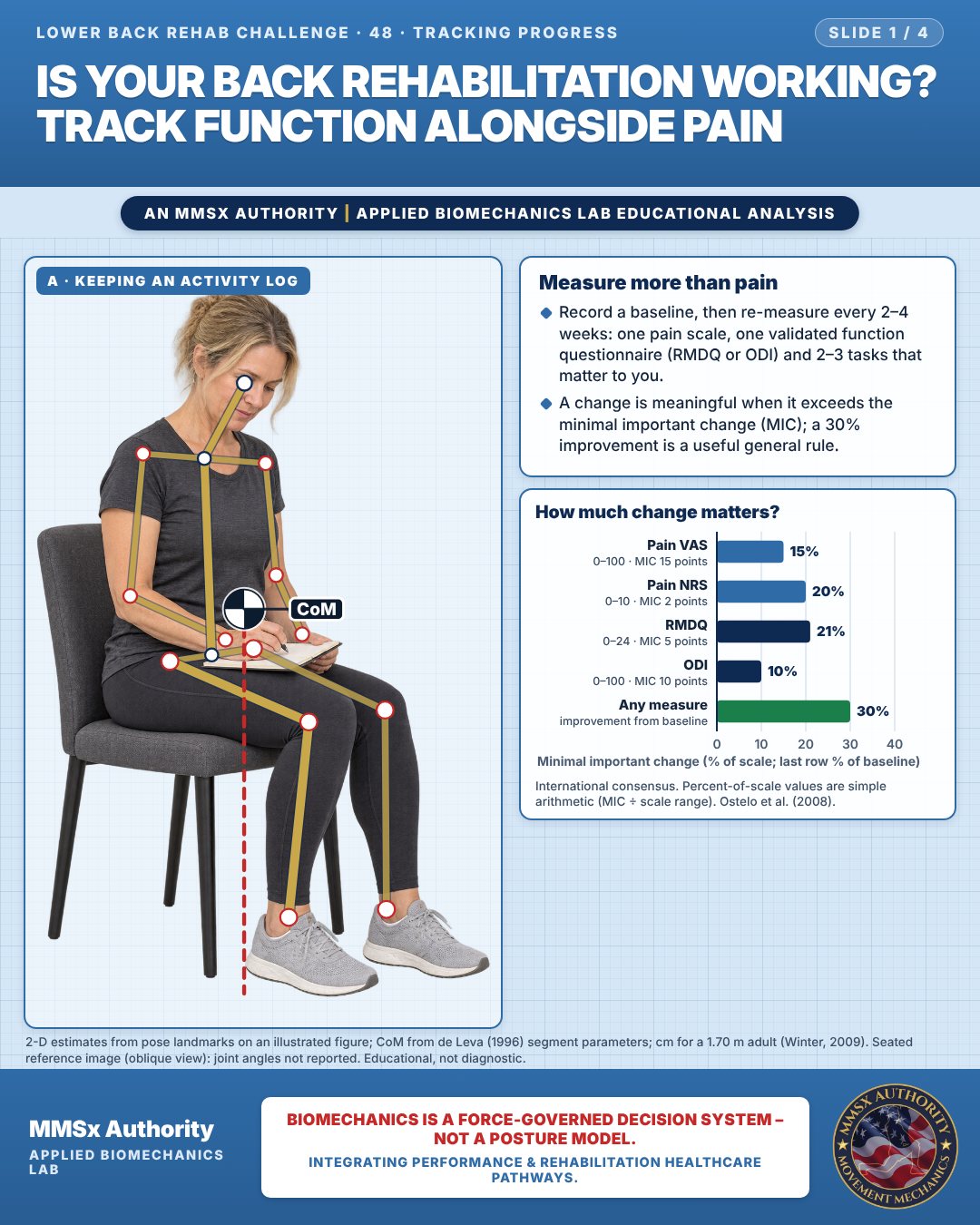
Measure more than pain
Record a baseline, then re-measure every 2–4 weeks: one pain scale, one validated function questionnaire (RMDQ or ODI) and 2–3 tasks that matter to you.
A change is meaningful when it exceeds the minimal important change (MIC); a 30% improvement is a useful general rule.
How much change matters?
Movement B: Chair-rise check
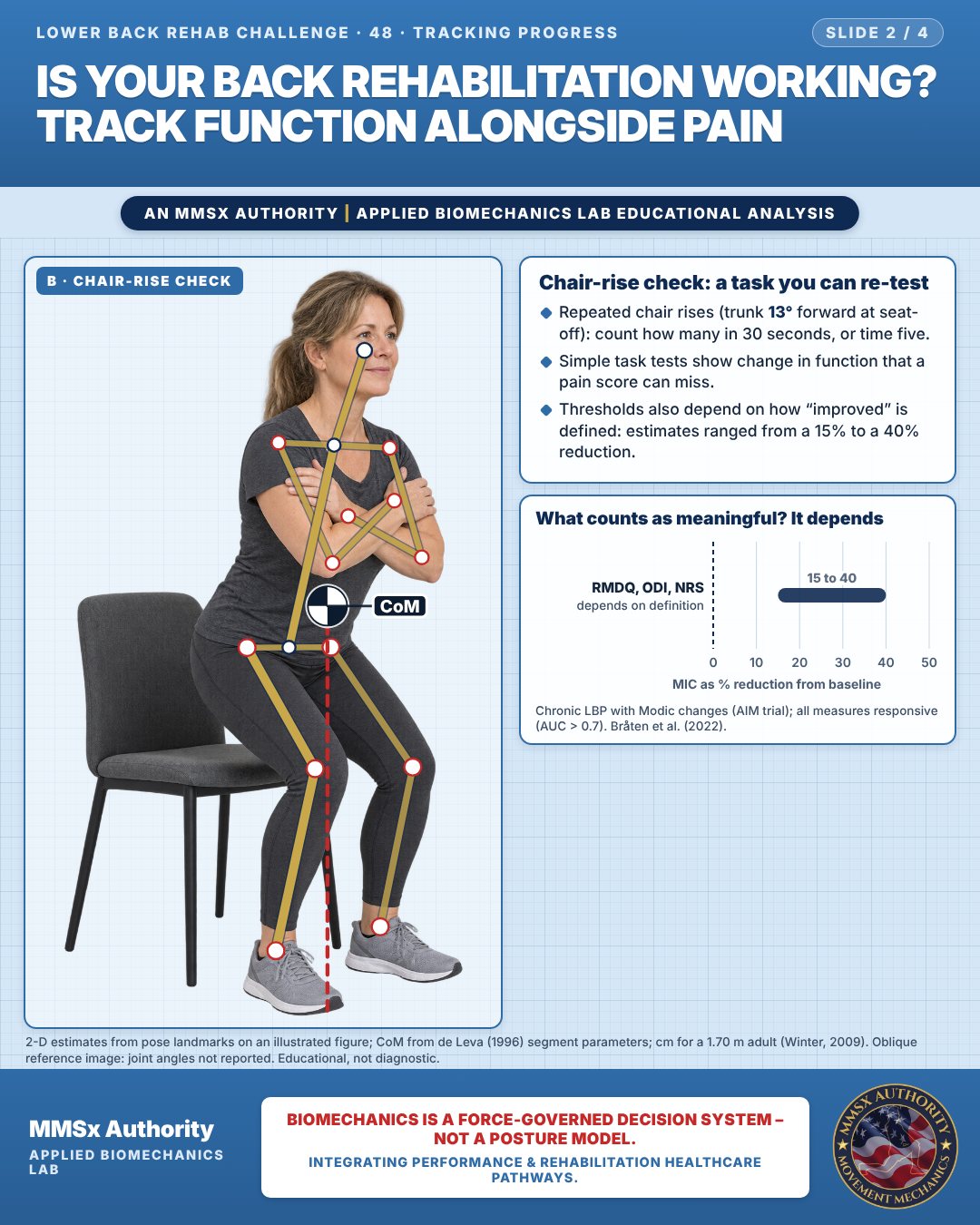
Chair-rise check: a task you can re-test
Repeated chair rises (trunk 13° forward at seat-off): count how many in 30 seconds, or time five.
Simple task tests show change in function that a pain score can miss.
Thresholds also depend on how “improved” is defined: estimates ranged from a 15% to a 40% reduction.
What counts as meaningful? It depends
Movement C: Walking goal (front view)
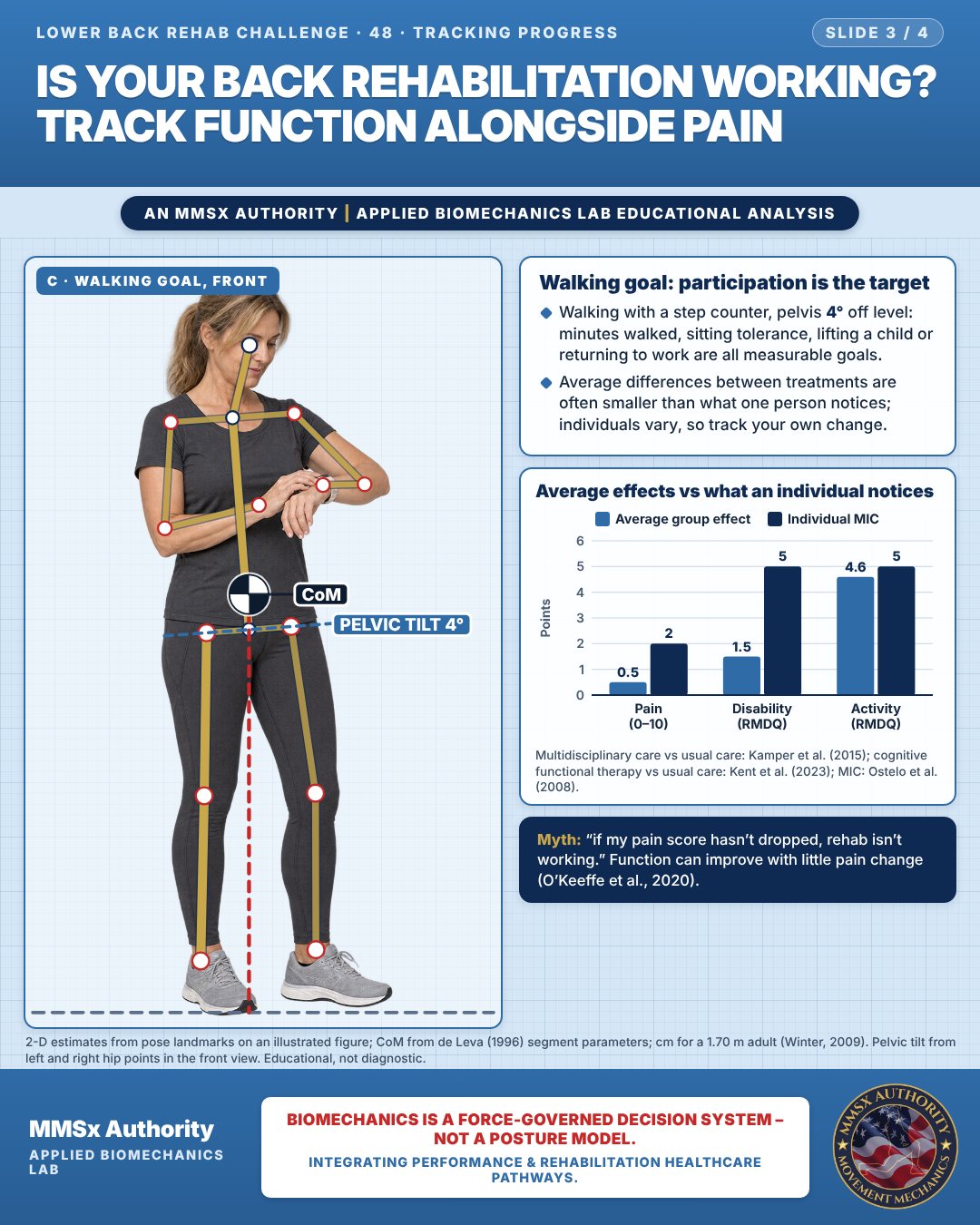
Walking goal: participation is the target
Walking with a step counter, pelvis 4° off level: minutes walked, sitting tolerance, lifting a child or returning to work are all measurable goals.
Average differences between treatments are often smaller than what one person notices; individuals vary, so track your own change.
Average effects vs what an individual notices
Decision pathway
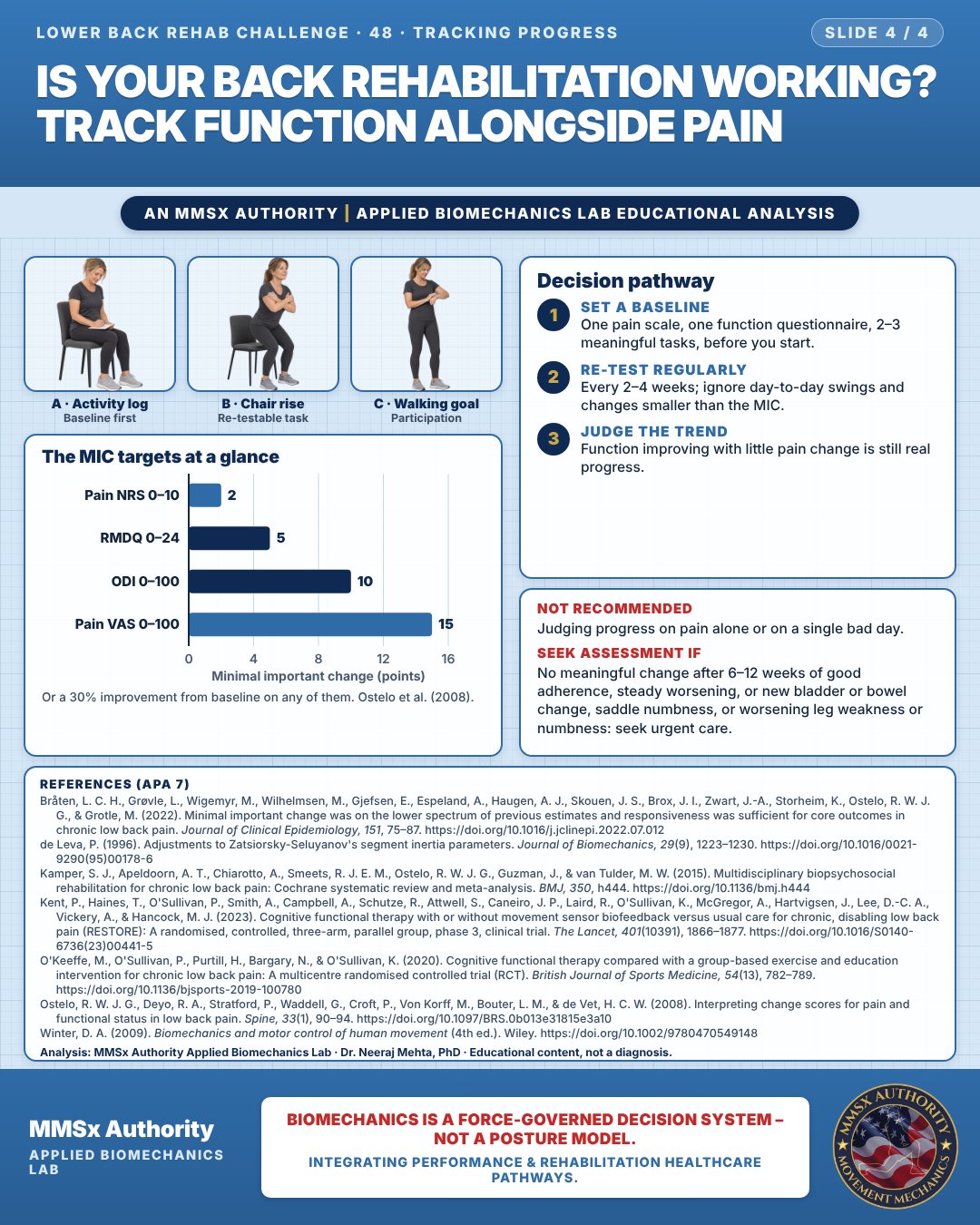
The MIC targets at a glance
Set a baseline
One pain scale, one function questionnaire, 2–3 meaningful tasks, before you start.
Re-test regularly
Every 2–4 weeks; ignore day-to-day swings and changes smaller than the MIC.
Judge the trend
Function improving with little pain change is still real progress.
What the evidence supports
- Recommend: record a baseline and re-measure at regular intervals (e.g. every 2–4 weeks) using one pain scale, one validated function questionnaire (RMDQ or ODI), and 2–3 personally meaningful tasks (e.g. minutes walked, sitting tolerance, lifting a child or shopping bag, return to a sport or work duty); judge progress against MIC values and the 30% rule (Ostelo et al., 2008; Bråten et al., 2022).
Myth and evidence
Myth“If my pain score hasn't dropped, rehab isn't working.”
EvidenceMeaningful change is defined for function as well as pain (e.g. 5 RMDQ points, 10 ODI points or a 30% improvement) (Ostelo et al., 2008), and treatments can improve disability without a detectable pain difference (O'Keeffe et al., 2020).
Cautions
Not recommended
Judging progress on pain alone or on a single bad day.
Seek assessment if
No meaningful change after 6–12 weeks of good adherence, steady worsening, or new bladder or bowel change, saddle numbness, or worsening leg weakness or numbness: seek urgent care.
Methods note
2-D estimates from pose landmarks on an illustrated figure; CoM from de Leva (1996) segment parameters; cm for a 1.70 m adult (Winter, 2009). Seated reference image (oblique view): joint angles not reported. Oblique reference image: joint angles not reported. Pelvic tilt from left and right hip points in the front view. These are educational estimates, not a diagnosis.
References
- Bråten, L. C. H., Grøvle, L., Wigemyr, M., Wilhelmsen, M., Gjefsen, E., Espeland, A., Haugen, A. J., Skouen, J. S., Brox, J. I., Zwart, J.-A., Storheim, K., Ostelo, R. W. J. G., & Grotle, M. (2022). Minimal important change was on the lower spectrum of previous estimates and responsiveness was sufficient for core outcomes in chronic low back pain. Journal of Clinical Epidemiology, 151, 75–87. https://doi.org/10.1016/j.jclinepi.2022.07.012
- de Leva, P. (1996). Adjustments to Zatsiorsky-Seluyanov's segment inertia parameters. Journal of Biomechanics, 29(9), 1223–1230. https://doi.org/10.1016/0021-9290(95)00178-6
- Kamper, S. J., Apeldoorn, A. T., Chiarotto, A., Smeets, R. J. E. M., Ostelo, R. W. J. G., Guzman, J., & van Tulder, M. W. (2015). Multidisciplinary biopsychosocial rehabilitation for chronic low back pain: Cochrane systematic review and meta-analysis. BMJ, 350, h444. https://doi.org/10.1136/bmj.h444
- Kent, P., Haines, T., O'Sullivan, P., Smith, A., Campbell, A., Schutze, R., Attwell, S., Caneiro, J. P., Laird, R., O'Sullivan, K., McGregor, A., Hartvigsen, J., Lee, D.-C. A., Vickery, A., & Hancock, M. J. (2023). Cognitive functional therapy with or without movement sensor biofeedback versus usual care for chronic, disabling low back pain (RESTORE): A randomised, controlled, three-arm, parallel group, phase 3, clinical trial. The Lancet, 401(10391), 1866–1877. https://doi.org/10.1016/S0140-6736(23)00441-5
- O'Keeffe, M., O'Sullivan, P., Purtill, H., Bargary, N., & O'Sullivan, K. (2020). Cognitive functional therapy compared with a group-based exercise and education intervention for chronic low back pain: A multicentre randomised controlled trial (RCT). British Journal of Sports Medicine, 54(13), 782–789. https://doi.org/10.1136/bjsports-2019-100780
- Ostelo, R. W. J. G., Deyo, R. A., Stratford, P., Waddell, G., Croft, P., Von Korff, M., Bouter, L. M., & de Vet, H. C. W. (2008). Interpreting change scores for pain and functional status in low back pain. Spine, 33(1), 90–94. https://doi.org/10.1097/BRS.0b013e31815e3a10
- Winter, D. A. (2009). Biomechanics and motor control of human movement (4th ed.). Wiley. https://doi.org/10.1002/9780470549148
Cite this article
Mehta, N. (2026, October 23). Is your back rehabilitation working? Track function alongside pain. MMSx Authority Applied Biomechanics Lab. https://mmsxauthority.org/edu/analysis/lower-back/48-is-your-back-rehabilitation-working-track-function-alongside-pain/
Part of the collection
Mehta, N. (2026). Lower Back Rehabilitation: 50 Evidence-Based Biomechanics Analyses [Collection]. MMSx Authority Applied Biomechanics Lab. Zenodo. https://doi.org/10.5281/zenodo.23735778
All Lower Back Rehab Challenge articles · Rehabilitation Library