Lower Back Rehab Challenge · 47
A lower back pain flare-up: how to adjust your activity plan
A flare-up is a period of increased pain, distinctly worse than it has been recently, within an ongoing or recurrent LBP condition.
Key points
- Check, then review. Rule out red flags; look back at sitting, load, sleep and stress over 1–3 days.
- Lower the dose. Shorter walks, position changes every 20–30 min, easier exercise versions, comfort strategies.
- Rebuild steadily. Return to your previous level over days as symptoms ease; keep the plan for next time.
What it is
A flare-up is a period of increased pain, distinctly worse than it has been recently, within an ongoing or recurrent LBP condition. One research definition: "a period of increased pain lasting at least 2 hours, when your pain intensity is distinctly worse than it has been recently" (Suri et al., 2018). Definitions vary between studies and people; a flare is not the same as new damage.
How we analysed the movement
Three movements relevant to this topic were analysed from illustrated reference figures. Joint centres were located with two-dimensional pose estimation; joint angles, the whole-body centre of mass and, where relevant, the low-back lever (the horizontal distance from the upper-body centre of mass to the L5/S1 joint) were then calculated from standard segment parameters. The figures are educational estimates that show how position changes mechanical demand; they are not measurements of a patient. Every research value quoted below comes from the published source cited beside it.
Movement A: Comfortable rest (side view)
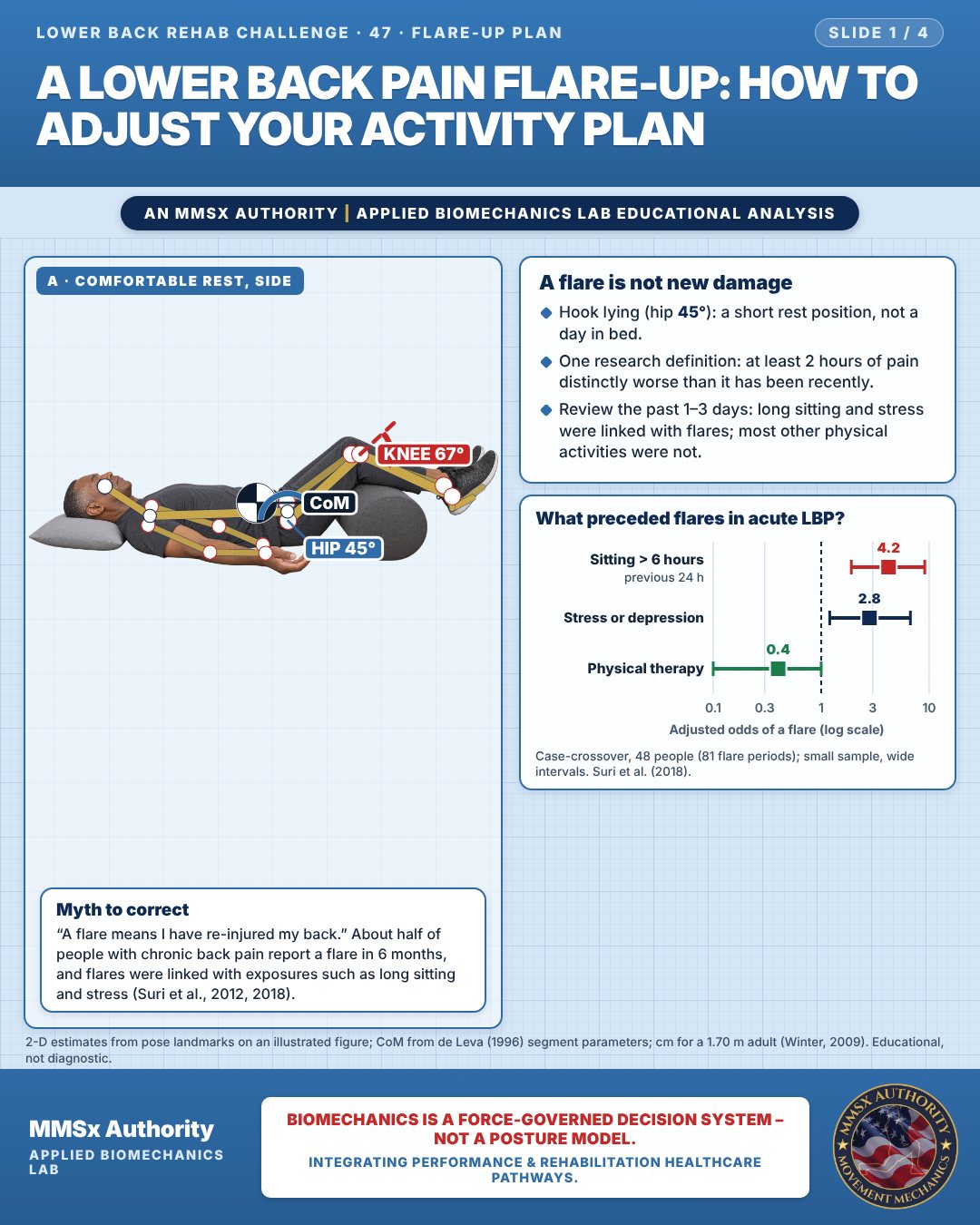
Myth to correct
“A flare means I have re-injured my back.” About half of people with chronic back pain report a flare in 6 months, and flares were linked with exposures such as long sitting and stress (Suri et al., 2012, 2018).
A flare is not new damage
Hook lying (hip 45°): a short rest position, not a day in bed.
One research definition: at least 2 hours of pain distinctly worse than it has been recently.
Review the past 1–3 days: long sitting and stress were linked with flares; most other physical activities were not.
What preceded flares in acute LBP?
Movement B: Short walk
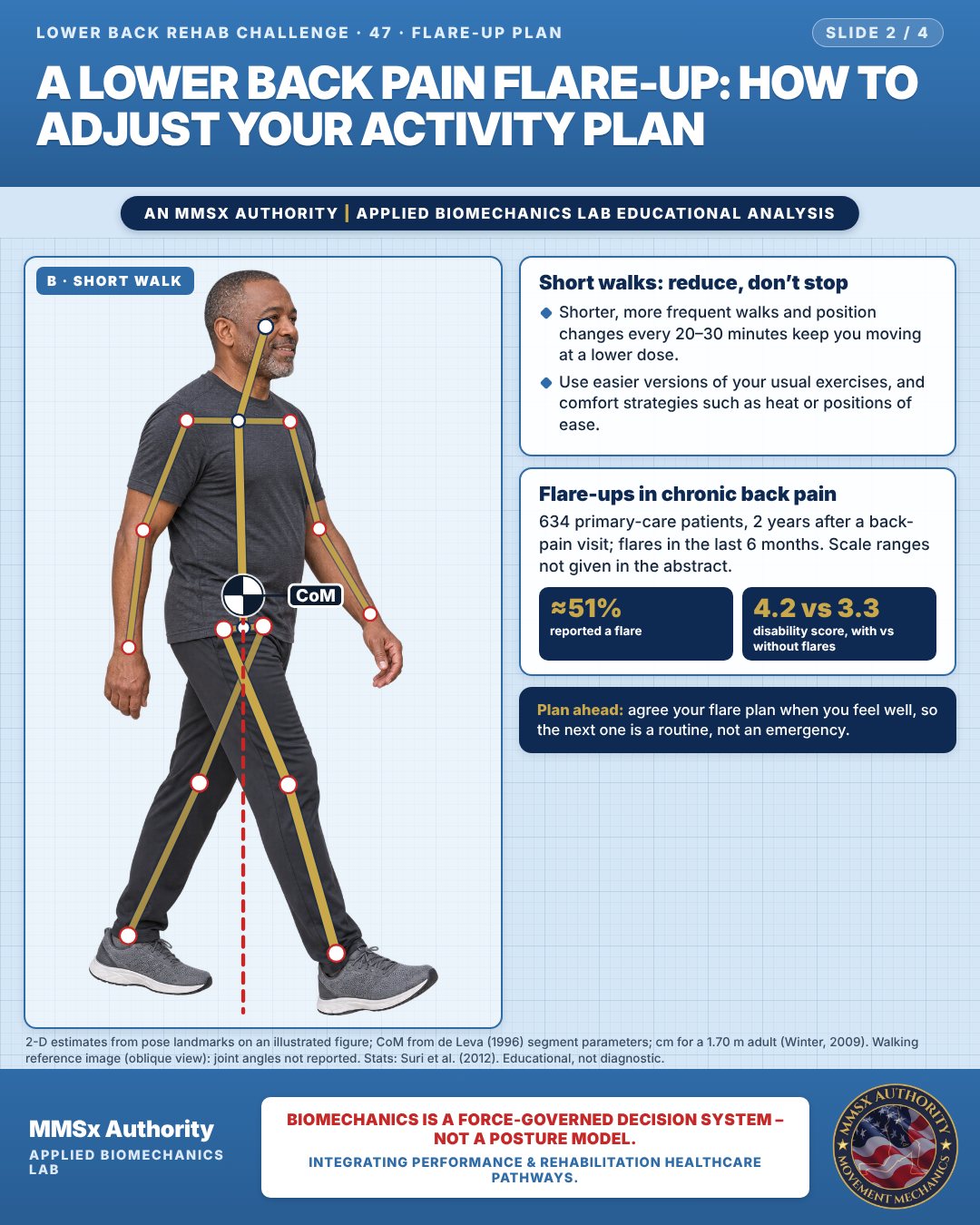
Short walks: reduce, don’t stop
Shorter, more frequent walks and position changes every 20–30 minutes keep you moving at a lower dose.
Use easier versions of your usual exercises, and comfort strategies such as heat or positions of ease.
Flare-ups in chronic back pain
634 primary-care patients, 2 years after a back-pain visit; flares in the last 6 months. Scale ranges not given in the abstract.
Movement C: Reduced-range movement
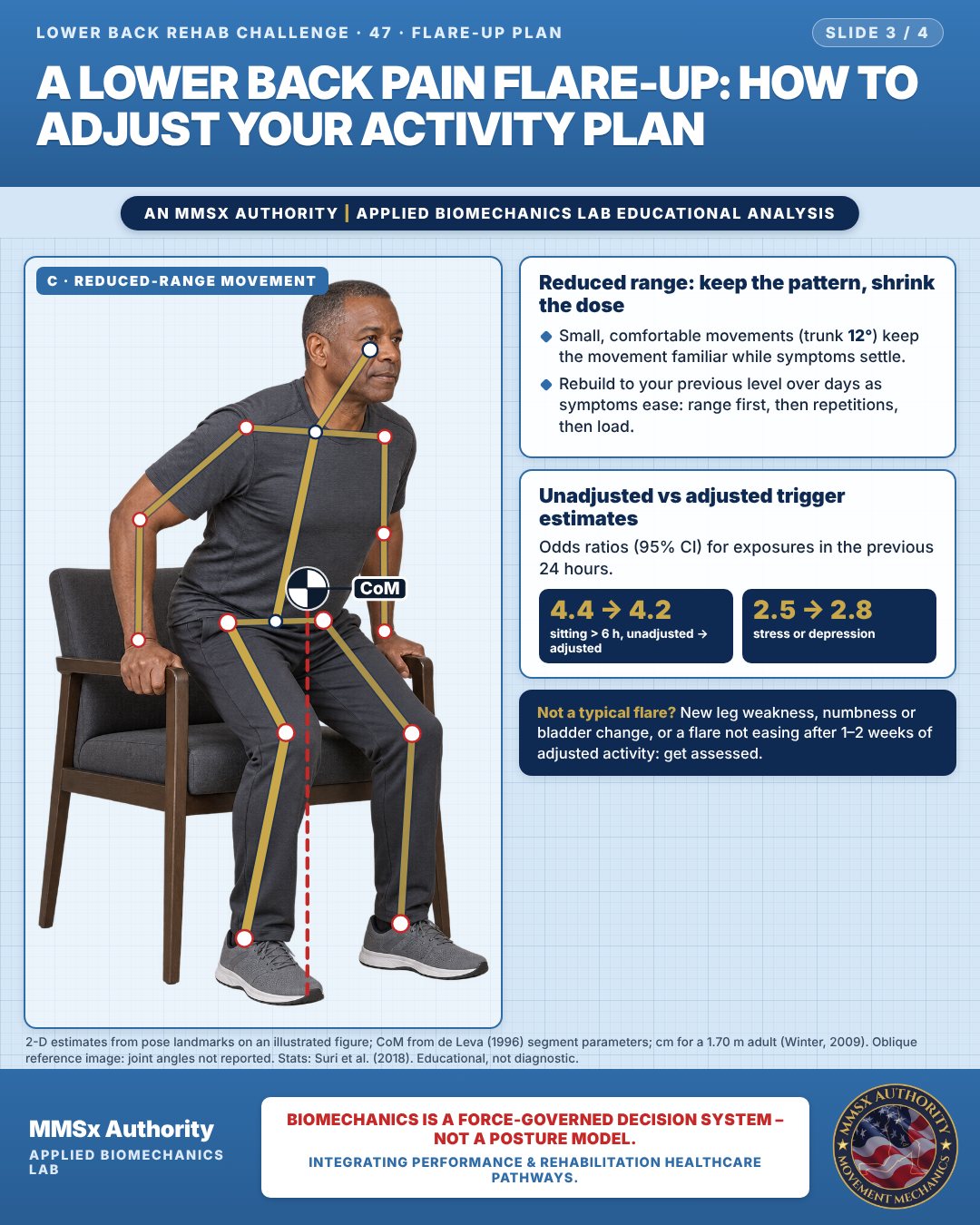
Reduced range: keep the pattern, shrink the dose
Small, comfortable movements (trunk 12°) keep the movement familiar while symptoms settle.
Rebuild to your previous level over days as symptoms ease: range first, then repetitions, then load.
Unadjusted vs adjusted trigger estimates
Odds ratios (95% CI) for exposures in the previous 24 hours.
Decision pathway
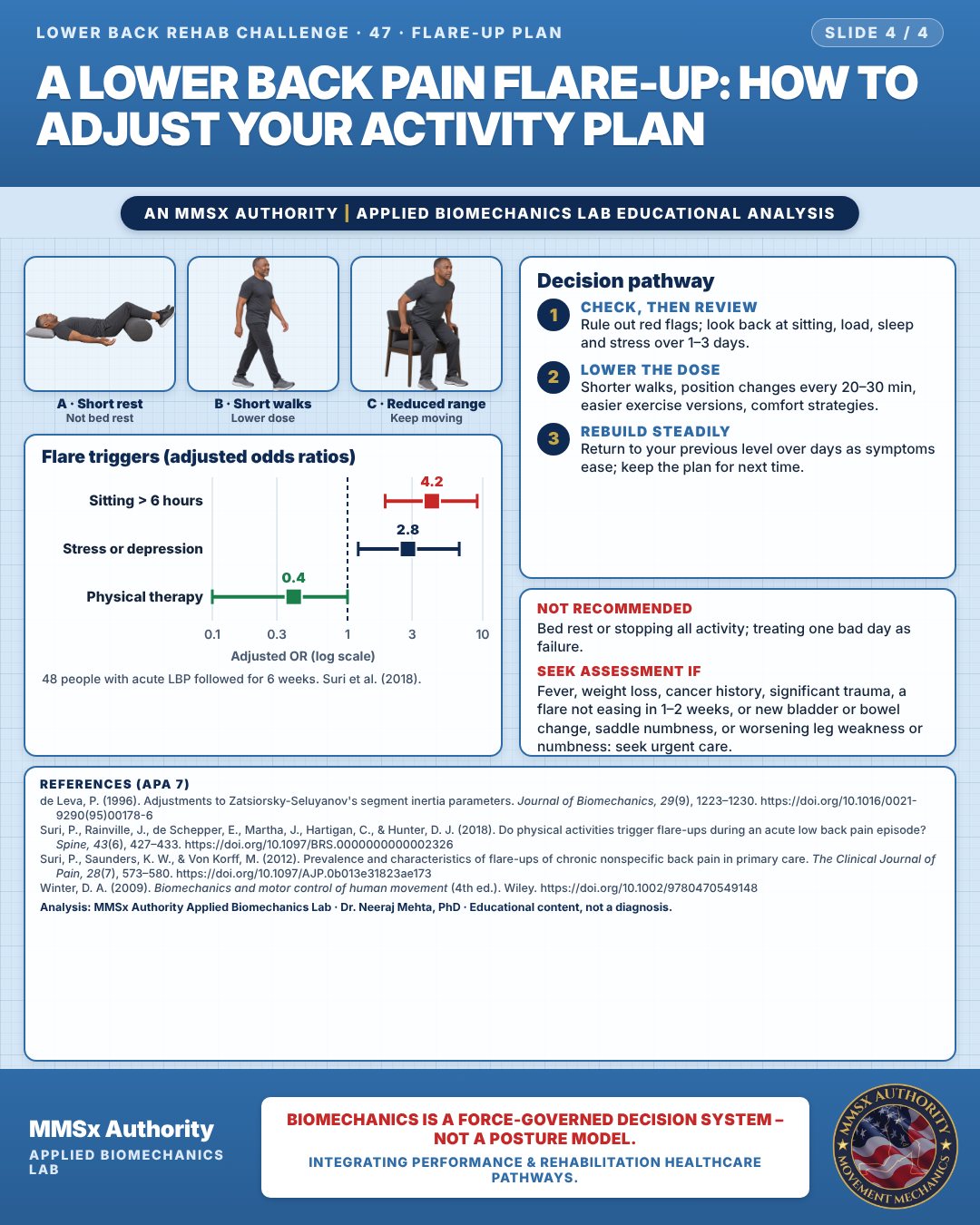
Flare triggers (adjusted odds ratios)
Check, then review
Rule out red flags; look back at sitting, load, sleep and stress over 1–3 days.
Lower the dose
Shorter walks, position changes every 20–30 min, easier exercise versions, comfort strategies.
Rebuild steadily
Return to your previous level over days as symptoms ease; keep the plan for next time.
What the evidence supports
- Recommend (flare plan): (1) check for red flags; (2) review the past 1–3 days — unusual sitting time, load, sleep or stress (Suri et al., 2018); (3) keep moving at a reduced level — shorter, more frequent walks, position changes every 20–30 minutes, easier versions of usual exercises; (4) use comfort strategies (heat, positions of ease, simple analgesia if appropriate and advised); (5) rebuild to the previous level over days as symptoms settle. Steps 3–5 are clinical-practice guidance, not trial-tested thresholds.
Myth and evidence
Myth“A flare means I have re-injured my back.”
EvidenceFlares are common (about half of people with chronic back pain report one in 6 months) (Suri et al., 2012) and were linked to exposures such as prolonged sitting and stress or depression rather than to most physical activities (Suri et al., 2018).
Cautions
Not recommended
Bed rest or stopping all activity; treating one bad day as failure.
Seek assessment if
Fever, weight loss, cancer history, significant trauma, a flare not easing in 1–2 weeks, or new bladder or bowel change, saddle numbness, or worsening leg weakness or numbness: seek urgent care.
Methods note
2-D estimates from pose landmarks on an illustrated figure; CoM from de Leva (1996) segment parameters; cm for a 1.70 m adult (Winter, 2009). Walking reference image (oblique view): joint angles not reported. Stats: Suri et al. (2012). Oblique reference image: joint angles not reported. Stats: Suri et al. (2018). These are educational estimates, not a diagnosis.
References
- de Leva, P. (1996). Adjustments to Zatsiorsky-Seluyanov's segment inertia parameters. Journal of Biomechanics, 29(9), 1223–1230. https://doi.org/10.1016/0021-9290(95)00178-6
- Suri, P., Rainville, J., de Schepper, E., Martha, J., Hartigan, C., & Hunter, D. J. (2018). Do physical activities trigger flare-ups during an acute low back pain episode? Spine, 43(6), 427–433. https://doi.org/10.1097/BRS.0000000000002326
- Suri, P., Saunders, K. W., & Von Korff, M. (2012). Prevalence and characteristics of flare-ups of chronic nonspecific back pain in primary care. The Clinical Journal of Pain, 28(7), 573–580. https://doi.org/10.1097/AJP.0b013e31823ae173
- Winter, D. A. (2009). Biomechanics and motor control of human movement (4th ed.). Wiley. https://doi.org/10.1002/9780470549148
Cite this article
Mehta, N. (2026, October 23). A lower back pain flare-up: how to adjust your activity plan. MMSx Authority Applied Biomechanics Lab. https://mmsxauthority.org/edu/analysis/lower-back/47-a-lower-back-pain-flare-up-how-to-adjust-your-activity-plan/
Part of the collection
Mehta, N. (2026). Lower Back Rehabilitation: 50 Evidence-Based Biomechanics Analyses [Collection]. MMSx Authority Applied Biomechanics Lab. Zenodo. https://doi.org/10.5281/zenodo.23735778
All Lower Back Rehab Challenge articles · Rehabilitation Library