Lower Back Rehab Challenge · 46
Pain during back rehabilitation: when to modify, pause, or seek help
Exercise-related pain in back rehabilitation is pain felt during or after exercise. Movement analysis, verified research data and a decision pathway from the
Key points
- Agree a level. Decide beforehand what pain is acceptable during and after exercise.
- Modify, don’t quit. Not settled by the next day: reduce load, range, volume or speed, then rebuild.
- Know the stop signs. Spreading or neurological symptoms, fever, chest pain: stop and get assessed.
What it is
Exercise-related pain in back rehabilitation is pain felt during or after exercise. Some temporary, tolerable discomfort (for example muscle soreness or a short-lived increase in familiar back pain that settles within about 24 hours) is common and usually not a sign of harm. Pain that escalates session to session, does not settle, spreads further into the leg, or comes with new neurological or systemic symptoms is a reason to modify, pause or seek assessment.
How we analysed the movement
Three movements relevant to this topic were analysed from illustrated reference figures. Joint centres were located with two-dimensional pose estimation; joint angles, the whole-body centre of mass and, where relevant, the low-back lever (the horizontal distance from the upper-body centre of mass to the L5/S1 joint) were then calculated from standard segment parameters. The figures are educational estimates that show how position changes mechanical demand; they are not measurements of a patient. Every research value quoted below comes from the published source cited beside it.
Movement A: Comfortable movement (side view)
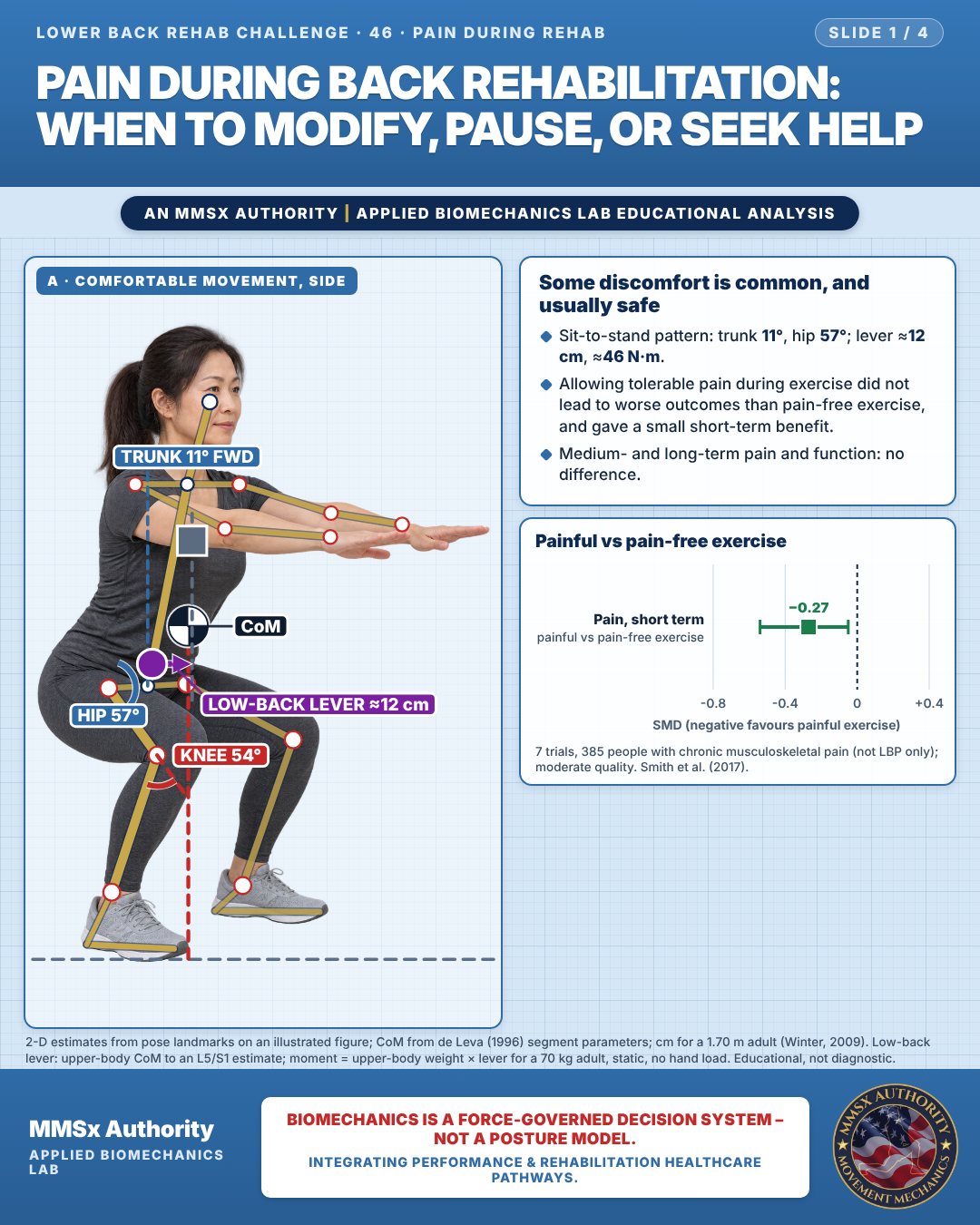
Some discomfort is common, and usually safe
Sit-to-stand pattern: trunk 11°, hip 57°; lever ≈12 cm, ≈46 N·m.
Allowing tolerable pain during exercise did not lead to worse outcomes than pain-free exercise, and gave a small short-term benefit.
Medium- and long-term pain and function: no difference.
Painful vs pain-free exercise
Movement B: Pause and review
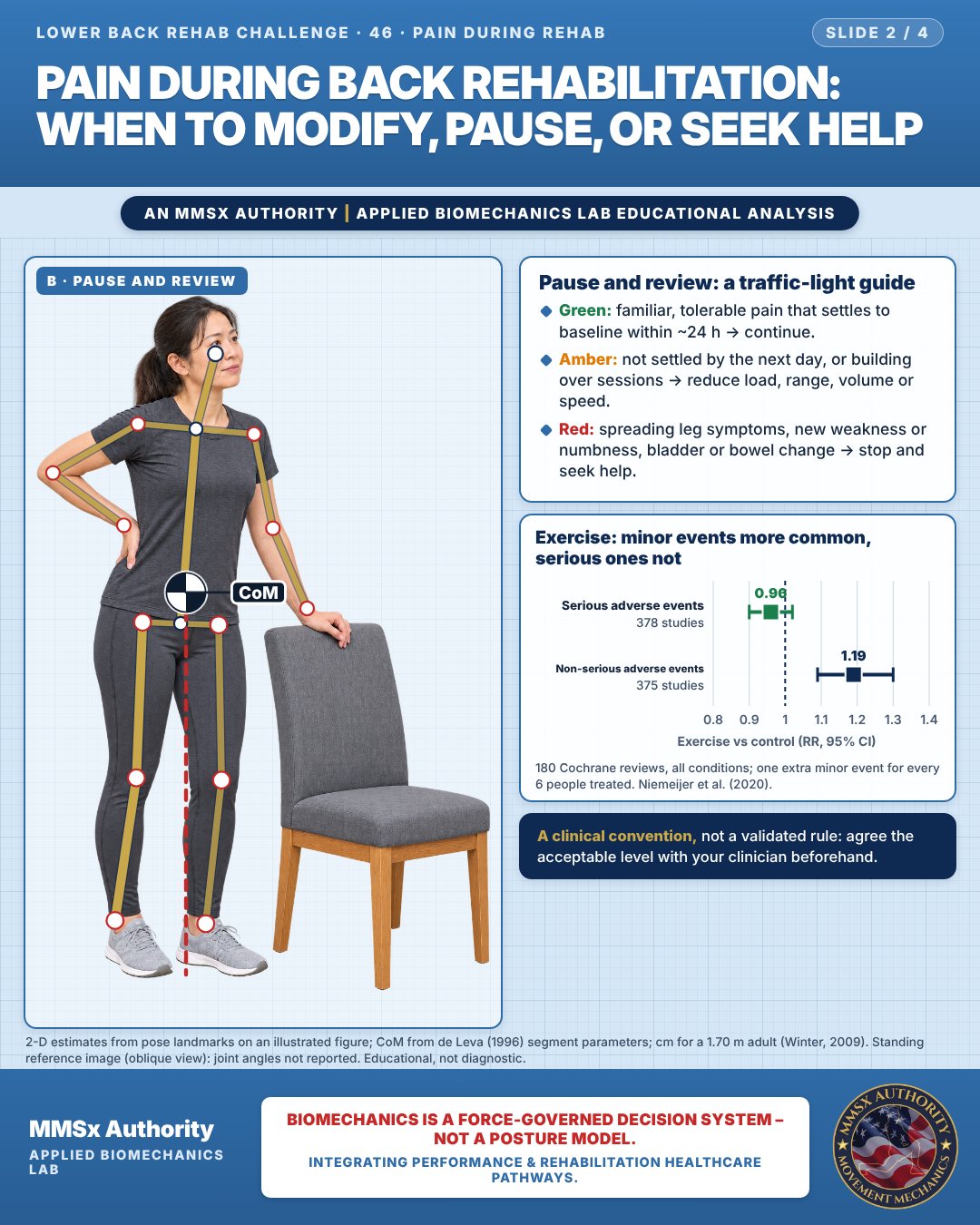
Pause and review: a traffic-light guide
Green: familiar, tolerable pain that settles to baseline within ~24 h → continue.
Amber: not settled by the next day, or building over sessions → reduce load, range, volume or speed.
Red: spreading leg symptoms, new weakness or numbness, bladder or bowel change → stop and seek help.
Exercise: minor events more common, serious ones not
Movement C: Seeking guidance (side view)
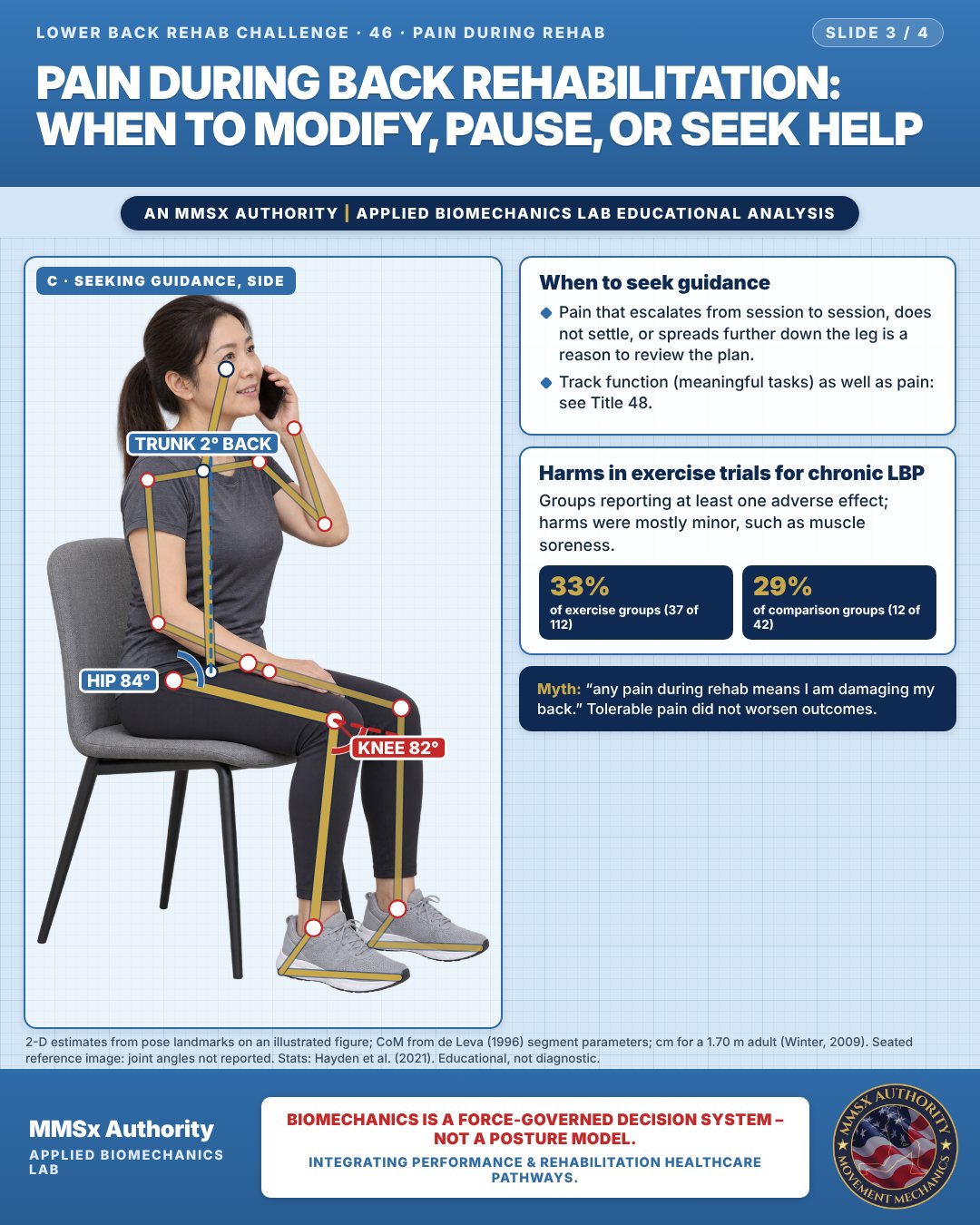
When to seek guidance
Pain that escalates from session to session, does not settle, or spreads further down the leg is a reason to review the plan.
Track function (meaningful tasks) as well as pain: see Title 48.
Harms in exercise trials for chronic LBP
Groups reporting at least one adverse effect; harms were mostly minor, such as muscle soreness.
Decision pathway
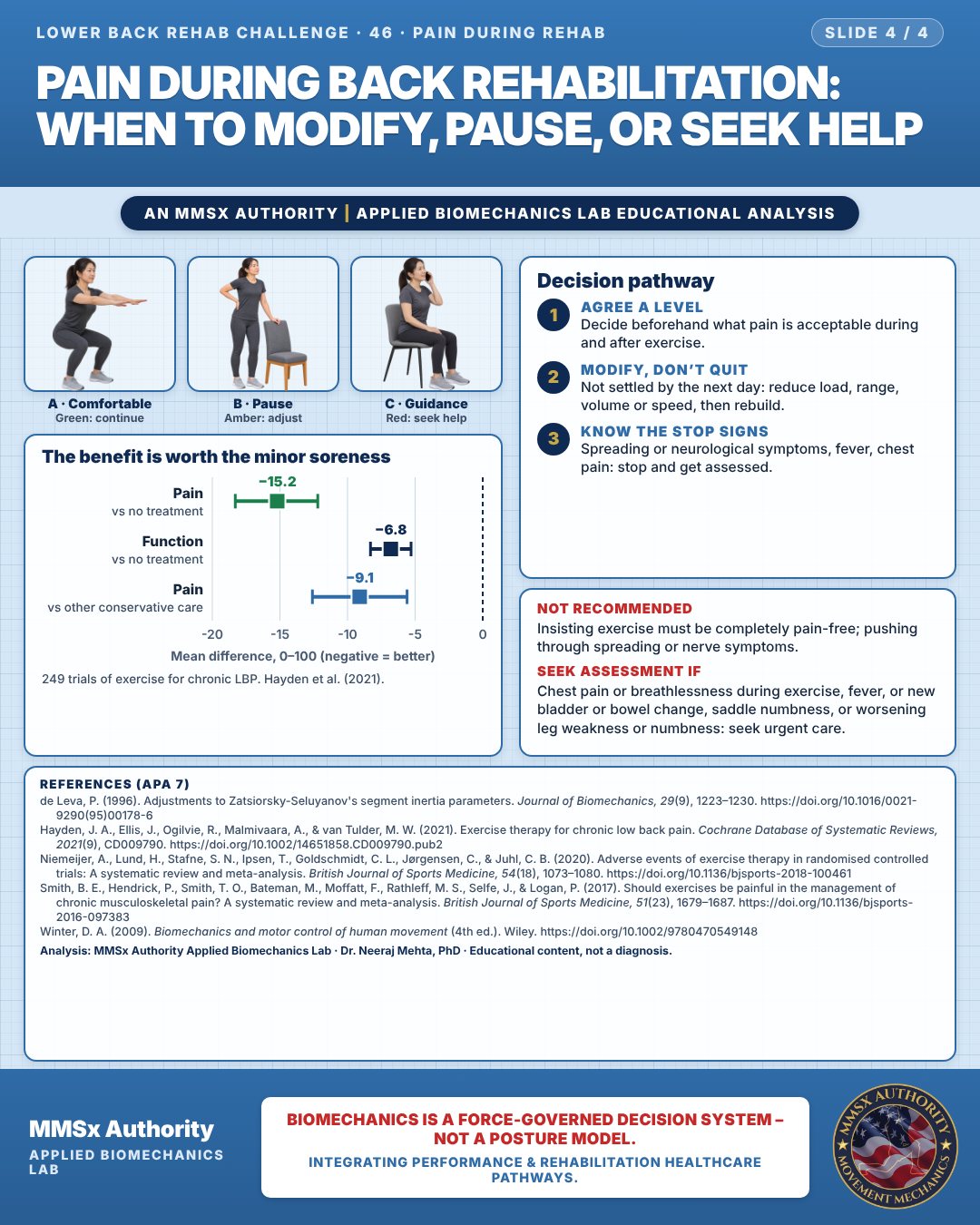
The benefit is worth the minor soreness
Agree a level
Decide beforehand what pain is acceptable during and after exercise.
Modify, don’t quit
Not settled by the next day: reduce load, range, volume or speed, then rebuild.
Know the stop signs
Spreading or neurological symptoms, fever, chest pain: stop and get assessed.
What the evidence supports
- Recommend: agree an acceptable pain level beforehand (a practical traffic-light approach is often used clinically: tolerable, familiar pain during exercise that settles to baseline within about 24 hours → continue; pain that does not settle by the next day or builds over sessions → reduce load, range, volume or speed; red-flag features → stop and seek assessment). This is a clinical monitoring convention rather than a validated rule; the trial evidence shows tolerable pain during exercise does not worsen outcomes (Smith et al., 2017).
Myth and evidence
Myth“Any pain during rehab means I am damaging my back.”
EvidencePainful (tolerable) exercise did not lead to worse outcomes than pain-free exercise (Smith et al., 2017); exercise did not increase serious adverse events, while minor events such as soreness were more common (Niemeijer et al., 2020; Hayden et al., 2021).
Cautions
Not recommended
Insisting exercise must be completely pain-free; pushing through spreading or nerve symptoms.
Seek assessment if
Chest pain or breathlessness during exercise, fever, or new bladder or bowel change, saddle numbness, or worsening leg weakness or numbness: seek urgent care.
Methods note
2-D estimates from pose landmarks on an illustrated figure; CoM from de Leva (1996) segment parameters; cm for a 1.70 m adult (Winter, 2009). Low-back lever: upper-body CoM to an L5/S1 estimate; moment = upper-body weight × lever for a 70 kg adult, static, no hand load. Standing reference image (oblique view): joint angles not reported. Seated reference image: joint angles not reported. Stats: Hayden et al. (2021). These are educational estimates, not a diagnosis.
References
- de Leva, P. (1996). Adjustments to Zatsiorsky-Seluyanov's segment inertia parameters. Journal of Biomechanics, 29(9), 1223–1230. https://doi.org/10.1016/0021-9290(95)00178-6
- Hayden, J. A., Ellis, J., Ogilvie, R., Malmivaara, A., & van Tulder, M. W. (2021). Exercise therapy for chronic low back pain. Cochrane Database of Systematic Reviews, 2021(9), CD009790. https://doi.org/10.1002/14651858.CD009790.pub2
- Niemeijer, A., Lund, H., Stafne, S. N., Ipsen, T., Goldschmidt, C. L., Jørgensen, C., & Juhl, C. B. (2020). Adverse events of exercise therapy in randomised controlled trials: A systematic review and meta-analysis. British Journal of Sports Medicine, 54(18), 1073–1080. https://doi.org/10.1136/bjsports-2018-100461
- Smith, B. E., Hendrick, P., Smith, T. O., Bateman, M., Moffatt, F., Rathleff, M. S., Selfe, J., & Logan, P. (2017). Should exercises be painful in the management of chronic musculoskeletal pain? A systematic review and meta-analysis. British Journal of Sports Medicine, 51(23), 1679–1687. https://doi.org/10.1136/bjsports-2016-097383
- Winter, D. A. (2009). Biomechanics and motor control of human movement (4th ed.). Wiley. https://doi.org/10.1002/9780470549148
Cite this article
Mehta, N. (2026, October 23). Pain during back rehabilitation: when to modify, pause, or seek help. MMSx Authority Applied Biomechanics Lab. https://mmsxauthority.org/edu/analysis/lower-back/46-pain-during-back-rehabilitation-when-to-modify-pause-or-seek-help/
Part of the collection
Mehta, N. (2026). Lower Back Rehabilitation: 50 Evidence-Based Biomechanics Analyses [Collection]. MMSx Authority Applied Biomechanics Lab. Zenodo. https://doi.org/10.5281/zenodo.23735778
All Lower Back Rehab Challenge articles · Rehabilitation Library