Lower Back Rehab Challenge · 45
Afraid to bend? Rebuilding confidence when your back hurts
Pain-related fear (kinesiophobia, fear-avoidance) is the belief that a movement such as bending will cause pain, harm or (re)injury, leading to…
Key points
- Explore the fear. What does the person expect will happen when they bend, and why?
- Build the ladder. List meaningful feared tasks (dishwasher, shoes, lifting a child) from easiest to hardest.
- Practise relaxed. Unguarded movement with breathing; progress range, then speed, then load, by confidence and the next-day response.
What it is
Pain-related fear (kinesiophobia, fear-avoidance) is the belief that a movement such as bending will cause pain, harm or (re)injury, leading to avoidance or guarded, stiff movement. Graded exposure and cognitive functional therapy (CFT) help people re-engage with feared, meaningful movements step by step while making sense of pain, rather than avoiding them.
How we analysed the movement
Three movements relevant to this topic were analysed from illustrated reference figures. Joint centres were located with two-dimensional pose estimation; joint angles, the whole-body centre of mass and, where relevant, the low-back lever (the horizontal distance from the upper-body centre of mass to the L5/S1 joint) were then calculated from standard segment parameters. The figures are educational estimates that show how position changes mechanical demand; they are not measurements of a patient. Every research value quoted below comes from the published source cited beside it.
Movement A: Small reach (side view)
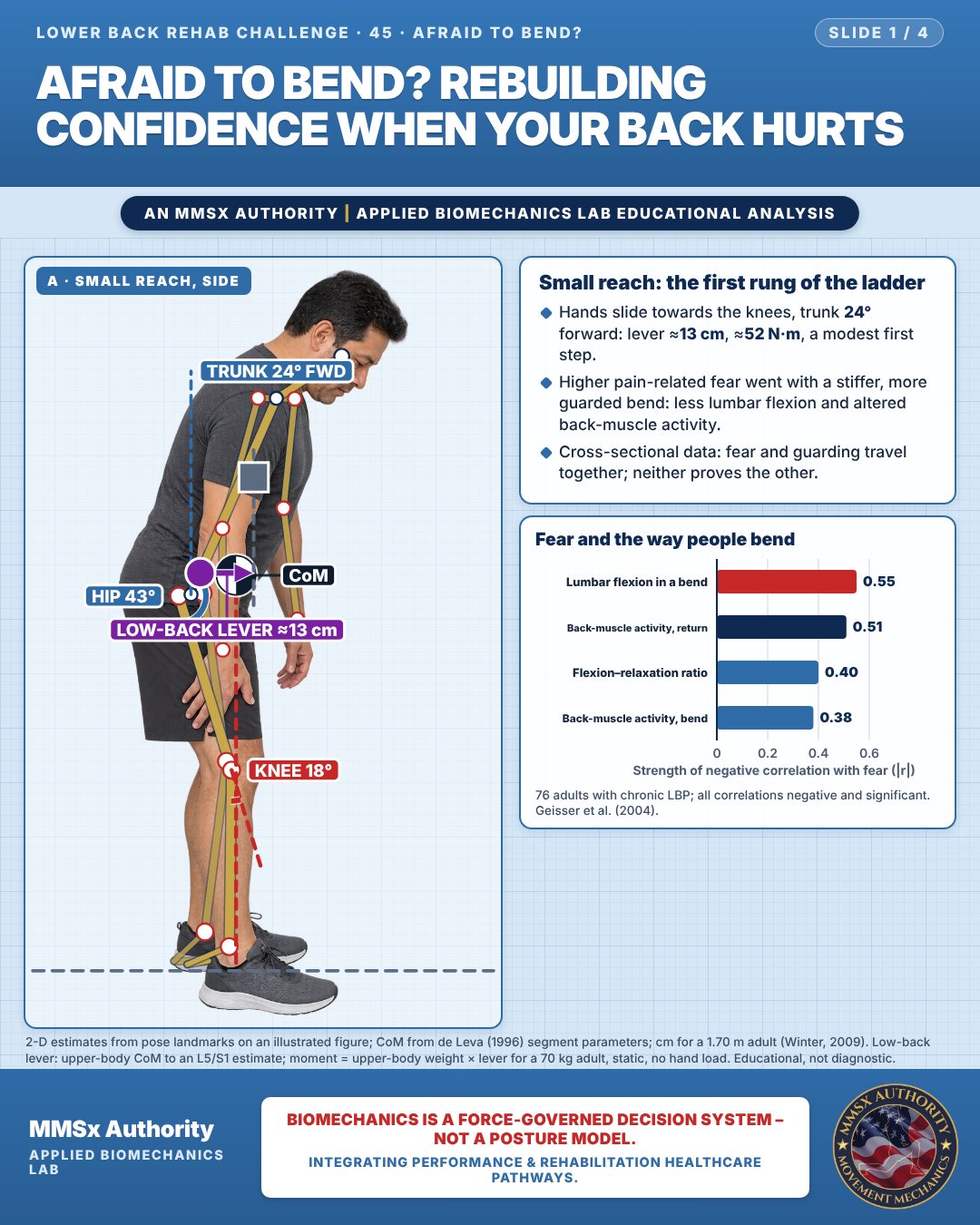
Small reach: the first rung of the ladder
Hands slide towards the knees, trunk 24° forward: lever ≈13 cm, ≈52 N·m, a modest first step.
Higher pain-related fear went with a stiffer, more guarded bend: less lumbar flexion and altered back-muscle activity.
Cross-sectional data: fear and guarding travel together; neither proves the other.
Fear and the way people bend
Movement B: Reach to a stool (side view)
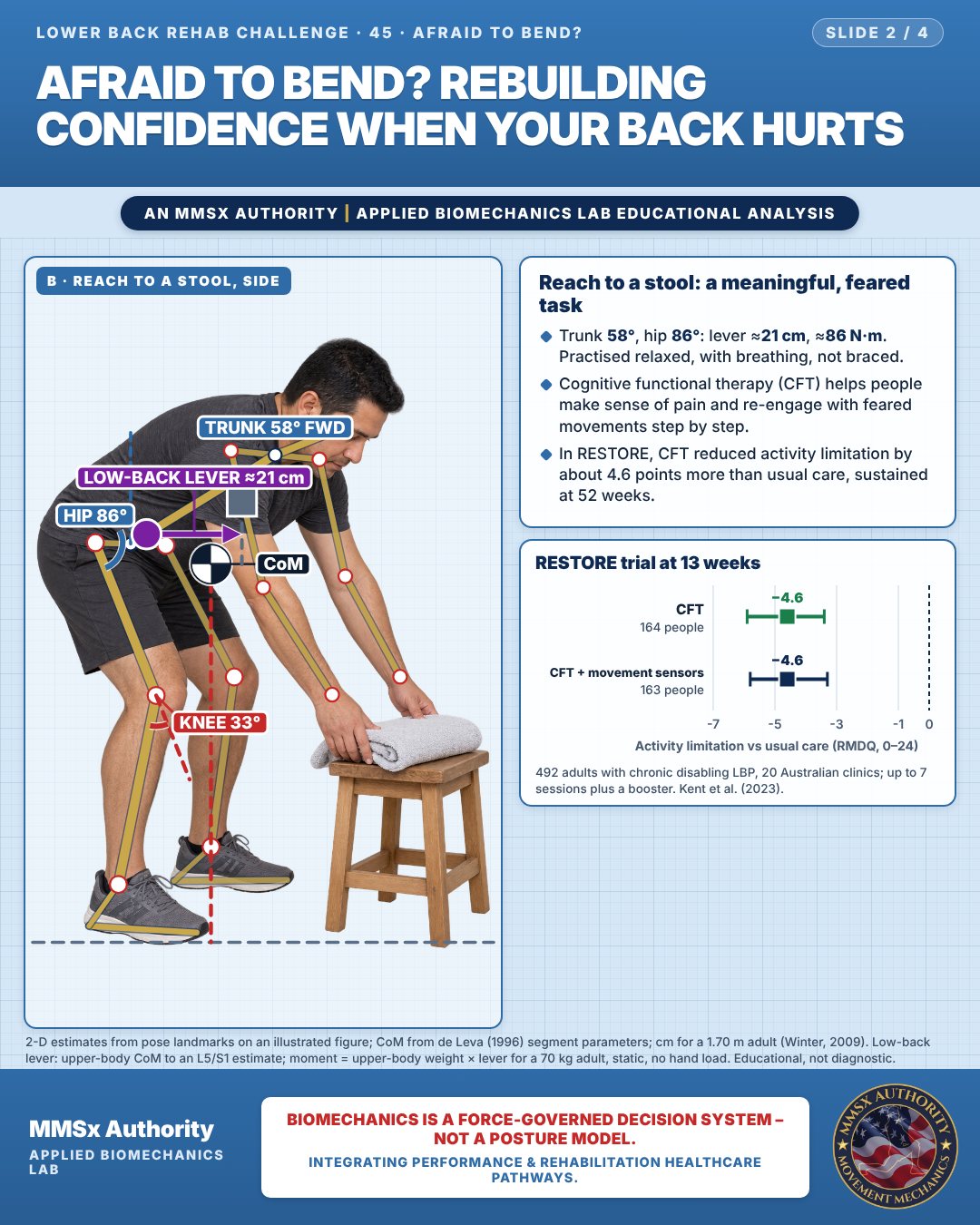
Reach to a stool: a meaningful, feared task
Trunk 58°, hip 86°: lever ≈21 cm, ≈86 N·m. Practised relaxed, with breathing, not braced.
Cognitive functional therapy (CFT) helps people make sense of pain and re-engage with feared movements step by step.
In RESTORE, CFT reduced activity limitation by about 4.6 points more than usual care, sustained at 52 weeks.
RESTORE trial at 13 weeks
Movement C: Lower reach (side view)
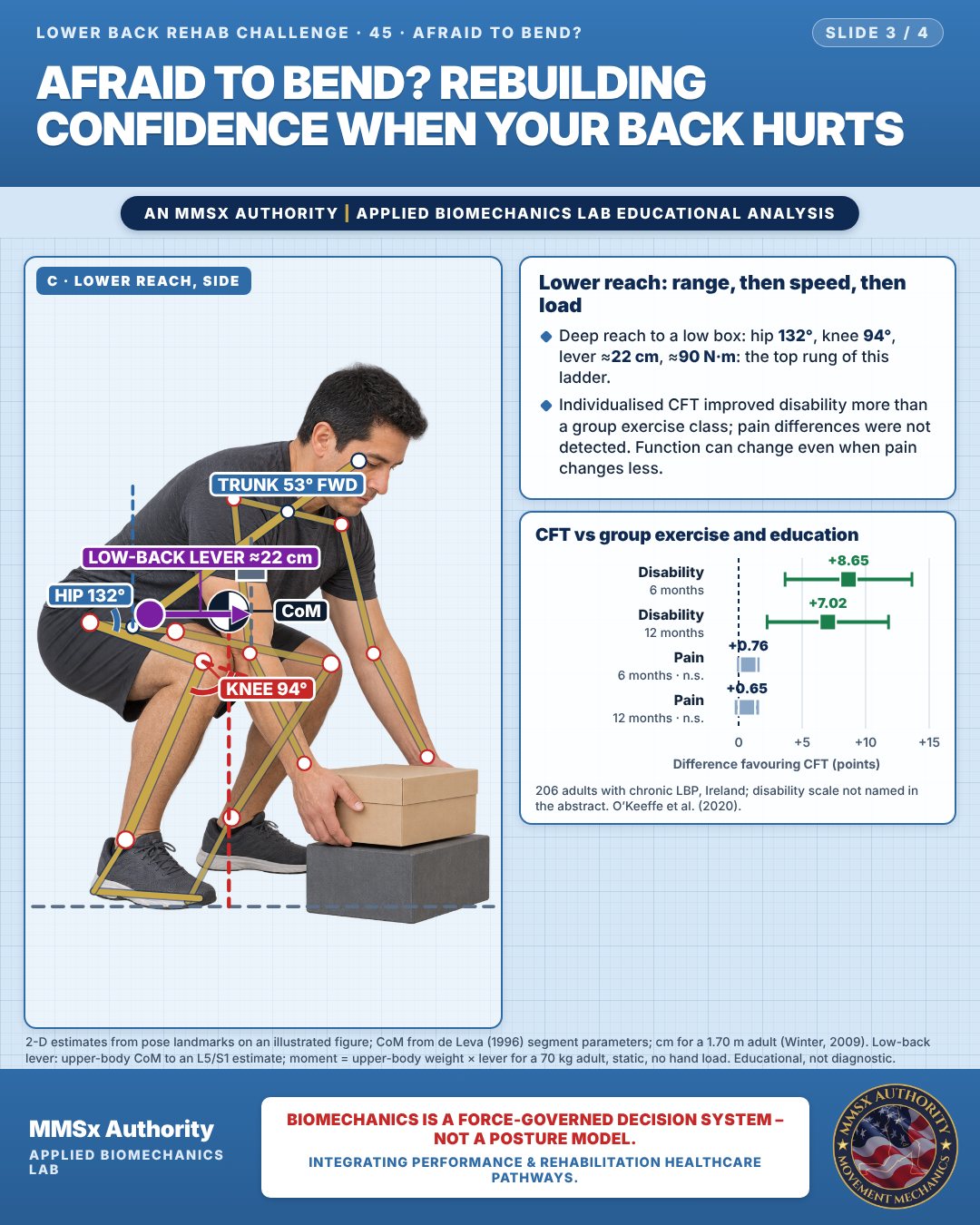
Lower reach: range, then speed, then load
Deep reach to a low box: hip 132°, knee 94°, lever ≈22 cm, ≈90 N·m: the top rung of this ladder.
Individualised CFT improved disability more than a group exercise class; pain differences were not detected. Function can change even when pain changes less.
CFT vs group exercise and education
Decision pathway
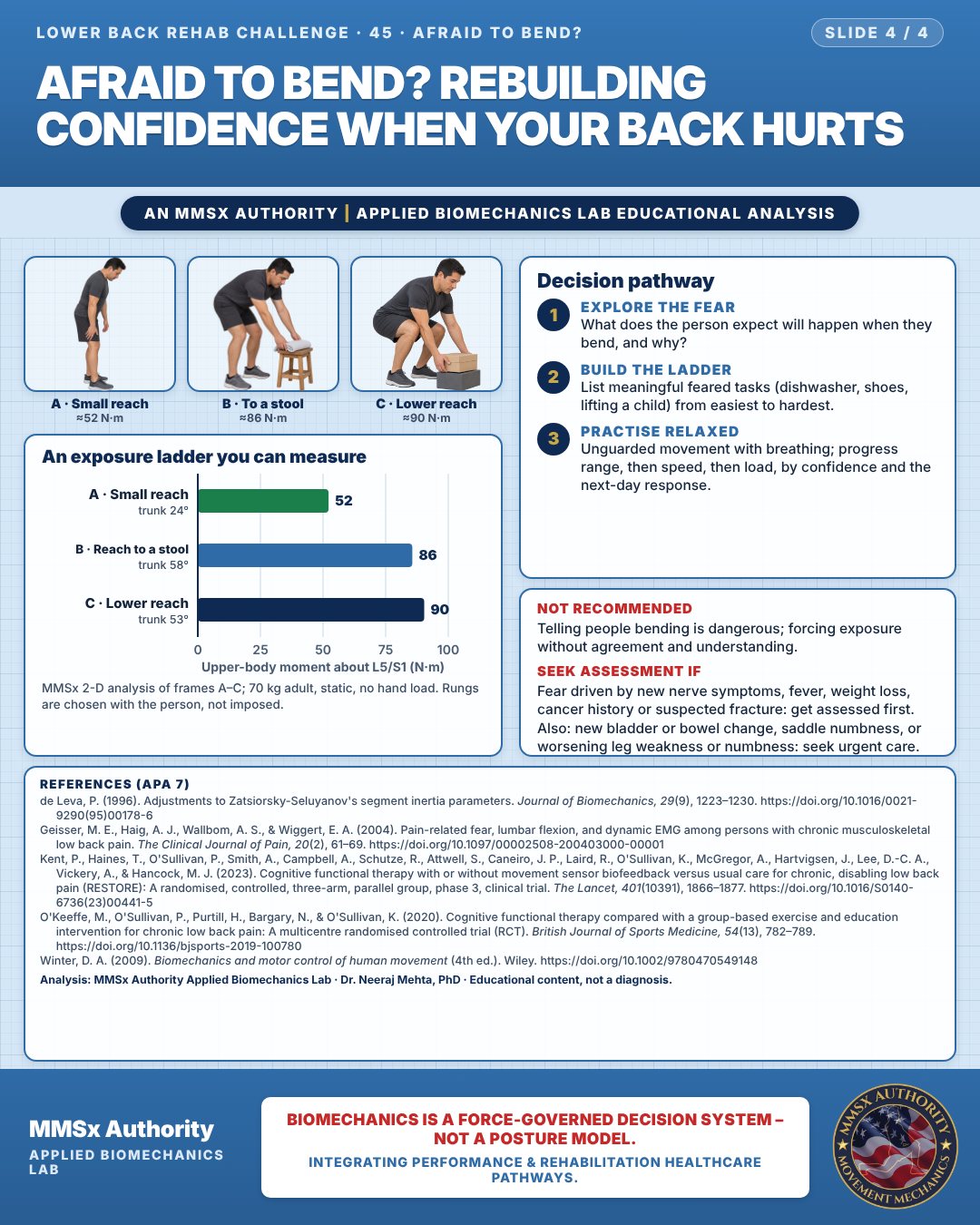
An exposure ladder you can measure
Explore the fear
What does the person expect will happen when they bend, and why?
Build the ladder
List meaningful feared tasks (dishwasher, shoes, lifting a child) from easiest to hardest.
Practise relaxed
Unguarded movement with breathing; progress range, then speed, then load, by confidence and the next-day response.
What the evidence supports
- Recommend: explore what the person fears and why; set a graded hierarchy of meaningful feared tasks (e.g. bending to load the dishwasher, picking up a child, tying shoes); practise them with relaxed, unguarded movement and progressively greater range, speed and load; combine with education that makes sense of pain (Kent et al., 2023; O'Keeffe et al., 2020).
Myth and evidence
Myth“If bending hurts, I should avoid bending to protect my spine.”
EvidenceHigher fear is associated with more restricted, guarded bending (Geisser et al., 2004), and an approach that helps people re-engage with feared movement (CFT) produced large, sustained reductions in activity limitation compared with usual care (Kent et al., 2023).
Cautions
Not recommended
Telling people bending is dangerous; forcing exposure without agreement and understanding.
Seek assessment if
Fear driven by new nerve symptoms, fever, weight loss, cancer history or suspected fracture: get assessed first. Also: new bladder or bowel change, saddle numbness, or worsening leg weakness or numbness: seek urgent care.
Methods note
2-D estimates from pose landmarks on an illustrated figure; CoM from de Leva (1996) segment parameters; cm for a 1.70 m adult (Winter, 2009). Low-back lever: upper-body CoM to an L5/S1 estimate; moment = upper-body weight × lever for a 70 kg adult, static, no hand load. These are educational estimates, not a diagnosis.
References
- de Leva, P. (1996). Adjustments to Zatsiorsky-Seluyanov's segment inertia parameters. Journal of Biomechanics, 29(9), 1223–1230. https://doi.org/10.1016/0021-9290(95)00178-6
- Geisser, M. E., Haig, A. J., Wallbom, A. S., & Wiggert, E. A. (2004). Pain-related fear, lumbar flexion, and dynamic EMG among persons with chronic musculoskeletal low back pain. The Clinical Journal of Pain, 20(2), 61–69. https://doi.org/10.1097/00002508-200403000-00001
- Kent, P., Haines, T., O'Sullivan, P., Smith, A., Campbell, A., Schutze, R., Attwell, S., Caneiro, J. P., Laird, R., O'Sullivan, K., McGregor, A., Hartvigsen, J., Lee, D.-C. A., Vickery, A., & Hancock, M. J. (2023). Cognitive functional therapy with or without movement sensor biofeedback versus usual care for chronic, disabling low back pain (RESTORE): A randomised, controlled, three-arm, parallel group, phase 3, clinical trial. The Lancet, 401(10391), 1866–1877. https://doi.org/10.1016/S0140-6736(23)00441-5
- O'Keeffe, M., O'Sullivan, P., Purtill, H., Bargary, N., & O'Sullivan, K. (2020). Cognitive functional therapy compared with a group-based exercise and education intervention for chronic low back pain: A multicentre randomised controlled trial (RCT). British Journal of Sports Medicine, 54(13), 782–789. https://doi.org/10.1136/bjsports-2019-100780
- Winter, D. A. (2009). Biomechanics and motor control of human movement (4th ed.). Wiley. https://doi.org/10.1002/9780470549148
Cite this article
Mehta, N. (2026, October 23). Afraid to bend? Rebuilding confidence when your back hurts. MMSx Authority Applied Biomechanics Lab. https://mmsxauthority.org/edu/analysis/lower-back/45-afraid-to-bend-rebuilding-confidence-when-your-back-hurts/
Part of the collection
Mehta, N. (2026). Lower Back Rehabilitation: 50 Evidence-Based Biomechanics Analyses [Collection]. MMSx Authority Applied Biomechanics Lab. Zenodo. https://doi.org/10.5281/zenodo.23735778
All Lower Back Rehab Challenge articles · Rehabilitation Library