Lower Back Rehab Challenge · 44
Stress and persistent lower back pain: understanding the connection
Persistent (chronic) lower back pain is pain lasting more than about three months. Movement analysis, verified research data and a decision pathway from the M
Key points
- Screen. Ask about mood, stress, worry, sleep, work and support alongside the physical findings.
- Combine. For high-impact persistent pain, combine exercise with psychological or work-focused approaches.
- Set expectations. Average effects are modest and individual responses vary; review progress together.
What it is
Persistent (chronic) lower back pain is pain lasting more than about three months. In a biopsychosocial model, physical factors (tissue sensitivity, deconditioning, load), psychological factors (low mood, stress, worry, fear, catastrophising) and social factors (work demands, support, finances) interact to influence pain, disability and recovery. Saying stress "contributes" does not mean the pain is imagined or "all in the head".
How we analysed the movement
Three movements relevant to this topic were analysed from illustrated reference figures. Joint centres were located with two-dimensional pose estimation; joint angles, the whole-body centre of mass and, where relevant, the low-back lever (the horizontal distance from the upper-body centre of mass to the L5/S1 joint) were then calculated from standard segment parameters. The figures are educational estimates that show how position changes mechanical demand; they are not measurements of a patient. Every research value quoted below comes from the published source cited beside it.
Movement A: Stress awareness, seated
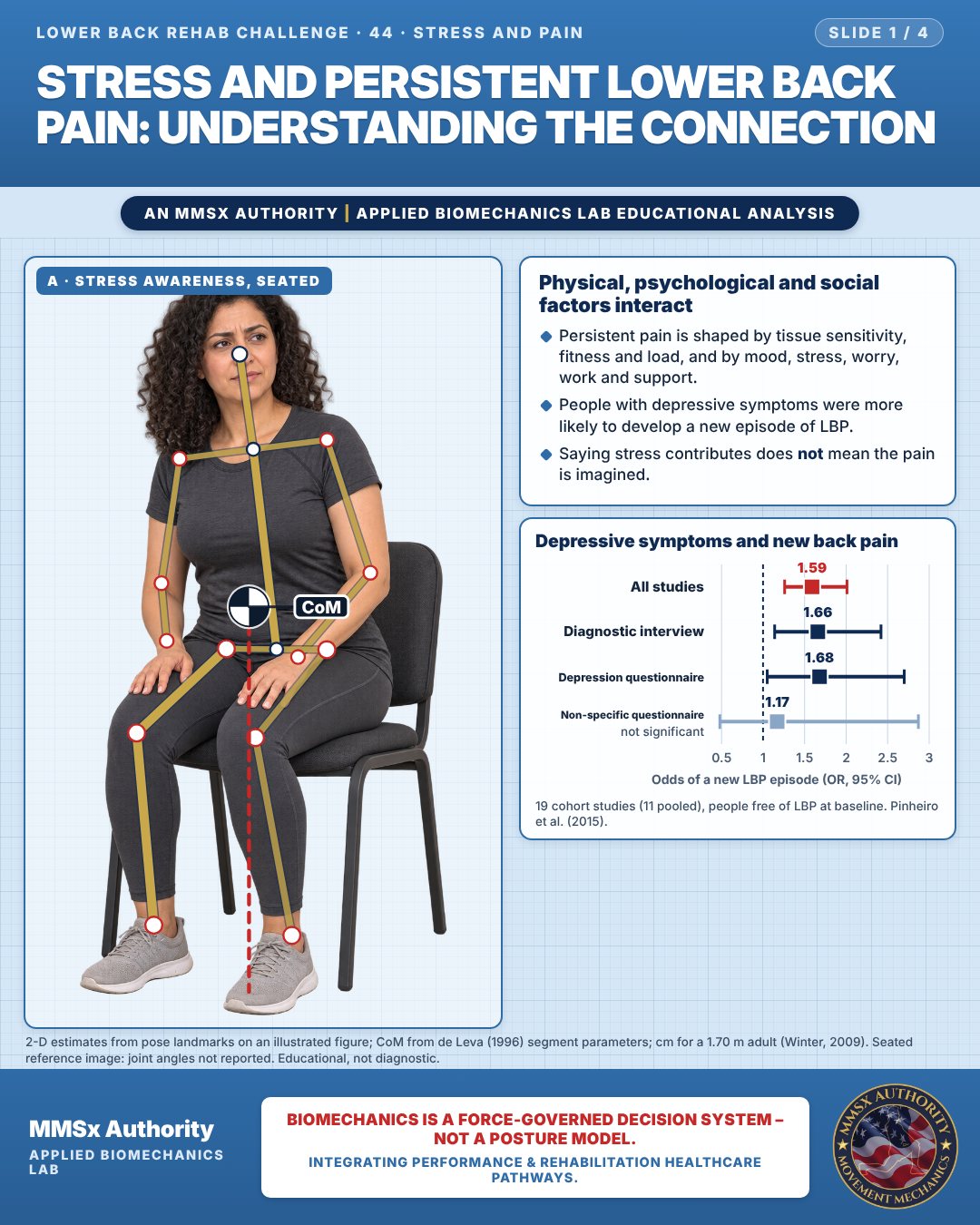
Physical, psychological and social factors interact
Persistent pain is shaped by tissue sensitivity, fitness and load, and by mood, stress, worry, work and support.
People with depressive symptoms were more likely to develop a new episode of LBP.
Saying stress contributes does not mean the pain is imagined.
Depressive symptoms and new back pain
Movement B: Slow breathing, seated
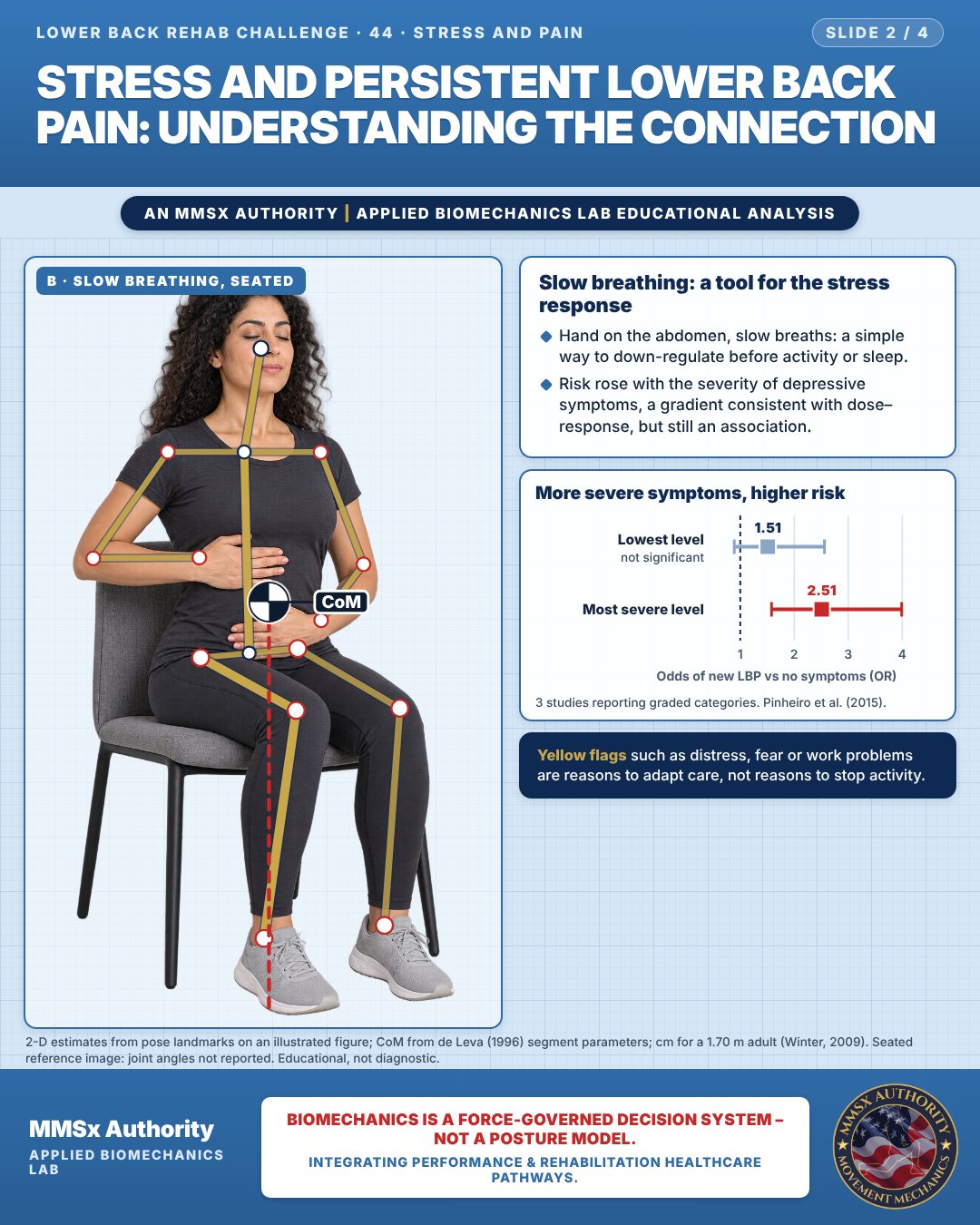
Slow breathing: a tool for the stress response
Hand on the abdomen, slow breaths: a simple way to down-regulate before activity or sleep.
Risk rose with the severity of depressive symptoms, a gradient consistent with dose–response, but still an association.
More severe symptoms, higher risk
Movement C: Restorative walk (front view)
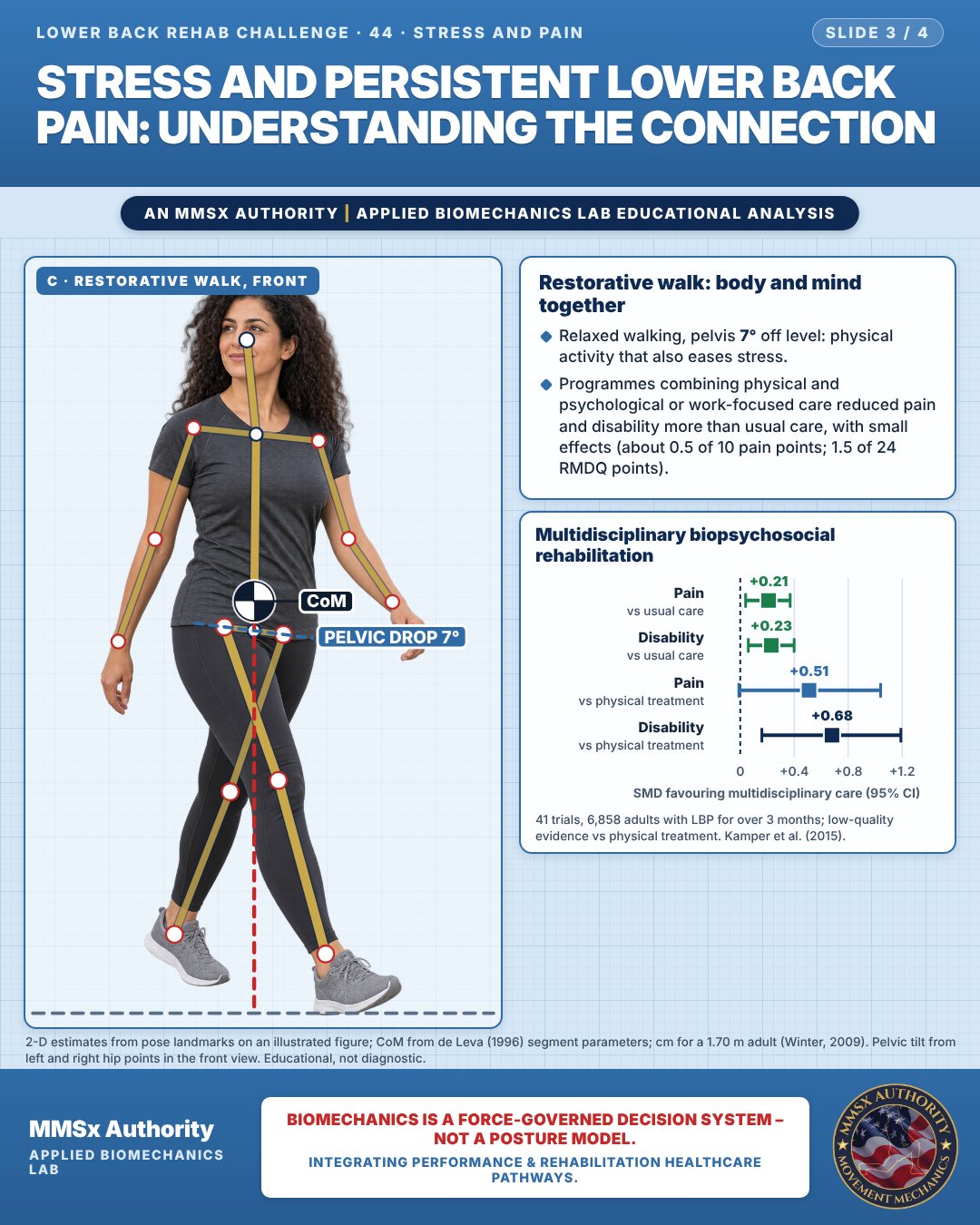
Restorative walk: body and mind together
Relaxed walking, pelvis 7° off level: physical activity that also eases stress.
Programmes combining physical and psychological or work-focused care reduced pain and disability more than usual care, with small effects (about 0.5 of 10 pain points; 1.5 of 24 RMDQ points).
Multidisciplinary biopsychosocial rehabilitation
Decision pathway
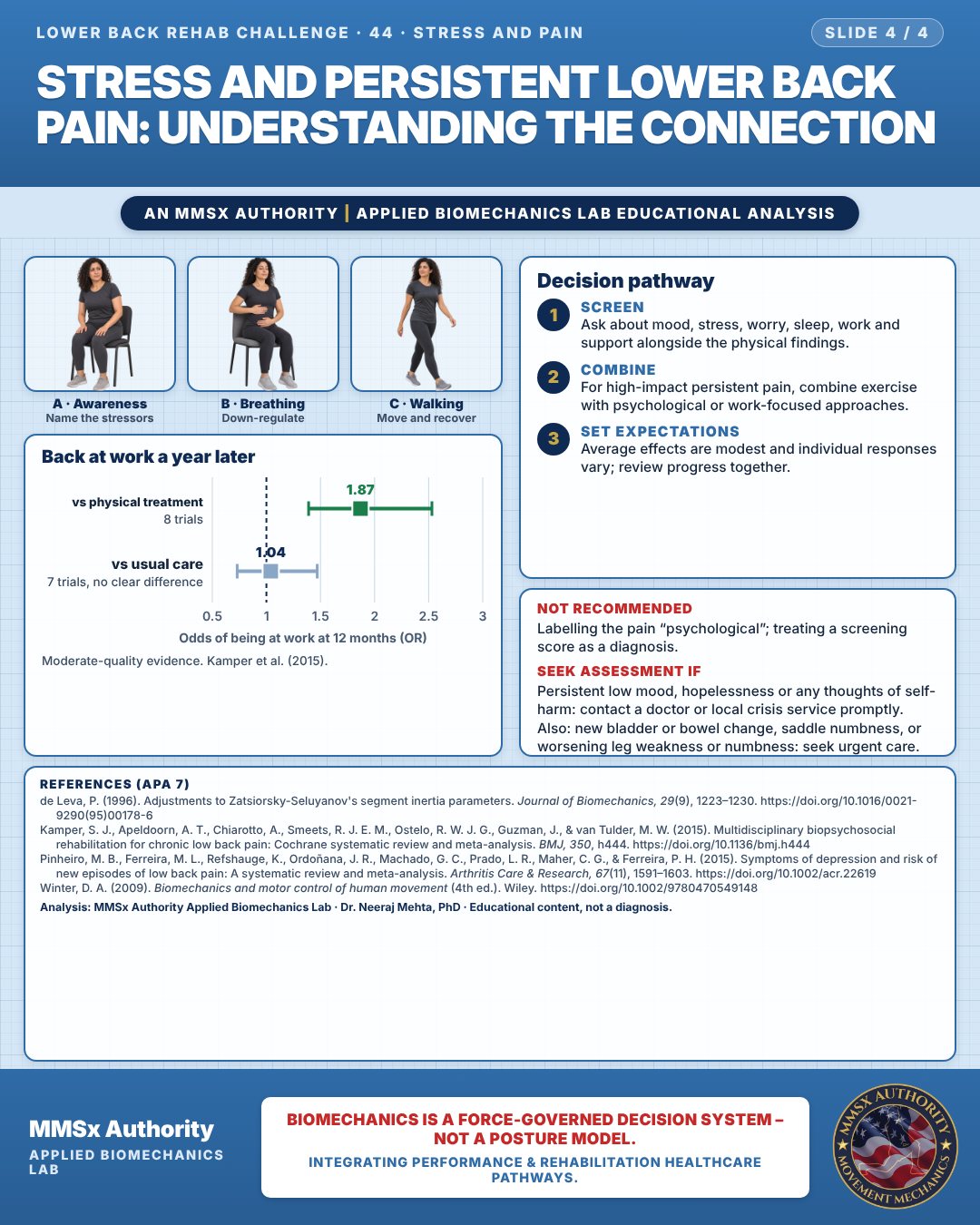
Back at work a year later
Screen
Ask about mood, stress, worry, sleep, work and support alongside the physical findings.
Combine
For high-impact persistent pain, combine exercise with psychological or work-focused approaches.
Set expectations
Average effects are modest and individual responses vary; review progress together.
What the evidence supports
- Recommend: screen for and discuss psychological and social contributors (mood, stress, worry, work, sleep) alongside physical findings; for persistent LBP with high impact, consider combined physical and psychological approaches (multidisciplinary rehabilitation, or exercise combined with psychological approaches such as cognitive behavioural strategies) (Kamper et al., 2015).
- Communicate that effects are modest on average (≈0.5/10 pain, ≈1.5/24 RMDQ vs usual care) and that individual responses vary (Kamper et al., 2015).
Myth and evidence
Myth“If stress affects my pain, the pain isn't real.”
EvidenceDepressive symptoms are associated with a higher risk of new LBP, with a gradient by severity (OR 1.51 → 2.51) (Pinheiro et al., 2015), and programmes combining physical and psychological care reduce pain and disability (Kamper et al., 2015) — pain is real and influenced by many interacting factors.
Cautions
Not recommended
Labelling the pain “psychological”; treating a screening score as a diagnosis.
Seek assessment if
Persistent low mood, hopelessness or any thoughts of self-harm: contact a doctor or local crisis service promptly. Also: new bladder or bowel change, saddle numbness, or worsening leg weakness or numbness: seek urgent care.
Methods note
2-D estimates from pose landmarks on an illustrated figure; CoM from de Leva (1996) segment parameters; cm for a 1.70 m adult (Winter, 2009). Seated reference image: joint angles not reported. Pelvic tilt from left and right hip points in the front view. These are educational estimates, not a diagnosis.
References
- de Leva, P. (1996). Adjustments to Zatsiorsky-Seluyanov's segment inertia parameters. Journal of Biomechanics, 29(9), 1223–1230. https://doi.org/10.1016/0021-9290(95)00178-6
- Kamper, S. J., Apeldoorn, A. T., Chiarotto, A., Smeets, R. J. E. M., Ostelo, R. W. J. G., Guzman, J., & van Tulder, M. W. (2015). Multidisciplinary biopsychosocial rehabilitation for chronic low back pain: Cochrane systematic review and meta-analysis. BMJ, 350, h444. https://doi.org/10.1136/bmj.h444
- Pinheiro, M. B., Ferreira, M. L., Refshauge, K., Ordoñana, J. R., Machado, G. C., Prado, L. R., Maher, C. G., & Ferreira, P. H. (2015). Symptoms of depression and risk of new episodes of low back pain: A systematic review and meta-analysis. Arthritis Care & Research, 67(11), 1591–1603. https://doi.org/10.1002/acr.22619
- Winter, D. A. (2009). Biomechanics and motor control of human movement (4th ed.). Wiley. https://doi.org/10.1002/9780470549148
Cite this article
Mehta, N. (2026, October 23). Stress and persistent lower back pain: understanding the connection. MMSx Authority Applied Biomechanics Lab. https://mmsxauthority.org/edu/analysis/lower-back/44-stress-and-persistent-lower-back-pain-understanding-the-connection/
Part of the collection
Mehta, N. (2026). Lower Back Rehabilitation: 50 Evidence-Based Biomechanics Analyses [Collection]. MMSx Authority Applied Biomechanics Lab. Zenodo. https://doi.org/10.5281/zenodo.23735778
All Lower Back Rehab Challenge articles · Rehabilitation Library