Lower Back Rehab Challenge · 43
Poor sleep and lower back pain: why both deserve attention
Sleep disturbance in lower back pain covers difficulty falling asleep, waking because of pain or discomfort, shortened sleep, poor self-rated sleep…
Key points
- Ask. Include sleep in the assessment of every person with back pain.
- Treat both. Comfort positions, routine, daytime activity; refer persistent insomnia for specific care.
- No sleep cure. Do not promise that a mattress or pillow alone will fix back pain.
What it is
Sleep disturbance in lower back pain covers difficulty falling asleep, waking because of pain or discomfort, shortened sleep, poor self-rated sleep quality and reduced daytime function. The relationship is considered two-way: pain can disturb sleep, and poor sleep is associated with higher subsequent pain and poorer recovery. Associations do not prove that improving sleep alone will resolve back pain.
How we analysed the movement
Three movements relevant to this topic were analysed from illustrated reference figures. Joint centres were located with two-dimensional pose estimation; joint angles, the whole-body centre of mass and, where relevant, the low-back lever (the horizontal distance from the upper-body centre of mass to the L5/S1 joint) were then calculated from standard segment parameters. The figures are educational estimates that show how position changes mechanical demand; they are not measurements of a patient. Every research value quoted below comes from the published source cited beside it.
Movement A: Side-lying with pillows
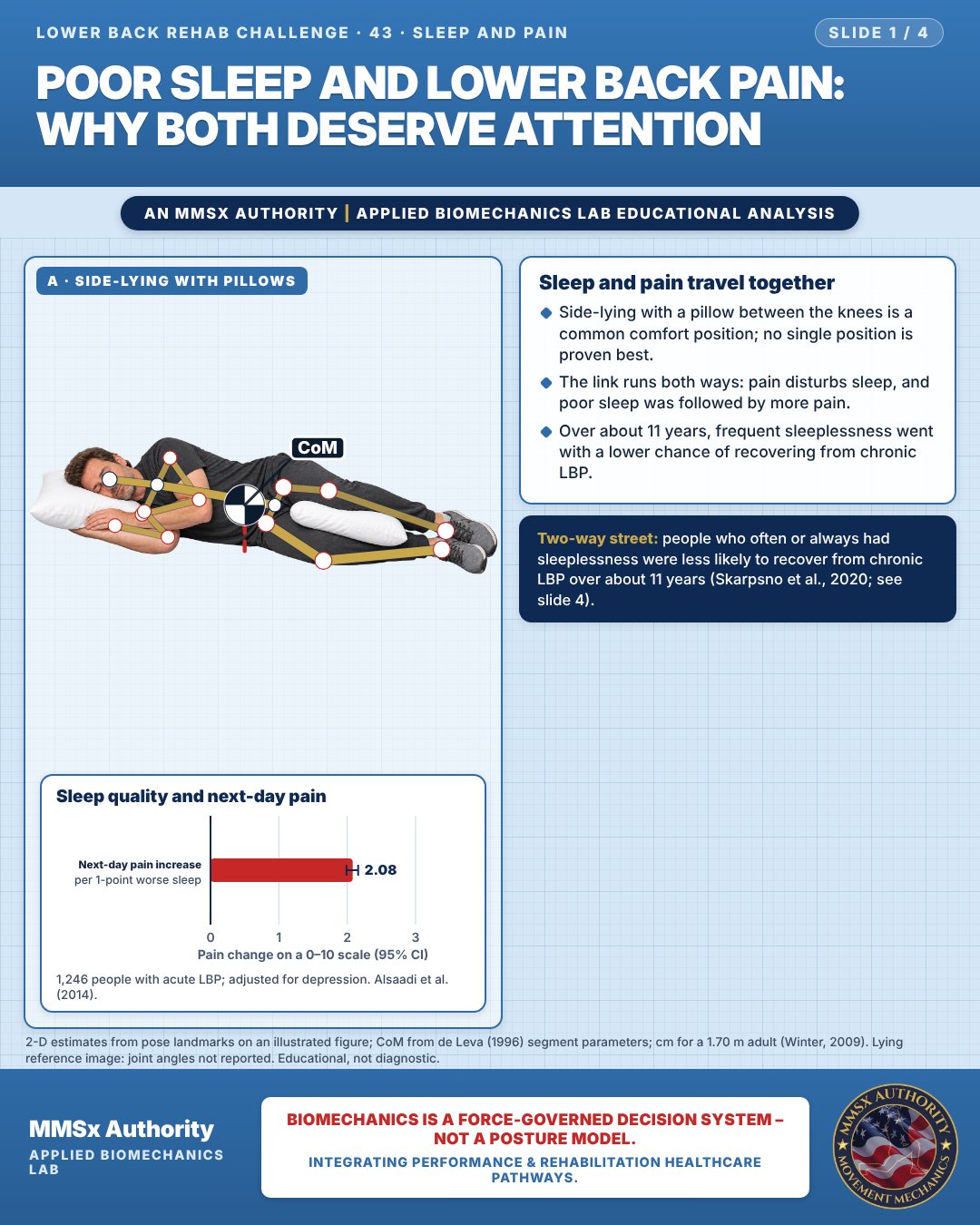
Sleep quality and next-day pain
Sleep and pain travel together
Side-lying with a pillow between the knees is a common comfort position; no single position is proven best.
The link runs both ways: pain disturbs sleep, and poor sleep was followed by more pain.
Over about 11 years, frequent sleeplessness went with a lower chance of recovering from chronic LBP.
Movement B: Evening wind-down
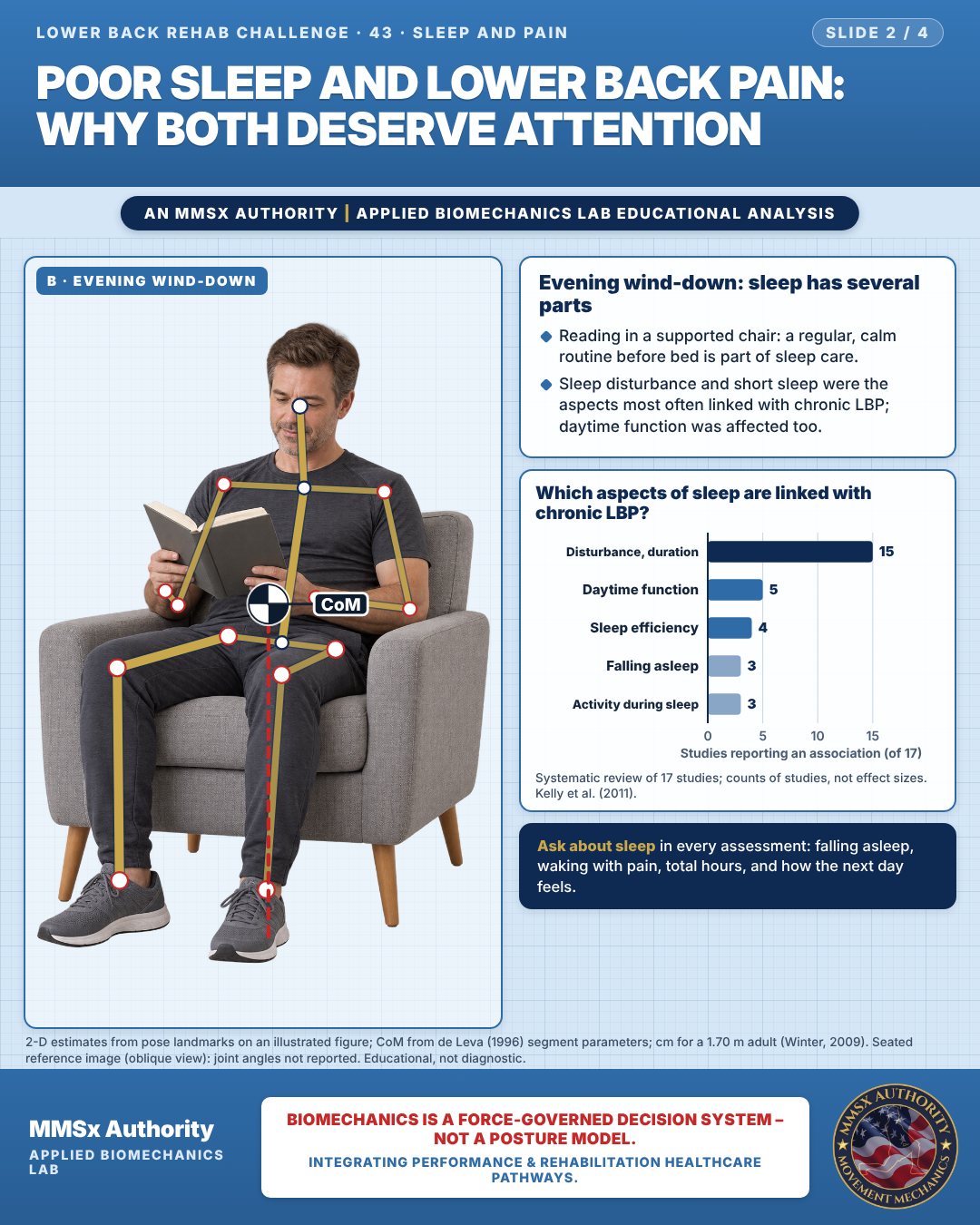
Evening wind-down: sleep has several parts
Reading in a supported chair: a regular, calm routine before bed is part of sleep care.
Sleep disturbance and short sleep were the aspects most often linked with chronic LBP; daytime function was affected too.
Which aspects of sleep are linked with chronic LBP?
Movement C: Morning walk
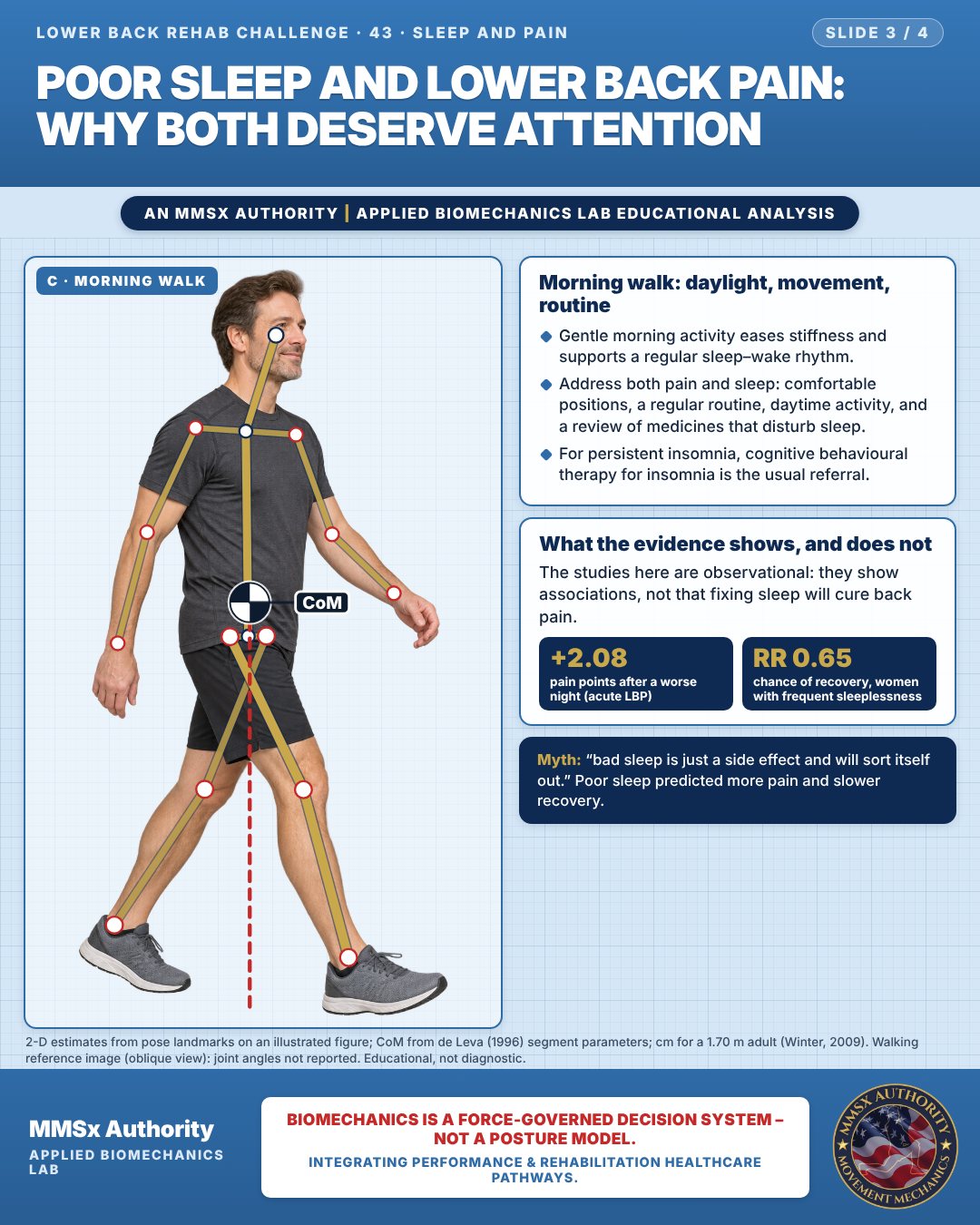
Morning walk: daylight, movement, routine
Gentle morning activity eases stiffness and supports a regular sleep–wake rhythm.
Address both pain and sleep: comfortable positions, a regular routine, daytime activity, and a review of medicines that disturb sleep.
For persistent insomnia, cognitive behavioural therapy for insomnia is the usual referral.
What the evidence shows, and does not
The studies here are observational: they show associations, not that fixing sleep will cure back pain.
Decision pathway
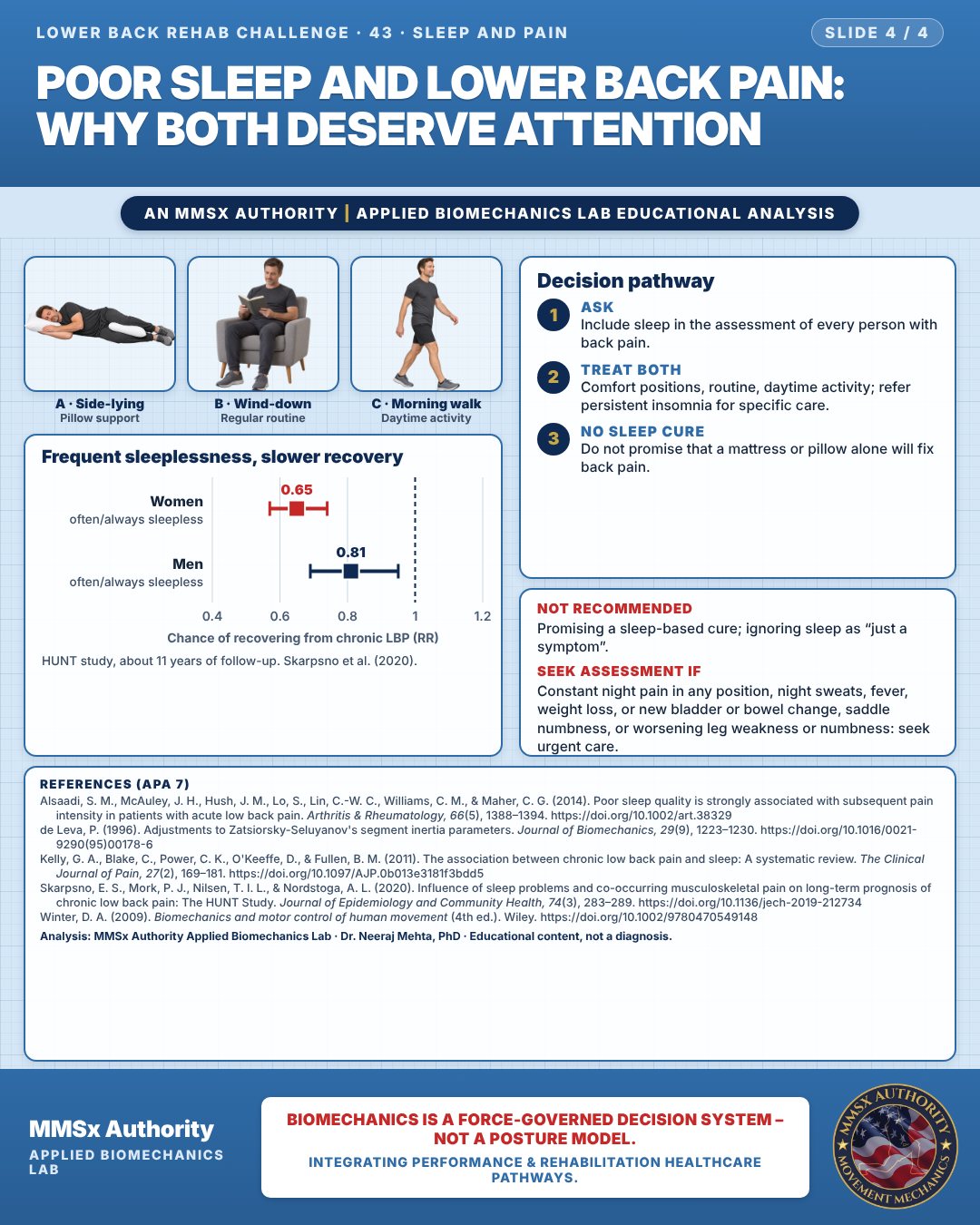
Frequent sleeplessness, slower recovery
Ask
Include sleep in the assessment of every person with back pain.
Treat both
Comfort positions, routine, daytime activity; refer persistent insomnia for specific care.
No sleep cure
Do not promise that a mattress or pillow alone will fix back pain.
What the evidence supports
- Do not: promise that fixing sleep (or buying a particular mattress or pillow) will cure back pain; the evidence here is observational (Alsaadi et al., 2014; Skarpsno et al., 2020).
Myth and evidence
Myth“Bad sleep is just a side effect of back pain — it will sort itself out.”
EvidencePoor sleep quality was associated with higher subsequent pain in acute LBP (+2.08/10 per point) (Alsaadi et al., 2014) and frequent sleeplessness with a lower chance of recovery from chronic LBP over about 11 years (Skarpsno et al., 2020). Both deserve attention — without claiming sleep is the sole cause.
Cautions
Not recommended
Promising a sleep-based cure; ignoring sleep as “just a symptom”.
Seek assessment if
Constant night pain in any position, night sweats, fever, weight loss, or new bladder or bowel change, saddle numbness, or worsening leg weakness or numbness: seek urgent care.
Methods note
2-D estimates from pose landmarks on an illustrated figure; CoM from de Leva (1996) segment parameters; cm for a 1.70 m adult (Winter, 2009). Lying reference image: joint angles not reported. Seated reference image (oblique view): joint angles not reported. Walking reference image (oblique view): joint angles not reported. These are educational estimates, not a diagnosis.
References
- Alsaadi, S. M., McAuley, J. H., Hush, J. M., Lo, S., Lin, C.-W. C., Williams, C. M., & Maher, C. G. (2014). Poor sleep quality is strongly associated with subsequent pain intensity in patients with acute low back pain. Arthritis & Rheumatology, 66(5), 1388–1394. https://doi.org/10.1002/art.38329
- de Leva, P. (1996). Adjustments to Zatsiorsky-Seluyanov's segment inertia parameters. Journal of Biomechanics, 29(9), 1223–1230. https://doi.org/10.1016/0021-9290(95)00178-6
- Kelly, G. A., Blake, C., Power, C. K., O'Keeffe, D., & Fullen, B. M. (2011). The association between chronic low back pain and sleep: A systematic review. The Clinical Journal of Pain, 27(2), 169–181. https://doi.org/10.1097/AJP.0b013e3181f3bdd5
- Skarpsno, E. S., Mork, P. J., Nilsen, T. I. L., & Nordstoga, A. L. (2020). Influence of sleep problems and co-occurring musculoskeletal pain on long-term prognosis of chronic low back pain: The HUNT Study. Journal of Epidemiology and Community Health, 74(3), 283–289. https://doi.org/10.1136/jech-2019-212734
- Winter, D. A. (2009). Biomechanics and motor control of human movement (4th ed.). Wiley. https://doi.org/10.1002/9780470549148
Cite this article
Mehta, N. (2026, October 23). Poor sleep and lower back pain: why both deserve attention. MMSx Authority Applied Biomechanics Lab. https://mmsxauthority.org/edu/analysis/lower-back/43-poor-sleep-and-lower-back-pain-why-both-deserve-attention/
Part of the collection
Mehta, N. (2026). Lower Back Rehabilitation: 50 Evidence-Based Biomechanics Analyses [Collection]. MMSx Authority Applied Biomechanics Lab. Zenodo. https://doi.org/10.5281/zenodo.23735778
All Lower Back Rehab Challenge articles · Rehabilitation Library