Lower Back Rehab Challenge · 42
Postpartum lower back pain: rebuilding capacity for lifting and daily care
Postpartum lower back pain is pain in the lumbar region and/or pelvic girdle that persists or begins after childbirth.
Key points
- Individualise. Return is guided by symptoms, birth type and postnatal advice, not a fixed date.
- Rehearse the tasks. Cot, car seat, pram and floor lifts as graded exercises: height, load, repetitions.
- Train the pelvis. Supervised trunk and pelvic-girdle exercise for persistent pelvic girdle pain.
What it is
Postpartum lower back pain is pain in the lumbar region and/or pelvic girdle that persists or begins after childbirth. Most pregnancy-related lumbopelvic pain eases in the months after delivery, but a minority of women have persistent symptoms, particularly when pain was present in several locations or pelvic pain-provocation tests were positive in pregnancy. Daily-care tasks (lifting and carrying the baby, car seats, prams, feeding postures) are repeated, often asymmetric loads that need to be rebuilt gradually.
How we analysed the movement
Three movements relevant to this topic were analysed from illustrated reference figures. Joint centres were located with two-dimensional pose estimation; joint angles, the whole-body centre of mass and, where relevant, the low-back lever (the horizontal distance from the upper-body centre of mass to the L5/S1 joint) were then calculated from standard segment parameters. The figures are educational estimates that show how position changes mechanical demand; they are not measurements of a patient. Every research value quoted below comes from the published source cited beside it.
Movement A: Supported seated rest
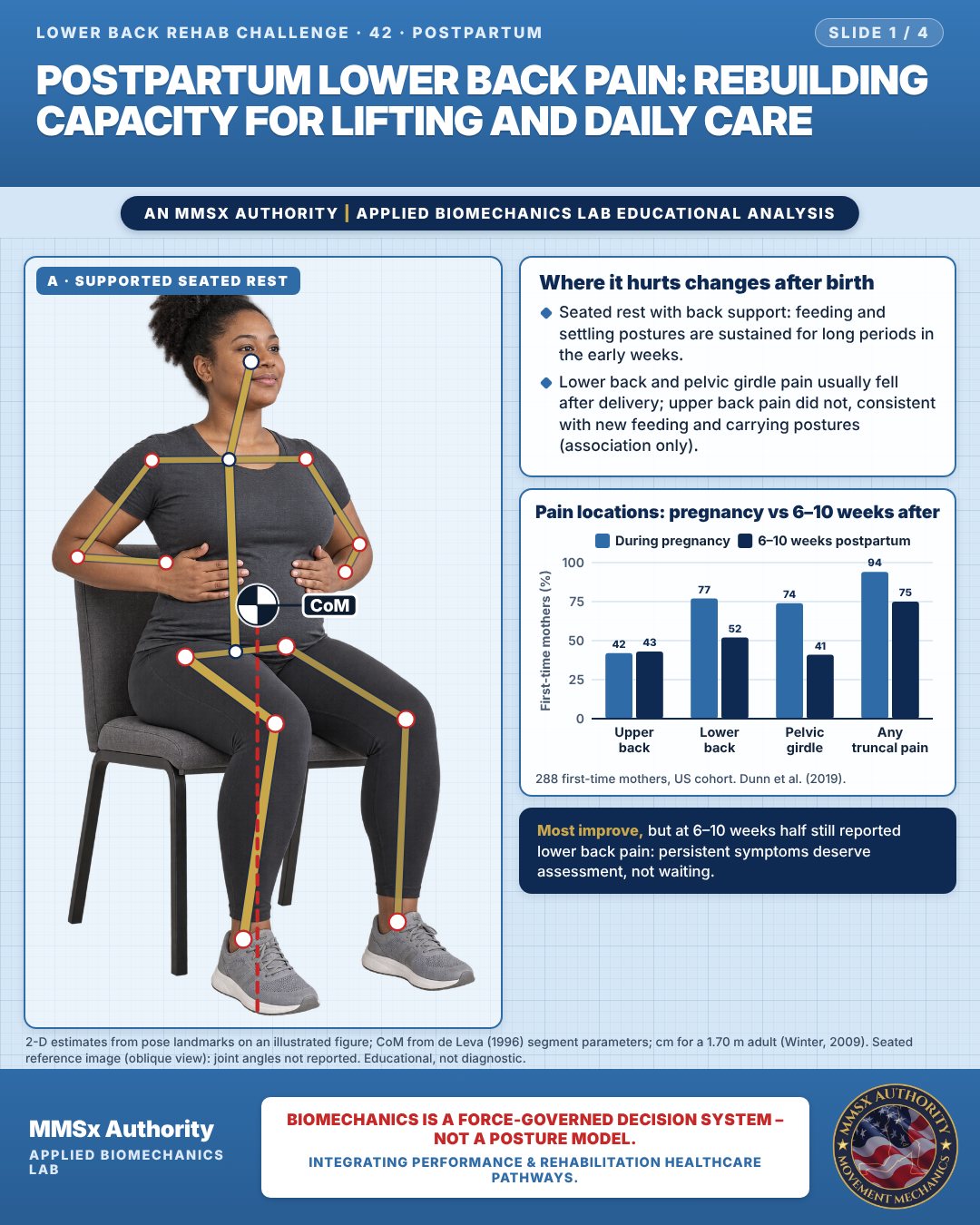
Where it hurts changes after birth
Seated rest with back support: feeding and settling postures are sustained for long periods in the early weeks.
Lower back and pelvic girdle pain usually fell after delivery; upper back pain did not, consistent with new feeding and carrying postures (association only).
Pain locations: pregnancy vs 6–10 weeks after
Movement B: Light basket lift (side view)
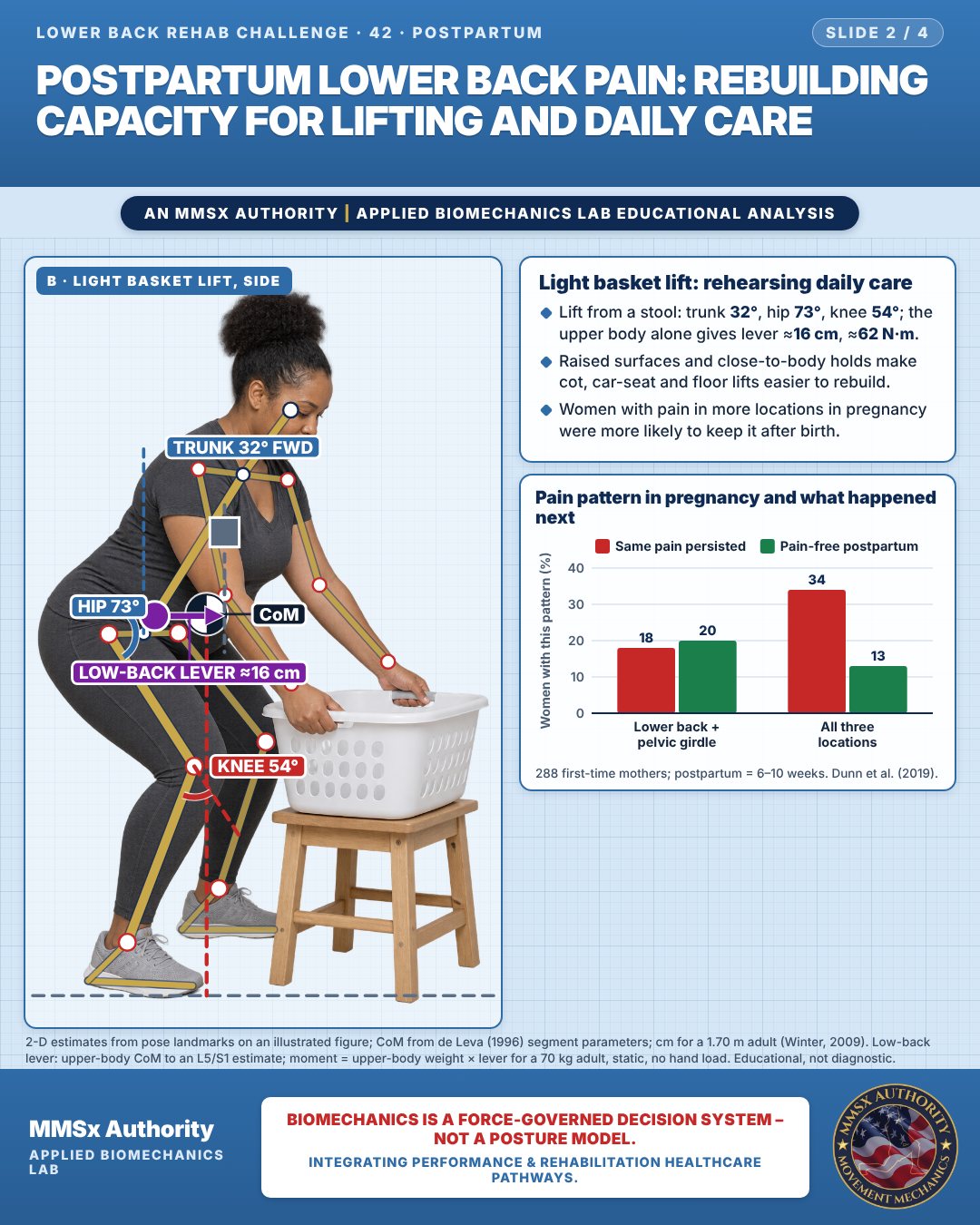
Light basket lift: rehearsing daily care
Lift from a stool: trunk 32°, hip 73°, knee 54°; the upper body alone gives lever ≈16 cm, ≈62 N·m.
Raised surfaces and close-to-body holds make cot, car-seat and floor lifts easier to rebuild.
Women with pain in more locations in pregnancy were more likely to keep it after birth.
Pain pattern in pregnancy and what happened next
Movement C: Basket carry (front view)
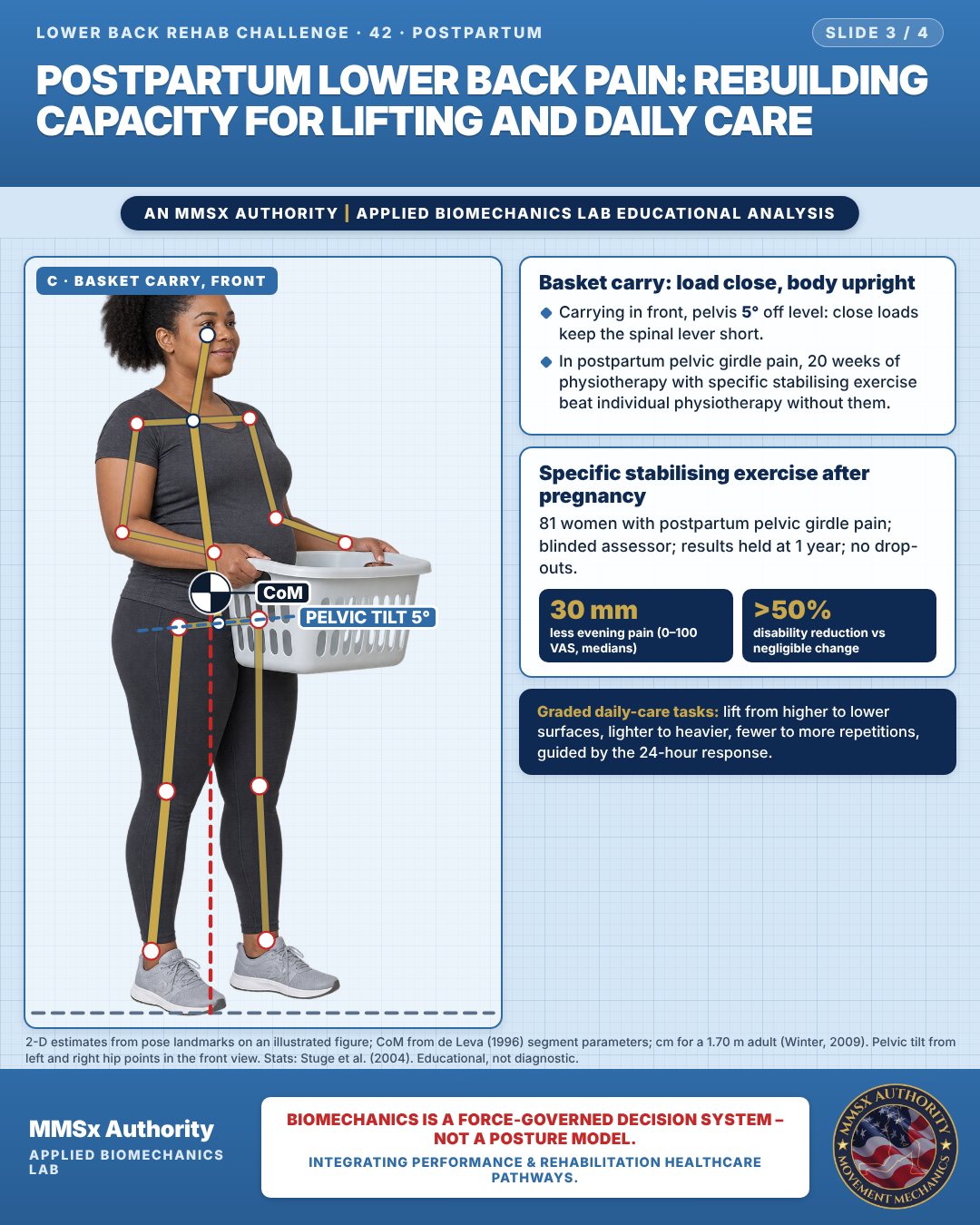
Basket carry: load close, body upright
Carrying in front, pelvis 5° off level: close loads keep the spinal lever short.
In postpartum pelvic girdle pain, 20 weeks of physiotherapy with specific stabilising exercise beat individual physiotherapy without them.
Specific stabilising exercise after pregnancy
81 women with postpartum pelvic girdle pain; blinded assessor; results held at 1 year; no drop-outs.
Decision pathway
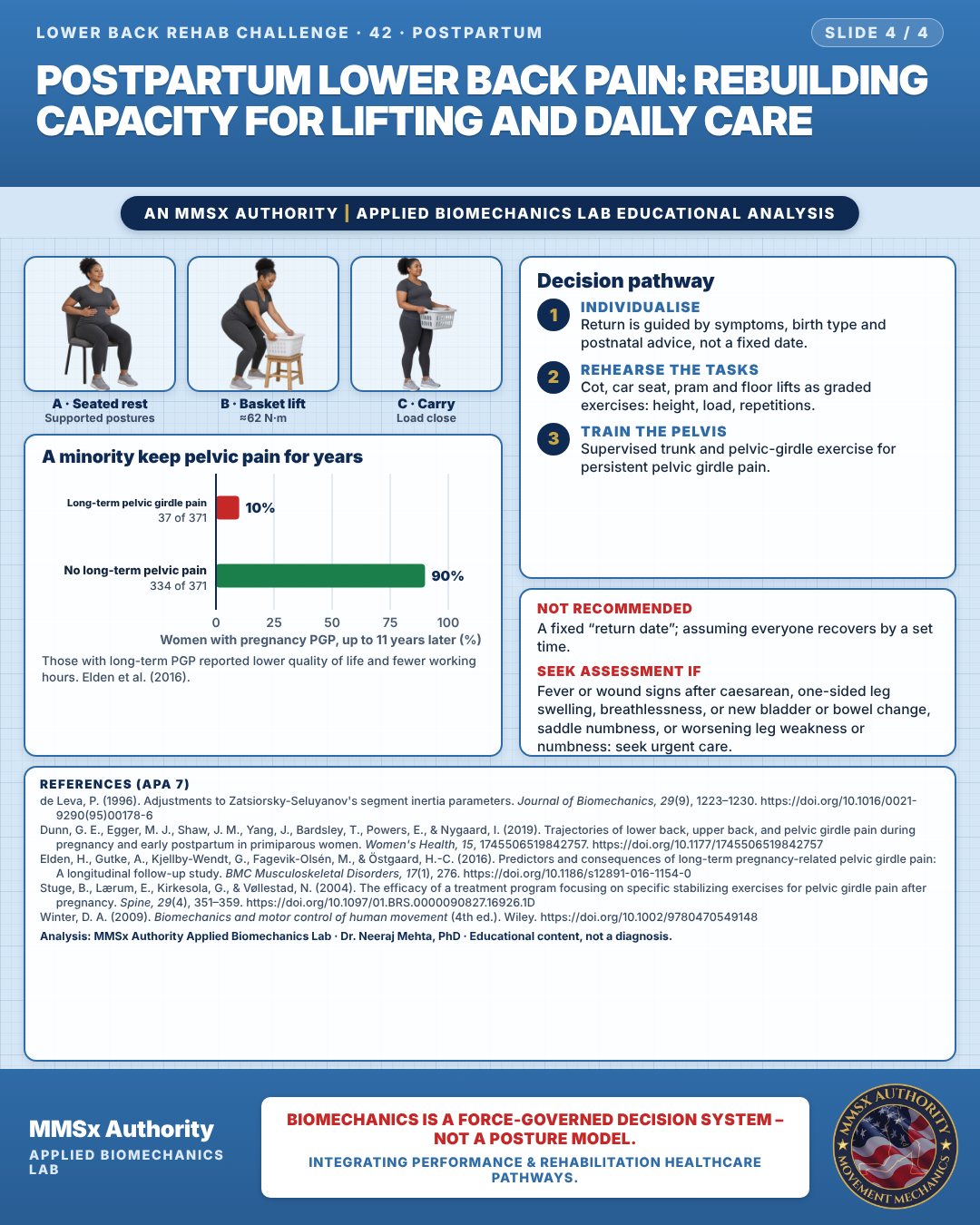
A minority keep pelvic pain for years
Individualise
Return is guided by symptoms, birth type and postnatal advice, not a fixed date.
Rehearse the tasks
Cot, car seat, pram and floor lifts as graded exercises: height, load, repetitions.
Train the pelvis
Supervised trunk and pelvic-girdle exercise for persistent pelvic girdle pain.
What the evidence supports
- Do not: impose a fixed "return date"; assume all women recover by a set time (a minority have persistent multi-site pain) (Dunn et al., 2019; Elden et al., 2016).
Myth and evidence
Myth“Postpartum back pain always settles on its own within weeks.”
EvidenceAt 6–10 weeks, 52% still reported lower back pain and 41% pelvic girdle pain (Dunn et al., 2019); about 1 in 10 women with pregnancy PGP had long-term PGP up to 11 years later (Elden et al., 2016). Most improve, but persistent symptoms deserve assessment rather than waiting.
Cautions
Not recommended
A fixed “return date”; assuming everyone recovers by a set time.
Seek assessment if
Fever or wound signs after caesarean, one-sided leg swelling, breathlessness, or new bladder or bowel change, saddle numbness, or worsening leg weakness or numbness: seek urgent care.
Methods note
2-D estimates from pose landmarks on an illustrated figure; CoM from de Leva (1996) segment parameters; cm for a 1.70 m adult (Winter, 2009). Seated reference image (oblique view): joint angles not reported. Low-back lever: upper-body CoM to an L5/S1 estimate; moment = upper-body weight × lever for a 70 kg adult, static, no hand load. Pelvic tilt from left and right hip points in the front view. Stats: Stuge et al. (2004). These are educational estimates, not a diagnosis.
References
- de Leva, P. (1996). Adjustments to Zatsiorsky-Seluyanov's segment inertia parameters. Journal of Biomechanics, 29(9), 1223–1230. https://doi.org/10.1016/0021-9290(95)00178-6
- Dunn, G. E., Egger, M. J., Shaw, J. M., Yang, J., Bardsley, T., Powers, E., & Nygaard, I. (2019). Trajectories of lower back, upper back, and pelvic girdle pain during pregnancy and early postpartum in primiparous women. Women's Health, 15, 1745506519842757. https://doi.org/10.1177/1745506519842757
- Elden, H., Gutke, A., Kjellby-Wendt, G., Fagevik-Olsén, M., & Östgaard, H.-C. (2016). Predictors and consequences of long-term pregnancy-related pelvic girdle pain: A longitudinal follow-up study. BMC Musculoskeletal Disorders, 17(1), 276. https://doi.org/10.1186/s12891-016-1154-0
- Stuge, B., Lærum, E., Kirkesola, G., & Vøllestad, N. (2004). The efficacy of a treatment program focusing on specific stabilizing exercises for pelvic girdle pain after pregnancy. Spine, 29(4), 351–359. https://doi.org/10.1097/01.BRS.0000090827.16926.1D
- Winter, D. A. (2009). Biomechanics and motor control of human movement (4th ed.). Wiley. https://doi.org/10.1002/9780470549148
Cite this article
Mehta, N. (2026, October 23). Postpartum lower back pain: rebuilding capacity for lifting and daily care. MMSx Authority Applied Biomechanics Lab. https://mmsxauthority.org/edu/analysis/lower-back/42-postpartum-lower-back-pain-rebuilding-capacity-for-lifting-and-daily/
Part of the collection
Mehta, N. (2026). Lower Back Rehabilitation: 50 Evidence-Based Biomechanics Analyses [Collection]. MMSx Authority Applied Biomechanics Lab. Zenodo. https://doi.org/10.5281/zenodo.23735778
All Lower Back Rehab Challenge articles · Rehabilitation Library