Lower Back Rehab Challenge · 41
Lower back pain during pregnancy: movement options and when to get assessed
Pregnancy-related lumbopelvic pain is an umbrella term for pain in the lower back (lumbar region, above the sacrum) and/or the pelvic girdle (between…
Key points
- Locate the pain. Lumbar, pelvic girdle or both: pelvic provocation tests help tell them apart.
- Stay active, adapted. Supervised land-based exercise, walking, cycling or water work, guided by symptoms and obstetric advice.
- Follow up pgp. Several positive pelvic tests or earlier back pain: plan closer follow-up after birth.
What it is
Pregnancy-related lumbopelvic pain is an umbrella term for pain in the lower back (lumbar region, above the sacrum) and/or the pelvic girdle (between the posterior iliac crest and the gluteal fold, particularly near the sacroiliac joints, and/or at the pubic symphysis) that begins during pregnancy or soon after delivery. Lumbar pain and pelvic girdle pain (PGP) can occur separately or together and are assessed differently (pain location plus pelvic pain-provocation tests for PGP).
How we analysed the movement
Three movements relevant to this topic were analysed from illustrated reference figures. Joint centres were located with two-dimensional pose estimation; joint angles, the whole-body centre of mass and, where relevant, the low-back lever (the horizontal distance from the upper-body centre of mass to the L5/S1 joint) were then calculated from standard segment parameters. The figures are educational estimates that show how position changes mechanical demand; they are not measurements of a patient. Every research value quoted below comes from the published source cited beside it.
Movement A: Supported standing (side view)
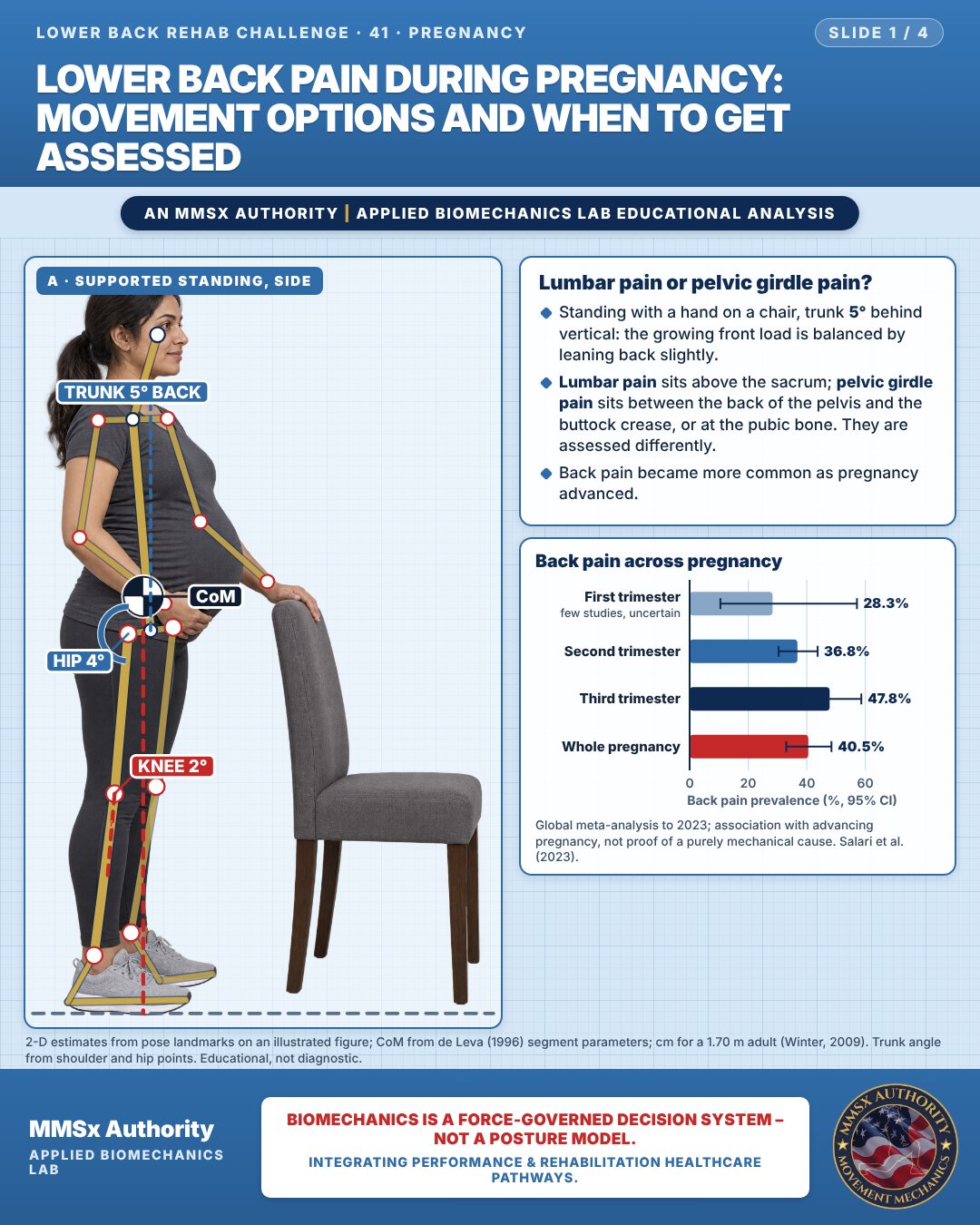
Lumbar pain or pelvic girdle pain?
Standing with a hand on a chair, trunk 5° behind vertical: the growing front load is balanced by leaning back slightly.
Lumbar pain sits above the sacrum; pelvic girdle pain sits between the back of the pelvis and the buttock crease, or at the pubic bone. They are assessed differently.
Back pain became more common as pregnancy advanced.
Back pain across pregnancy
Movement B: Side-lying rest
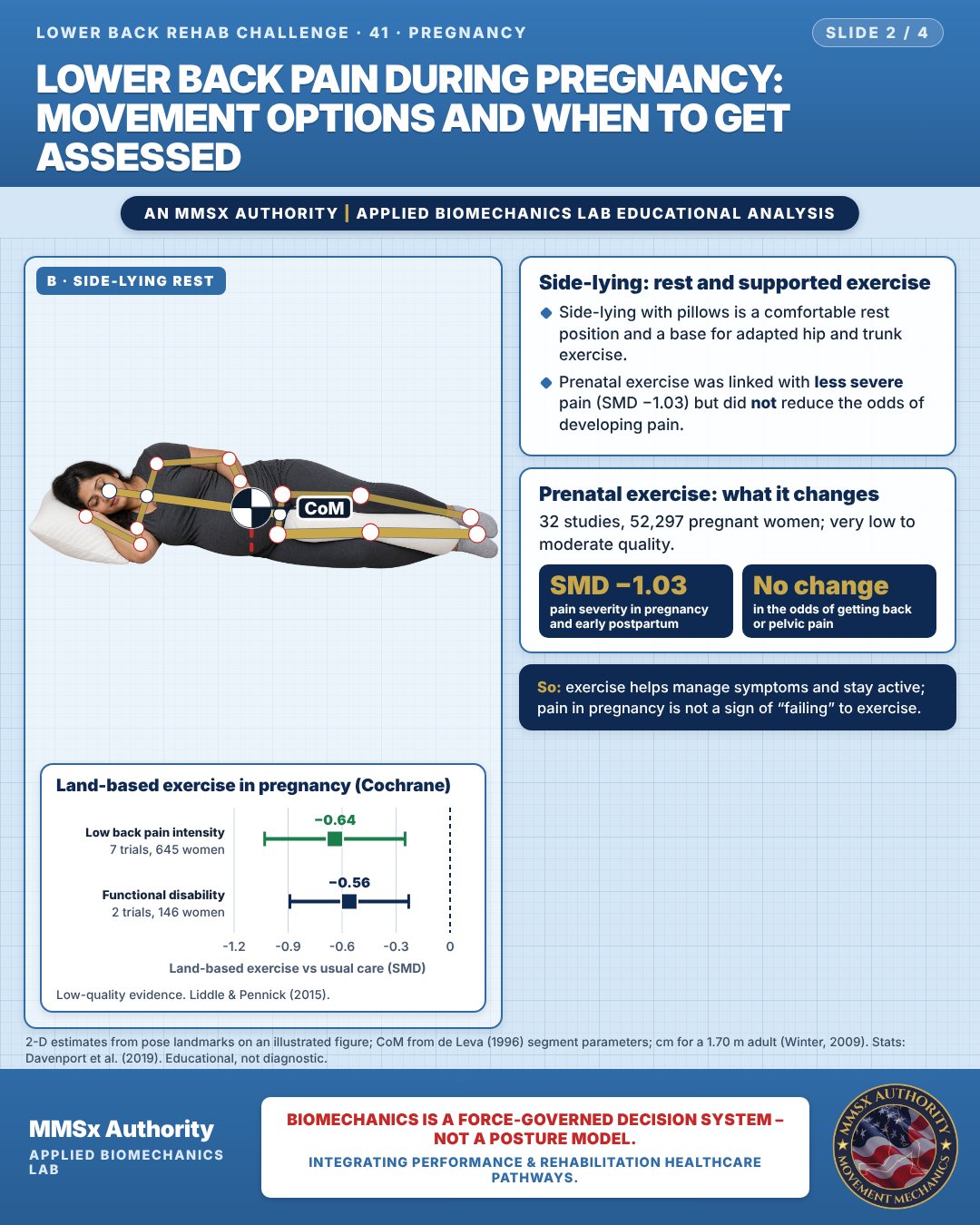
Land-based exercise in pregnancy (Cochrane)
Side-lying: rest and supported exercise
Side-lying with pillows is a comfortable rest position and a base for adapted hip and trunk exercise.
Prenatal exercise was linked with less severe pain (SMD −1.03) but did not reduce the odds of developing pain.
Prenatal exercise: what it changes
32 studies, 52,297 pregnant women; very low to moderate quality.
Movement C: Gentle walk (side view)
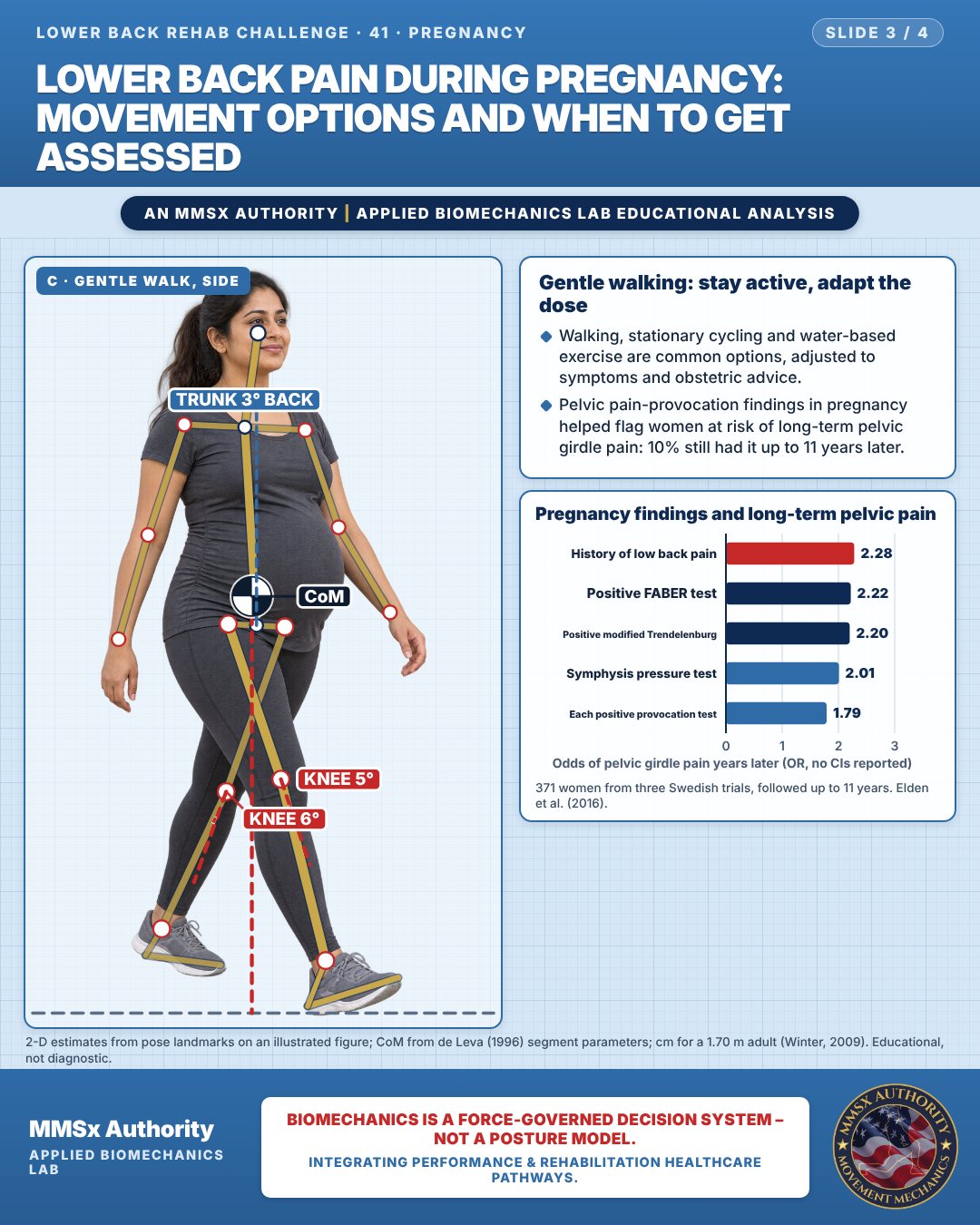
Gentle walking: stay active, adapt the dose
Walking, stationary cycling and water-based exercise are common options, adjusted to symptoms and obstetric advice.
Pelvic pain-provocation findings in pregnancy helped flag women at risk of long-term pelvic girdle pain: 10% still had it up to 11 years later.
Pregnancy findings and long-term pelvic pain
Decision pathway
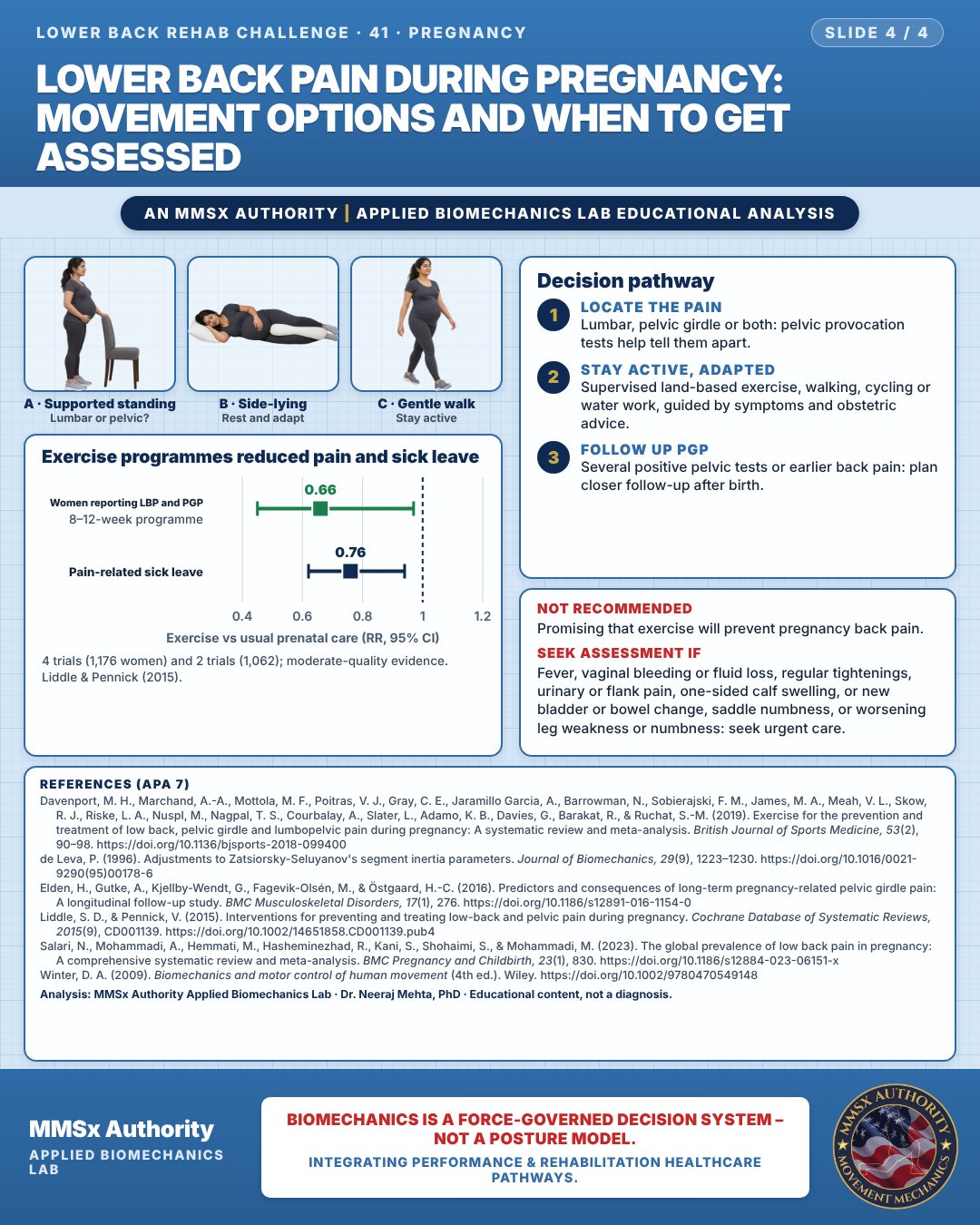
Exercise programmes reduced pain and sick leave
Locate the pain
Lumbar, pelvic girdle or both: pelvic provocation tests help tell them apart.
Stay active, adapted
Supervised land-based exercise, walking, cycling or water work, guided by symptoms and obstetric advice.
Follow up pgp
Several positive pelvic tests or earlier back pain: plan closer follow-up after birth.
What the evidence supports
- Recommend: staying active and individually adapted, supervised land-based exercise during pregnancy; exercise programmes of 8–12 weeks reduced women reporting lumbopelvic pain and pain-related sick leave (moderate-quality evidence) (Liddle & Pennick, 2015). Exercise is associated with lower pain severity (Davenport et al., 2019).
- Do not promise: that exercise will prevent pregnancy back pain — pooled RCTs did not show reduced odds of developing LBP/PGP (Davenport et al., 2019).
Cautions
Not recommended
Promising that exercise will prevent pregnancy back pain.
Seek assessment if
Fever, vaginal bleeding or fluid loss, regular tightenings, urinary or flank pain, one-sided calf swelling, or new bladder or bowel change, saddle numbness, or worsening leg weakness or numbness: seek urgent care.
Methods note
2-D estimates from pose landmarks on an illustrated figure; CoM from de Leva (1996) segment parameters; cm for a 1.70 m adult (Winter, 2009). Trunk angle from shoulder and hip points. Stats: Davenport et al. (2019). These are educational estimates, not a diagnosis.
References
- Davenport, M. H., Marchand, A.-A., Mottola, M. F., Poitras, V. J., Gray, C. E., Jaramillo Garcia, A., Barrowman, N., Sobierajski, F. M., James, M. A., Meah, V. L., Skow, R. J., Riske, L. A., Nuspl, M., Nagpal, T. S., Courbalay, A., Slater, L., Adamo, K. B., Davies, G., Barakat, R., & Ruchat, S.-M. (2019). Exercise for the prevention and treatment of low back, pelvic girdle and lumbopelvic pain during pregnancy: A systematic review and meta-analysis. British Journal of Sports Medicine, 53(2), 90–98. https://doi.org/10.1136/bjsports-2018-099400
- de Leva, P. (1996). Adjustments to Zatsiorsky-Seluyanov's segment inertia parameters. Journal of Biomechanics, 29(9), 1223–1230. https://doi.org/10.1016/0021-9290(95)00178-6
- Elden, H., Gutke, A., Kjellby-Wendt, G., Fagevik-Olsén, M., & Östgaard, H.-C. (2016). Predictors and consequences of long-term pregnancy-related pelvic girdle pain: A longitudinal follow-up study. BMC Musculoskeletal Disorders, 17(1), 276. https://doi.org/10.1186/s12891-016-1154-0
- Liddle, S. D., & Pennick, V. (2015). Interventions for preventing and treating low-back and pelvic pain during pregnancy. Cochrane Database of Systematic Reviews, 2015(9), CD001139. https://doi.org/10.1002/14651858.CD001139.pub4
- Salari, N., Mohammadi, A., Hemmati, M., Hasheminezhad, R., Kani, S., Shohaimi, S., & Mohammadi, M. (2023). The global prevalence of low back pain in pregnancy: A comprehensive systematic review and meta-analysis. BMC Pregnancy and Childbirth, 23(1), 830. https://doi.org/10.1186/s12884-023-06151-x
- Winter, D. A. (2009). Biomechanics and motor control of human movement (4th ed.). Wiley. https://doi.org/10.1002/9780470549148
Cite this article
Mehta, N. (2026, October 23). Lower back pain during pregnancy: movement options and when to get assessed. MMSx Authority Applied Biomechanics Lab. https://mmsxauthority.org/edu/analysis/lower-back/41-lower-back-pain-during-pregnancy-movement-options-and-when-to-get/
Part of the collection
Mehta, N. (2026). Lower Back Rehabilitation: 50 Evidence-Based Biomechanics Analyses [Collection]. MMSx Authority Applied Biomechanics Lab. Zenodo. https://doi.org/10.5281/zenodo.23735778
All Lower Back Rehab Challenge articles · Rehabilitation Library