Lower Back Rehab Challenge · 40
Lower back pain after 60: building strength, walking capacity, and independence
Rehabilitation for LBP in adults aged 60+ is individualised active care — progressive strength, walking/aerobic and balance or mind–body exercise,…
Key points
- Set personal goals. Stairs, walking distance, lifting, independence: build the programme around them.
- Dose it. ≥12 weeks, ≥3 sessions a week: strength, walking and balance, progressed gradually.
- Adapt to health. Osteoporosis, falls risk, heart disease and medicines shape the plan, not age alone.
What it is
Rehabilitation for LBP in adults aged 60+ is individualised active care — progressive strength, walking/aerobic and balance or mind–body exercise, plus education — dosed around comorbidities, medication, fracture risk and the person's functional goals (stairs, walking distance, lifting grandchildren, independence).
How we analysed the movement
Three movements relevant to this topic were analysed from illustrated reference figures. Joint centres were located with two-dimensional pose estimation; joint angles, the whole-body centre of mass and, where relevant, the low-back lever (the horizontal distance from the upper-body centre of mass to the L5/S1 joint) were then calculated from standard segment parameters. The figures are educational estimates that show how position changes mechanical demand; they are not measurements of a patient. Every research value quoted below comes from the published source cited beside it.
Movement A: Chair strength (side view)
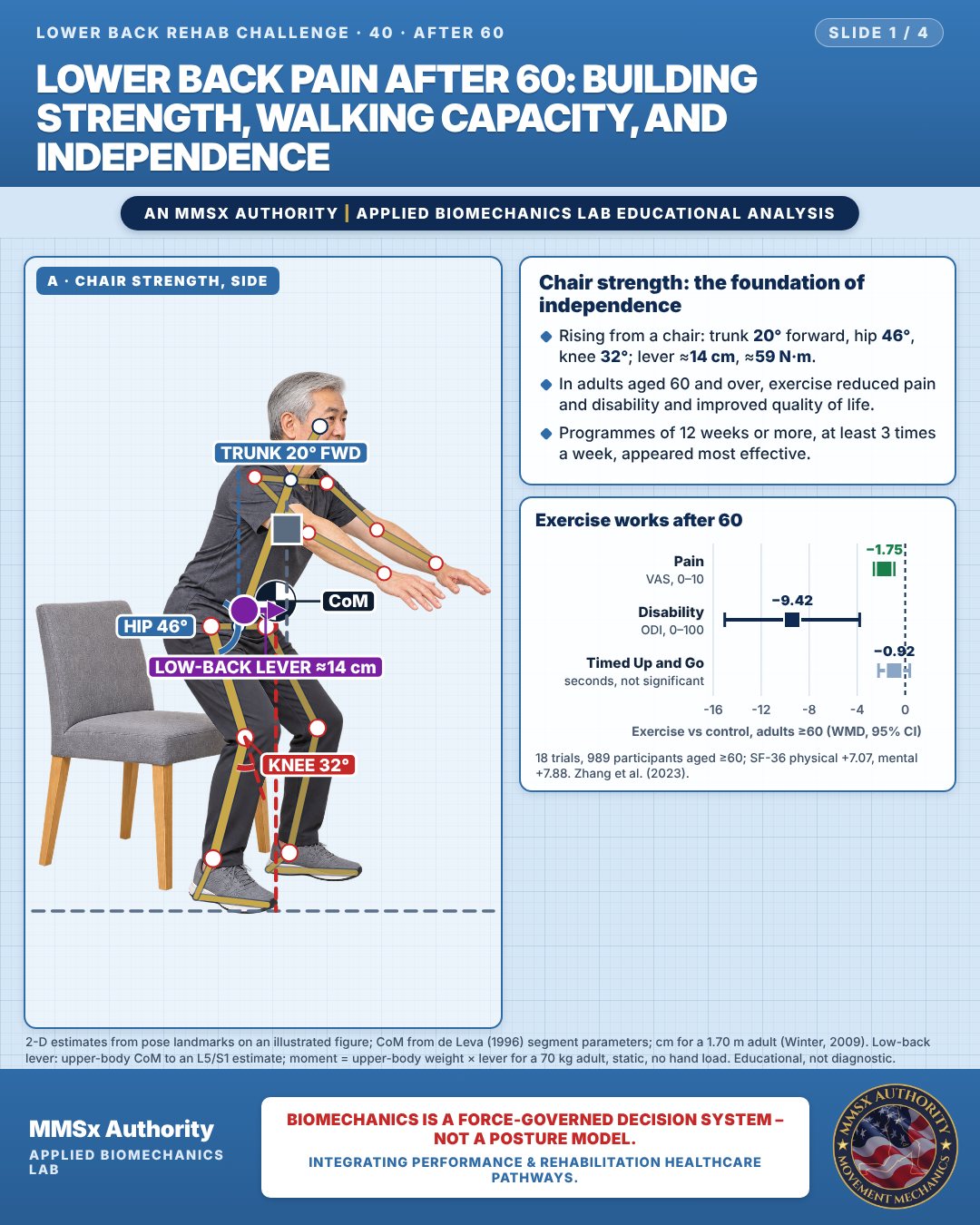
Chair strength: the foundation of independence
Rising from a chair: trunk 20° forward, hip 46°, knee 32°; lever ≈14 cm, ≈59 N·m.
In adults aged 60 and over, exercise reduced pain and disability and improved quality of life.
Programmes of 12 weeks or more, at least 3 times a week, appeared most effective.
Exercise works after 60
Movement B: Daily walk
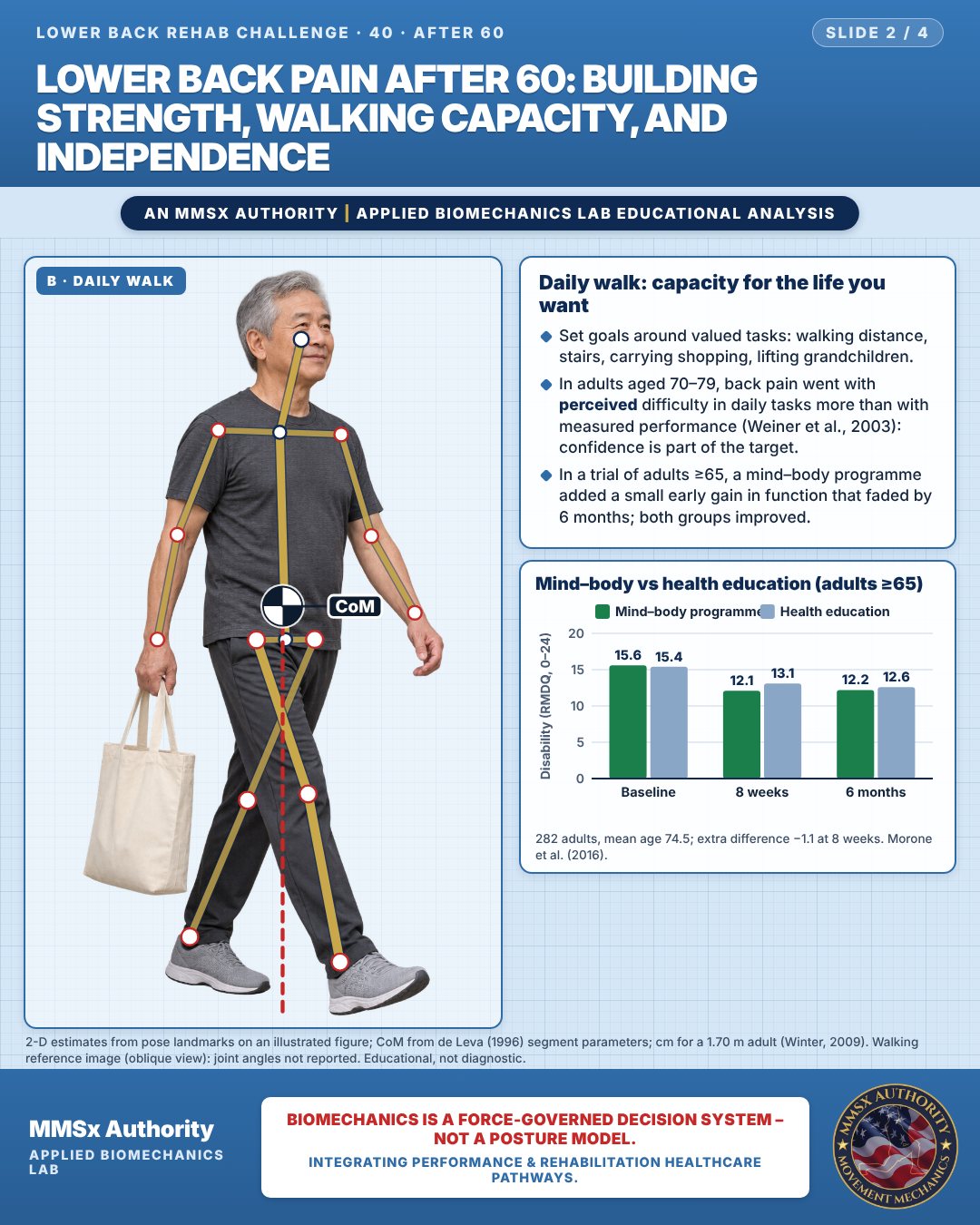
Daily walk: capacity for the life you want
Set goals around valued tasks: walking distance, stairs, carrying shopping, lifting grandchildren.
In adults aged 70–79, back pain went with perceived difficulty in daily tasks more than with measured performance (Weiner et al., 2003): confidence is part of the target.
In a trial of adults ≥65, a mind–body programme added a small early gain in function that faded by 6 months; both groups improved.
Mind–body vs health education (adults ≥65)
Movement C: Supported balance
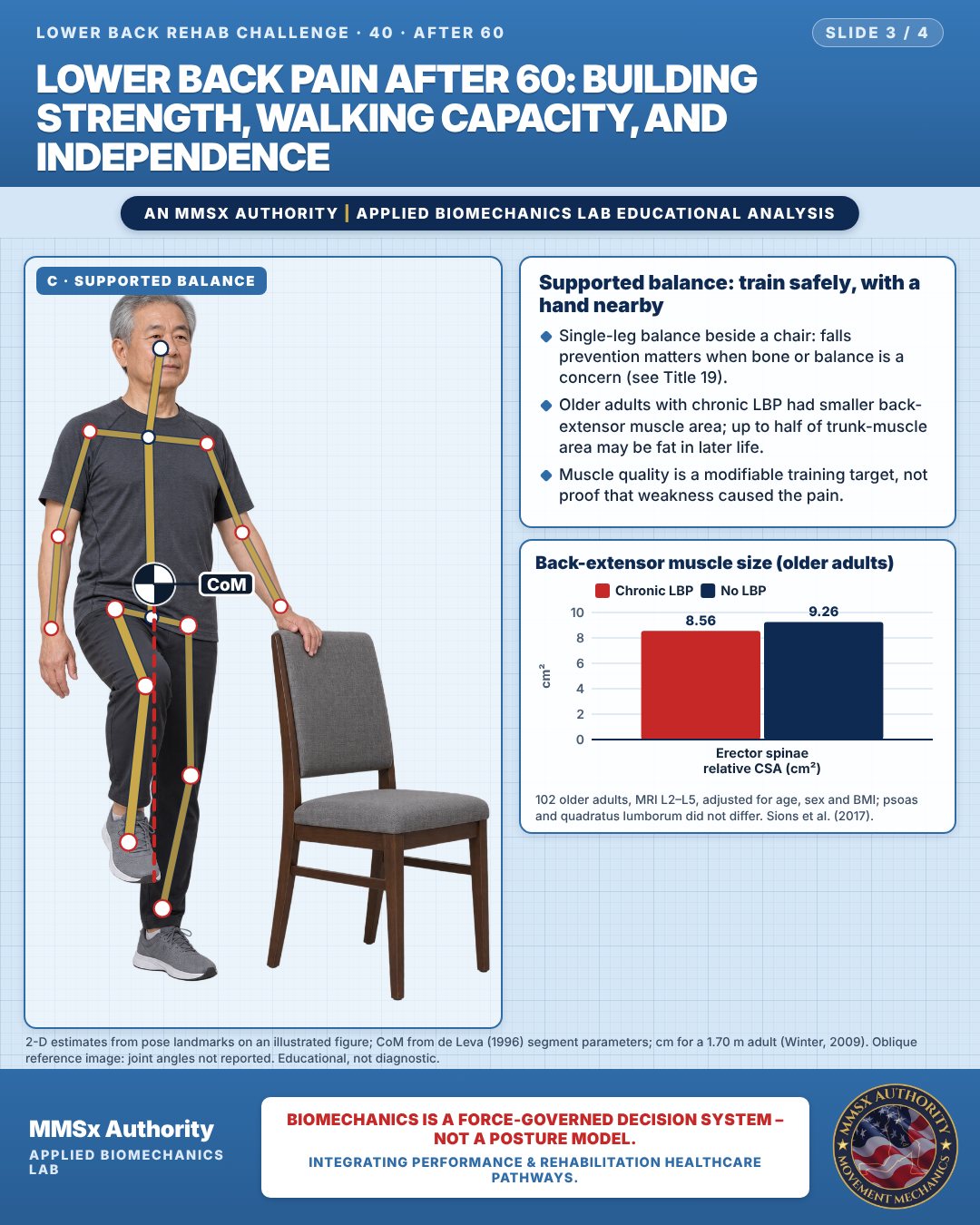
Supported balance: train safely, with a hand nearby
Single-leg balance beside a chair: falls prevention matters when bone or balance is a concern (see Title 19).
Older adults with chronic LBP had smaller back-extensor muscle area; up to half of trunk-muscle area may be fat in later life.
Muscle quality is a modifiable training target, not proof that weakness caused the pain.
Back-extensor muscle size (older adults)
Decision pathway
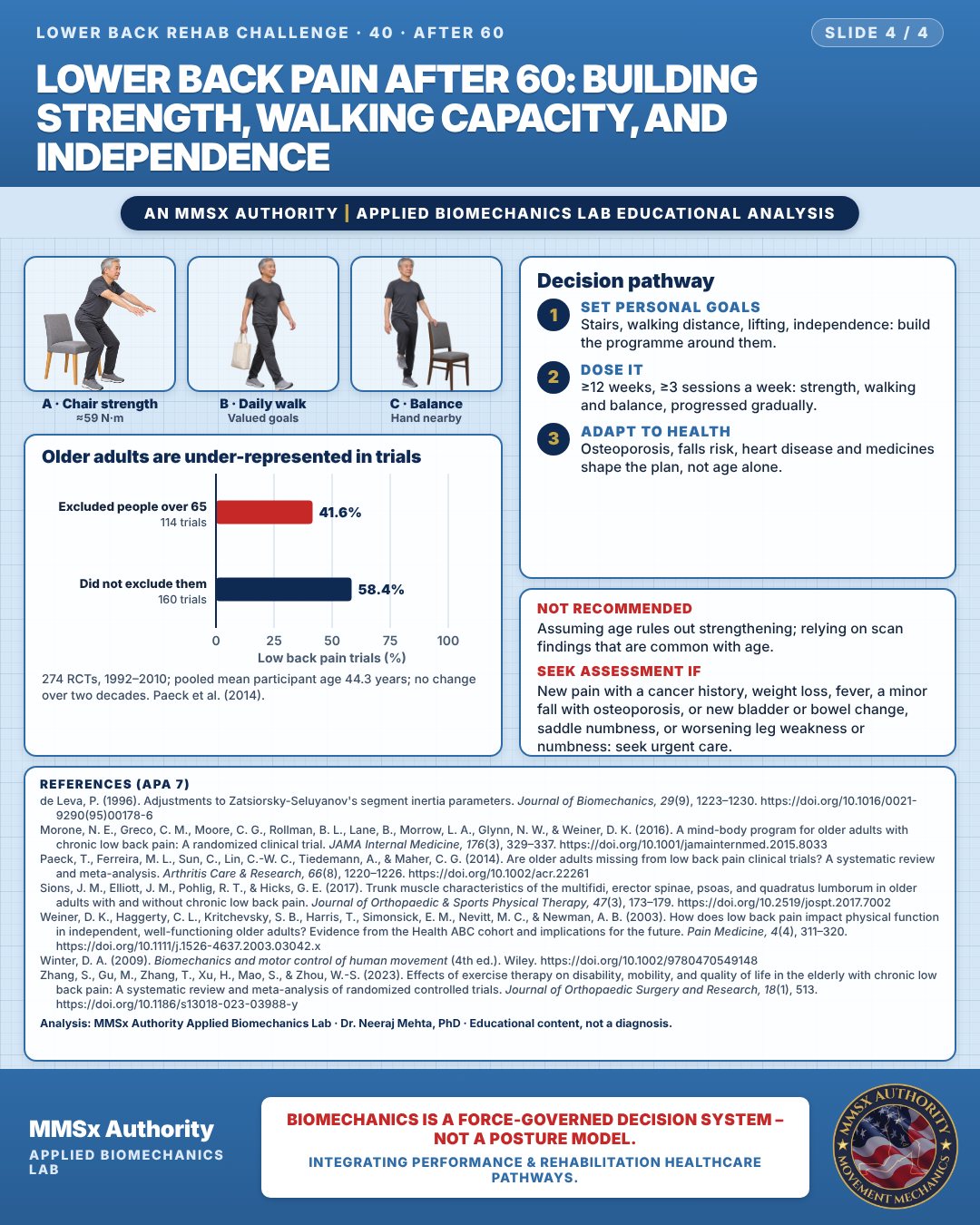
Older adults are under-represented in trials
Set personal goals
Stairs, walking distance, lifting, independence: build the programme around them.
Dose it
≥12 weeks, ≥3 sessions a week: strength, walking and balance, progressed gradually.
Adapt to health
Osteoporosis, falls risk, heart disease and medicines shape the plan, not age alone.
Cautions
Not recommended
Assuming age rules out strengthening; relying on scan findings that are common with age.
Seek assessment if
New pain with a cancer history, weight loss, fever, a minor fall with osteoporosis, or new bladder or bowel change, saddle numbness, or worsening leg weakness or numbness: seek urgent care.
Methods note
2-D estimates from pose landmarks on an illustrated figure; CoM from de Leva (1996) segment parameters; cm for a 1.70 m adult (Winter, 2009). Low-back lever: upper-body CoM to an L5/S1 estimate; moment = upper-body weight × lever for a 70 kg adult, static, no hand load. Walking reference image (oblique view): joint angles not reported. Oblique reference image: joint angles not reported. These are educational estimates, not a diagnosis.
References
- de Leva, P. (1996). Adjustments to Zatsiorsky-Seluyanov's segment inertia parameters. Journal of Biomechanics, 29(9), 1223–1230. https://doi.org/10.1016/0021-9290(95)00178-6
- Morone, N. E., Greco, C. M., Moore, C. G., Rollman, B. L., Lane, B., Morrow, L. A., Glynn, N. W., & Weiner, D. K. (2016). A mind-body program for older adults with chronic low back pain: A randomized clinical trial. JAMA Internal Medicine, 176(3), 329–337. https://doi.org/10.1001/jamainternmed.2015.8033
- Paeck, T., Ferreira, M. L., Sun, C., Lin, C.-W. C., Tiedemann, A., & Maher, C. G. (2014). Are older adults missing from low back pain clinical trials? A systematic review and meta-analysis. Arthritis Care & Research, 66(8), 1220–1226. https://doi.org/10.1002/acr.22261
- Sions, J. M., Elliott, J. M., Pohlig, R. T., & Hicks, G. E. (2017). Trunk muscle characteristics of the multifidi, erector spinae, psoas, and quadratus lumborum in older adults with and without chronic low back pain. Journal of Orthopaedic & Sports Physical Therapy, 47(3), 173–179. https://doi.org/10.2519/jospt.2017.7002
- Weiner, D. K., Haggerty, C. L., Kritchevsky, S. B., Harris, T., Simonsick, E. M., Nevitt, M. C., & Newman, A. B. (2003). How does low back pain impact physical function in independent, well-functioning older adults? Evidence from the Health ABC cohort and implications for the future. Pain Medicine, 4(4), 311–320. https://doi.org/10.1111/j.1526-4637.2003.03042.x
- Winter, D. A. (2009). Biomechanics and motor control of human movement (4th ed.). Wiley. https://doi.org/10.1002/9780470549148
- Zhang, S., Gu, M., Zhang, T., Xu, H., Mao, S., & Zhou, W.-S. (2023). Effects of exercise therapy on disability, mobility, and quality of life in the elderly with chronic low back pain: A systematic review and meta-analysis of randomized controlled trials. Journal of Orthopaedic Surgery and Research, 18(1), 513. https://doi.org/10.1186/s13018-023-03988-y
Cite this article
Mehta, N. (2026, October 23). Lower back pain after 60: building strength, walking capacity, and independence. MMSx Authority Applied Biomechanics Lab. https://mmsxauthority.org/edu/analysis/lower-back/40-lower-back-pain-after-60-building-strength-walking-capacity-and/
Part of the collection
Mehta, N. (2026). Lower Back Rehabilitation: 50 Evidence-Based Biomechanics Analyses [Collection]. MMSx Authority Applied Biomechanics Lab. Zenodo. https://doi.org/10.5281/zenodo.23735778
All Lower Back Rehab Challenge articles · Rehabilitation Library