Lower Back Rehab Challenge · 39
Returning to sport after lower back pain: rebuilding the demands of your game
Return to sport after LBP is a graded, criteria-informed progression from symptom-guided general activity, through sport-specific movements (running,…
Key points
- Rebuild the demands. Progress the sport’s own tasks (running, jumping, twisting, lifting, contact) as tolerated.
- Volume, then intensity. Sessions and minutes first, then speed, load and contact; share decisions with coach and athlete.
- Keep conditioning. A previous episode raises the odds of another: continue capacity work after return.
What it is
Return to sport after LBP is a graded, criteria-informed progression from symptom-guided general activity, through sport-specific movements (running, jumping, twisting, lifting, contact) and increasing training volume and intensity, to full training and competition, guided by symptoms, function and the athlete's confidence.
How we analysed the movement
Three movements relevant to this topic were analysed from illustrated reference figures. Joint centres were located with two-dimensional pose estimation; joint angles, the whole-body centre of mass and, where relevant, the low-back lever (the horizontal distance from the upper-body centre of mass to the L5/S1 joint) were then calculated from standard segment parameters. The figures are educational estimates that show how position changes mechanical demand; they are not measurements of a patient. Every research value quoted below comes from the published source cited beside it.
Movement A: Single-leg balance drill
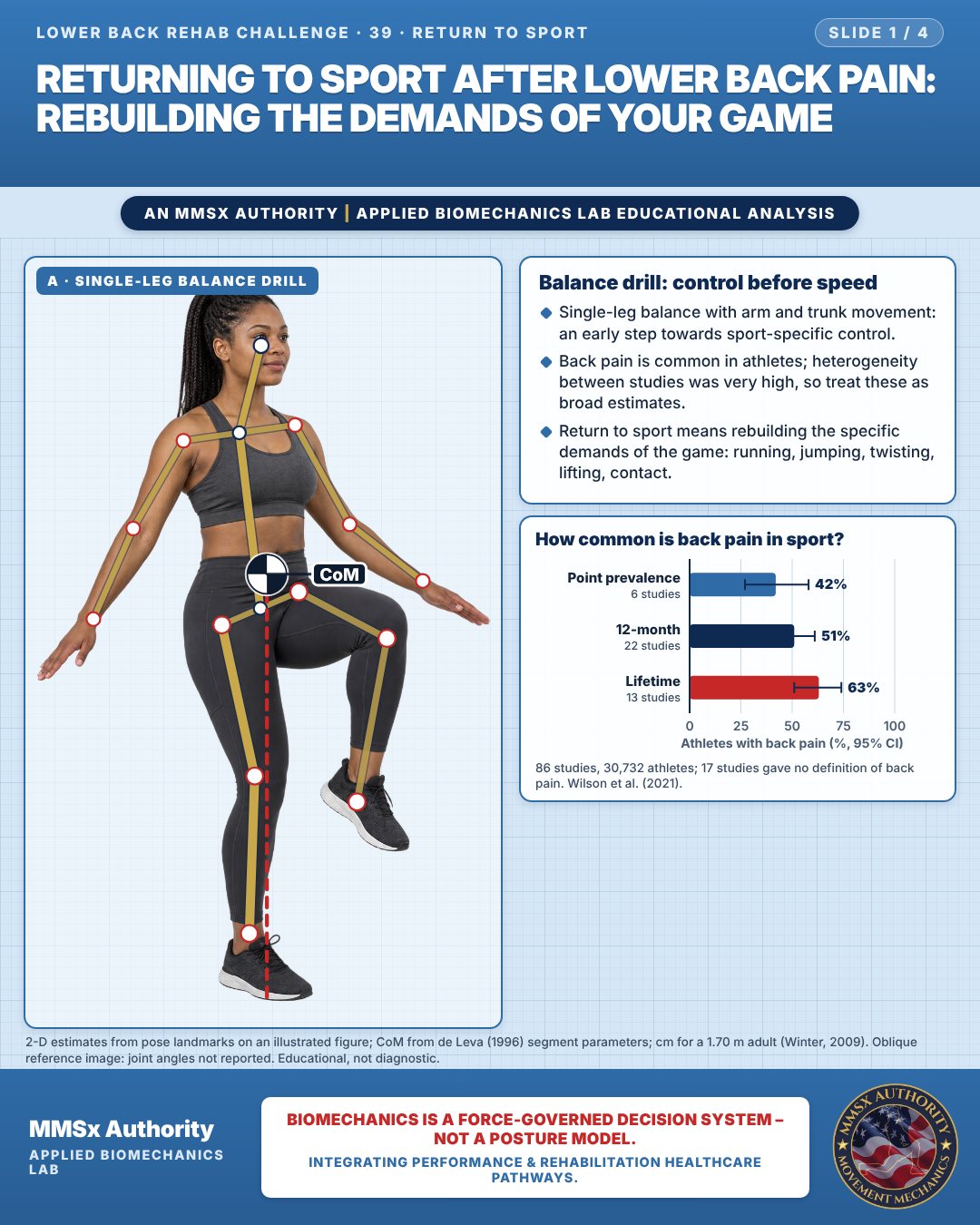
Balance drill: control before speed
Single-leg balance with arm and trunk movement: an early step towards sport-specific control.
Back pain is common in athletes; heterogeneity between studies was very high, so treat these as broad estimates.
Return to sport means rebuilding the specific demands of the game: running, jumping, twisting, lifting, contact.
How common is back pain in sport?
Movement B: Shallow split squat (side view)
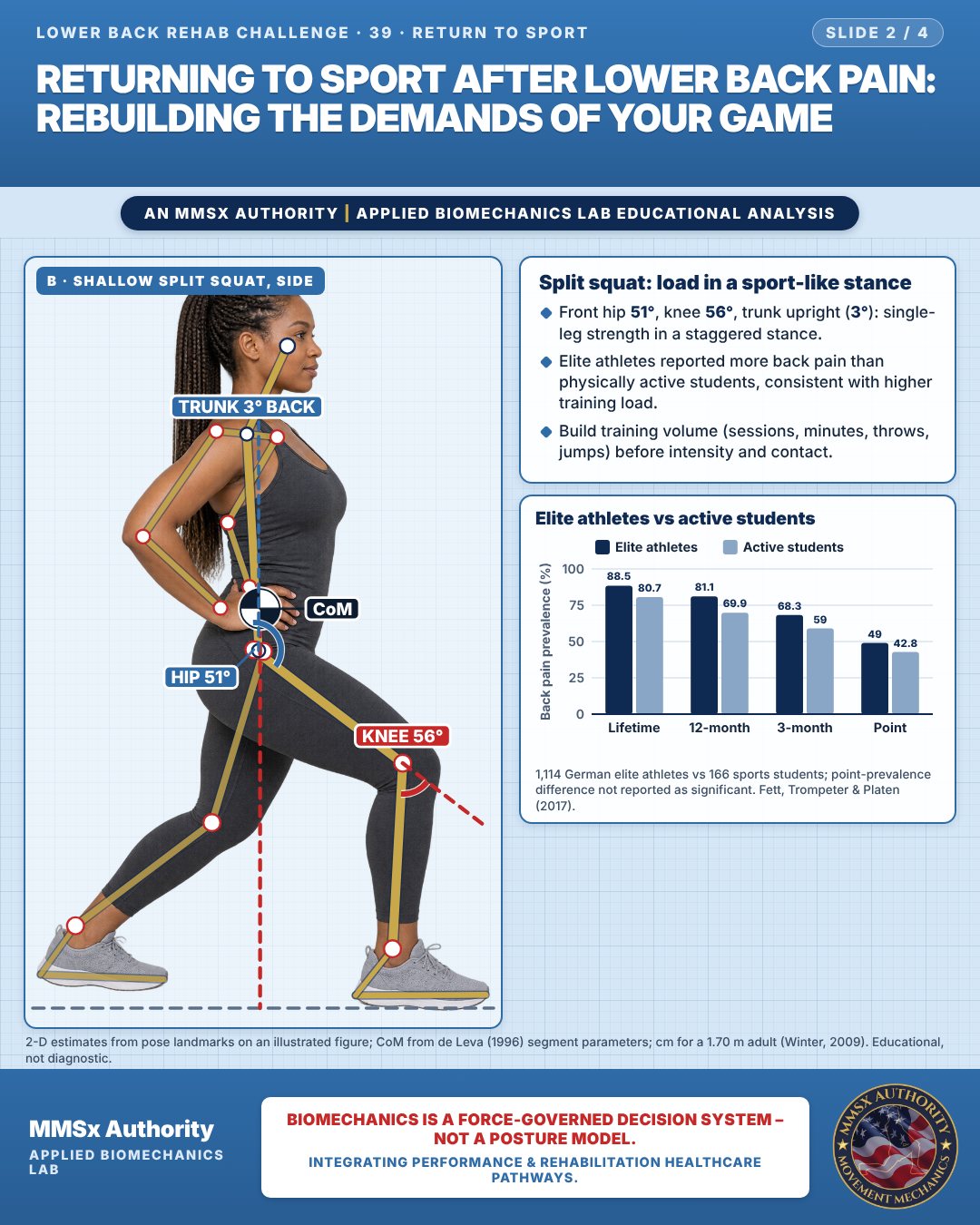
Split squat: load in a sport-like stance
Front hip 51°, knee 56°, trunk upright (3°): single-leg strength in a staggered stance.
Elite athletes reported more back pain than physically active students, consistent with higher training load.
Build training volume (sessions, minutes, throws, jumps) before intensity and contact.
Elite athletes vs active students
Movement C: Sport-ready stance (front view)
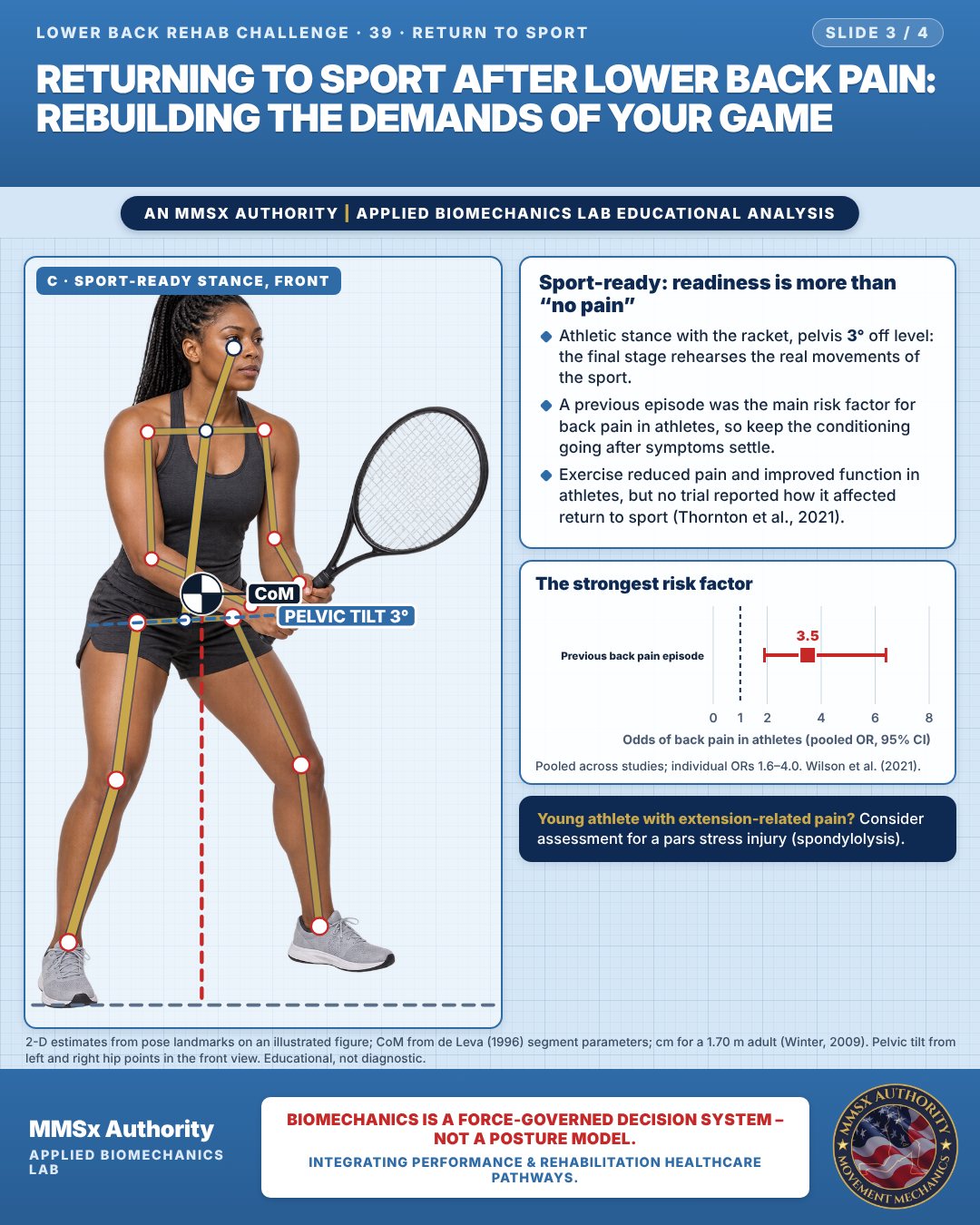
Sport-ready: readiness is more than “no pain”
Athletic stance with the racket, pelvis 3° off level: the final stage rehearses the real movements of the sport.
A previous episode was the main risk factor for back pain in athletes, so keep the conditioning going after symptoms settle.
Exercise reduced pain and improved function in athletes, but no trial reported how it affected return to sport (Thornton et al., 2021).
The strongest risk factor
Decision pathway
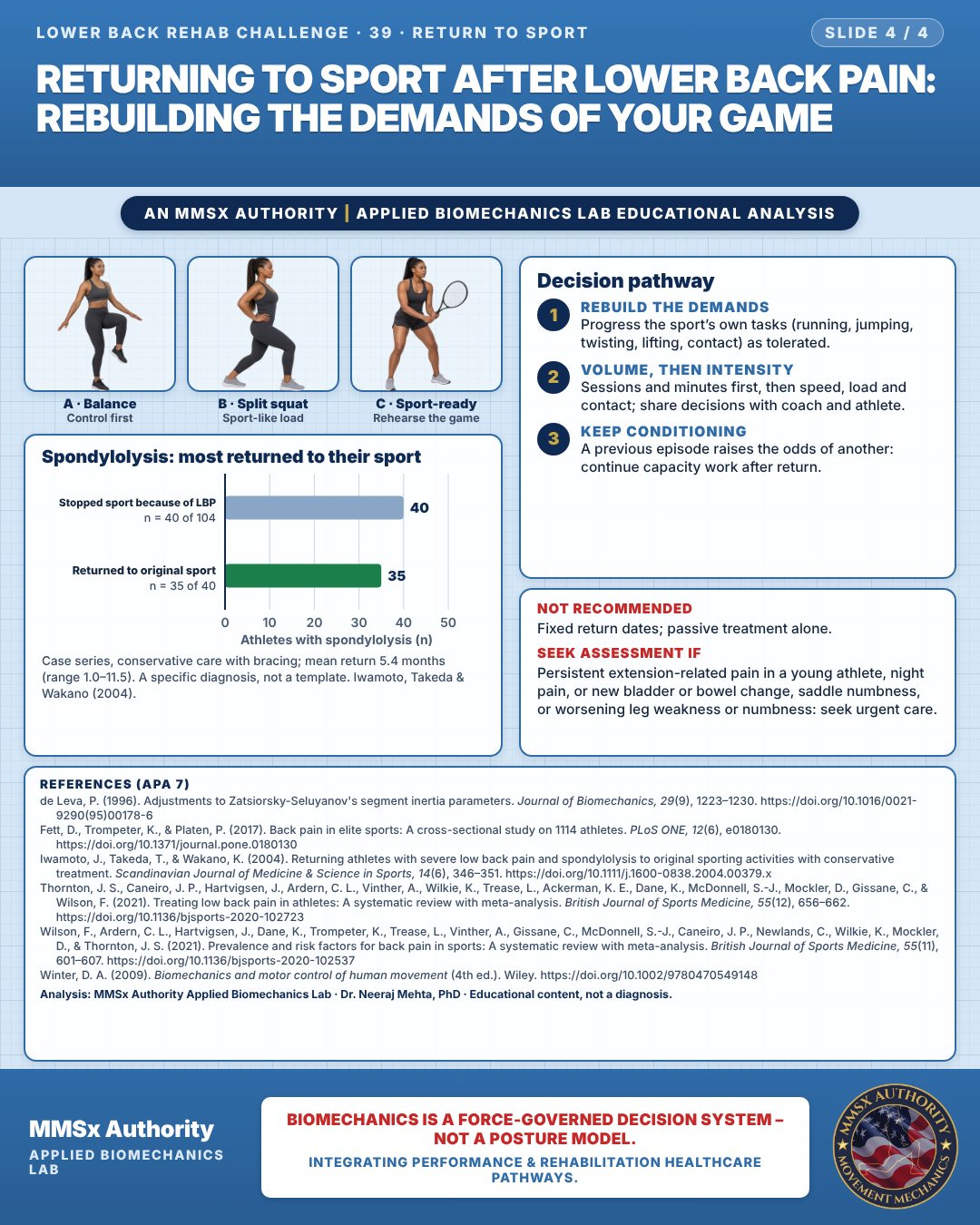
Spondylolysis: most returned to their sport
Rebuild the demands
Progress the sport’s own tasks (running, jumping, twisting, lifting, contact) as tolerated.
Volume, then intensity
Sessions and minutes first, then speed, load and contact; share decisions with coach and athlete.
Keep conditioning
A previous episode raises the odds of another: continue capacity work after return.
What the evidence supports
- Recommend: exercise-based rehabilitation that progresses toward the specific demands of the sport — volume (sessions, minutes, throws/jumps), intensity, then sport-specific skills and contact — with decisions shared between athlete, coach and clinician (Thornton et al., 2021, conclusion that exercise improves pain/function while RTS evidence is lacking). Address previous-episode risk with continued conditioning (Wilson et al., 2021).
- Do not: promise fixed return dates; rely on passive treatments alone (insufficient evidence for massage or manipulation alone in athletes; Thornton et al., 2021).
- Adolescents with extension-related pain may need assessment for pars stress injury (Iwamoto et al., 2004 population).
Cautions
Not recommended
Fixed return dates; passive treatment alone.
Seek assessment if
Persistent extension-related pain in a young athlete, night pain, or new bladder or bowel change, saddle numbness, or worsening leg weakness or numbness: seek urgent care.
Methods note
2-D estimates from pose landmarks on an illustrated figure; CoM from de Leva (1996) segment parameters; cm for a 1.70 m adult (Winter, 2009). Oblique reference image: joint angles not reported. Pelvic tilt from left and right hip points in the front view. These are educational estimates, not a diagnosis.
References
- de Leva, P. (1996). Adjustments to Zatsiorsky-Seluyanov's segment inertia parameters. Journal of Biomechanics, 29(9), 1223–1230. https://doi.org/10.1016/0021-9290(95)00178-6
- Fett, D., Trompeter, K., & Platen, P. (2017). Back pain in elite sports: A cross-sectional study on 1114 athletes. PLoS ONE, 12(6), e0180130. https://doi.org/10.1371/journal.pone.0180130
- Iwamoto, J., Takeda, T., & Wakano, K. (2004). Returning athletes with severe low back pain and spondylolysis to original sporting activities with conservative treatment. Scandinavian Journal of Medicine & Science in Sports, 14(6), 346–351. https://doi.org/10.1111/j.1600-0838.2004.00379.x
- Thornton, J. S., Caneiro, J. P., Hartvigsen, J., Ardern, C. L., Vinther, A., Wilkie, K., Trease, L., Ackerman, K. E., Dane, K., McDonnell, S.-J., Mockler, D., Gissane, C., & Wilson, F. (2021). Treating low back pain in athletes: A systematic review with meta-analysis. British Journal of Sports Medicine, 55(12), 656–662. https://doi.org/10.1136/bjsports-2020-102723
- Wilson, F., Ardern, C. L., Hartvigsen, J., Dane, K., Trompeter, K., Trease, L., Vinther, A., Gissane, C., McDonnell, S.-J., Caneiro, J. P., Newlands, C., Wilkie, K., Mockler, D., & Thornton, J. S. (2021). Prevalence and risk factors for back pain in sports: A systematic review with meta-analysis. British Journal of Sports Medicine, 55(11), 601–607. https://doi.org/10.1136/bjsports-2020-102537
- Winter, D. A. (2009). Biomechanics and motor control of human movement (4th ed.). Wiley. https://doi.org/10.1002/9780470549148
Cite this article
Mehta, N. (2026, October 23). Returning to sport after lower back pain: rebuilding the demands of your game. MMSx Authority Applied Biomechanics Lab. https://mmsxauthority.org/edu/analysis/lower-back/39-returning-to-sport-after-lower-back-pain-rebuilding-the-demands-of/
Part of the collection
Mehta, N. (2026). Lower Back Rehabilitation: 50 Evidence-Based Biomechanics Analyses [Collection]. MMSx Authority Applied Biomechanics Lab. Zenodo. https://doi.org/10.5281/zenodo.23735778
All Lower Back Rehab Challenge articles · Rehabilitation Library