Lower Back Rehab Challenge · 38
Desk work and lower back pain: building movement into your workday
Desk-work LBP management means varying posture and position across the working day (sitting, standing, walking, breaks), adjusting the workstation…
Key points
- Vary position. Sit, stand and walk across the day; no single posture is protective.
- Break often. Short breaks every ~30 minutes beat two long breaks for cutting sitting time.
- Keep active. Exercise and general activity remain the core of care; the desk is a helper, not a cure.
What it is
Desk-work LBP management means varying posture and position across the working day (sitting, standing, walking, breaks), adjusting the workstation for comfort, and building general activity and work tolerance — rather than searching for one "correct" sitting posture.
How we analysed the movement
Three movements relevant to this topic were analysed from illustrated reference figures. Joint centres were located with two-dimensional pose estimation; joint angles, the whole-body centre of mass and, where relevant, the low-back lever (the horizontal distance from the upper-body centre of mass to the L5/S1 joint) were then calculated from standard segment parameters. The figures are educational estimates that show how position changes mechanical demand; they are not measurements of a patient. Every research value quoted below comes from the published source cited beside it.
Movement A: Seated work (side view)
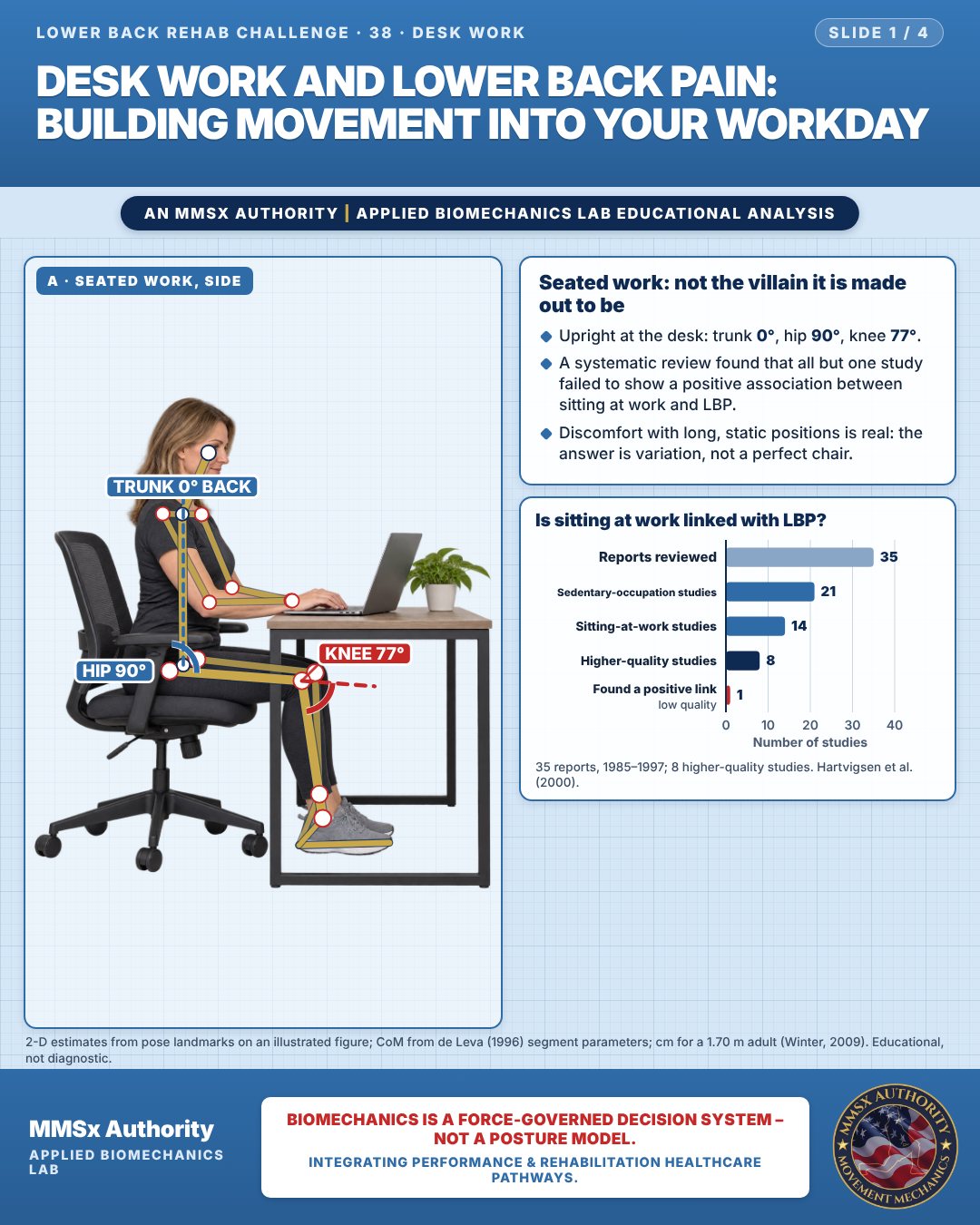
Seated work: not the villain it is made out to be
Upright at the desk: trunk 0°, hip 90°, knee 77°.
A systematic review found that all but one study failed to show a positive association between sitting at work and LBP.
Discomfort with long, static positions is real: the answer is variation, not a perfect chair.
Is sitting at work linked with LBP?
Movement B: Standing break
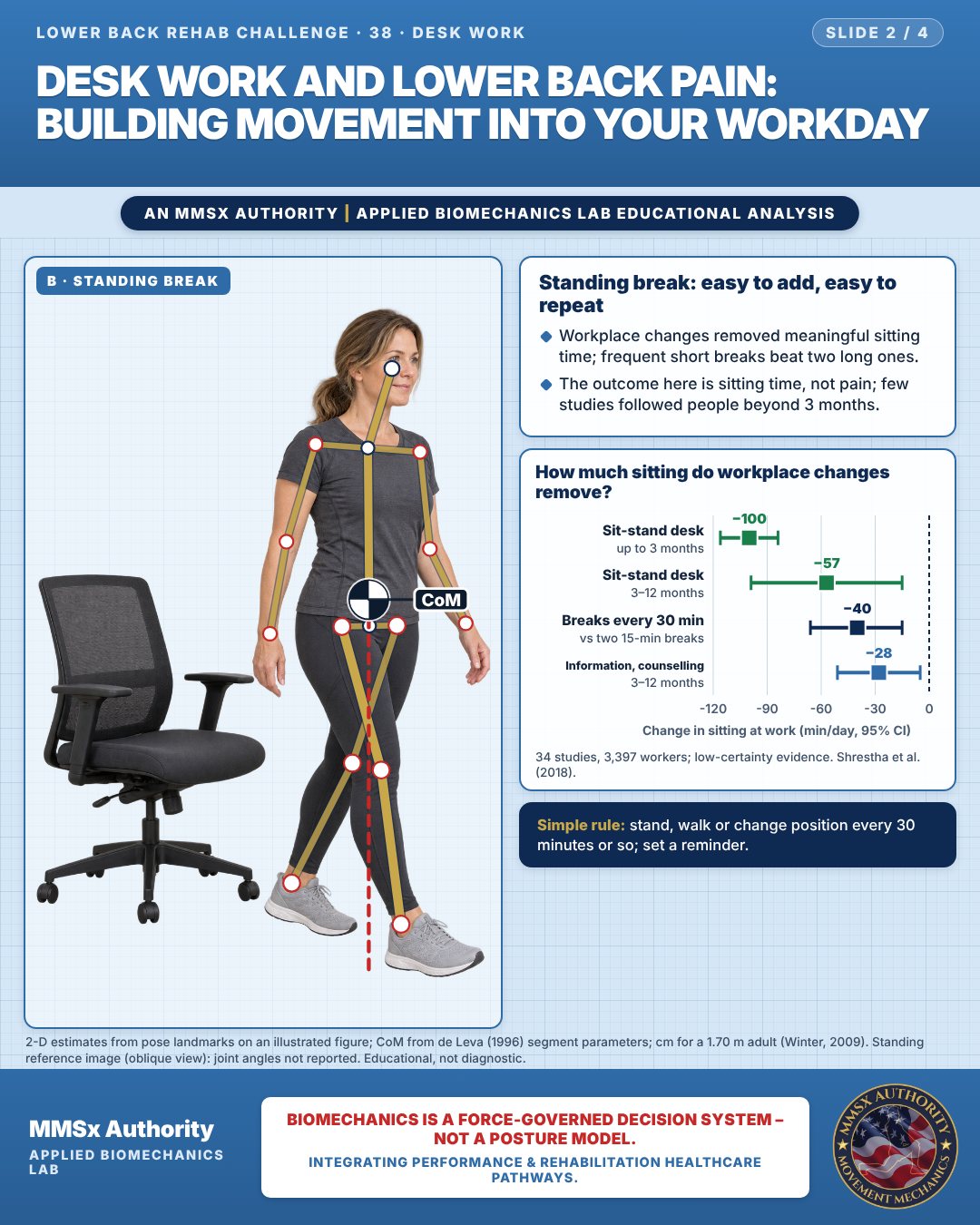
Standing break: easy to add, easy to repeat
Workplace changes removed meaningful sitting time; frequent short breaks beat two long ones.
The outcome here is sitting time, not pain; few studies followed people beyond 3 months.
How much sitting do workplace changes remove?
Movement C: Seated march
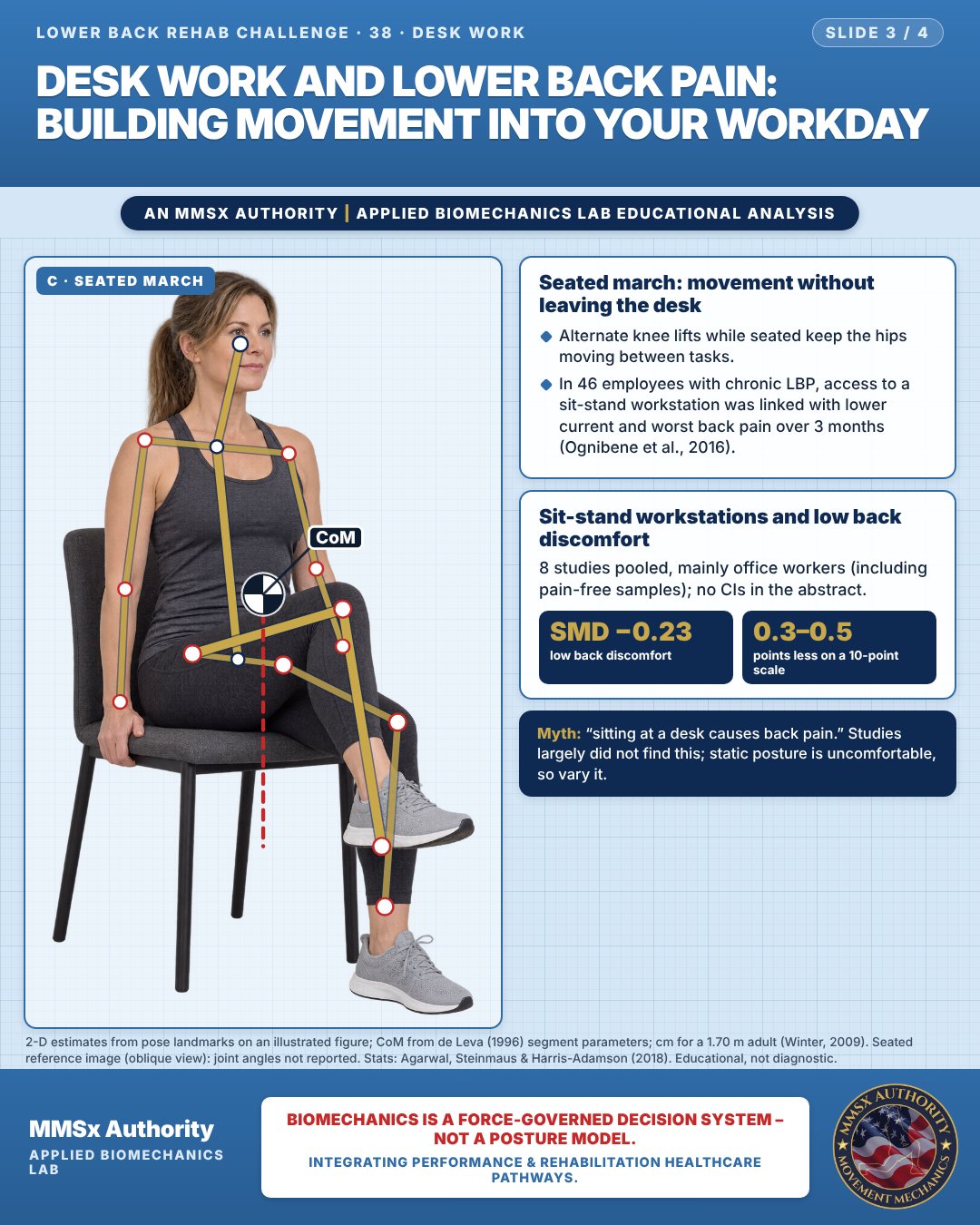
Seated march: movement without leaving the desk
Alternate knee lifts while seated keep the hips moving between tasks.
In 46 employees with chronic LBP, access to a sit-stand workstation was linked with lower current and worst back pain over 3 months (Ognibene et al., 2016).
Sit-stand workstations and low back discomfort
8 studies pooled, mainly office workers (including pain-free samples); no CIs in the abstract.
Decision pathway
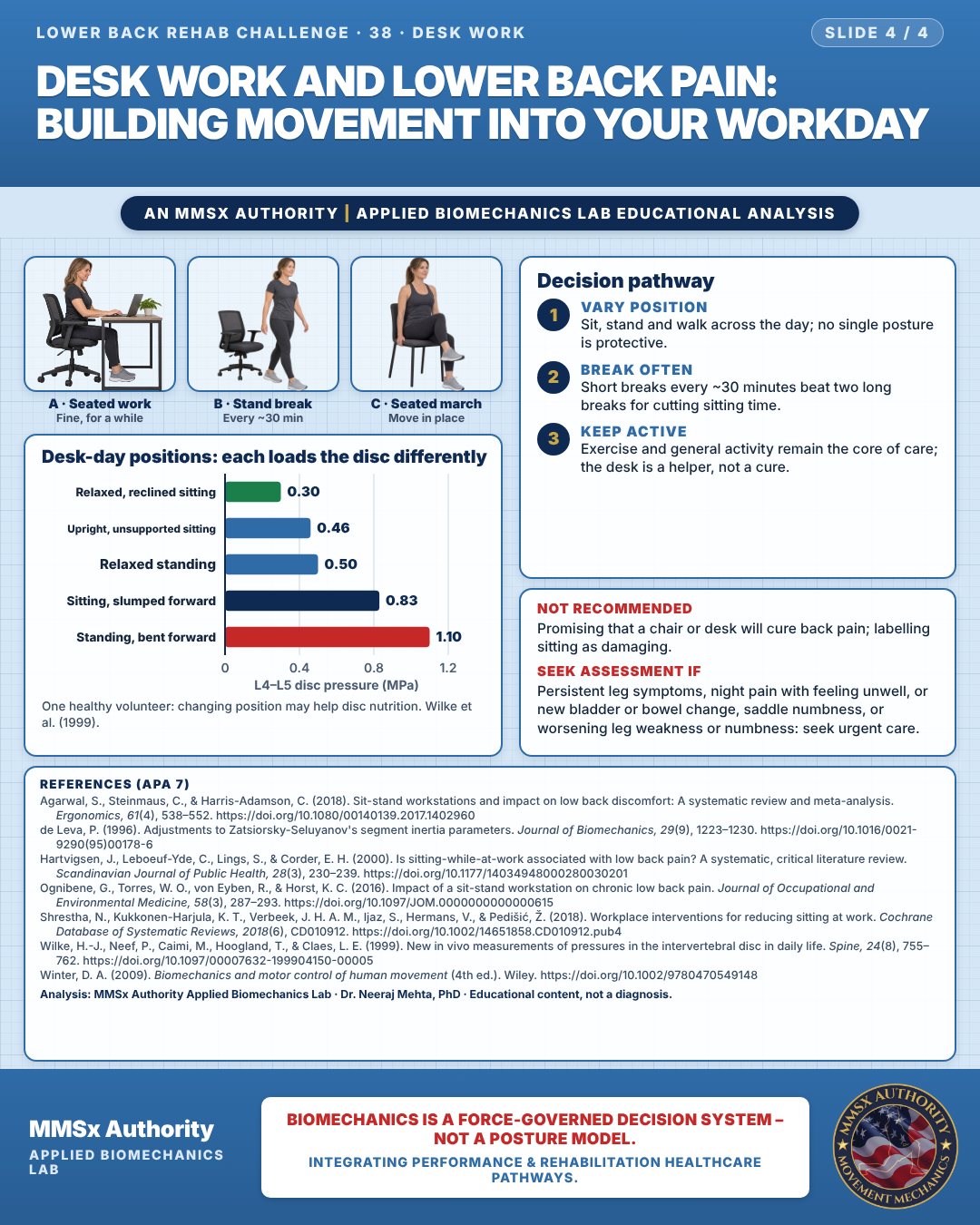
Desk-day positions: each loads the disc differently
Vary position
Sit, stand and walk across the day; no single posture is protective.
Break often
Short breaks every ~30 minutes beat two long breaks for cutting sitting time.
Keep active
Exercise and general activity remain the core of care; the desk is a helper, not a cure.
Cautions
Not recommended
Promising that a chair or desk will cure back pain; labelling sitting as damaging.
Seek assessment if
Persistent leg symptoms, night pain with feeling unwell, or new bladder or bowel change, saddle numbness, or worsening leg weakness or numbness: seek urgent care.
Methods note
2-D estimates from pose landmarks on an illustrated figure; CoM from de Leva (1996) segment parameters; cm for a 1.70 m adult (Winter, 2009). Standing reference image (oblique view): joint angles not reported. Seated reference image (oblique view): joint angles not reported. Stats: Agarwal, Steinmaus & Harris-Adamson (2018). These are educational estimates, not a diagnosis.
References
- Agarwal, S., Steinmaus, C., & Harris-Adamson, C. (2018). Sit-stand workstations and impact on low back discomfort: A systematic review and meta-analysis. Ergonomics, 61(4), 538–552. https://doi.org/10.1080/00140139.2017.1402960
- de Leva, P. (1996). Adjustments to Zatsiorsky-Seluyanov's segment inertia parameters. Journal of Biomechanics, 29(9), 1223–1230. https://doi.org/10.1016/0021-9290(95)00178-6
- Hartvigsen, J., Leboeuf-Yde, C., Lings, S., & Corder, E. H. (2000). Is sitting-while-at-work associated with low back pain? A systematic, critical literature review. Scandinavian Journal of Public Health, 28(3), 230–239. https://doi.org/10.1177/14034948000280030201
- Ognibene, G., Torres, W. O., von Eyben, R., & Horst, K. C. (2016). Impact of a sit-stand workstation on chronic low back pain. Journal of Occupational and Environmental Medicine, 58(3), 287–293. https://doi.org/10.1097/JOM.0000000000000615
- Shrestha, N., Kukkonen-Harjula, K. T., Verbeek, J. H. A. M., Ijaz, S., Hermans, V., & Pedišić, Ž. (2018). Workplace interventions for reducing sitting at work. Cochrane Database of Systematic Reviews, 2018(6), CD010912. https://doi.org/10.1002/14651858.CD010912.pub4
- Wilke, H.-J., Neef, P., Caimi, M., Hoogland, T., & Claes, L. E. (1999). New in vivo measurements of pressures in the intervertebral disc in daily life. Spine, 24(8), 755–762. https://doi.org/10.1097/00007632-199904150-00005
- Winter, D. A. (2009). Biomechanics and motor control of human movement (4th ed.). Wiley. https://doi.org/10.1002/9780470549148
Cite this article
Mehta, N. (2026, October 23). Desk work and lower back pain: building movement into your workday. MMSx Authority Applied Biomechanics Lab. https://mmsxauthority.org/edu/analysis/lower-back/38-desk-work-and-lower-back-pain-building-movement-into-your-workday/
Part of the collection
Mehta, N. (2026). Lower Back Rehabilitation: 50 Evidence-Based Biomechanics Analyses [Collection]. MMSx Authority Applied Biomechanics Lab. Zenodo. https://doi.org/10.5281/zenodo.23735778
All Lower Back Rehab Challenge articles · Rehabilitation Library