Lower Back Rehab Challenge · 37
Running with chronic lower back pain: what the ASTEROID trial found
A run–walk interval programme alternates short running bouts with walking recovery and progresses the running proportion, speed and volume over weeks.
Key points
- Select. An option for adults with non-specific chronic LBP who want to run; not tested in older adults or radicular pain.
- Start walk-heavy. Short run bouts with longer walks, three times a week; add running time gradually.
- Watch the legs. Most adverse events were lower-limb: progress volume slowly and vary surfaces.
What it is
A run–walk interval programme alternates short running bouts with walking recovery and progresses the running proportion, speed and volume over weeks; in the ASTEROID trial it was a 12-week, digitally delivered programme for adults aged 18–45 with non-specific chronic LBP.
How we analysed the movement
Three movements relevant to this topic were analysed from illustrated reference figures. Joint centres were located with two-dimensional pose estimation; joint angles, the whole-body centre of mass and, where relevant, the low-back lever (the horizontal distance from the upper-body centre of mass to the L5/S1 joint) were then calculated from standard segment parameters. The figures are educational estimates that show how position changes mechanical demand; they are not measurements of a patient. Every research value quoted below comes from the published source cited beside it.
Movement A: Walking interval
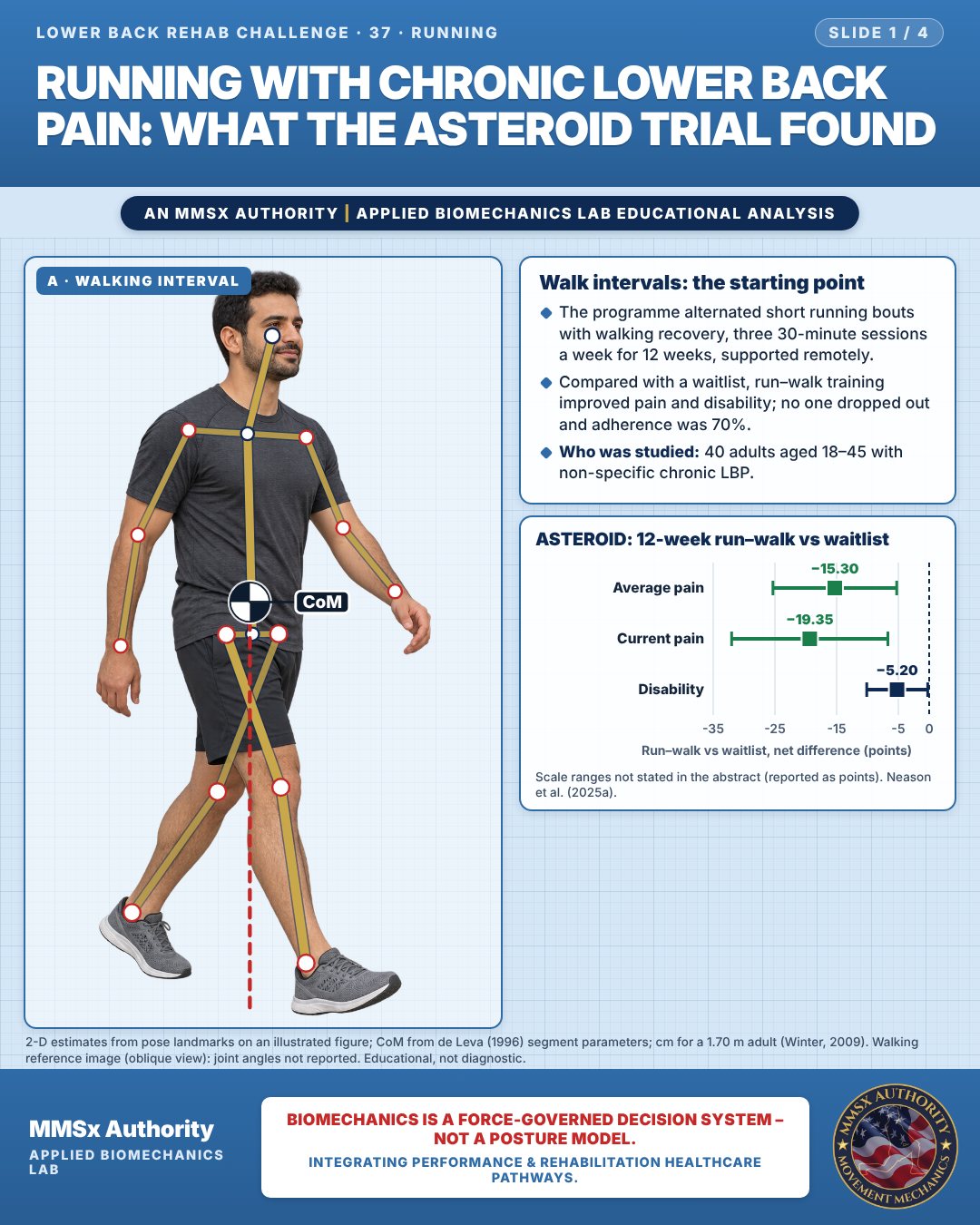
Walk intervals: the starting point
The programme alternated short running bouts with walking recovery, three 30-minute sessions a week for 12 weeks, supported remotely.
Compared with a waitlist, run–walk training improved pain and disability; no one dropped out and adherence was 70%.
Who was studied: 40 adults aged 18–45 with non-specific chronic LBP.
ASTEROID: 12-week run–walk vs waitlist
Movement B: Easy jog
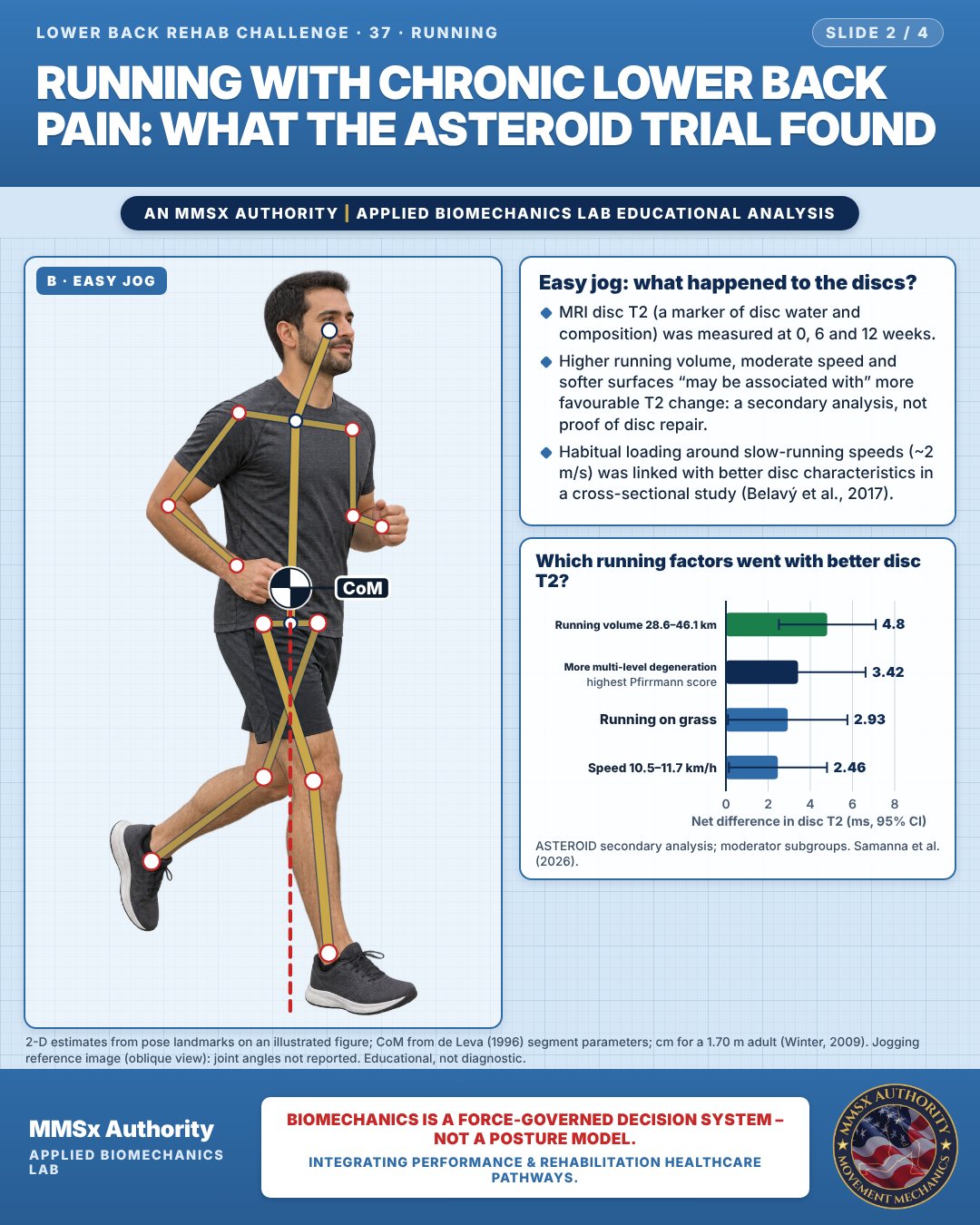
Easy jog: what happened to the discs?
MRI disc T2 (a marker of disc water and composition) was measured at 0, 6 and 12 weeks.
Higher running volume, moderate speed and softer surfaces “may be associated with” more favourable T2 change: a secondary analysis, not proof of disc repair.
Habitual loading around slow-running speeds (~2 m/s) was linked with better disc characteristics in a cross-sectional study (Belavý et al., 2017).
Which running factors went with better disc T2?
Movement C: Recovery pause (front view)
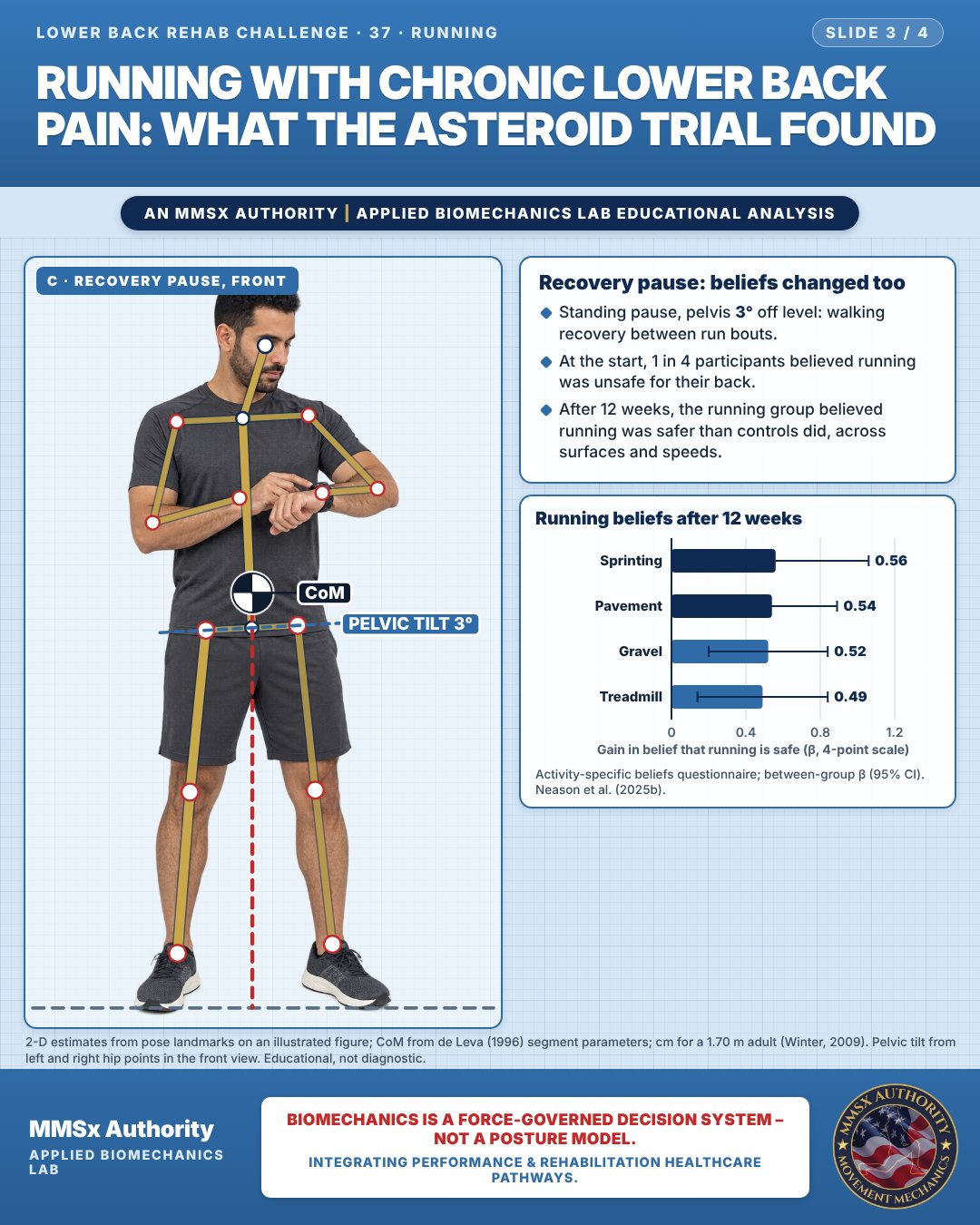
Recovery pause: beliefs changed too
Standing pause, pelvis 3° off level: walking recovery between run bouts.
At the start, 1 in 4 participants believed running was unsafe for their back.
After 12 weeks, the running group believed running was safer than controls did, across surfaces and speeds.
Running beliefs after 12 weeks
Decision pathway
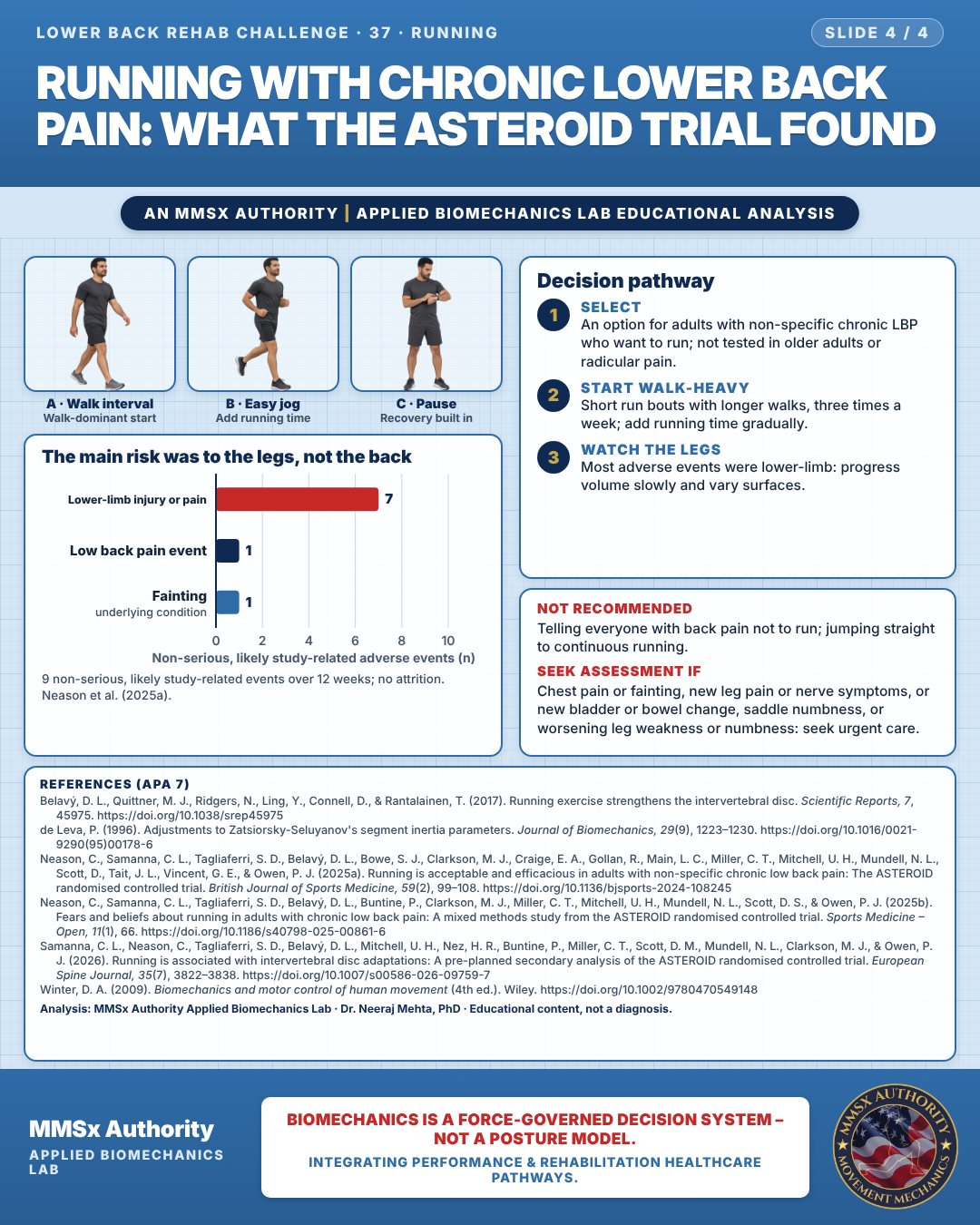
The main risk was to the legs, not the back
Select
An option for adults with non-specific chronic LBP who want to run; not tested in older adults or radicular pain.
Start walk-heavy
Short run bouts with longer walks, three times a week; add running time gradually.
Watch the legs
Most adverse events were lower-limb: progress volume slowly and vary surfaces.
What the evidence supports
- Option for selected people: a graded run–walk programme can be considered for adults with non-specific chronic LBP who wish to run (Neason et al., 2025a); start with walk-dominant intervals, three sessions/week, progress running time gradually; monitor lower-limb load (7 of 9 adverse events were lower-limb).
Cautions
Not recommended
Telling everyone with back pain not to run; jumping straight to continuous running.
Seek assessment if
Chest pain or fainting, new leg pain or nerve symptoms, or new bladder or bowel change, saddle numbness, or worsening leg weakness or numbness: seek urgent care.
Methods note
2-D estimates from pose landmarks on an illustrated figure; CoM from de Leva (1996) segment parameters; cm for a 1.70 m adult (Winter, 2009). Walking reference image (oblique view): joint angles not reported. Jogging reference image (oblique view): joint angles not reported. Pelvic tilt from left and right hip points in the front view. These are educational estimates, not a diagnosis.
References
- Belavý, D. L., Quittner, M. J., Ridgers, N., Ling, Y., Connell, D., & Rantalainen, T. (2017). Running exercise strengthens the intervertebral disc. Scientific Reports, 7, 45975. https://doi.org/10.1038/srep45975
- de Leva, P. (1996). Adjustments to Zatsiorsky-Seluyanov's segment inertia parameters. Journal of Biomechanics, 29(9), 1223–1230. https://doi.org/10.1016/0021-9290(95)00178-6
- Neason, C., Samanna, C. L., Tagliaferri, S. D., Belavý, D. L., Bowe, S. J., Clarkson, M. J., Craige, E. A., Gollan, R., Main, L. C., Miller, C. T., Mitchell, U. H., Mundell, N. L., Scott, D., Tait, J. L., Vincent, G. E., & Owen, P. J. (2025a). Running is acceptable and efficacious in adults with non-specific chronic low back pain: The ASTEROID randomised controlled trial. British Journal of Sports Medicine, 59(2), 99–108. https://doi.org/10.1136/bjsports-2024-108245
- Neason, C., Samanna, C. L., Tagliaferri, S. D., Belavý, D. L., Buntine, P., Clarkson, M. J., Miller, C. T., Mitchell, U. H., Mundell, N. L., Scott, D. S., & Owen, P. J. (2025b). Fears and beliefs about running in adults with chronic low back pain: A mixed methods study from the ASTEROID randomised controlled trial. Sports Medicine – Open, 11(1), 66. https://doi.org/10.1186/s40798-025-00861-6
- Samanna, C. L., Neason, C., Tagliaferri, S. D., Belavý, D. L., Mitchell, U. H., Nez, H. R., Buntine, P., Miller, C. T., Scott, D. M., Mundell, N. L., Clarkson, M. J., & Owen, P. J. (2026). Running is associated with intervertebral disc adaptations: A pre-planned secondary analysis of the ASTEROID randomised controlled trial. European Spine Journal, 35(7), 3822–3838. https://doi.org/10.1007/s00586-026-09759-7
- Winter, D. A. (2009). Biomechanics and motor control of human movement (4th ed.). Wiley. https://doi.org/10.1002/9780470549148
Cite this article
Mehta, N. (2026, October 23). Running with chronic lower back pain: what the ASTEROID trial found. MMSx Authority Applied Biomechanics Lab. https://mmsxauthority.org/edu/analysis/lower-back/37-running-with-chronic-lower-back-pain-what-the-asteroid-trial-found/
Part of the collection
Mehta, N. (2026). Lower Back Rehabilitation: 50 Evidence-Based Biomechanics Analyses [Collection]. MMSx Authority Applied Biomechanics Lab. Zenodo. https://doi.org/10.5281/zenodo.23735778
All Lower Back Rehab Challenge articles · Rehabilitation Library