Lower Back Rehab Challenge · 36
Squats with lower back pain: adjusting depth, load, and support
A modified squat for LBP is a hip–knee–ankle bending task whose depth (e.g. Movement analysis, verified research data and a decision pathway from the MMSx Aut
Key points
- Pick the depth. Use a box or chair; raise it to regress, lower it to progress.
- Pick the support. Hand support → free squat → goblet → barbell, as tolerance grows.
- One change at a time. Depth, load, position, tempo or volume; review the next-day response.
What it is
A modified squat for LBP is a hip–knee–ankle bending task whose depth (e.g. box height), external load (body weight, goblet, barbell), load position and support (hand support, wall, chair) are chosen and progressed so the movement stays within current symptom tolerance while building leg and trunk capacity.
How we analysed the movement
Three movements relevant to this topic were analysed from illustrated reference figures. Joint centres were located with two-dimensional pose estimation; joint angles, the whole-body centre of mass and, where relevant, the low-back lever (the horizontal distance from the upper-body centre of mass to the L5/S1 joint) were then calculated from standard segment parameters. The figures are educational estimates that show how position changes mechanical demand; they are not measurements of a patient. Every research value quoted below comes from the published source cited beside it.
Movement A: Chair squat (side view)
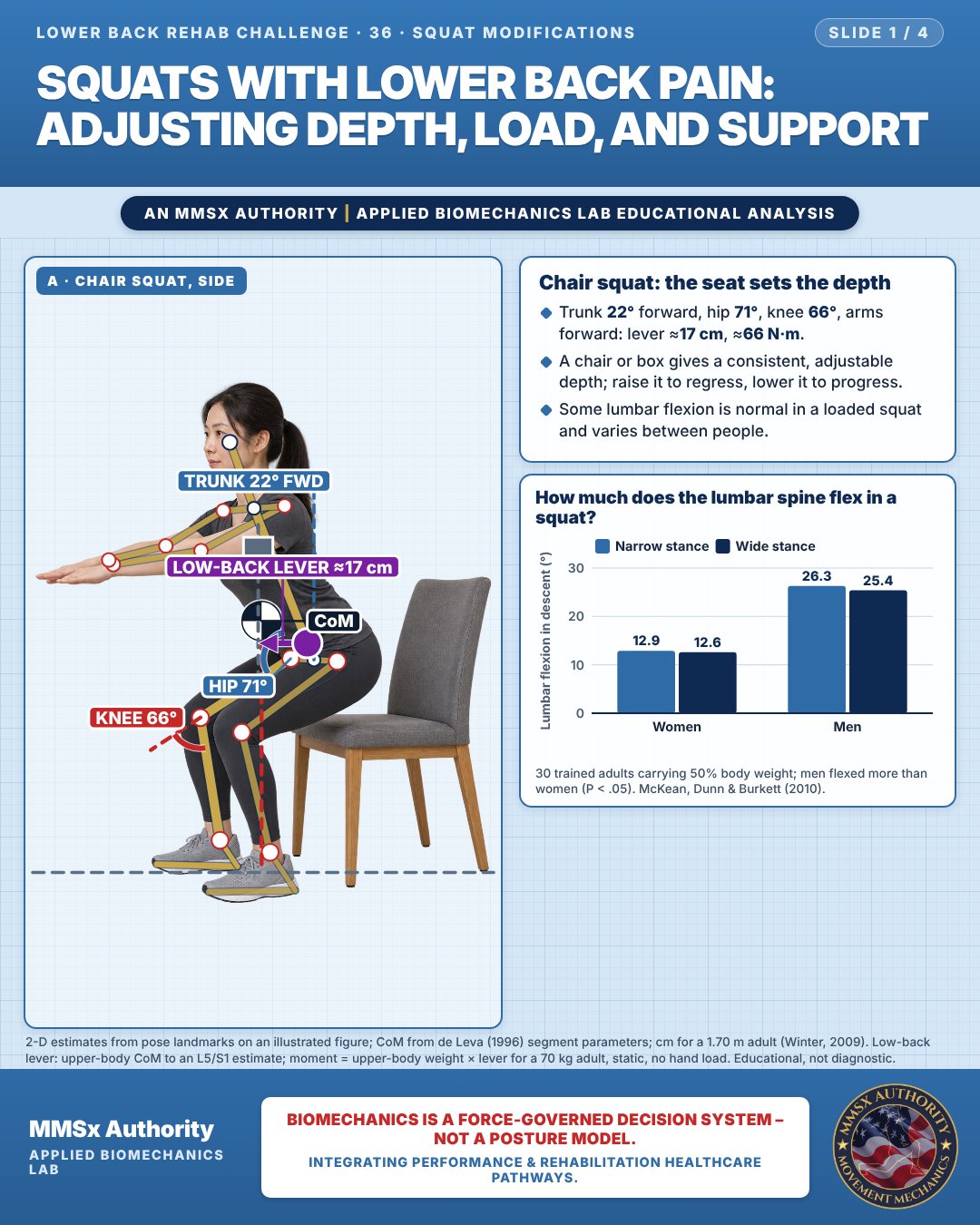
Chair squat: the seat sets the depth
Trunk 22° forward, hip 71°, knee 66°, arms forward: lever ≈17 cm, ≈66 N·m.
A chair or box gives a consistent, adjustable depth; raise it to regress, lower it to progress.
Some lumbar flexion is normal in a loaded squat and varies between people.
How much does the lumbar spine flex in a squat?
Movement B: Hand-supported squat (side view)
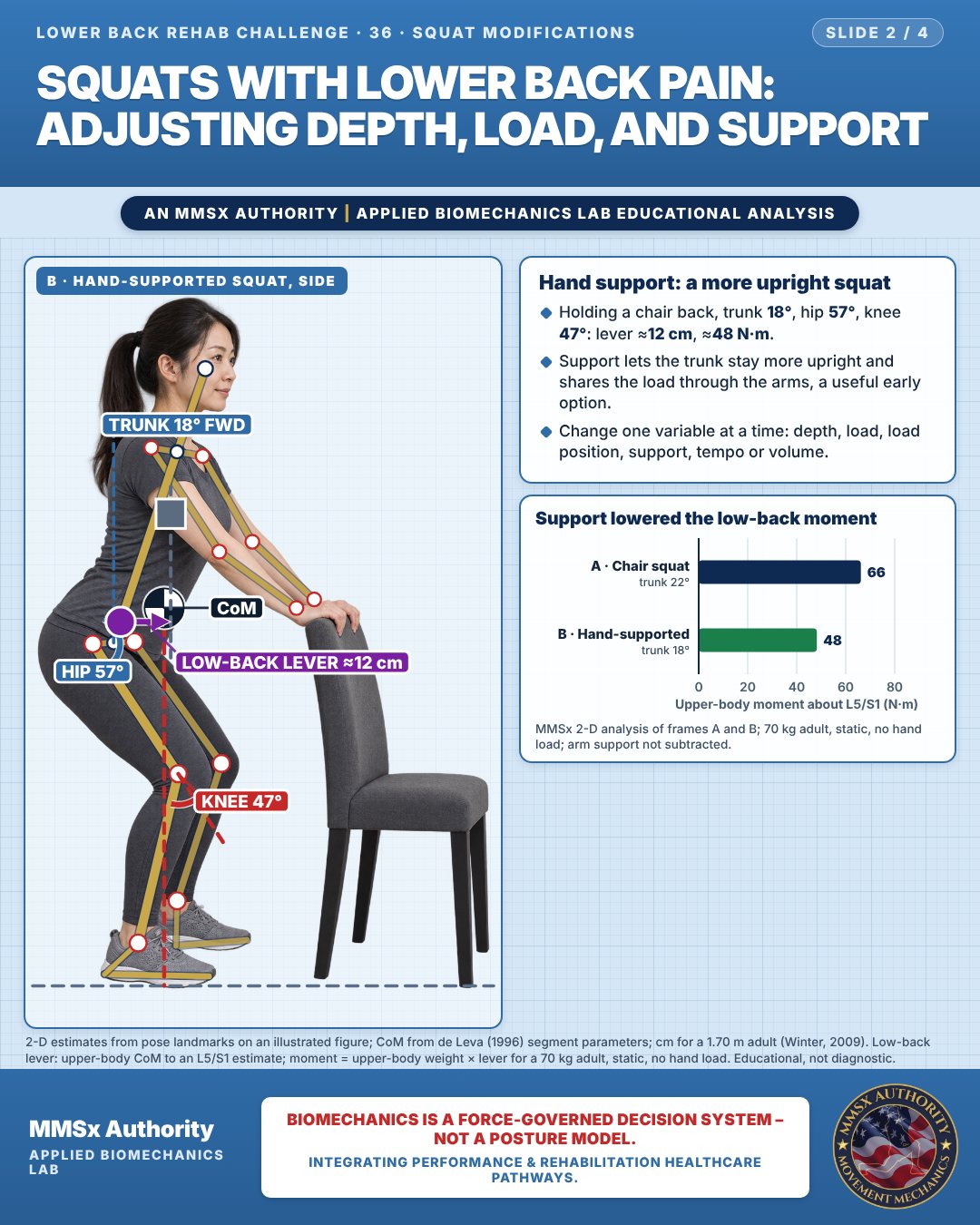
Hand support: a more upright squat
Holding a chair back, trunk 18°, hip 57°, knee 47°: lever ≈12 cm, ≈48 N·m.
Support lets the trunk stay more upright and shares the load through the arms, a useful early option.
Change one variable at a time: depth, load, load position, support, tempo or volume.
Support lowered the low-back moment
Movement C: Goblet squat (front view)
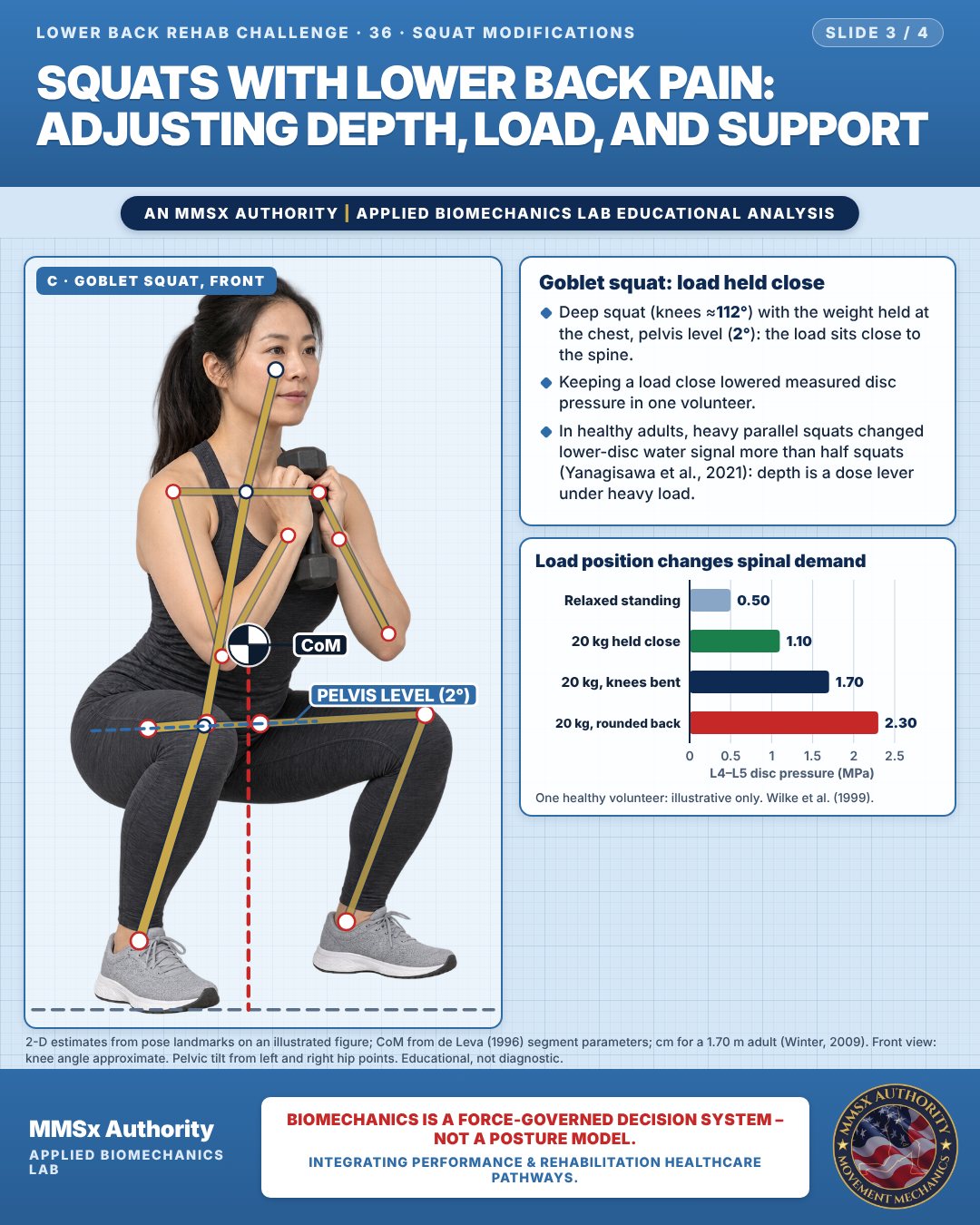
Goblet squat: load held close
Deep squat (knees ≈112°) with the weight held at the chest, pelvis level (2°): the load sits close to the spine.
Keeping a load close lowered measured disc pressure in one volunteer.
In healthy adults, heavy parallel squats changed lower-disc water signal more than half squats (Yanagisawa et al., 2021): depth is a dose lever under heavy load.
Load position changes spinal demand
Decision pathway
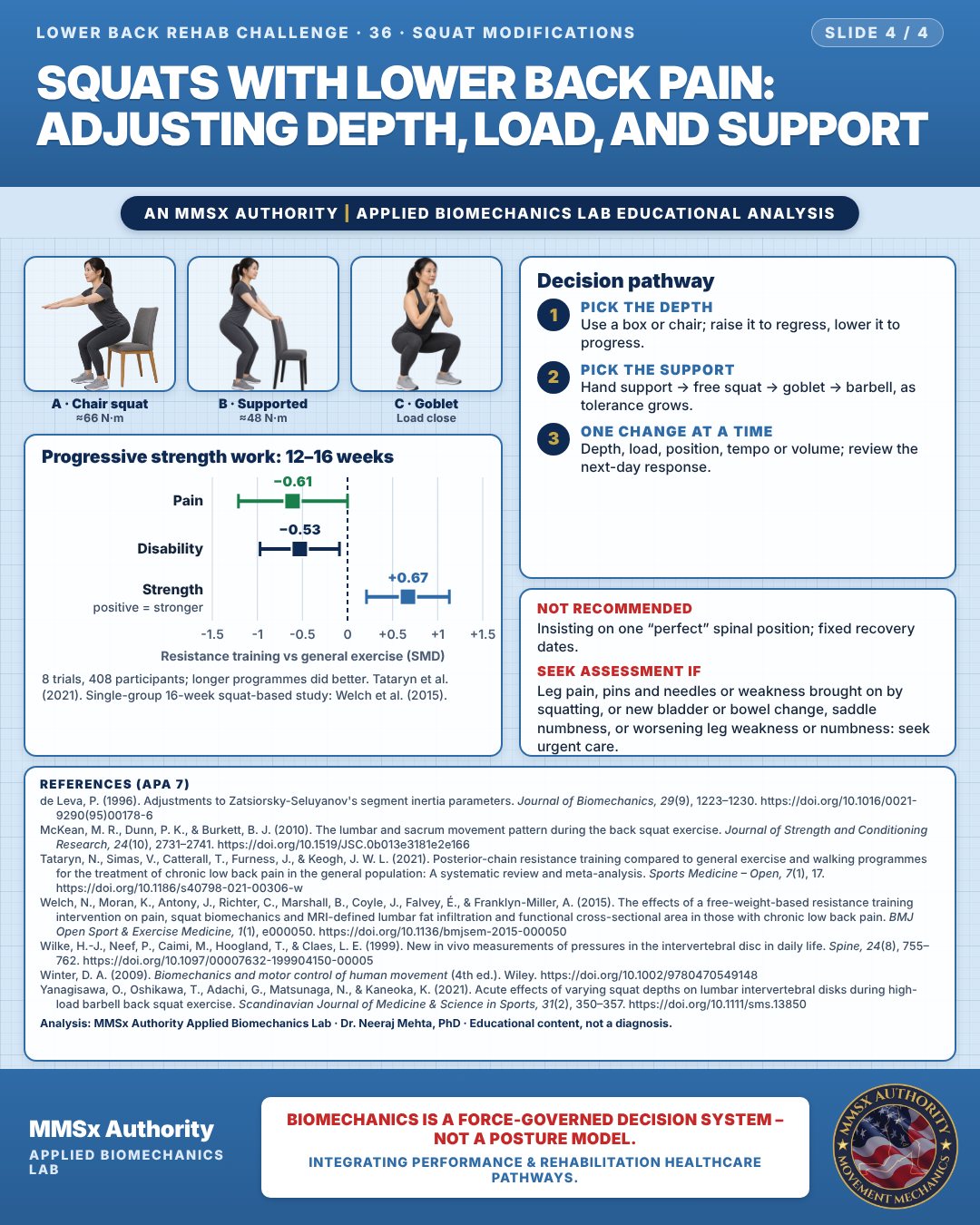
Progressive strength work: 12–16 weeks
Pick the depth
Use a box or chair; raise it to regress, lower it to progress.
Pick the support
Hand support → free squat → goblet → barbell, as tolerance grows.
One change at a time
Depth, load, position, tempo or volume; review the next-day response.
Cautions
Not recommended
Insisting on one “perfect” spinal position; fixed recovery dates.
Seek assessment if
Leg pain, pins and needles or weakness brought on by squatting, or new bladder or bowel change, saddle numbness, or worsening leg weakness or numbness: seek urgent care.
Methods note
2-D estimates from pose landmarks on an illustrated figure; CoM from de Leva (1996) segment parameters; cm for a 1.70 m adult (Winter, 2009). Low-back lever: upper-body CoM to an L5/S1 estimate; moment = upper-body weight × lever for a 70 kg adult, static, no hand load. Front view: knee angle approximate. Pelvic tilt from left and right hip points. These are educational estimates, not a diagnosis.
References
- de Leva, P. (1996). Adjustments to Zatsiorsky-Seluyanov's segment inertia parameters. Journal of Biomechanics, 29(9), 1223–1230. https://doi.org/10.1016/0021-9290(95)00178-6
- McKean, M. R., Dunn, P. K., & Burkett, B. J. (2010). The lumbar and sacrum movement pattern during the back squat exercise. Journal of Strength and Conditioning Research, 24(10), 2731–2741. https://doi.org/10.1519/JSC.0b013e3181e2e166
- Tataryn, N., Simas, V., Catterall, T., Furness, J., & Keogh, J. W. L. (2021). Posterior-chain resistance training compared to general exercise and walking programmes for the treatment of chronic low back pain in the general population: A systematic review and meta-analysis. Sports Medicine – Open, 7(1), 17. https://doi.org/10.1186/s40798-021-00306-w
- Welch, N., Moran, K., Antony, J., Richter, C., Marshall, B., Coyle, J., Falvey, É., & Franklyn-Miller, A. (2015). The effects of a free-weight-based resistance training intervention on pain, squat biomechanics and MRI-defined lumbar fat infiltration and functional cross-sectional area in those with chronic low back pain. BMJ Open Sport & Exercise Medicine, 1(1), e000050. https://doi.org/10.1136/bmjsem-2015-000050
- Wilke, H.-J., Neef, P., Caimi, M., Hoogland, T., & Claes, L. E. (1999). New in vivo measurements of pressures in the intervertebral disc in daily life. Spine, 24(8), 755–762. https://doi.org/10.1097/00007632-199904150-00005
- Winter, D. A. (2009). Biomechanics and motor control of human movement (4th ed.). Wiley. https://doi.org/10.1002/9780470549148
- Yanagisawa, O., Oshikawa, T., Adachi, G., Matsunaga, N., & Kaneoka, K. (2021). Acute effects of varying squat depths on lumbar intervertebral disks during high-load barbell back squat exercise. Scandinavian Journal of Medicine & Science in Sports, 31(2), 350–357. https://doi.org/10.1111/sms.13850
Cite this article
Mehta, N. (2026, October 23). Squats with lower back pain: adjusting depth, load, and support. MMSx Authority Applied Biomechanics Lab. https://mmsxauthority.org/edu/analysis/lower-back/36-squats-with-lower-back-pain-adjusting-depth-load-and-support/
Part of the collection
Mehta, N. (2026). Lower Back Rehabilitation: 50 Evidence-Based Biomechanics Analyses [Collection]. MMSx Authority Applied Biomechanics Lab. Zenodo. https://doi.org/10.5281/zenodo.23735778
All Lower Back Rehab Challenge articles · Rehabilitation Library