Lower Back Rehab Challenge · 35
Deadlifting with lower back pain: can it be part of rehabilitation?
Deadlift-based rehabilitation uses the hip-hinge lift of a load from the floor (or from an elevated start) as a progressive, supervised strengthening…
Key points
- Select. Lower pain and reasonable back-extensor endurance predicted benefit; avoid maximal loads in a flare.
- Coach and raise. Teach the hinge unloaded, start from a raised height, keep the load close.
- Progress 12–16 weeks. Increase load, then lower the start height, guided by the next-day response.
What it is
Deadlift-based rehabilitation uses the hip-hinge lift of a load from the floor (or from an elevated start) as a progressive, supervised strengthening exercise for the hip and back extensors in selected people with LBP, with load, range and starting height adjusted to symptom response.
How we analysed the movement
Three movements relevant to this topic were analysed from illustrated reference figures. Joint centres were located with two-dimensional pose estimation; joint angles, the whole-body centre of mass and, where relevant, the low-back lever (the horizontal distance from the upper-body centre of mass to the L5/S1 joint) were then calculated from standard segment parameters. The figures are educational estimates that show how position changes mechanical demand; they are not measurements of a patient. Every research value quoted below comes from the published source cited beside it.
Movement A: Unloaded hip hinge (side view)
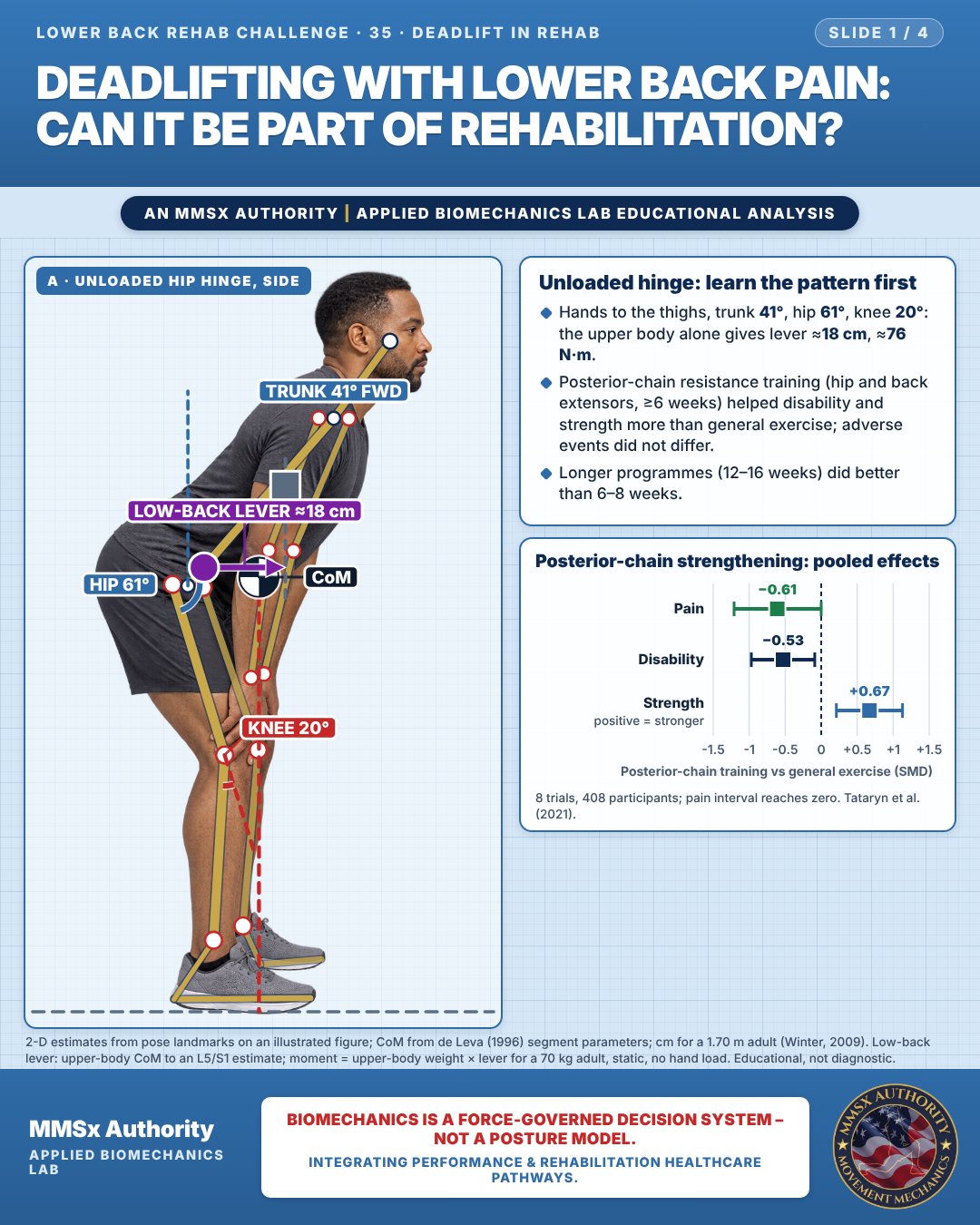
Unloaded hinge: learn the pattern first
Hands to the thighs, trunk 41°, hip 61°, knee 20°: the upper body alone gives lever ≈18 cm, ≈76 N·m.
Posterior-chain resistance training (hip and back extensors, ≥6 weeks) helped disability and strength more than general exercise; adverse events did not differ.
Longer programmes (12–16 weeks) did better than 6–8 weeks.
Posterior-chain strengthening: pooled effects
Movement B: Raised kettlebell pull (side view)
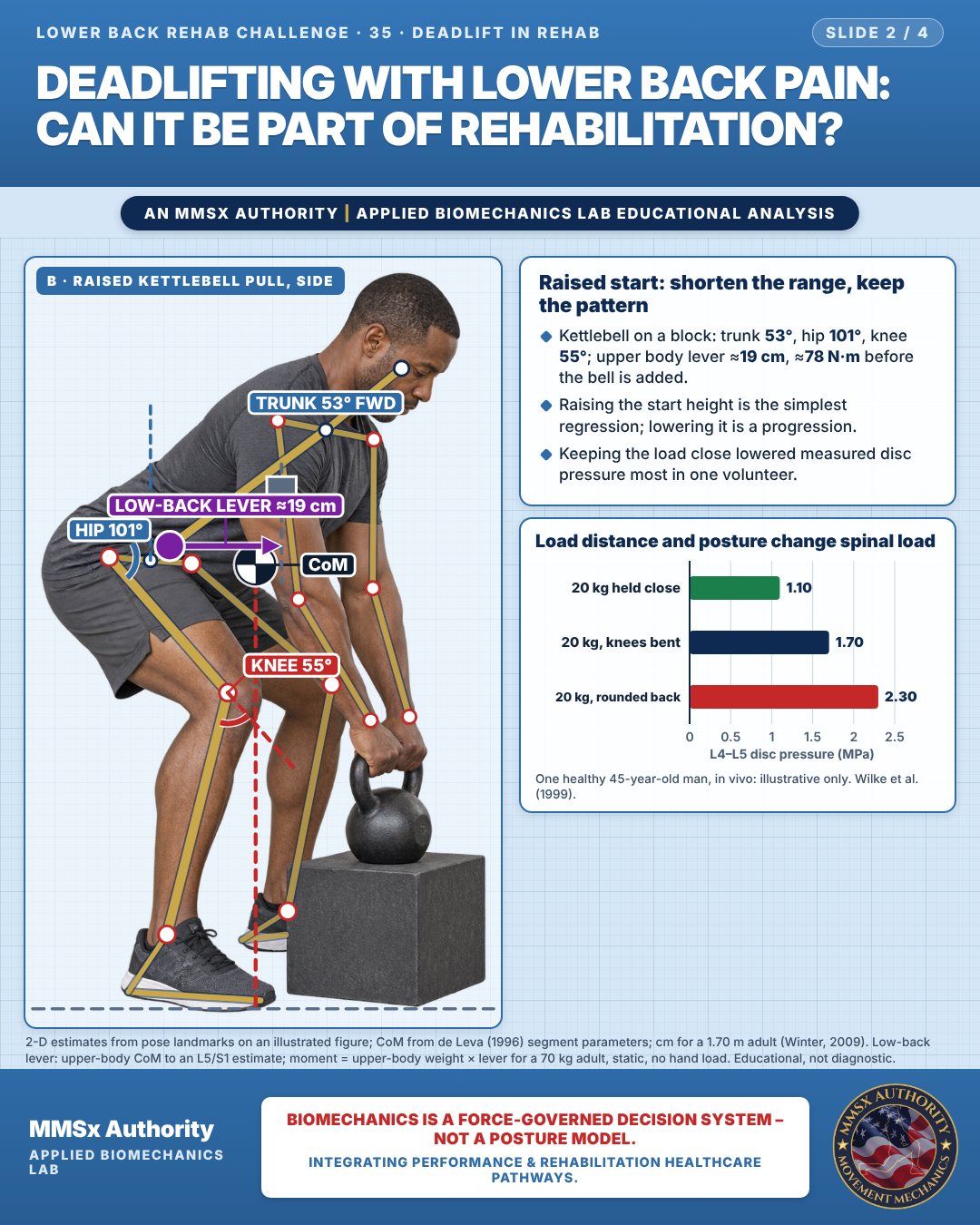
Raised start: shorten the range, keep the pattern
Kettlebell on a block: trunk 53°, hip 101°, knee 55°; upper body lever ≈19 cm, ≈78 N·m before the bell is added.
Raising the start height is the simplest regression; lowering it is a progression.
Keeping the load close lowered measured disc pressure most in one volunteer.
Load distance and posture change spinal load
Movement C: Light deadlift finish (front view)
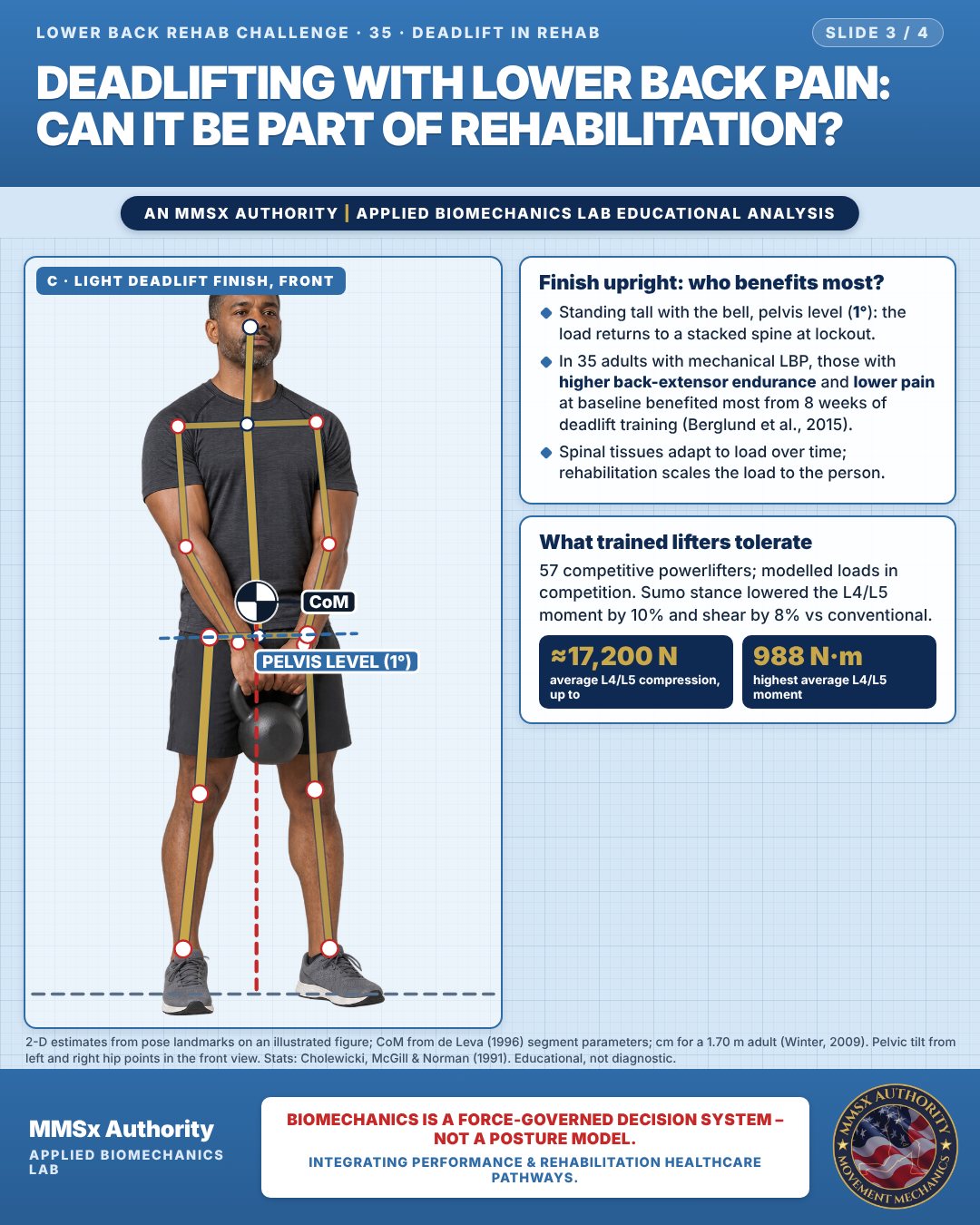
Finish upright: who benefits most?
Standing tall with the bell, pelvis level (1°): the load returns to a stacked spine at lockout.
In 35 adults with mechanical LBP, those with higher back-extensor endurance and lower pain at baseline benefited most from 8 weeks of deadlift training (Berglund et al., 2015).
Spinal tissues adapt to load over time; rehabilitation scales the load to the person.
What trained lifters tolerate
57 competitive powerlifters; modelled loads in competition. Sumo stance lowered the L4/L5 moment by 10% and shear by 8% vs conventional.
Decision pathway
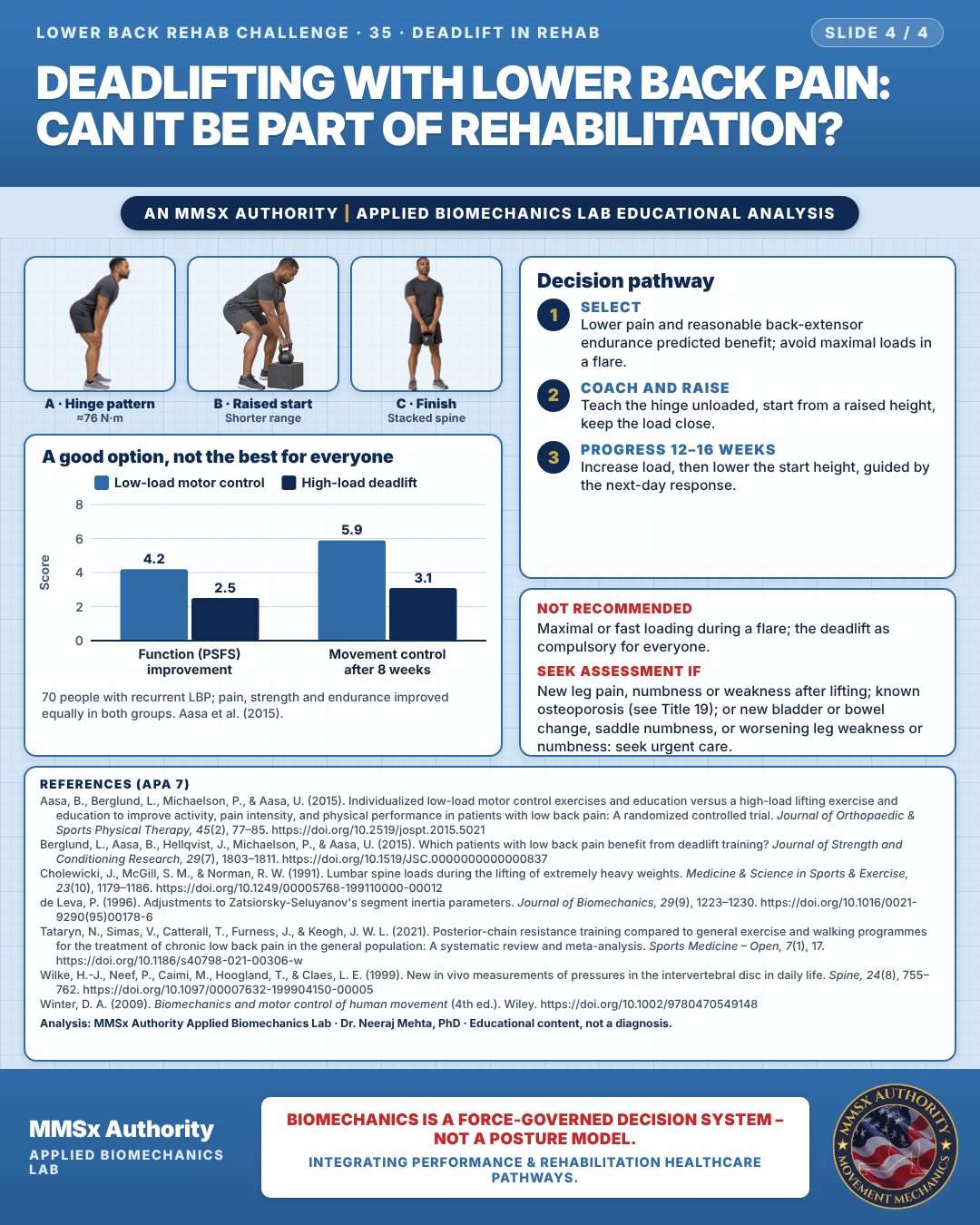
A good option, not the best for everyone
Select
Lower pain and reasonable back-extensor endurance predicted benefit; avoid maximal loads in a flare.
Coach and raise
Teach the hinge unloaded, start from a raised height, keep the load close.
Progress 12–16 weeks
Increase load, then lower the start height, guided by the next-day response.
What the evidence supports
- Do not: present the deadlift as superior for everyone — low-load motor control produced greater activity gains in one RCT (Aasa et al., 2015); avoid maximal loads during flares.
Cautions
Not recommended
Maximal or fast loading during a flare; the deadlift as compulsory for everyone.
Seek assessment if
New leg pain, numbness or weakness after lifting; known osteoporosis (see Title 19); or new bladder or bowel change, saddle numbness, or worsening leg weakness or numbness: seek urgent care.
Methods note
2-D estimates from pose landmarks on an illustrated figure; CoM from de Leva (1996) segment parameters; cm for a 1.70 m adult (Winter, 2009). Low-back lever: upper-body CoM to an L5/S1 estimate; moment = upper-body weight × lever for a 70 kg adult, static, no hand load. Pelvic tilt from left and right hip points in the front view. Stats: Cholewicki, McGill & Norman (1991). These are educational estimates, not a diagnosis.
References
- Aasa, B., Berglund, L., Michaelson, P., & Aasa, U. (2015). Individualized low-load motor control exercises and education versus a high-load lifting exercise and education to improve activity, pain intensity, and physical performance in patients with low back pain: A randomized controlled trial. Journal of Orthopaedic & Sports Physical Therapy, 45(2), 77–85. https://doi.org/10.2519/jospt.2015.5021
- Berglund, L., Aasa, B., Hellqvist, J., Michaelson, P., & Aasa, U. (2015). Which patients with low back pain benefit from deadlift training? Journal of Strength and Conditioning Research, 29(7), 1803–1811. https://doi.org/10.1519/JSC.0000000000000837
- Cholewicki, J., McGill, S. M., & Norman, R. W. (1991). Lumbar spine loads during the lifting of extremely heavy weights. Medicine & Science in Sports & Exercise, 23(10), 1179–1186. https://doi.org/10.1249/00005768-199110000-00012
- de Leva, P. (1996). Adjustments to Zatsiorsky-Seluyanov's segment inertia parameters. Journal of Biomechanics, 29(9), 1223–1230. https://doi.org/10.1016/0021-9290(95)00178-6
- Tataryn, N., Simas, V., Catterall, T., Furness, J., & Keogh, J. W. L. (2021). Posterior-chain resistance training compared to general exercise and walking programmes for the treatment of chronic low back pain in the general population: A systematic review and meta-analysis. Sports Medicine – Open, 7(1), 17. https://doi.org/10.1186/s40798-021-00306-w
- Wilke, H.-J., Neef, P., Caimi, M., Hoogland, T., & Claes, L. E. (1999). New in vivo measurements of pressures in the intervertebral disc in daily life. Spine, 24(8), 755–762. https://doi.org/10.1097/00007632-199904150-00005
- Winter, D. A. (2009). Biomechanics and motor control of human movement (4th ed.). Wiley. https://doi.org/10.1002/9780470549148
Cite this article
Mehta, N. (2026, October 23). Deadlifting with lower back pain: can it be part of rehabilitation? MMSx Authority Applied Biomechanics Lab. https://mmsxauthority.org/edu/analysis/lower-back/35-deadlifting-with-lower-back-pain-can-it-be-part-of-rehabilitation/
Part of the collection
Mehta, N. (2026). Lower Back Rehabilitation: 50 Evidence-Based Biomechanics Analyses [Collection]. MMSx Authority Applied Biomechanics Lab. Zenodo. https://doi.org/10.5281/zenodo.23735778
All Lower Back Rehab Challenge articles · Rehabilitation Library