Lower Back Rehab Challenge · 34
Water-based exercise for lower back pain: when the pool may help
Therapeutic aquatic exercise is supervised exercise performed in (usually warm) water, using buoyancy to reduce effective body weight and water…
Key points
- Consider the pool. When land exercise is poorly tolerated, or for higher body mass or fear of movement.
- Keep it active. Exercise in water, not passive soaking; it outperformed passive modalities.
- Bridge to land. Move to land-based tasks as tolerance grows if those are the person’s goals.
What it is
Therapeutic aquatic exercise is supervised exercise performed in (usually warm) water, using buoyancy to reduce effective body weight and water resistance to load muscles; it is an option for people who find land-based exercise hard to tolerate, not a different category of treatment.
How we analysed the movement
Three movements relevant to this topic were analysed from illustrated reference figures. Joint centres were located with two-dimensional pose estimation; joint angles, the whole-body centre of mass and, where relevant, the low-back lever (the horizontal distance from the upper-body centre of mass to the L5/S1 joint) were then calculated from standard segment parameters. The figures are educational estimates that show how position changes mechanical demand; they are not measurements of a patient. Every research value quoted below comes from the published source cited beside it.
Movement A: Water walking
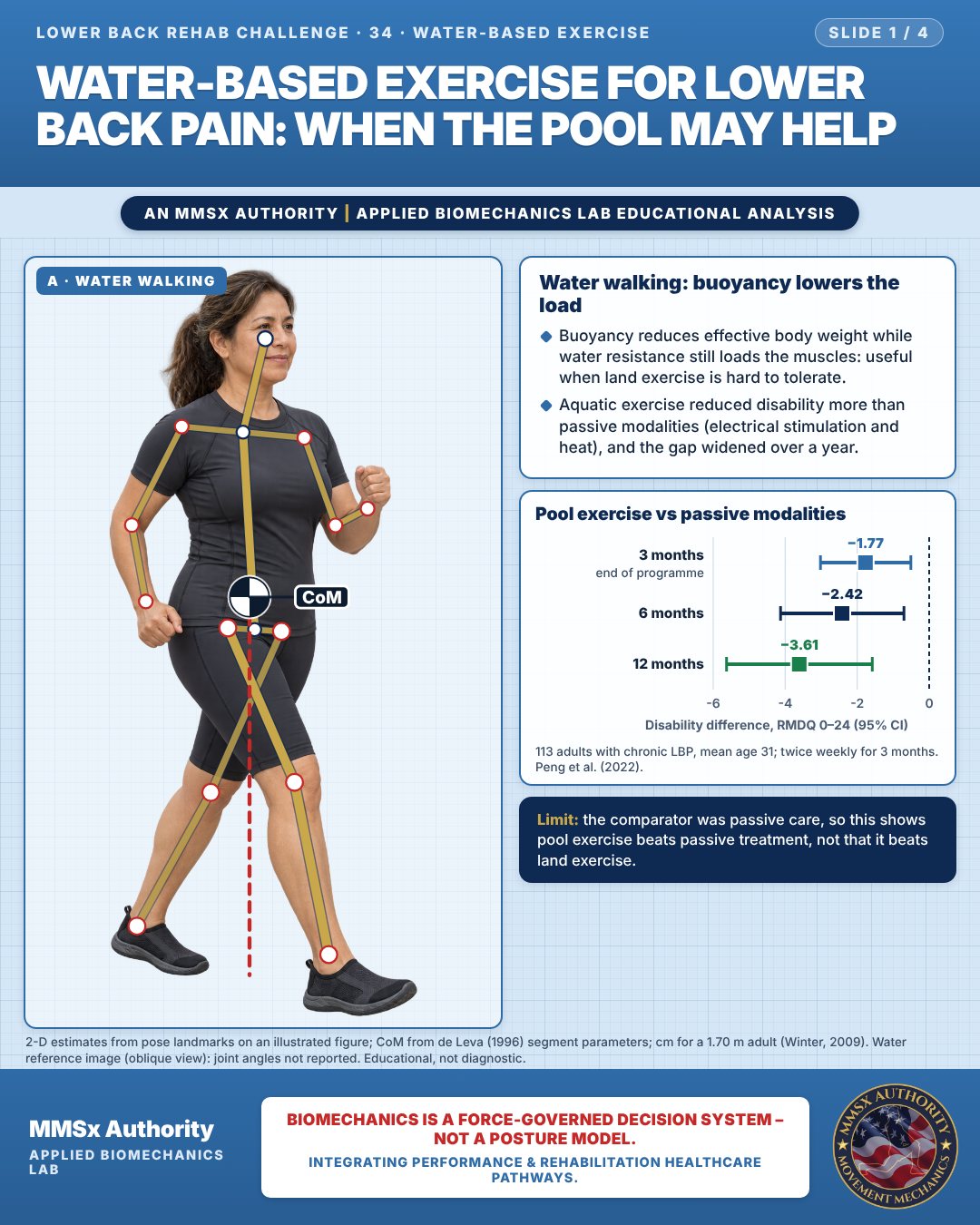
Water walking: buoyancy lowers the load
Buoyancy reduces effective body weight while water resistance still loads the muscles: useful when land exercise is hard to tolerate.
Aquatic exercise reduced disability more than passive modalities (electrical stimulation and heat), and the gap widened over a year.
Pool exercise vs passive modalities
Movement B: Water march
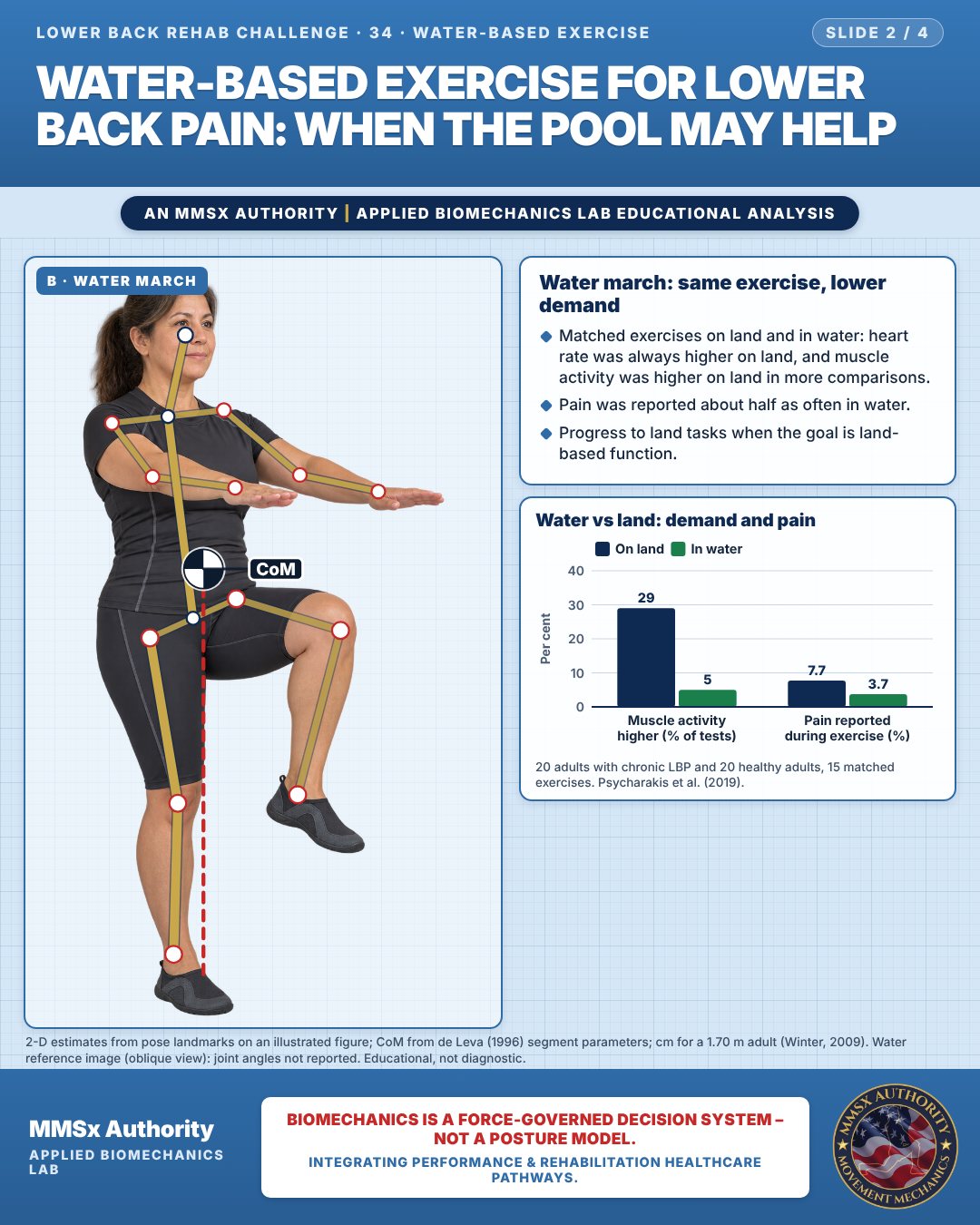
Water march: same exercise, lower demand
Matched exercises on land and in water: heart rate was always higher on land, and muscle activity was higher on land in more comparisons.
Pain was reported about half as often in water.
Progress to land tasks when the goal is land-based function.
Water vs land: demand and pain
Movement C: Water side step (front view)
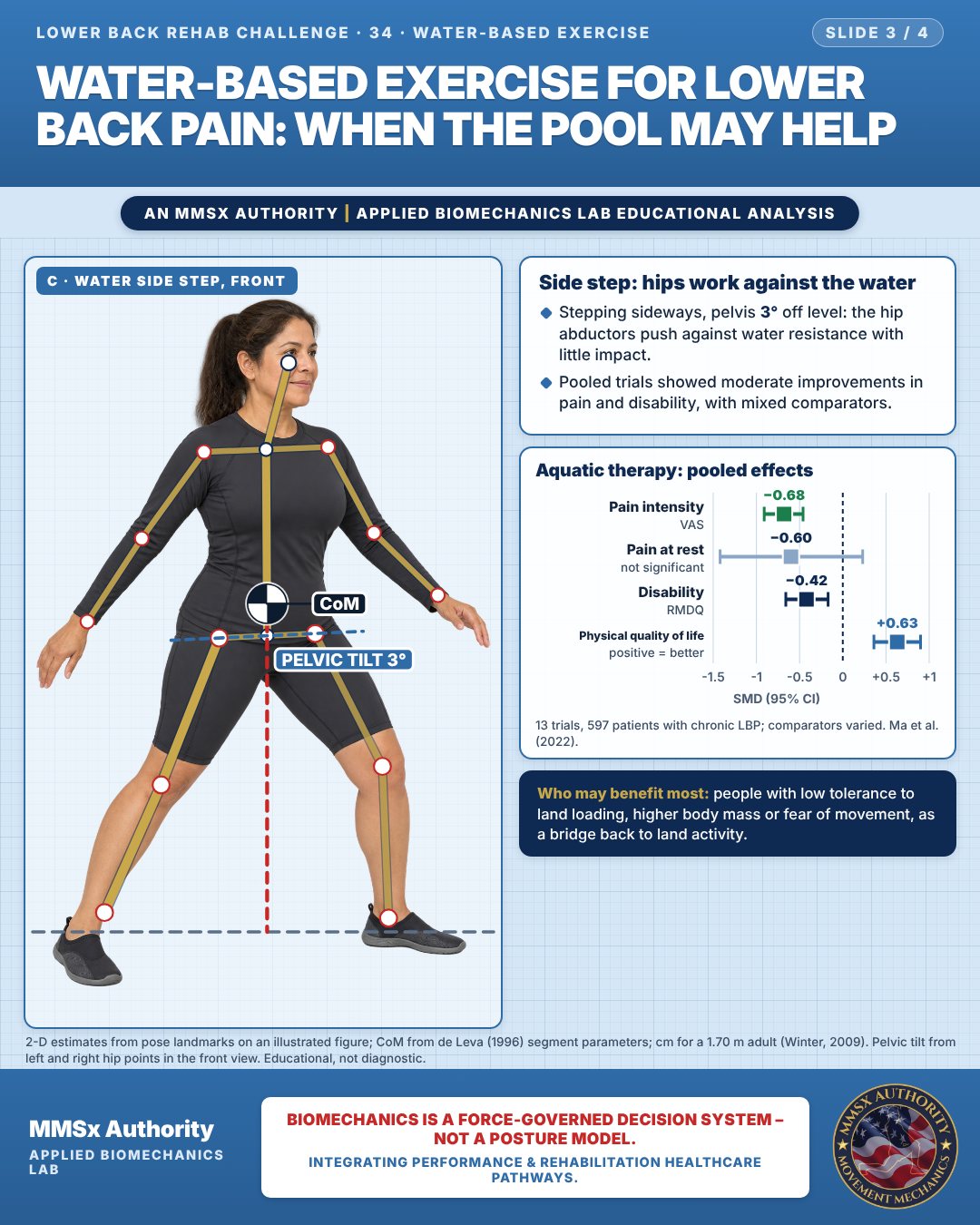
Side step: hips work against the water
Stepping sideways, pelvis 3° off level: the hip abductors push against water resistance with little impact.
Pooled trials showed moderate improvements in pain and disability, with mixed comparators.
Aquatic therapy: pooled effects
Decision pathway
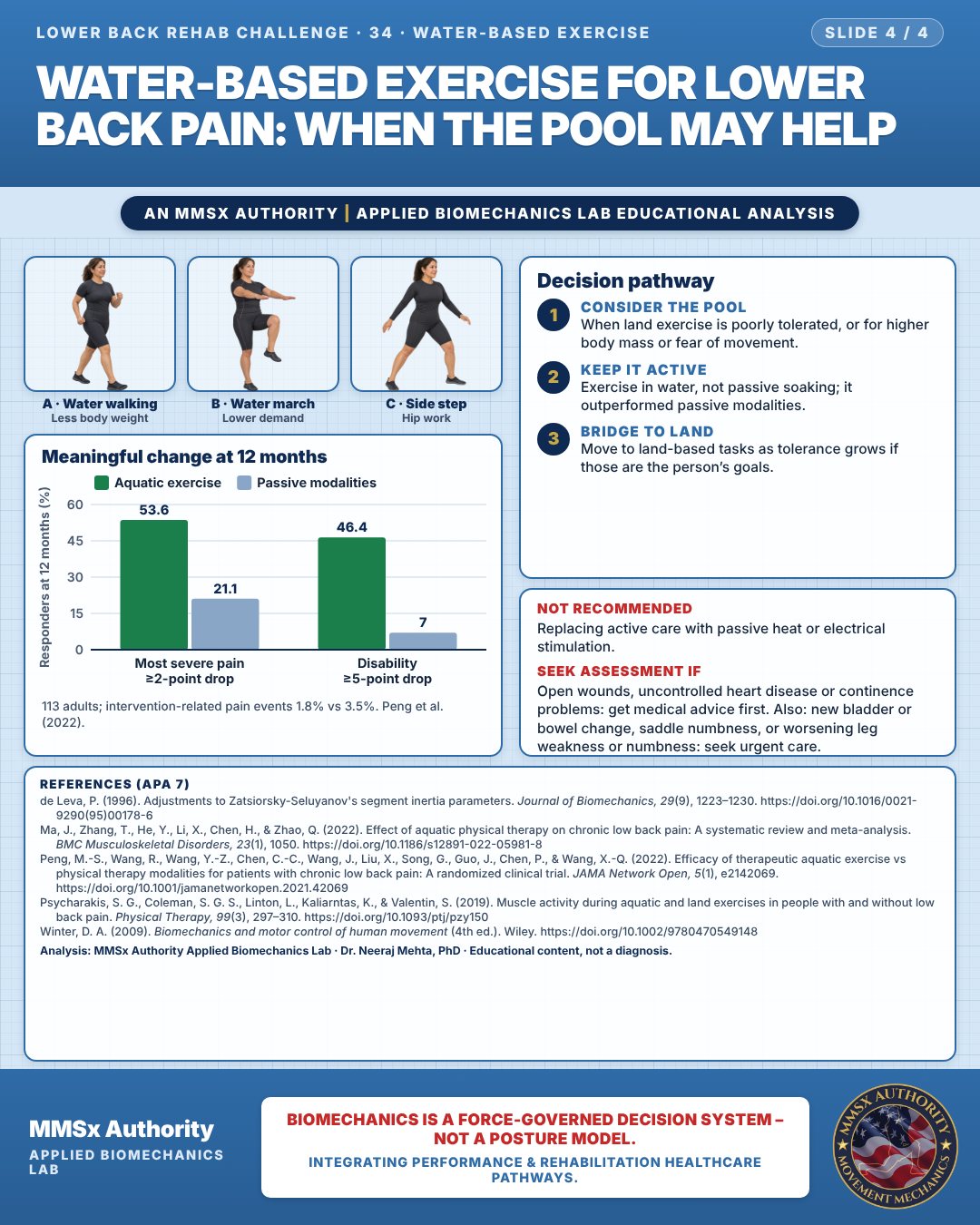
Meaningful change at 12 months
Consider the pool
When land exercise is poorly tolerated, or for higher body mass or fear of movement.
Keep it active
Exercise in water, not passive soaking; it outperformed passive modalities.
Bridge to land
Move to land-based tasks as tolerance grows if those are the person’s goals.
What the evidence supports
- Do not recommend: replacing active care with passive modalities (heat/electrical stimulation) — aquatic exercise outperformed them (Peng et al., 2022).
Cautions
Not recommended
Replacing active care with passive heat or electrical stimulation.
Seek assessment if
Open wounds, uncontrolled heart disease or continence problems: get medical advice first. Also: new bladder or bowel change, saddle numbness, or worsening leg weakness or numbness: seek urgent care.
Methods note
2-D estimates from pose landmarks on an illustrated figure; CoM from de Leva (1996) segment parameters; cm for a 1.70 m adult (Winter, 2009). Water reference image (oblique view): joint angles not reported. Pelvic tilt from left and right hip points in the front view. These are educational estimates, not a diagnosis.
References
- de Leva, P. (1996). Adjustments to Zatsiorsky-Seluyanov's segment inertia parameters. Journal of Biomechanics, 29(9), 1223–1230. https://doi.org/10.1016/0021-9290(95)00178-6
- Ma, J., Zhang, T., He, Y., Li, X., Chen, H., & Zhao, Q. (2022). Effect of aquatic physical therapy on chronic low back pain: A systematic review and meta-analysis. BMC Musculoskeletal Disorders, 23(1), 1050. https://doi.org/10.1186/s12891-022-05981-8
- Peng, M.-S., Wang, R., Wang, Y.-Z., Chen, C.-C., Wang, J., Liu, X., Song, G., Guo, J., Chen, P., & Wang, X.-Q. (2022). Efficacy of therapeutic aquatic exercise vs physical therapy modalities for patients with chronic low back pain: A randomized clinical trial. JAMA Network Open, 5(1), e2142069. https://doi.org/10.1001/jamanetworkopen.2021.42069
- Psycharakis, S. G., Coleman, S. G. S., Linton, L., Kaliarntas, K., & Valentin, S. (2019). Muscle activity during aquatic and land exercises in people with and without low back pain. Physical Therapy, 99(3), 297–310. https://doi.org/10.1093/ptj/pzy150
- Winter, D. A. (2009). Biomechanics and motor control of human movement (4th ed.). Wiley. https://doi.org/10.1002/9780470549148
Cite this article
Mehta, N. (2026, October 23). Water-based exercise for lower back pain: when the pool may help. MMSx Authority Applied Biomechanics Lab. https://mmsxauthority.org/edu/analysis/lower-back/34-water-based-exercise-for-lower-back-pain-when-the-pool-may-help/
Part of the collection
Mehta, N. (2026). Lower Back Rehabilitation: 50 Evidence-Based Biomechanics Analyses [Collection]. MMSx Authority Applied Biomechanics Lab. Zenodo. https://doi.org/10.5281/zenodo.23735778
All Lower Back Rehab Challenge articles · Rehabilitation Library