Lower Back Rehab Challenge · 33
Pilates for lower back pain: how does it compare with other exercise?
Pilates-based exercise for LBP is a supervised programme (mat or equipment-based) emphasising controlled movement, breathing, trunk and hip control,…
Key points
- A good option. Pilates helps compared with minimal care; choose it if the person prefers and can access it.
- About twice a week. Two supervised sessions a week appeared efficient in one dose trial.
- Not the only way. Other exercise types gave similar results head to head; adherence matters most.
What it is
Pilates-based exercise for LBP is a supervised programme (mat or equipment-based) emphasising controlled movement, breathing, trunk and hip control, posture and flexibility, progressed in complexity and load; it is one form of therapeutic exercise rather than a distinct treatment class.
How we analysed the movement
Three movements relevant to this topic were analysed from illustrated reference figures. Joint centres were located with two-dimensional pose estimation; joint angles, the whole-body centre of mass and, where relevant, the low-back lever (the horizontal distance from the upper-body centre of mass to the L5/S1 joint) were then calculated from standard segment parameters. The figures are educational estimates that show how position changes mechanical demand; they are not measurements of a patient. Every research value quoted below comes from the published source cited beside it.
Movement A: Breathing set-up (side view)
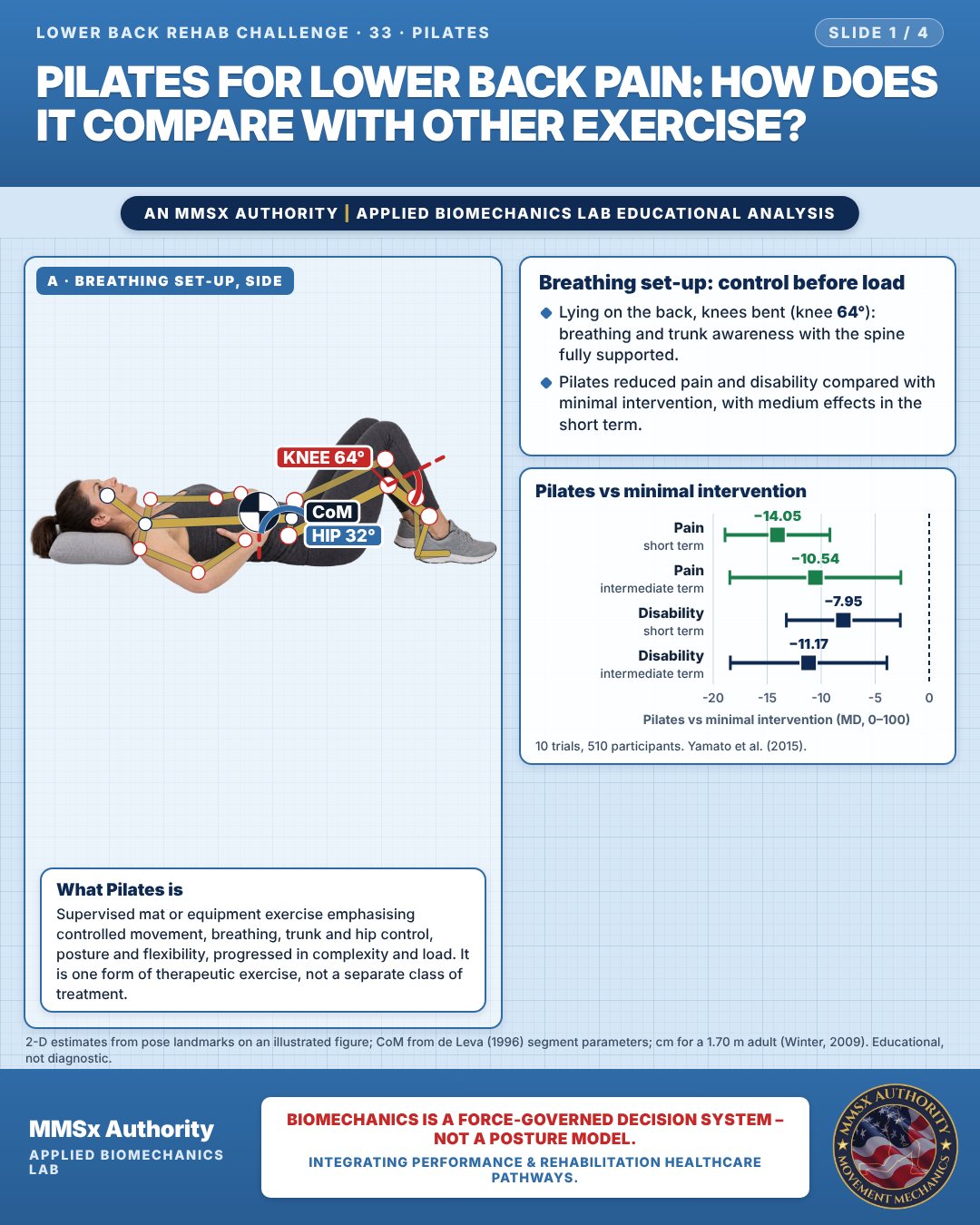
What Pilates is
Supervised mat or equipment exercise emphasising controlled movement, breathing, trunk and hip control, posture and flexibility, progressed in complexity and load. It is one form of therapeutic exercise, not a separate class of treatment.
Breathing set-up: control before load
Lying on the back, knees bent (knee 64°): breathing and trunk awareness with the spine fully supported.
Pilates reduced pain and disability compared with minimal intervention, with medium effects in the short term.
Pilates vs minimal intervention
Movement B: Heel slide (side view)
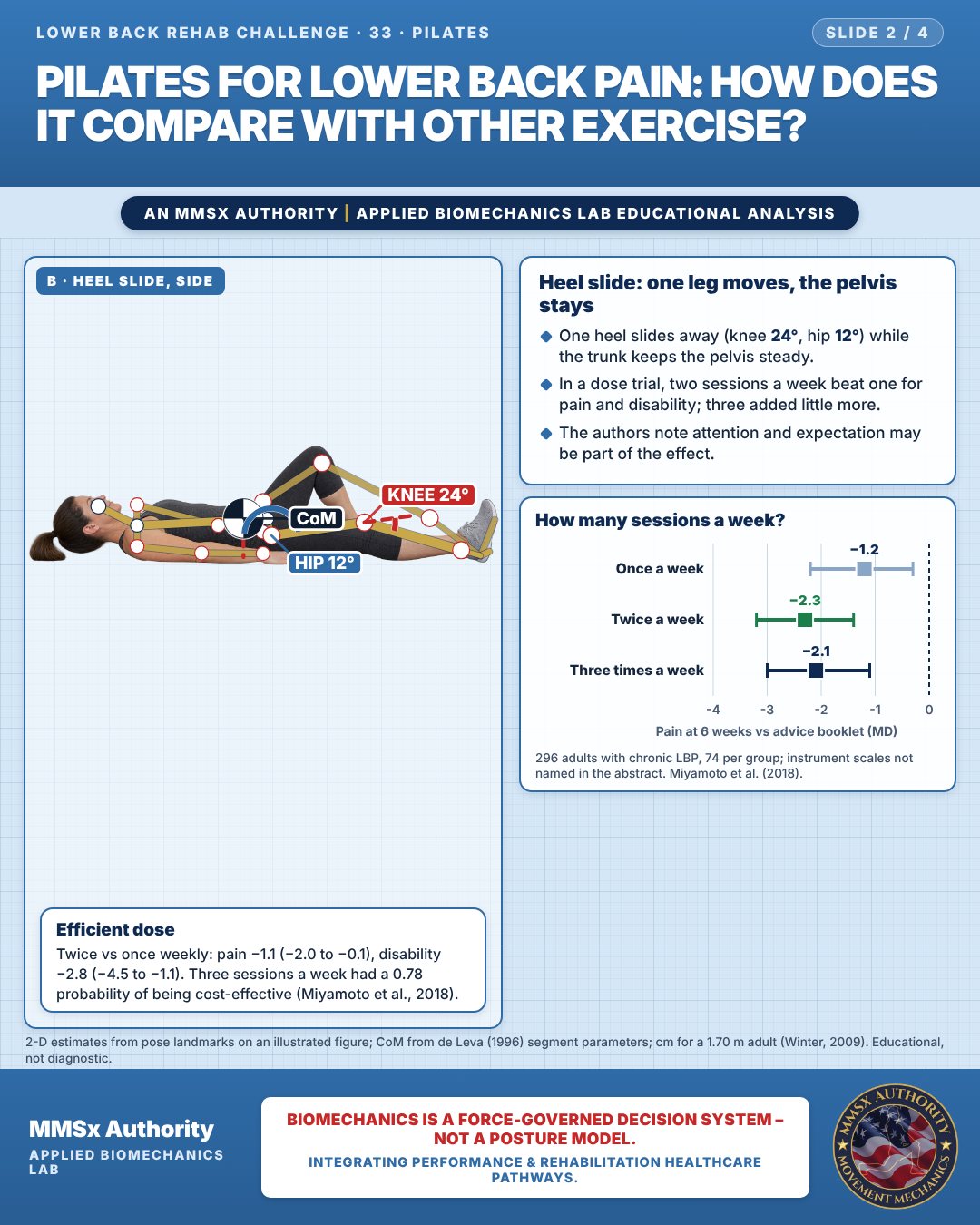
Efficient dose
Twice vs once weekly: pain −1.1 (−2.0 to −0.1), disability −2.8 (−4.5 to −1.1). Three sessions a week had a 0.78 probability of being cost-effective (Miyamoto et al., 2018).
Heel slide: one leg moves, the pelvis stays
One heel slides away (knee 24°, hip 12°) while the trunk keeps the pelvis steady.
In a dose trial, two sessions a week beat one for pain and disability; three added little more.
The authors note attention and expectation may be part of the effect.
How many sessions a week?
Movement C: Knee fall-out (side view)
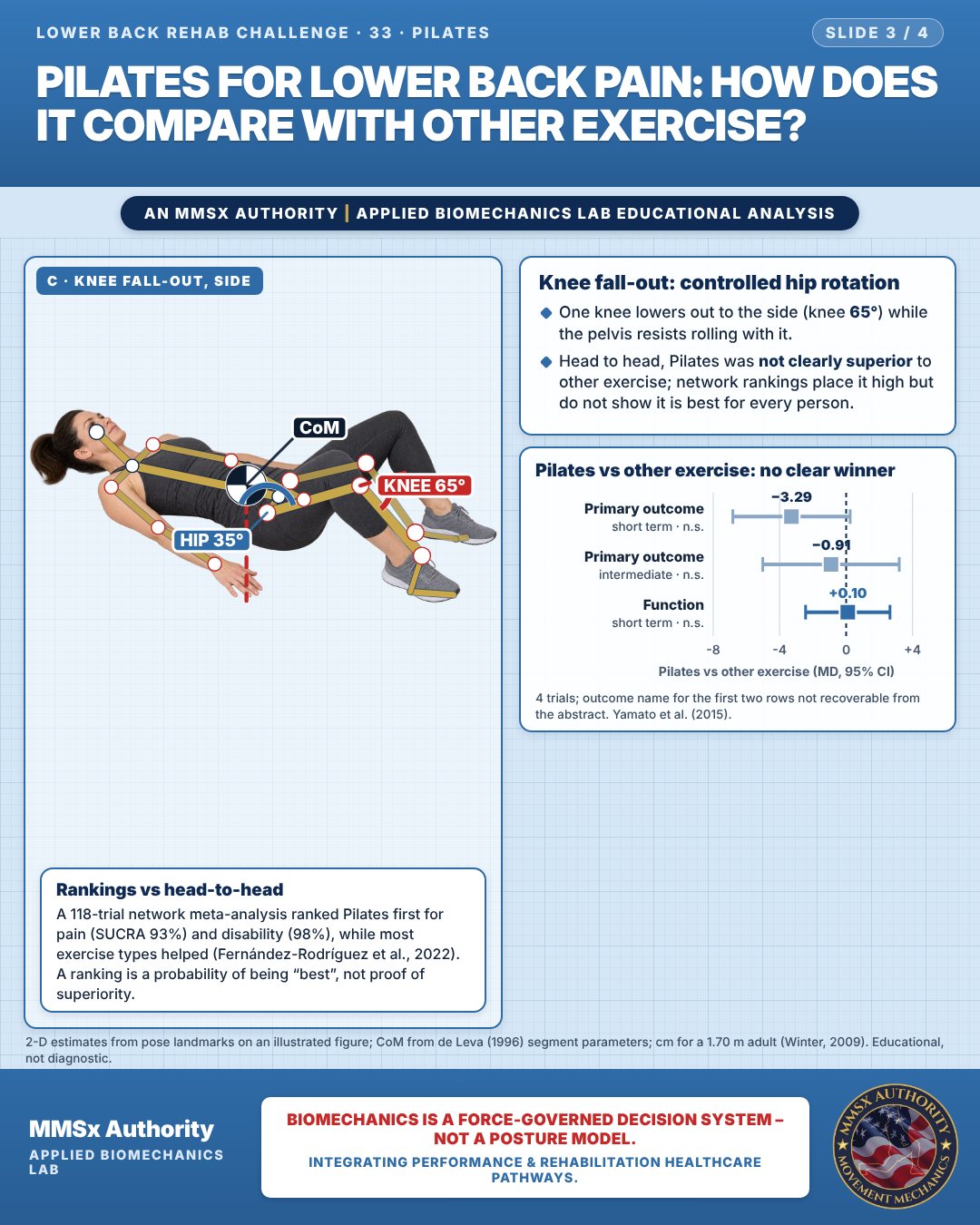
Rankings vs head-to-head
A 118-trial network meta-analysis ranked Pilates first for pain (SUCRA 93%) and disability (98%), while most exercise types helped (Fernández-Rodríguez et al., 2022). A ranking is a probability of being “best”, not proof of superiority.
Knee fall-out: controlled hip rotation
One knee lowers out to the side (knee 65°) while the pelvis resists rolling with it.
Head to head, Pilates was not clearly superior to other exercise; network rankings place it high but do not show it is best for every person.
Pilates vs other exercise: no clear winner
Decision pathway
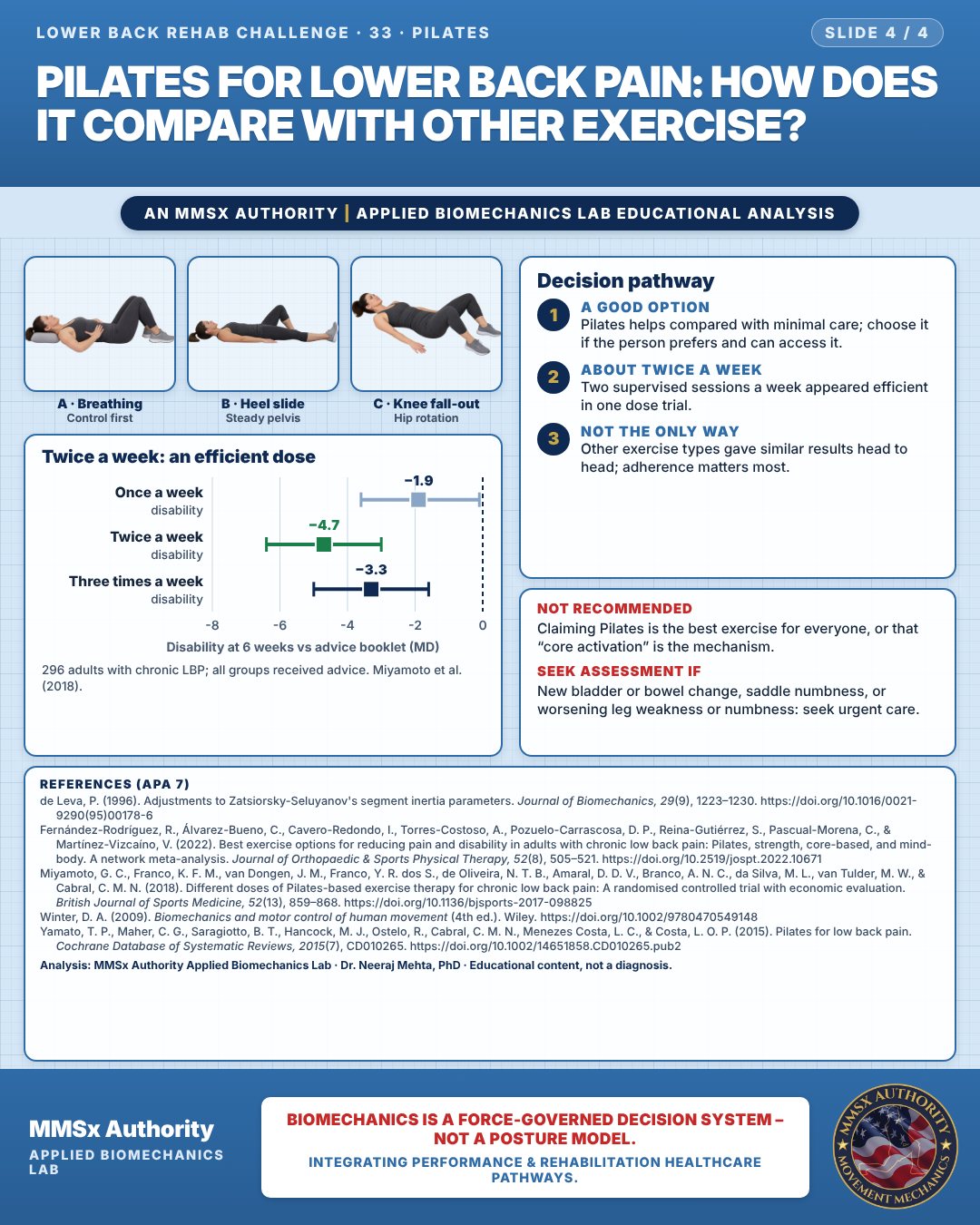
Twice a week: an efficient dose
A good option
Pilates helps compared with minimal care; choose it if the person prefers and can access it.
About twice a week
Two supervised sessions a week appeared efficient in one dose trial.
Not the only way
Other exercise types gave similar results head to head; adherence matters most.
Cautions
Not recommended
Claiming Pilates is the best exercise for everyone, or that “core activation” is the mechanism.
Seek assessment if
New bladder or bowel change, saddle numbness, or worsening leg weakness or numbness: seek urgent care.
Methods note
2-D estimates from pose landmarks on an illustrated figure; CoM from de Leva (1996) segment parameters; cm for a 1.70 m adult (Winter, 2009). These are educational estimates, not a diagnosis.
References
- de Leva, P. (1996). Adjustments to Zatsiorsky-Seluyanov's segment inertia parameters. Journal of Biomechanics, 29(9), 1223–1230. https://doi.org/10.1016/0021-9290(95)00178-6
- Fernández-Rodríguez, R., Álvarez-Bueno, C., Cavero-Redondo, I., Torres-Costoso, A., Pozuelo-Carrascosa, D. P., Reina-Gutiérrez, S., Pascual-Morena, C., & Martínez-Vizcaíno, V. (2022). Best exercise options for reducing pain and disability in adults with chronic low back pain: Pilates, strength, core-based, and mind-body. A network meta-analysis. Journal of Orthopaedic & Sports Physical Therapy, 52(8), 505–521. https://doi.org/10.2519/jospt.2022.10671
- Miyamoto, G. C., Franco, K. F. M., van Dongen, J. M., Franco, Y. R. dos S., de Oliveira, N. T. B., Amaral, D. D. V., Branco, A. N. C., da Silva, M. L., van Tulder, M. W., & Cabral, C. M. N. (2018). Different doses of Pilates-based exercise therapy for chronic low back pain: A randomised controlled trial with economic evaluation. British Journal of Sports Medicine, 52(13), 859–868. https://doi.org/10.1136/bjsports-2017-098825
- Winter, D. A. (2009). Biomechanics and motor control of human movement (4th ed.). Wiley. https://doi.org/10.1002/9780470549148
- Yamato, T. P., Maher, C. G., Saragiotto, B. T., Hancock, M. J., Ostelo, R., Cabral, C. M. N., Menezes Costa, L. C., & Costa, L. O. P. (2015). Pilates for low back pain. Cochrane Database of Systematic Reviews, 2015(7), CD010265. https://doi.org/10.1002/14651858.CD010265.pub2
Cite this article
Mehta, N. (2026, October 23). Pilates for lower back pain: how does it compare with other exercise? MMSx Authority Applied Biomechanics Lab. https://mmsxauthority.org/edu/analysis/lower-back/33-pilates-for-lower-back-pain-how-does-it-compare-with-other-exercise/
Part of the collection
Mehta, N. (2026). Lower Back Rehabilitation: 50 Evidence-Based Biomechanics Analyses [Collection]. MMSx Authority Applied Biomechanics Lab. Zenodo. https://doi.org/10.5281/zenodo.23735778
All Lower Back Rehab Challenge articles · Rehabilitation Library