Lower Back Rehab Challenge · 32
Yoga for chronic lower back pain: benefits, limitations, and adaptations
Therapeutic yoga for chronic non-specific LBP is a structured mind–body exercise programme combining postures (asanas), breathing and relaxation,…
Key points
- Choose if preferred. Yoga is a reasonable first-line option for people who enjoy it and can access it.
- Adapt the poses. Props, chair support, reduced range and shorter holds; progress hold time before depth.
- Expect modest gains. Similar to stretching or physiotherapy; reassess after 8–12 weeks.
What it is
Therapeutic yoga for chronic non-specific LBP is a structured mind–body exercise programme combining postures (asanas), breathing and relaxation, usually delivered as weekly group classes with home practice and adapted (props, reduced range, avoiding provocative end-range positions) to the individual's symptoms.
How we analysed the movement
Three movements relevant to this topic were analysed from illustrated reference figures. Joint centres were located with two-dimensional pose estimation; joint angles, the whole-body centre of mass and, where relevant, the low-back lever (the horizontal distance from the upper-body centre of mass to the L5/S1 joint) were then calculated from standard segment parameters. The figures are educational estimates that show how position changes mechanical demand; they are not measurements of a patient. Every research value quoted below comes from the published source cited beside it.
Movement A: Mountain pose (front view)
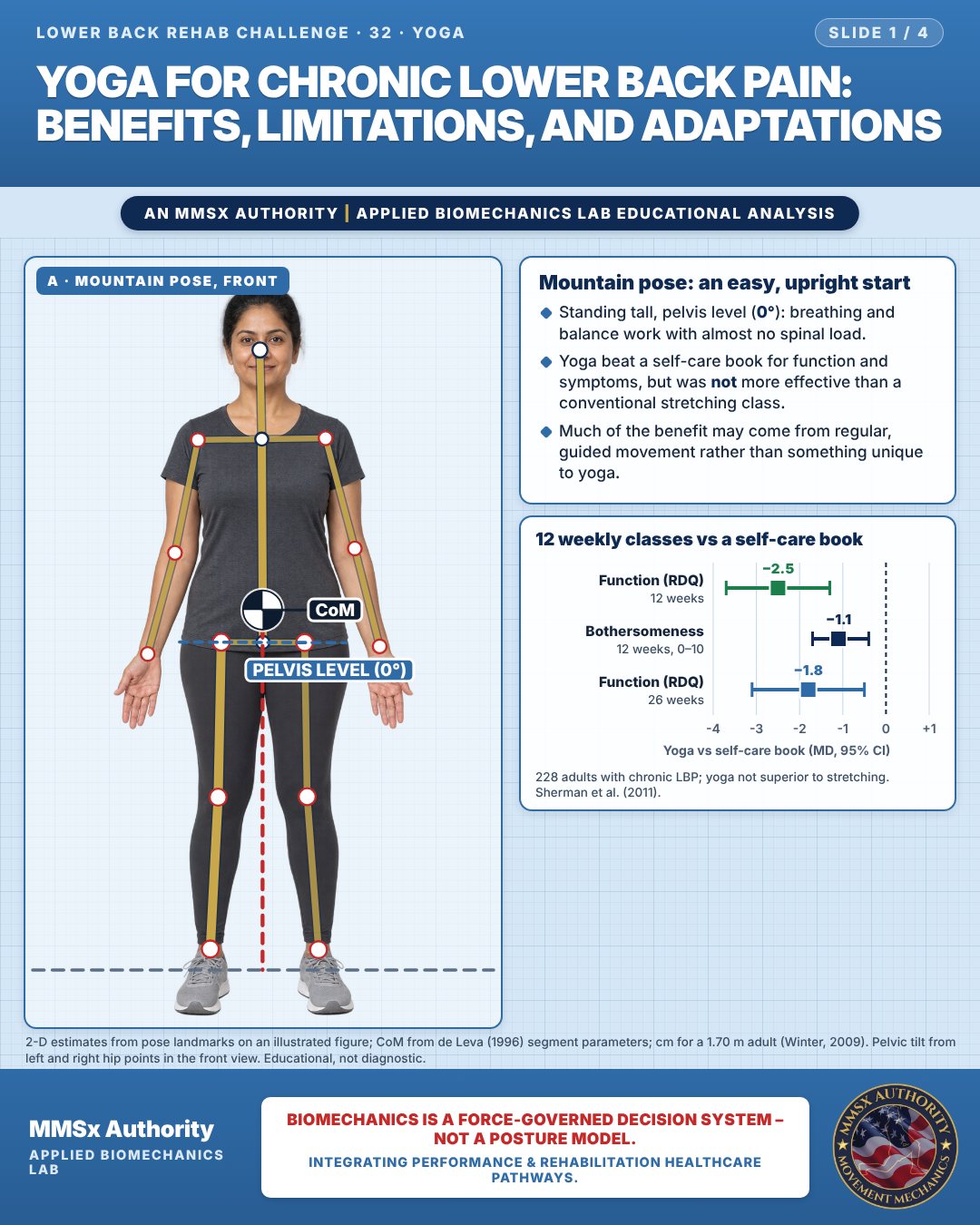
Mountain pose: an easy, upright start
Standing tall, pelvis level (0°): breathing and balance work with almost no spinal load.
Yoga beat a self-care book for function and symptoms, but was not more effective than a conventional stretching class.
Much of the benefit may come from regular, guided movement rather than something unique to yoga.
12 weekly classes vs a self-care book
Movement B: Chair-supported hinge (side view)
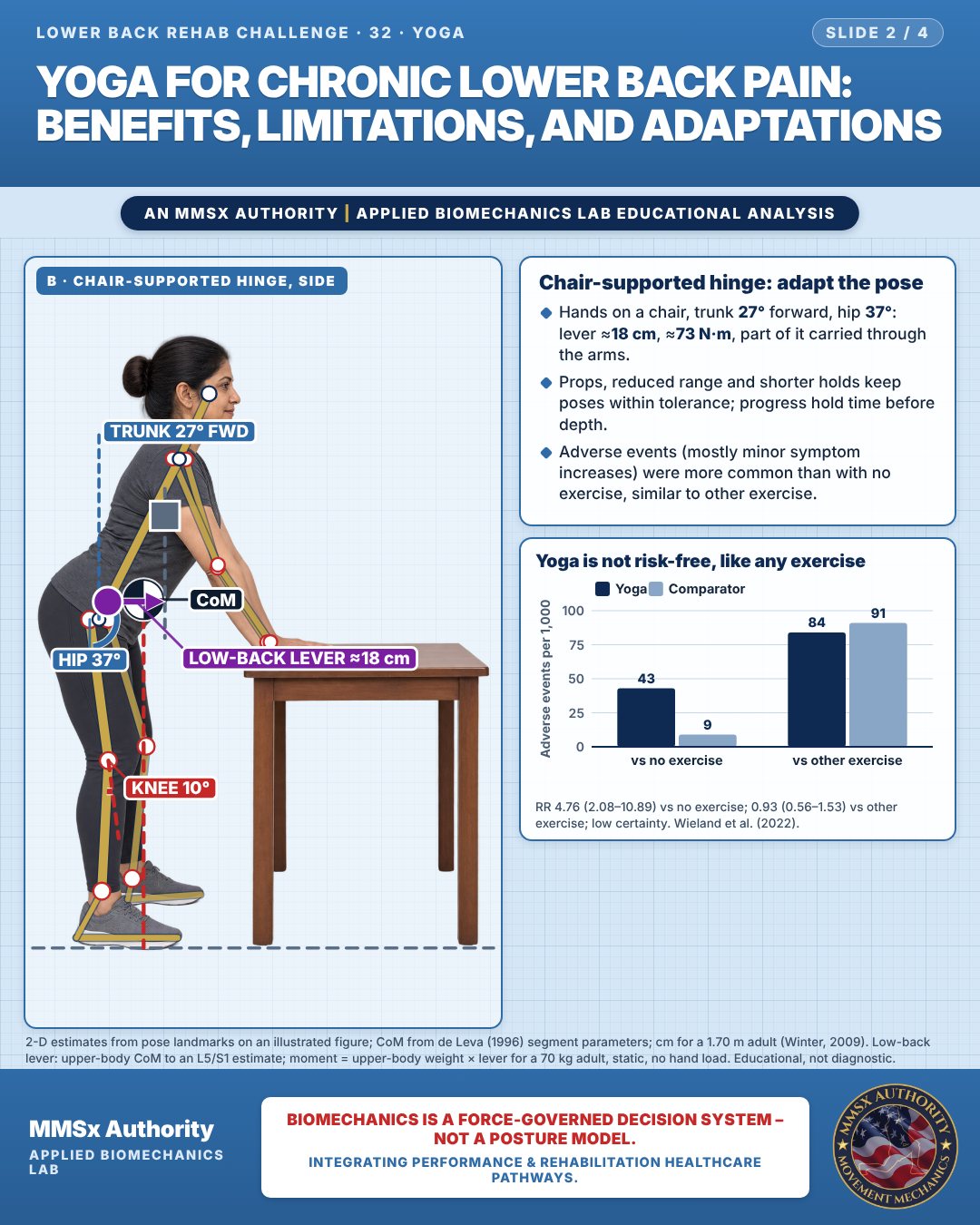
Chair-supported hinge: adapt the pose
Hands on a chair, trunk 27° forward, hip 37°: lever ≈18 cm, ≈73 N·m, part of it carried through the arms.
Props, reduced range and shorter holds keep poses within tolerance; progress hold time before depth.
Adverse events (mostly minor symptom increases) were more common than with no exercise, similar to other exercise.
Yoga is not risk-free, like any exercise
Movement C: Quadruped mobility (side view)
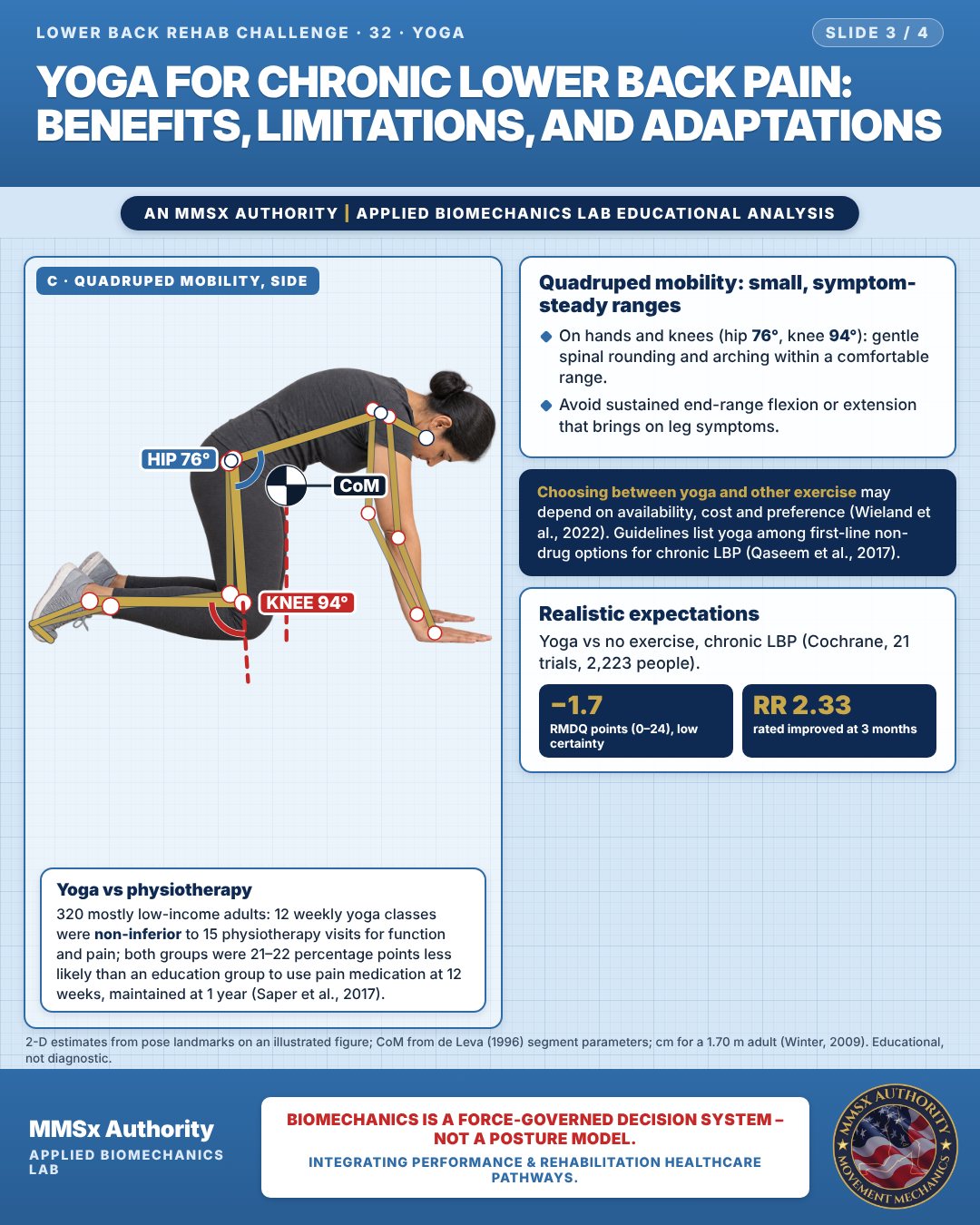
Yoga vs physiotherapy
320 mostly low-income adults: 12 weekly yoga classes were non-inferior to 15 physiotherapy visits for function and pain; both groups were 21–22 percentage points less likely than an education group to use pain medication at 12 weeks, maintained at 1 year (Saper et al., 2017).
Quadruped mobility: small, symptom-steady ranges
On hands and knees (hip 76°, knee 94°): gentle spinal rounding and arching within a comfortable range.
Avoid sustained end-range flexion or extension that brings on leg symptoms.
Realistic expectations
Yoga vs no exercise, chronic LBP (Cochrane, 21 trials, 2,223 people).
Decision pathway
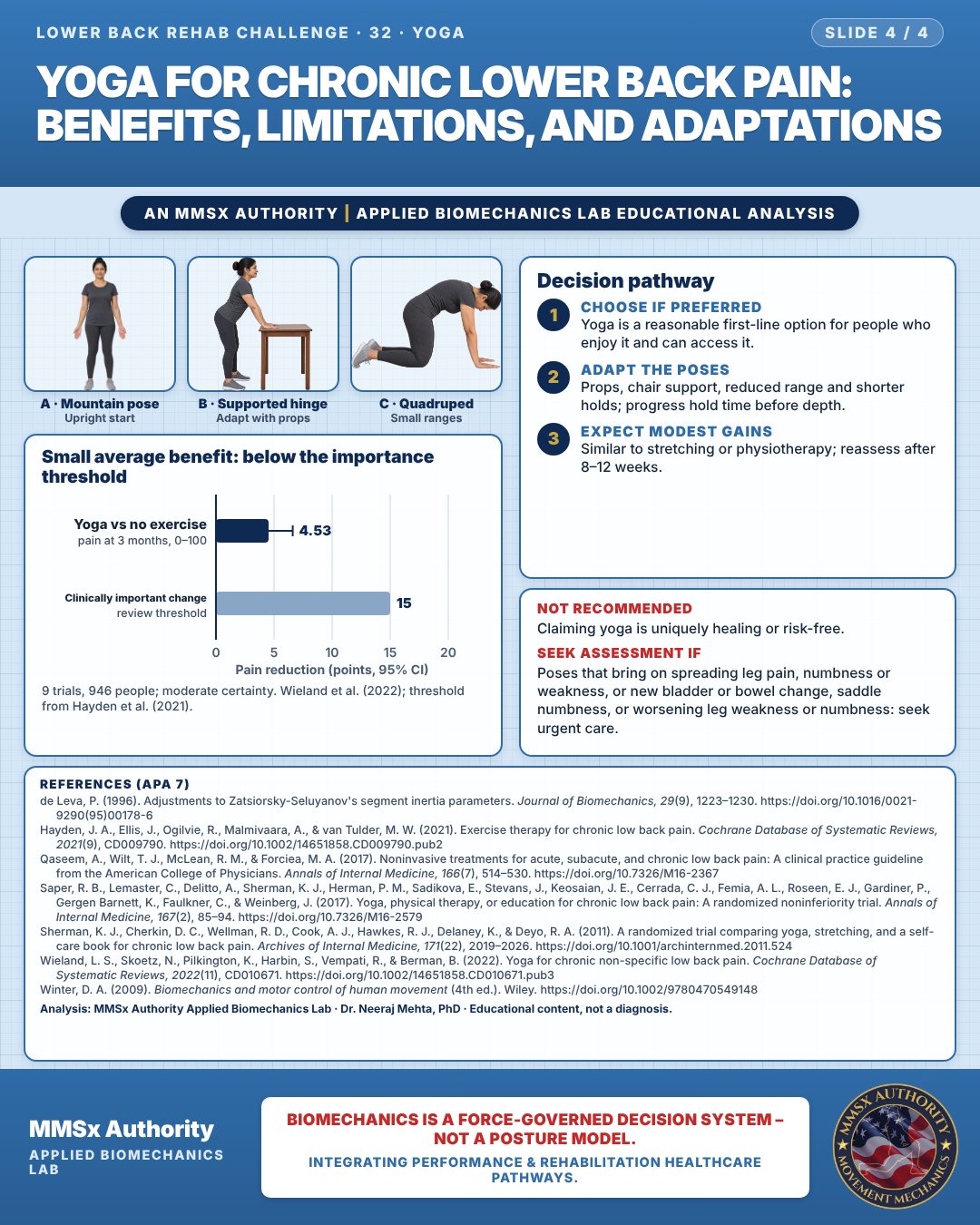
Small average benefit: below the importance threshold
Choose if preferred
Yoga is a reasonable first-line option for people who enjoy it and can access it.
Adapt the poses
Props, chair support, reduced range and shorter holds; progress hold time before depth.
Expect modest gains
Similar to stretching or physiotherapy; reassess after 8–12 weeks.
What the evidence supports
- Recommend: yoga is a reasonable first-line option for chronic LBP for those who prefer it (Qaseem et al., 2017); expect small average benefits similar to other exercise (Wieland et al., 2022; Sherman et al., 2011) and comparable to PT (Saper et al., 2017).
Cautions
Not recommended
Claiming yoga is uniquely healing or risk-free.
Seek assessment if
Poses that bring on spreading leg pain, numbness or weakness, or new bladder or bowel change, saddle numbness, or worsening leg weakness or numbness: seek urgent care.
Methods note
2-D estimates from pose landmarks on an illustrated figure; CoM from de Leva (1996) segment parameters; cm for a 1.70 m adult (Winter, 2009). Pelvic tilt from left and right hip points in the front view. Low-back lever: upper-body CoM to an L5/S1 estimate; moment = upper-body weight × lever for a 70 kg adult, static, no hand load. These are educational estimates, not a diagnosis.
References
- de Leva, P. (1996). Adjustments to Zatsiorsky-Seluyanov's segment inertia parameters. Journal of Biomechanics, 29(9), 1223–1230. https://doi.org/10.1016/0021-9290(95)00178-6
- Hayden, J. A., Ellis, J., Ogilvie, R., Malmivaara, A., & van Tulder, M. W. (2021). Exercise therapy for chronic low back pain. Cochrane Database of Systematic Reviews, 2021(9), CD009790. https://doi.org/10.1002/14651858.CD009790.pub2
- Qaseem, A., Wilt, T. J., McLean, R. M., & Forciea, M. A. (2017). Noninvasive treatments for acute, subacute, and chronic low back pain: A clinical practice guideline from the American College of Physicians. Annals of Internal Medicine, 166(7), 514–530. https://doi.org/10.7326/M16-2367
- Saper, R. B., Lemaster, C., Delitto, A., Sherman, K. J., Herman, P. M., Sadikova, E., Stevans, J., Keosaian, J. E., Cerrada, C. J., Femia, A. L., Roseen, E. J., Gardiner, P., Gergen Barnett, K., Faulkner, C., & Weinberg, J. (2017). Yoga, physical therapy, or education for chronic low back pain: A randomized noninferiority trial. Annals of Internal Medicine, 167(2), 85–94. https://doi.org/10.7326/M16-2579
- Sherman, K. J., Cherkin, D. C., Wellman, R. D., Cook, A. J., Hawkes, R. J., Delaney, K., & Deyo, R. A. (2011). A randomized trial comparing yoga, stretching, and a self-care book for chronic low back pain. Archives of Internal Medicine, 171(22), 2019–2026. https://doi.org/10.1001/archinternmed.2011.524
- Wieland, L. S., Skoetz, N., Pilkington, K., Harbin, S., Vempati, R., & Berman, B. (2022). Yoga for chronic non-specific low back pain. Cochrane Database of Systematic Reviews, 2022(11), CD010671. https://doi.org/10.1002/14651858.CD010671.pub3
- Winter, D. A. (2009). Biomechanics and motor control of human movement (4th ed.). Wiley. https://doi.org/10.1002/9780470549148
Cite this article
Mehta, N. (2026, October 23). Yoga for chronic lower back pain: benefits, limitations, and adaptations. MMSx Authority Applied Biomechanics Lab. https://mmsxauthority.org/edu/analysis/lower-back/32-yoga-for-chronic-lower-back-pain-benefits-limitations-and-adaptations/
Part of the collection
Mehta, N. (2026). Lower Back Rehabilitation: 50 Evidence-Based Biomechanics Analyses [Collection]. MMSx Authority Applied Biomechanics Lab. Zenodo. https://doi.org/10.5281/zenodo.23735778
All Lower Back Rehab Challenge articles · Rehabilitation Library