Lower Back Rehab Challenge · 31
Walking with lower back pain: how to find a manageable starting level
A walking programme for low back pain is a graded, usually self-managed aerobic activity in which daily walking time or steps start at a level that…
Key points
- Find the baseline. Walk for a time or step count that does not cause a lasting flare; start just below it.
- Check 24 hours. Settled by the next day? Keep or progress. Worse for longer? Step back one level.
- Progress one variable. Duration → frequency → pace or hills, in small steps each week.
What it is
A walking programme for low back pain is a graded, usually self-managed aerobic activity in which daily walking time or steps start at a level that does not provoke a lasting increase in symptoms and is progressed in small steps according to the response over the following 24 hours.
How we analysed the movement
Three movements relevant to this topic were analysed from illustrated reference figures. Joint centres were located with two-dimensional pose estimation; joint angles, the whole-body centre of mass and, where relevant, the low-back lever (the horizontal distance from the upper-body centre of mass to the L5/S1 joint) were then calculated from standard segment parameters. The figures are educational estimates that show how position changes mechanical demand; they are not measurements of a patient. Every research value quoted below comes from the published source cited beside it.
Movement A: Easy walk (side view)
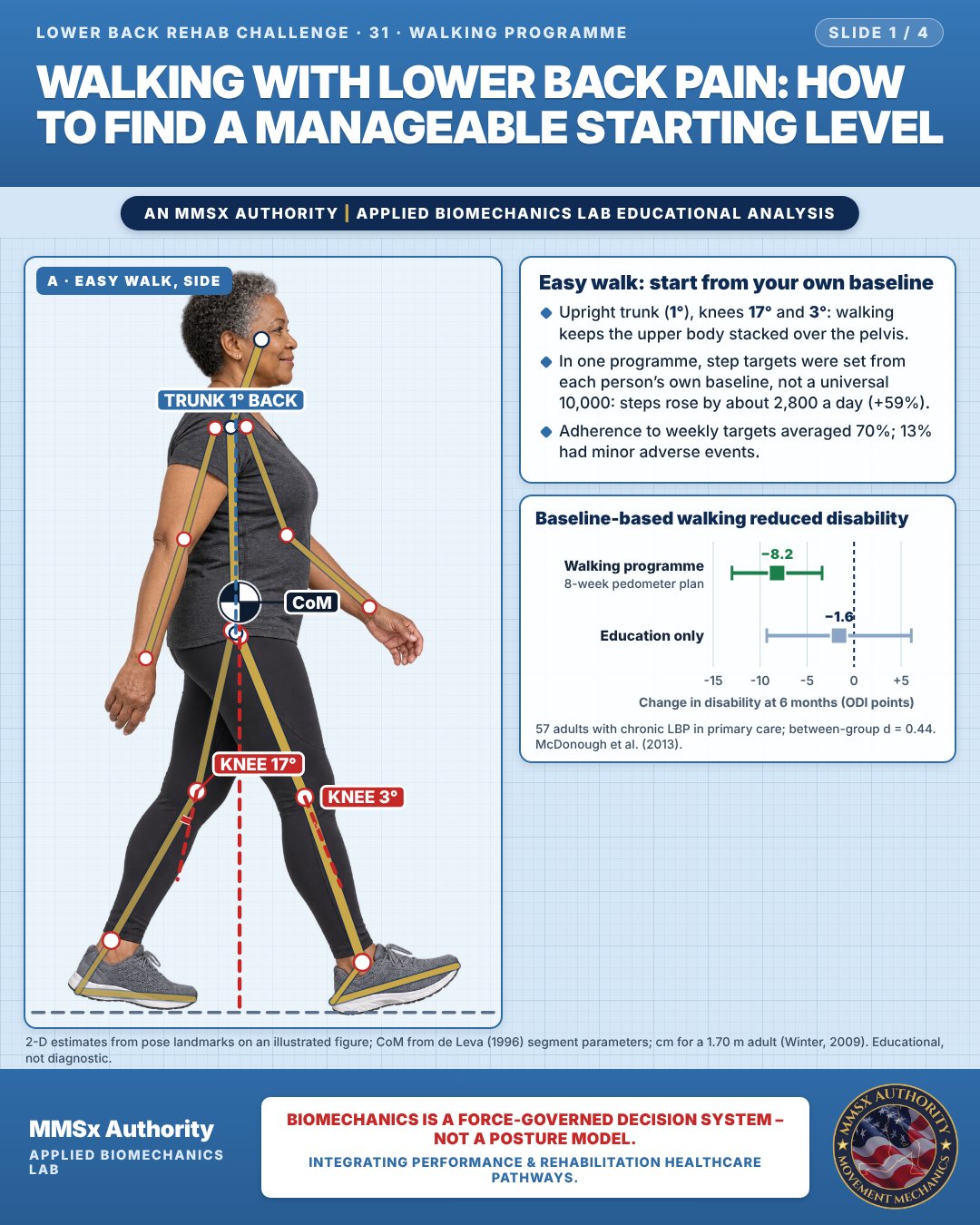
Easy walk: start from your own baseline
Upright trunk (1°), knees 17° and 3°: walking keeps the upper body stacked over the pelvis.
In one programme, step targets were set from each person’s own baseline, not a universal 10,000: steps rose by about 2,800 a day (+59%).
Adherence to weekly targets averaged 70%; 13% had minor adverse events.
Baseline-based walking reduced disability
Movement B: Rest break (front view)
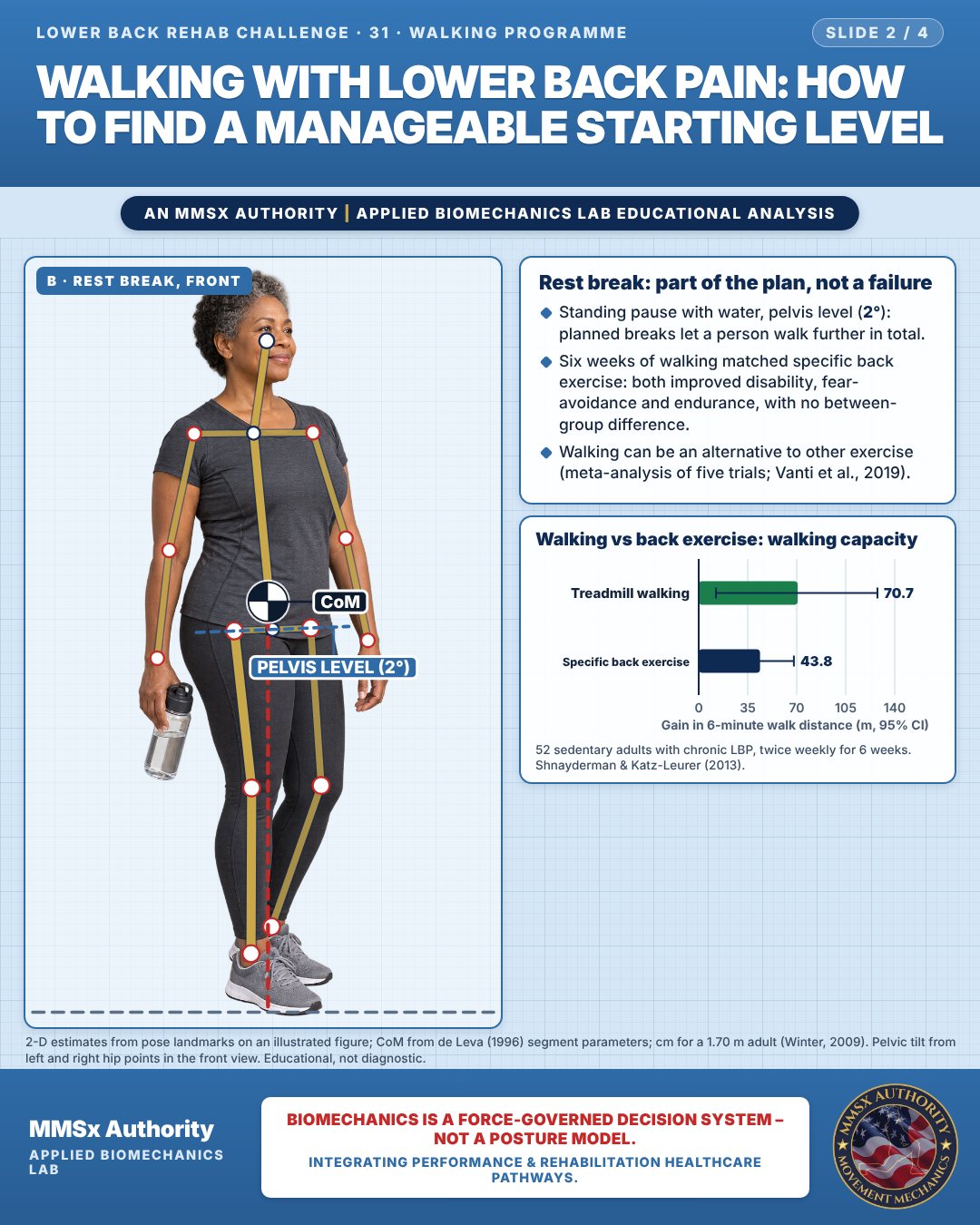
Rest break: part of the plan, not a failure
Standing pause with water, pelvis level (2°): planned breaks let a person walk further in total.
Six weeks of walking matched specific back exercise: both improved disability, fear-avoidance and endurance, with no between-group difference.
Walking can be an alternative to other exercise (meta-analysis of five trials; Vanti et al., 2019).
Walking vs back exercise: walking capacity
Movement C: Brisk walk
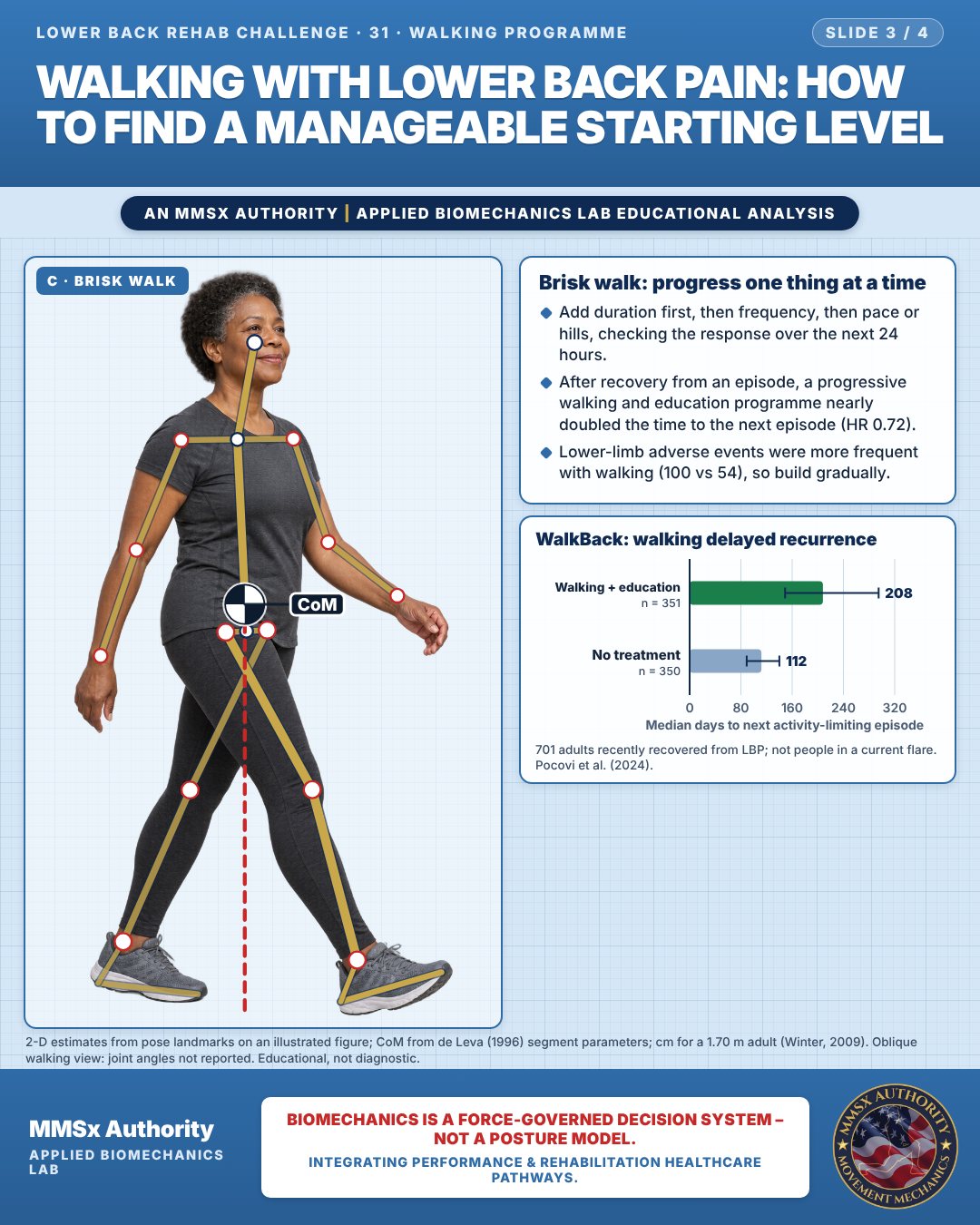
Brisk walk: progress one thing at a time
Add duration first, then frequency, then pace or hills, checking the response over the next 24 hours.
After recovery from an episode, a progressive walking and education programme nearly doubled the time to the next episode (HR 0.72).
Lower-limb adverse events were more frequent with walking (100 vs 54), so build gradually.
WalkBack: walking delayed recurrence
Decision pathway
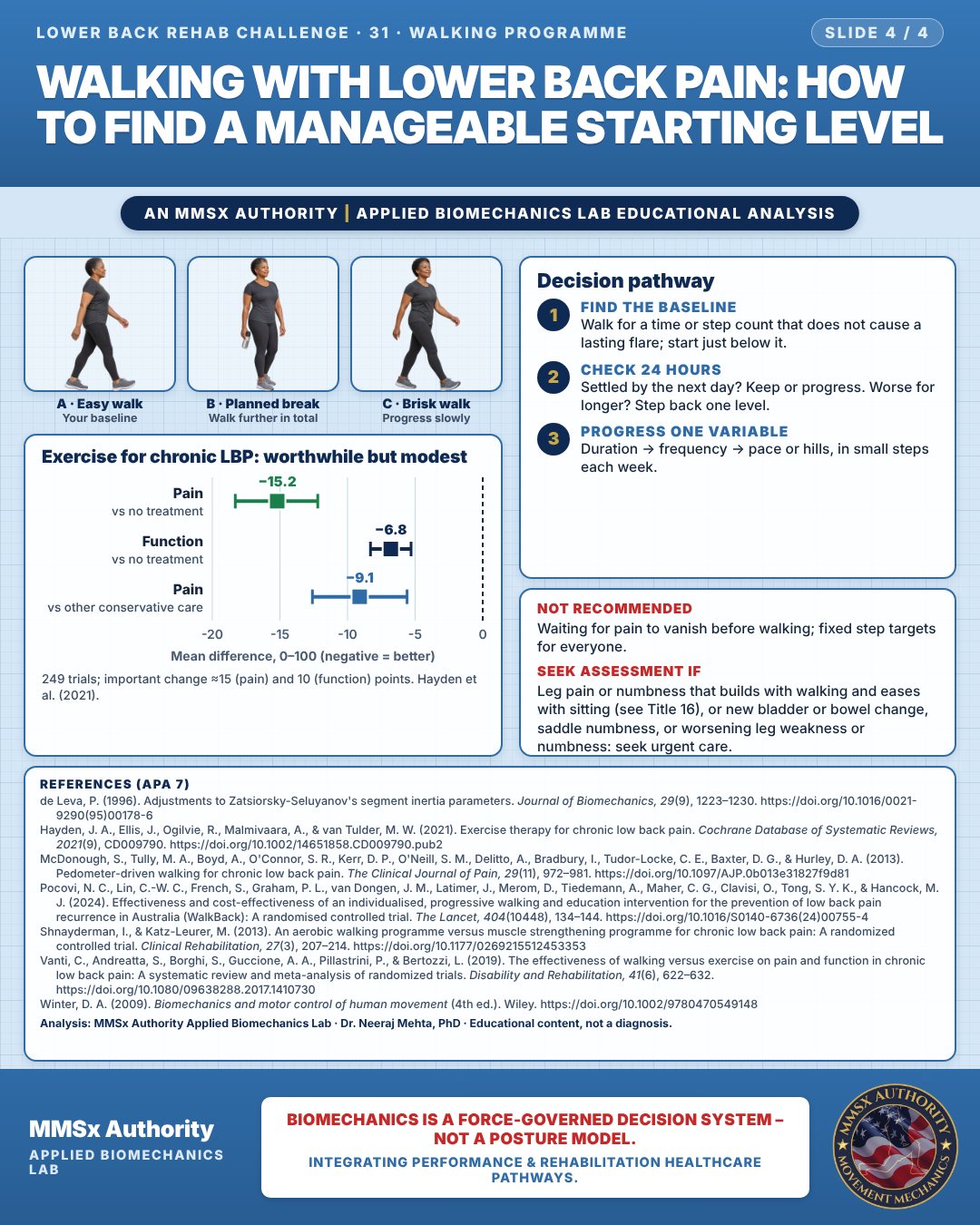
Exercise for chronic LBP: worthwhile but modest
Find the baseline
Walk for a time or step count that does not cause a lasting flare; start just below it.
Check 24 hours
Settled by the next day? Keep or progress. Worse for longer? Step back one level.
Progress one variable
Duration → frequency → pace or hills, in small steps each week.
Cautions
Not recommended
Waiting for pain to vanish before walking; fixed step targets for everyone.
Seek assessment if
Leg pain or numbness that builds with walking and eases with sitting (see Title 16), or new bladder or bowel change, saddle numbness, or worsening leg weakness or numbness: seek urgent care.
Methods note
2-D estimates from pose landmarks on an illustrated figure; CoM from de Leva (1996) segment parameters; cm for a 1.70 m adult (Winter, 2009). Pelvic tilt from left and right hip points in the front view. Oblique walking view: joint angles not reported. These are educational estimates, not a diagnosis.
References
- de Leva, P. (1996). Adjustments to Zatsiorsky-Seluyanov's segment inertia parameters. Journal of Biomechanics, 29(9), 1223–1230. https://doi.org/10.1016/0021-9290(95)00178-6
- Hayden, J. A., Ellis, J., Ogilvie, R., Malmivaara, A., & van Tulder, M. W. (2021). Exercise therapy for chronic low back pain. Cochrane Database of Systematic Reviews, 2021(9), CD009790. https://doi.org/10.1002/14651858.CD009790.pub2
- McDonough, S., Tully, M. A., Boyd, A., O'Connor, S. R., Kerr, D. P., O'Neill, S. M., Delitto, A., Bradbury, I., Tudor-Locke, C. E., Baxter, D. G., & Hurley, D. A. (2013). Pedometer-driven walking for chronic low back pain. The Clinical Journal of Pain, 29(11), 972–981. https://doi.org/10.1097/AJP.0b013e31827f9d81
- Pocovi, N. C., Lin, C.-W. C., French, S., Graham, P. L., van Dongen, J. M., Latimer, J., Merom, D., Tiedemann, A., Maher, C. G., Clavisi, O., Tong, S. Y. K., & Hancock, M. J. (2024). Effectiveness and cost-effectiveness of an individualised, progressive walking and education intervention for the prevention of low back pain recurrence in Australia (WalkBack): A randomised controlled trial. The Lancet, 404(10448), 134–144. https://doi.org/10.1016/S0140-6736(24)00755-4
- Shnayderman, I., & Katz-Leurer, M. (2013). An aerobic walking programme versus muscle strengthening programme for chronic low back pain: A randomized controlled trial. Clinical Rehabilitation, 27(3), 207–214. https://doi.org/10.1177/0269215512453353
- Vanti, C., Andreatta, S., Borghi, S., Guccione, A. A., Pillastrini, P., & Bertozzi, L. (2019). The effectiveness of walking versus exercise on pain and function in chronic low back pain: A systematic review and meta-analysis of randomized trials. Disability and Rehabilitation, 41(6), 622–632. https://doi.org/10.1080/09638288.2017.1410730
- Winter, D. A. (2009). Biomechanics and motor control of human movement (4th ed.). Wiley. https://doi.org/10.1002/9780470549148
Cite this article
Mehta, N. (2026, October 23). Walking with lower back pain: how to find a manageable starting level. MMSx Authority Applied Biomechanics Lab. https://mmsxauthority.org/edu/analysis/lower-back/31-walking-with-lower-back-pain-how-to-find-a-manageable-starting-level/
Part of the collection
Mehta, N. (2026). Lower Back Rehabilitation: 50 Evidence-Based Biomechanics Analyses [Collection]. MMSx Authority Applied Biomechanics Lab. Zenodo. https://doi.org/10.5281/zenodo.23735778
All Lower Back Rehab Challenge articles · Rehabilitation Library