Lower Back Rehab Challenge · 30
Massage, manipulation, and exercise for back pain: how do they fit together?
Spinal manipulative therapy (SMT) includes high-velocity thrust manipulation and lower-velocity mobilisation of spinal joints.
Key points
- Active first. Exercise and staying active form the plan for chronic LBP.
- Add if it helps. Massage or manipulation as a short-term adjunct that makes movement easier.
- Review and taper. Move from passive to active care; avoid long courses of passive treatment alone.
What it is
Spinal manipulative therapy (SMT) includes high-velocity thrust manipulation and lower-velocity mobilisation of spinal joints; massage is soft-tissue manipulation by hand; exercise therapy is a planned programme of physical activity. Guidelines position manual therapies as optional adjuncts, mainly for short-term relief, alongside active care and advice to stay active.
How we analysed the movement
Three movements relevant to this topic were analysed from illustrated reference figures. Joint centres were located with two-dimensional pose estimation; joint angles, the whole-body centre of mass and, where relevant, the low-back lever (the horizontal distance from the upper-body centre of mass to the L5/S1 joint) were then calculated from standard segment parameters. The figures are educational estimates that show how position changes mechanical demand; they are not measurements of a patient. Every research value quoted below comes from the published source cited beside it.
Movement A: Self-massage
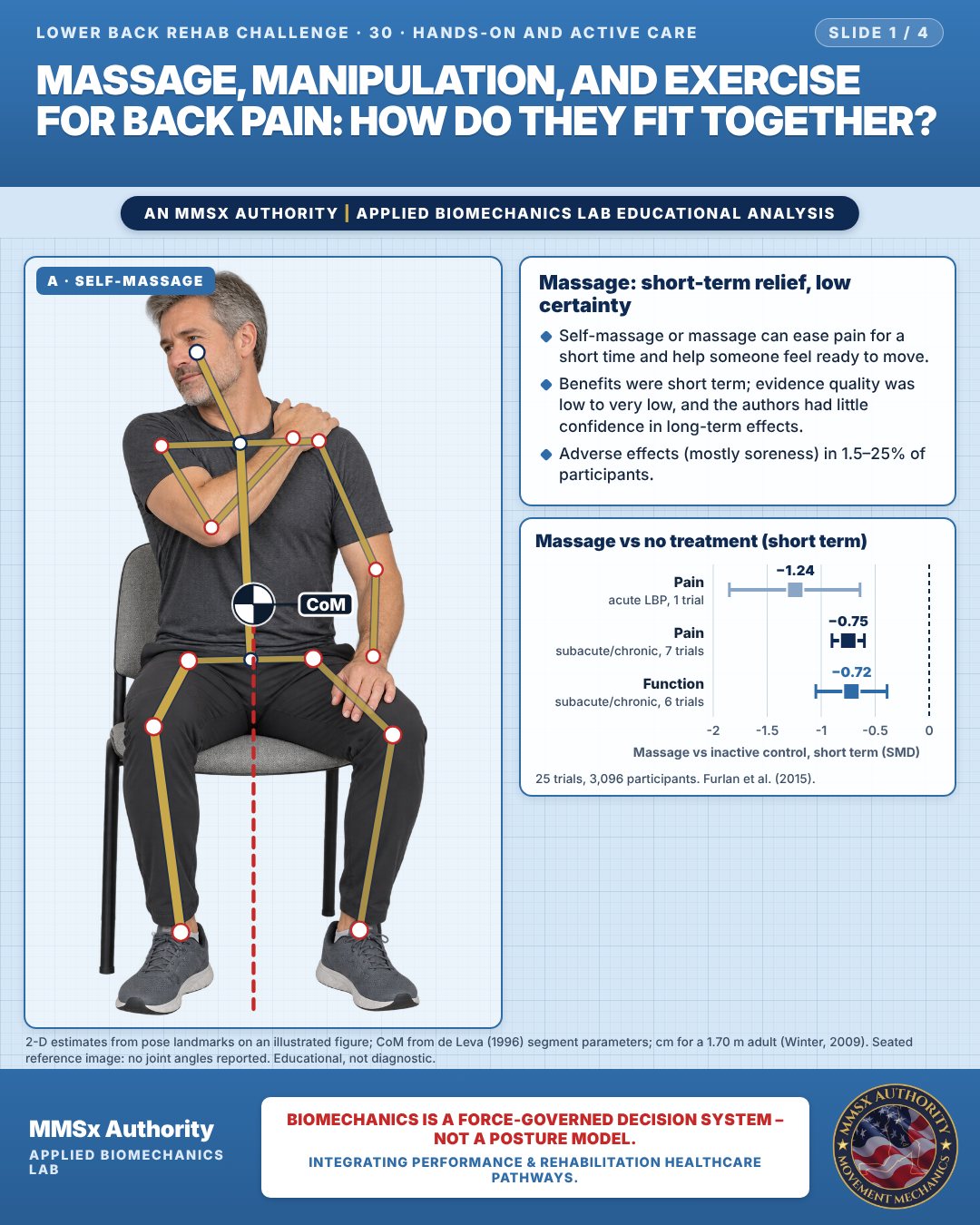
Massage: short-term relief, low certainty
Self-massage or massage can ease pain for a short time and help someone feel ready to move.
Benefits were short term; evidence quality was low to very low, and the authors had little confidence in long-term effects.
Adverse effects (mostly soreness) in 1.5–25% of participants.
Massage vs no treatment (short term)
Movement B: Active rehab (side view)
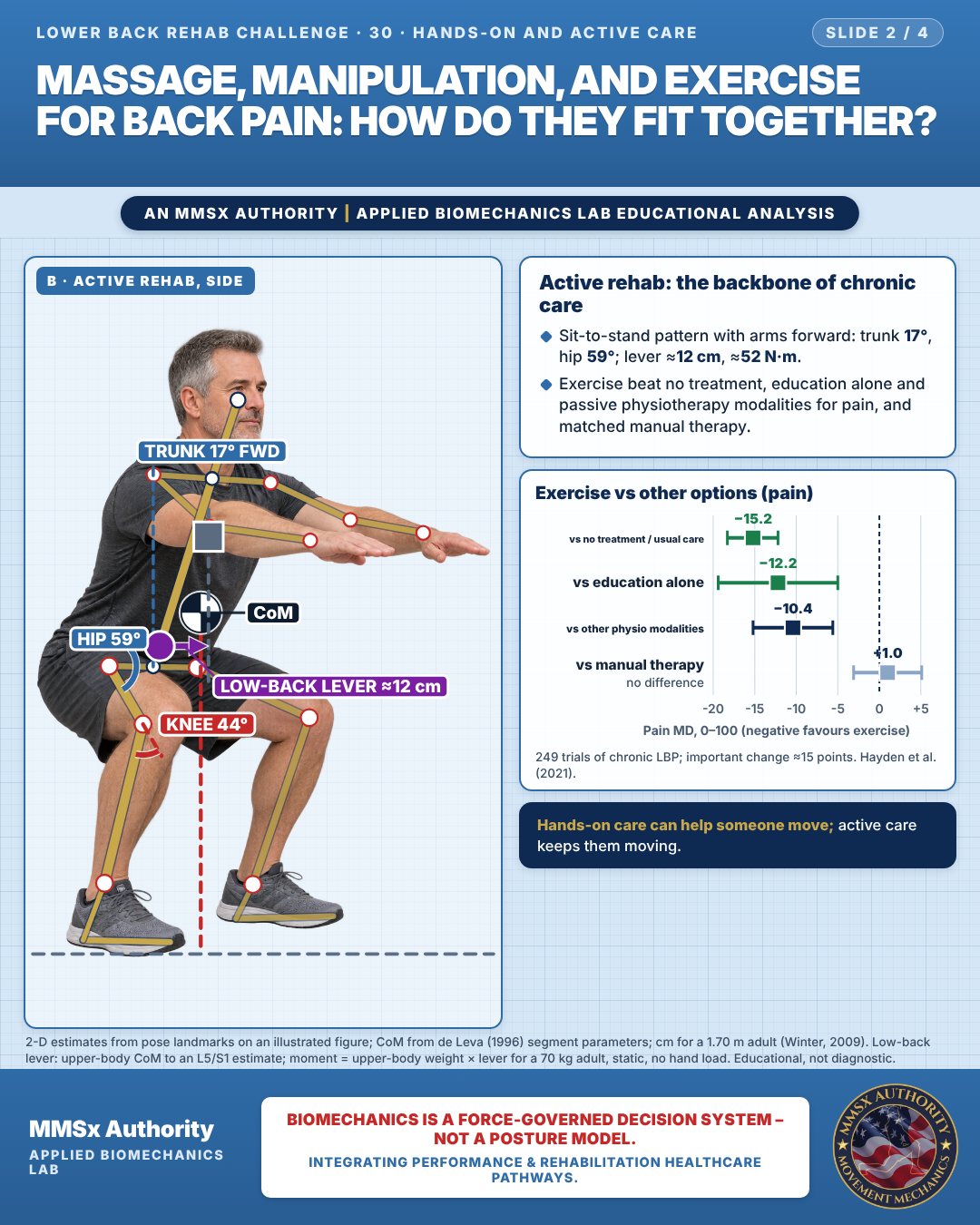
Active rehab: the backbone of chronic care
Sit-to-stand pattern with arms forward: trunk 17°, hip 59°; lever ≈12 cm, ≈52 N·m.
Exercise beat no treatment, education alone and passive physiotherapy modalities for pain, and matched manual therapy.
Exercise vs other options (pain)
Movement C: Shared decision
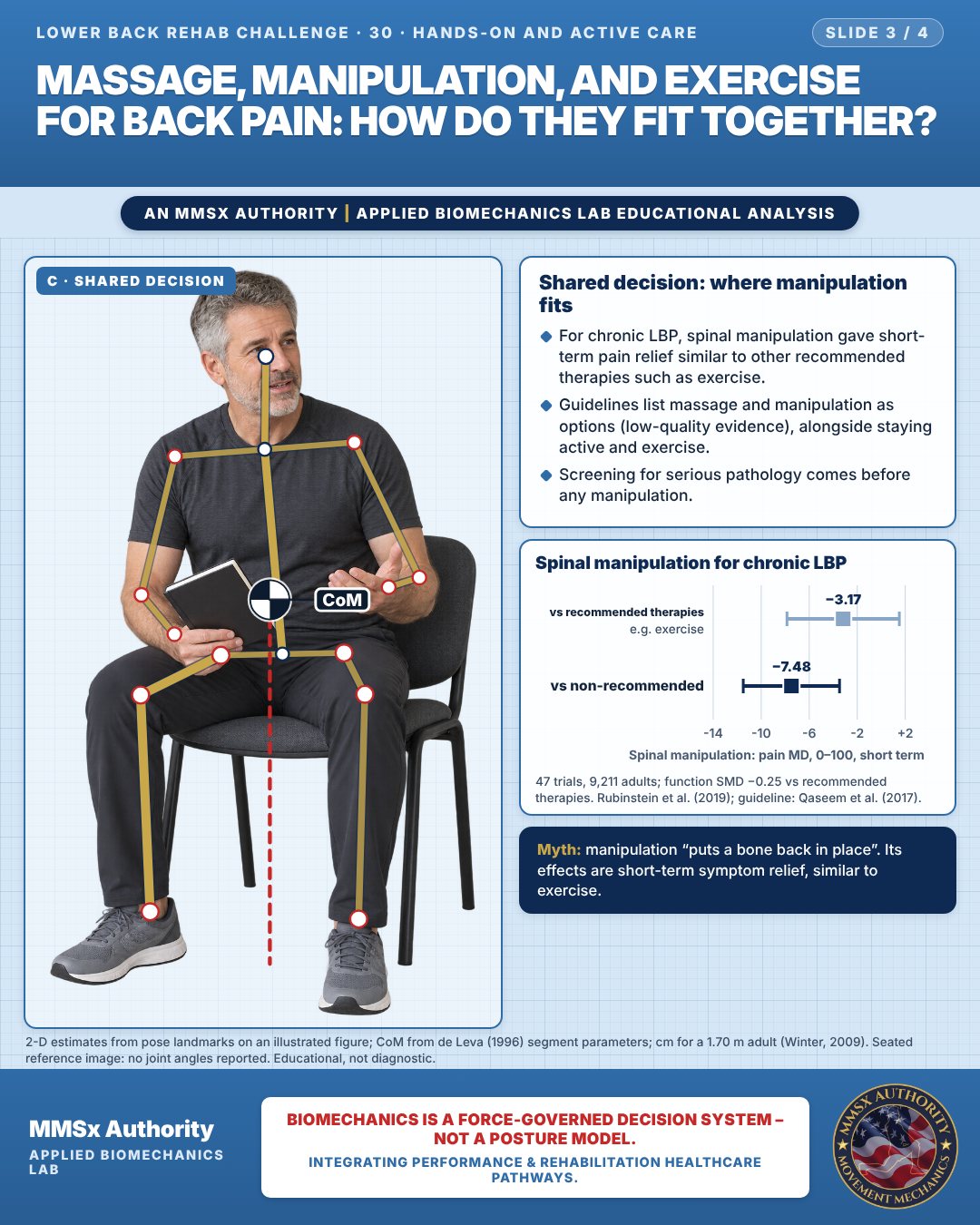
Shared decision: where manipulation fits
For chronic LBP, spinal manipulation gave short-term pain relief similar to other recommended therapies such as exercise.
Guidelines list massage and manipulation as options (low-quality evidence), alongside staying active and exercise.
Screening for serious pathology comes before any manipulation.
Spinal manipulation for chronic LBP
Decision pathway
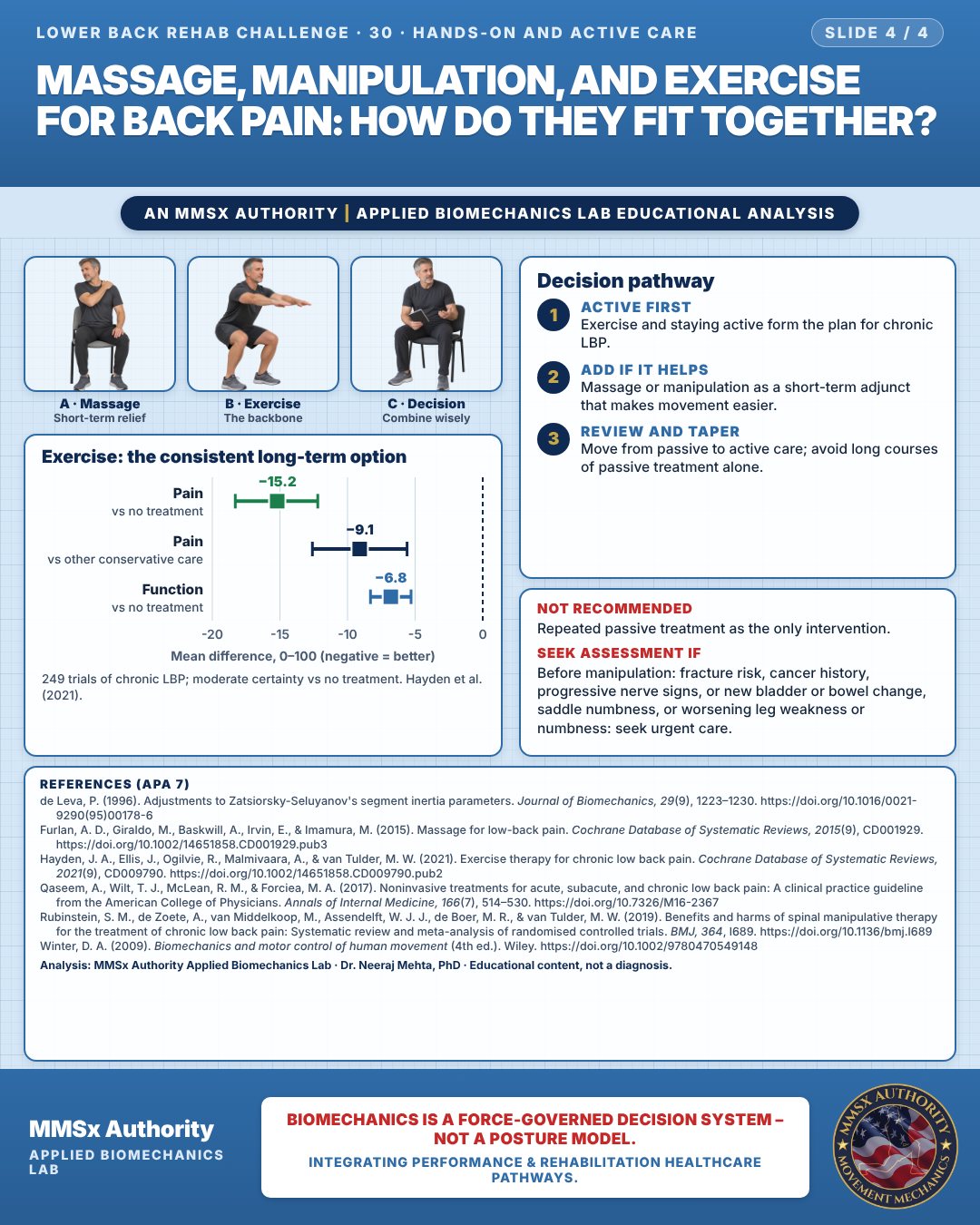
Exercise: the consistent long-term option
Active first
Exercise and staying active form the plan for chronic LBP.
Add if it helps
Massage or manipulation as a short-term adjunct that makes movement easier.
Review and taper
Move from passive to active care; avoid long courses of passive treatment alone.
What the evidence supports
- Use manual therapy, if chosen, as a short-term adjunct to support engagement in exercise and normal activity, not as a stand-alone long-term plan (Qaseem et al., 2017; Rubinstein et al., 2019; Furlan et al., 2015).
- Exercise is the backbone of chronic LBP care; it performs similarly to manual therapy for pain and better than education alone or passive modalities (Hayden et al., 2021).
Myth and evidence
Myth“Hands-on treatment fixes the problem; exercise is optional.”
EvidenceSMT is similar to other recommended therapies for short-term pain (Rubinstein et al., 2019); massage evidence is low certainty and mainly short term (Furlan et al., 2015); exercise outperforms minimal care and matches manual therapy for pain (Hayden et al., 2021). Hands-on care can help someone move; active care keeps them moving.
Cautions
Not recommended
Repeated passive treatment as the only intervention.
Seek assessment if
Before manipulation: fracture risk, cancer history, progressive nerve signs, or new bladder or bowel change, saddle numbness, or worsening leg weakness or numbness: seek urgent care.
Methods note
2-D estimates from pose landmarks on an illustrated figure; CoM from de Leva (1996) segment parameters; cm for a 1.70 m adult (Winter, 2009). Seated reference image: no joint angles reported. Low-back lever: upper-body CoM to an L5/S1 estimate; moment = upper-body weight × lever for a 70 kg adult, static, no hand load. These are educational estimates, not a diagnosis.
References
- de Leva, P. (1996). Adjustments to Zatsiorsky-Seluyanov's segment inertia parameters. Journal of Biomechanics, 29(9), 1223–1230. https://doi.org/10.1016/0021-9290(95)00178-6
- Furlan, A. D., Giraldo, M., Baskwill, A., Irvin, E., & Imamura, M. (2015). Massage for low-back pain. Cochrane Database of Systematic Reviews, 2015(9), CD001929. https://doi.org/10.1002/14651858.CD001929.pub3
- Hayden, J. A., Ellis, J., Ogilvie, R., Malmivaara, A., & van Tulder, M. W. (2021). Exercise therapy for chronic low back pain. Cochrane Database of Systematic Reviews, 2021(9), CD009790. https://doi.org/10.1002/14651858.CD009790.pub2
- Qaseem, A., Wilt, T. J., McLean, R. M., & Forciea, M. A. (2017). Noninvasive treatments for acute, subacute, and chronic low back pain: A clinical practice guideline from the American College of Physicians. Annals of Internal Medicine, 166(7), 514–530. https://doi.org/10.7326/M16-2367
- Rubinstein, S. M., de Zoete, A., van Middelkoop, M., Assendelft, W. J. J., de Boer, M. R., & van Tulder, M. W. (2019). Benefits and harms of spinal manipulative therapy for the treatment of chronic low back pain: Systematic review and meta-analysis of randomised controlled trials. BMJ, 364, l689. https://doi.org/10.1136/bmj.l689
- Winter, D. A. (2009). Biomechanics and motor control of human movement (4th ed.). Wiley. https://doi.org/10.1002/9780470549148
Cite this article
Mehta, N. (2026, October 23). Massage, manipulation, and exercise for back pain: how do they fit together? MMSx Authority Applied Biomechanics Lab. https://mmsxauthority.org/edu/analysis/lower-back/30-massage-manipulation-and-exercise-for-back-pain-how-do-they-fit/
Part of the collection
Mehta, N. (2026). Lower Back Rehabilitation: 50 Evidence-Based Biomechanics Analyses [Collection]. MMSx Authority Applied Biomechanics Lab. Zenodo. https://doi.org/10.5281/zenodo.23735778
All Lower Back Rehab Challenge articles · Rehabilitation Library