Lower Back Rehab Challenge · 29
Stretching or strengthening for lower back pain: what is your goal?
Stretching (flexibility) exercise aims to increase range of motion or comfort at end range.
Key points
- Name the goal. Comfort and range → mobility work; function and capacity → strength; mood → aerobic or resistance.
- Combine if useful. Most programmes mix modes; neither stretching nor strengthening is universally superior.
- Keep what lasts. The mode a person enjoys and keeps doing usually wins in the long run.
What it is
Stretching (flexibility) exercise aims to increase range of motion or comfort at end range; strengthening (resistance) exercise aims to increase force capacity; endurance training aims to sustain effort; functional training rehearses meaningful tasks. In chronic LBP these are tools matched to a person's goals and preferences — not competing cures.
How we analysed the movement
Three movements relevant to this topic were analysed from illustrated reference figures. Joint centres were located with two-dimensional pose estimation; joint angles, the whole-body centre of mass and, where relevant, the low-back lever (the horizontal distance from the upper-body centre of mass to the L5/S1 joint) were then calculated from standard segment parameters. The figures are educational estimates that show how position changes mechanical demand; they are not measurements of a patient. Every research value quoted below comes from the published source cited beside it.
Movement A: Gentle mobility, seated
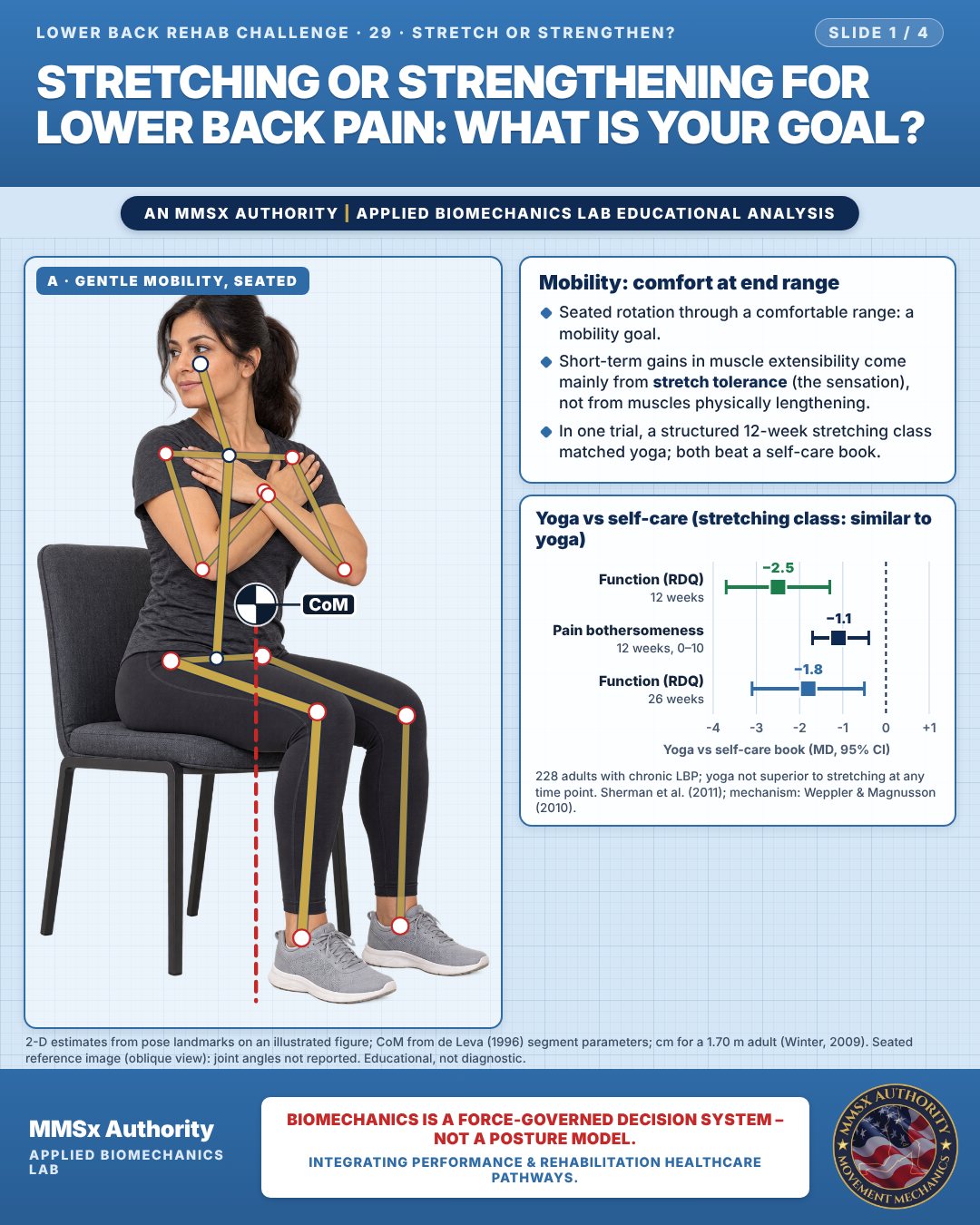
Mobility: comfort at end range
Seated rotation through a comfortable range: a mobility goal.
Short-term gains in muscle extensibility come mainly from stretch tolerance (the sensation), not from muscles physically lengthening.
In one trial, a structured 12-week stretching class matched yoga; both beat a self-care book.
Yoga vs self-care (stretching class: similar to yoga)
Movement B: Chair rise (side view)
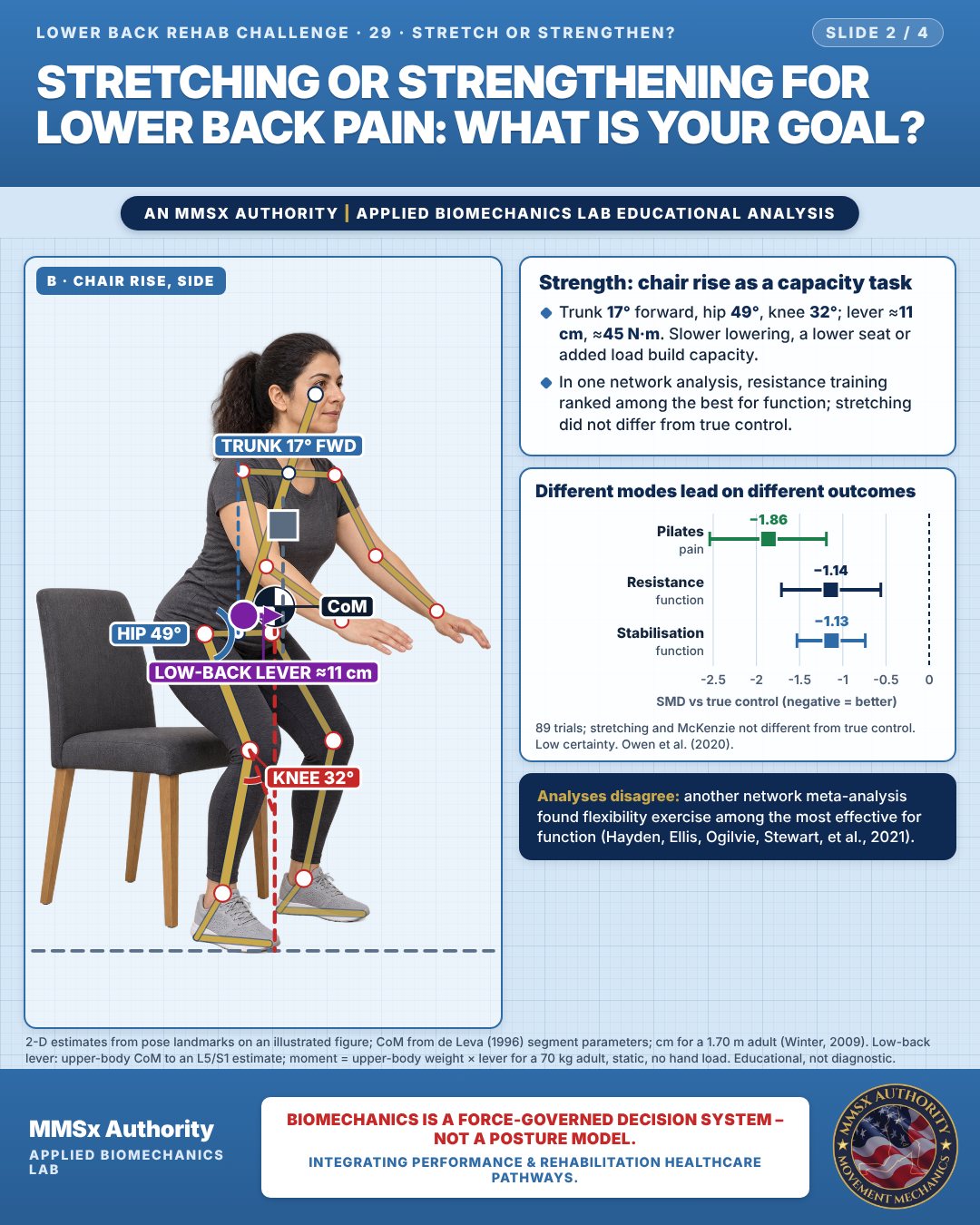
Strength: chair rise as a capacity task
Trunk 17° forward, hip 49°, knee 32°; lever ≈11 cm, ≈45 N·m. Slower lowering, a lower seat or added load build capacity.
In one network analysis, resistance training ranked among the best for function; stretching did not differ from true control.
Different modes lead on different outcomes
Movement C: Light resistance (front view)
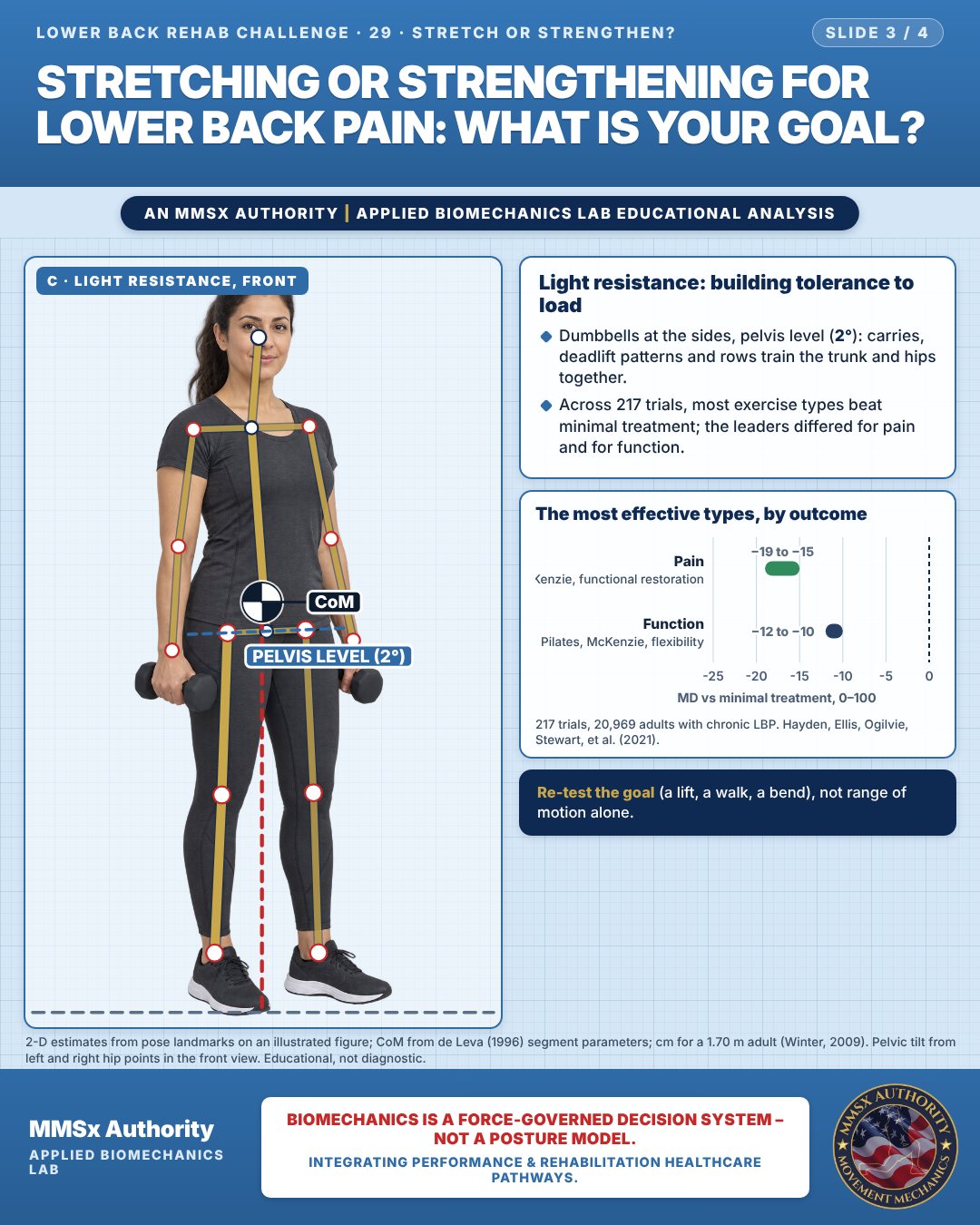
Light resistance: building tolerance to load
Dumbbells at the sides, pelvis level (2°): carries, deadlift patterns and rows train the trunk and hips together.
Across 217 trials, most exercise types beat minimal treatment; the leaders differed for pain and for function.
The most effective types, by outcome
Decision pathway
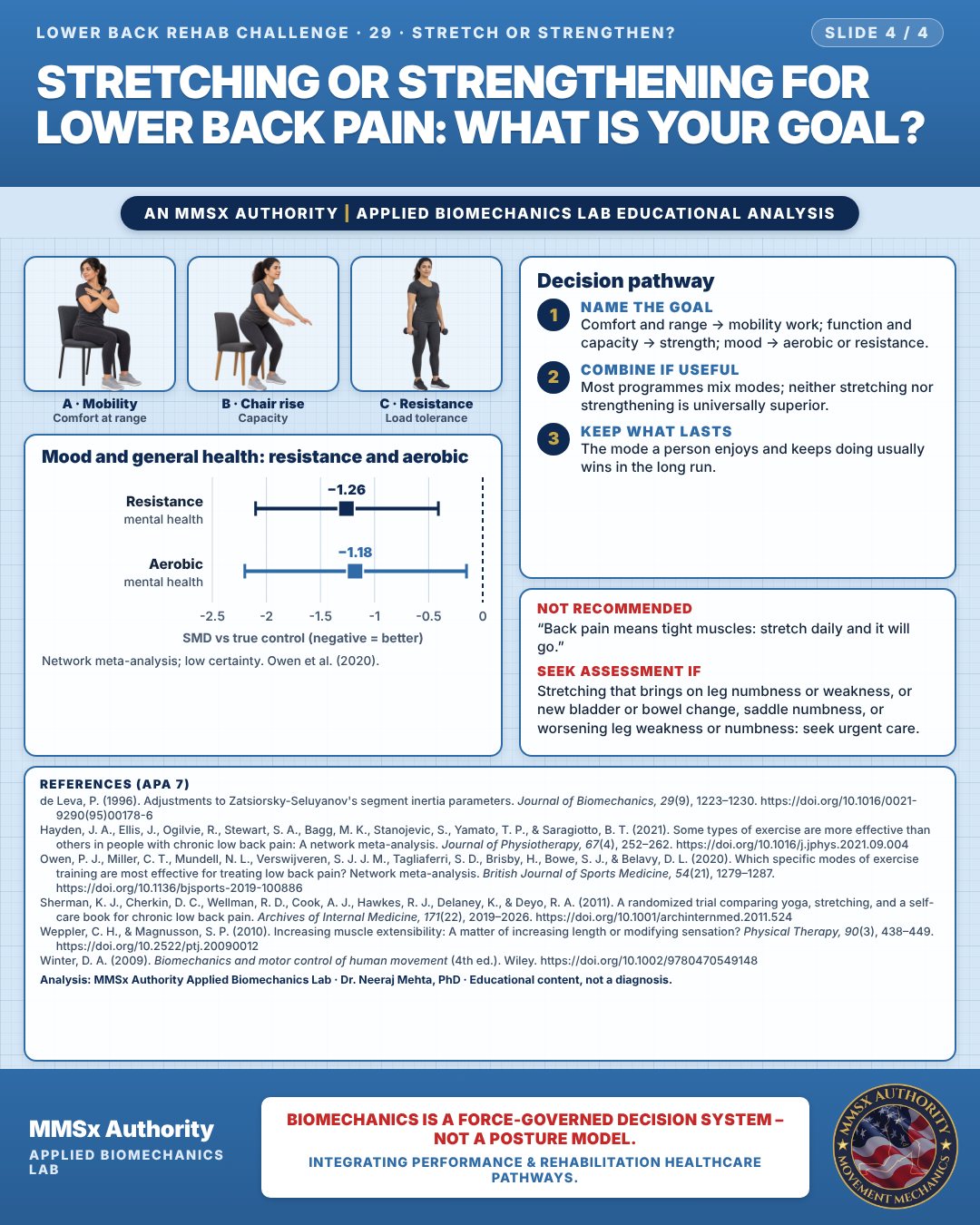
Mood and general health: resistance and aerobic
Name the goal
Comfort and range → mobility work; function and capacity → strength; mood → aerobic or resistance.
Combine if useful
Most programmes mix modes; neither stretching nor strengthening is universally superior.
Keep what lasts
The mode a person enjoys and keeps doing usually wins in the long run.
What the evidence supports
- Not recommended: framing stretching as "lengthening tight muscles that cause back pain" — short-term gains are mainly sensory (Weppler & Magnusson, 2010).
Myth and evidence
Myth“Back pain means tight muscles — stretch daily and it will go.”
EvidenceStretching mainly changes stretch tolerance in the short term (Weppler & Magnusson, 2010); one network meta-analysis found stretching no better than true control (Owen et al., 2020), while another found flexibility exercise useful for function (Hayden et al., 2021). Neither stretching nor strengthening is universally superior — the goal decides.
Cautions
Not recommended
“Back pain means tight muscles: stretch daily and it will go.”
Seek assessment if
Stretching that brings on leg numbness or weakness, or new bladder or bowel change, saddle numbness, or worsening leg weakness or numbness: seek urgent care.
Methods note
2-D estimates from pose landmarks on an illustrated figure; CoM from de Leva (1996) segment parameters; cm for a 1.70 m adult (Winter, 2009). Seated reference image (oblique view): joint angles not reported. Low-back lever: upper-body CoM to an L5/S1 estimate; moment = upper-body weight × lever for a 70 kg adult, static, no hand load. Pelvic tilt from left and right hip points in the front view. These are educational estimates, not a diagnosis.
References
- de Leva, P. (1996). Adjustments to Zatsiorsky-Seluyanov's segment inertia parameters. Journal of Biomechanics, 29(9), 1223–1230. https://doi.org/10.1016/0021-9290(95)00178-6
- Hayden, J. A., Ellis, J., Ogilvie, R., Stewart, S. A., Bagg, M. K., Stanojevic, S., Yamato, T. P., & Saragiotto, B. T. (2021). Some types of exercise are more effective than others in people with chronic low back pain: A network meta-analysis. Journal of Physiotherapy, 67(4), 252–262. https://doi.org/10.1016/j.jphys.2021.09.004
- Owen, P. J., Miller, C. T., Mundell, N. L., Verswijveren, S. J. J. M., Tagliaferri, S. D., Brisby, H., Bowe, S. J., & Belavy, D. L. (2020). Which specific modes of exercise training are most effective for treating low back pain? Network meta-analysis. British Journal of Sports Medicine, 54(21), 1279–1287. https://doi.org/10.1136/bjsports-2019-100886
- Sherman, K. J., Cherkin, D. C., Wellman, R. D., Cook, A. J., Hawkes, R. J., Delaney, K., & Deyo, R. A. (2011). A randomized trial comparing yoga, stretching, and a self-care book for chronic low back pain. Archives of Internal Medicine, 171(22), 2019–2026. https://doi.org/10.1001/archinternmed.2011.524
- Weppler, C. H., & Magnusson, S. P. (2010). Increasing muscle extensibility: A matter of increasing length or modifying sensation? Physical Therapy, 90(3), 438–449. https://doi.org/10.2522/ptj.20090012
- Winter, D. A. (2009). Biomechanics and motor control of human movement (4th ed.). Wiley. https://doi.org/10.1002/9780470549148
Cite this article
Mehta, N. (2026, October 23). Stretching or strengthening for lower back pain: what is your goal? MMSx Authority Applied Biomechanics Lab. https://mmsxauthority.org/edu/analysis/lower-back/29-stretching-or-strengthening-for-lower-back-pain-what-is-your-goal/
Part of the collection
Mehta, N. (2026). Lower Back Rehabilitation: 50 Evidence-Based Biomechanics Analyses [Collection]. MMSx Authority Applied Biomechanics Lab. Zenodo. https://doi.org/10.5281/zenodo.23735778
All Lower Back Rehab Challenge articles · Rehabilitation Library