Lower Back Rehab Challenge · 28
Bending with a rounded back: what lifting research actually shows
"Rounded-back" (stoop or flexed-spine) lifting means the load is raised with greater lumbar flexion and less knee bend.
Key points
- Offer options. Load close, feet placed to suit the object, a tolerable speed: choices, not one “correct” lift.
- Build capacity. Progress lifting load by symptom response; heavy lifting can be part of rehab for selected people.
- Respect dose. Mass, distance, repetition and fatigue still decide demand: plan them.
What it is
"Rounded-back" (stoop or flexed-spine) lifting means the load is raised with greater lumbar flexion and less knee bend; "squat" lifting uses more knee and hip flexion with a more upright trunk. Real lifting usually sits between the two. Low back load depends mainly on load mass, its horizontal distance from the body, speed and repetition — not on spinal shape alone.
How we analysed the movement
Three movements relevant to this topic were analysed from illustrated reference figures. Joint centres were located with two-dimensional pose estimation; joint angles, the whole-body centre of mass and, where relevant, the low-back lever (the horizontal distance from the upper-body centre of mass to the L5/S1 joint) were then calculated from standard segment parameters. The figures are educational estimates that show how position changes mechanical demand; they are not measurements of a patient. Every research value quoted below comes from the published source cited beside it.
Movement A: Hip-dominant bend (side view)
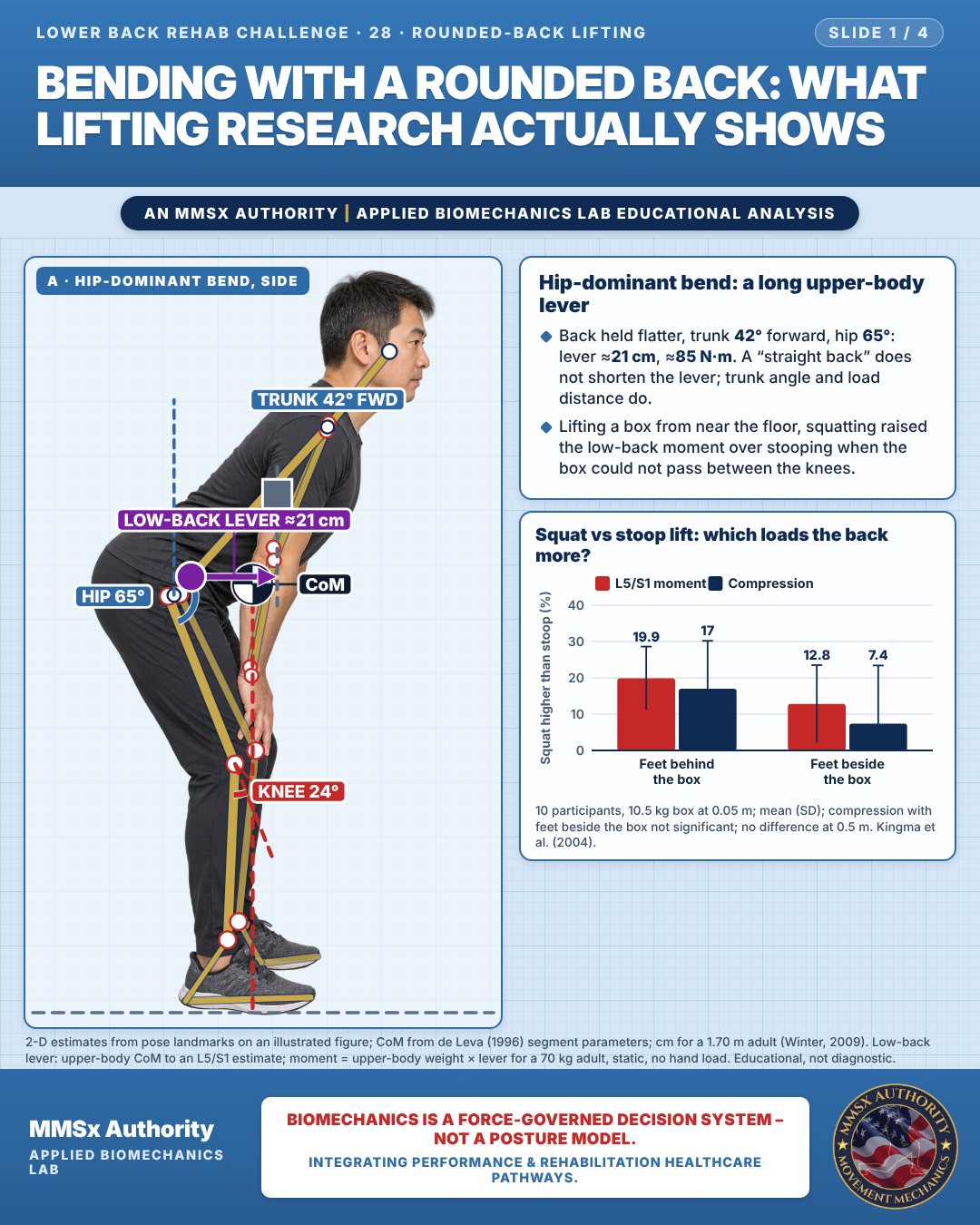
Hip-dominant bend: a long upper-body lever
Back held flatter, trunk 42° forward, hip 65°: lever ≈21 cm, ≈85 N·m. A “straight back” does not shorten the lever; trunk angle and load distance do.
Lifting a box from near the floor, squatting raised the low-back moment over stooping when the box could not pass between the knees.
Squat vs stoop lift: which loads the back more?
Movement B: Relaxed spinal bend (side view)
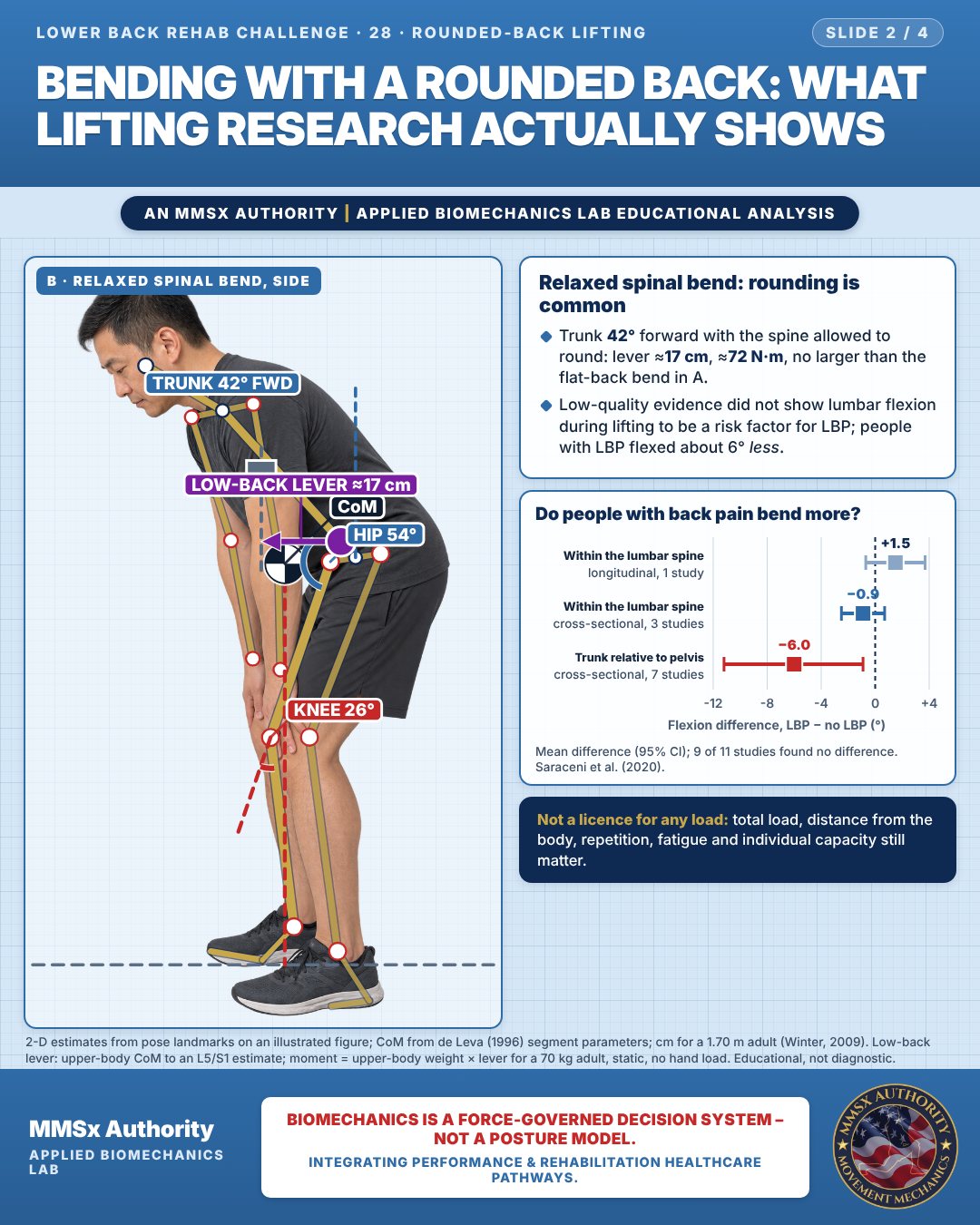
Relaxed spinal bend: rounding is common
Trunk 42° forward with the spine allowed to round: lever ≈17 cm, ≈72 N·m, no larger than the flat-back bend in A.
Low-quality evidence did not show lumbar flexion during lifting to be a risk factor for LBP; people with LBP flexed about 6° less.
Do people with back pain bend more?
Movement C: Reach to a low stool (side view)
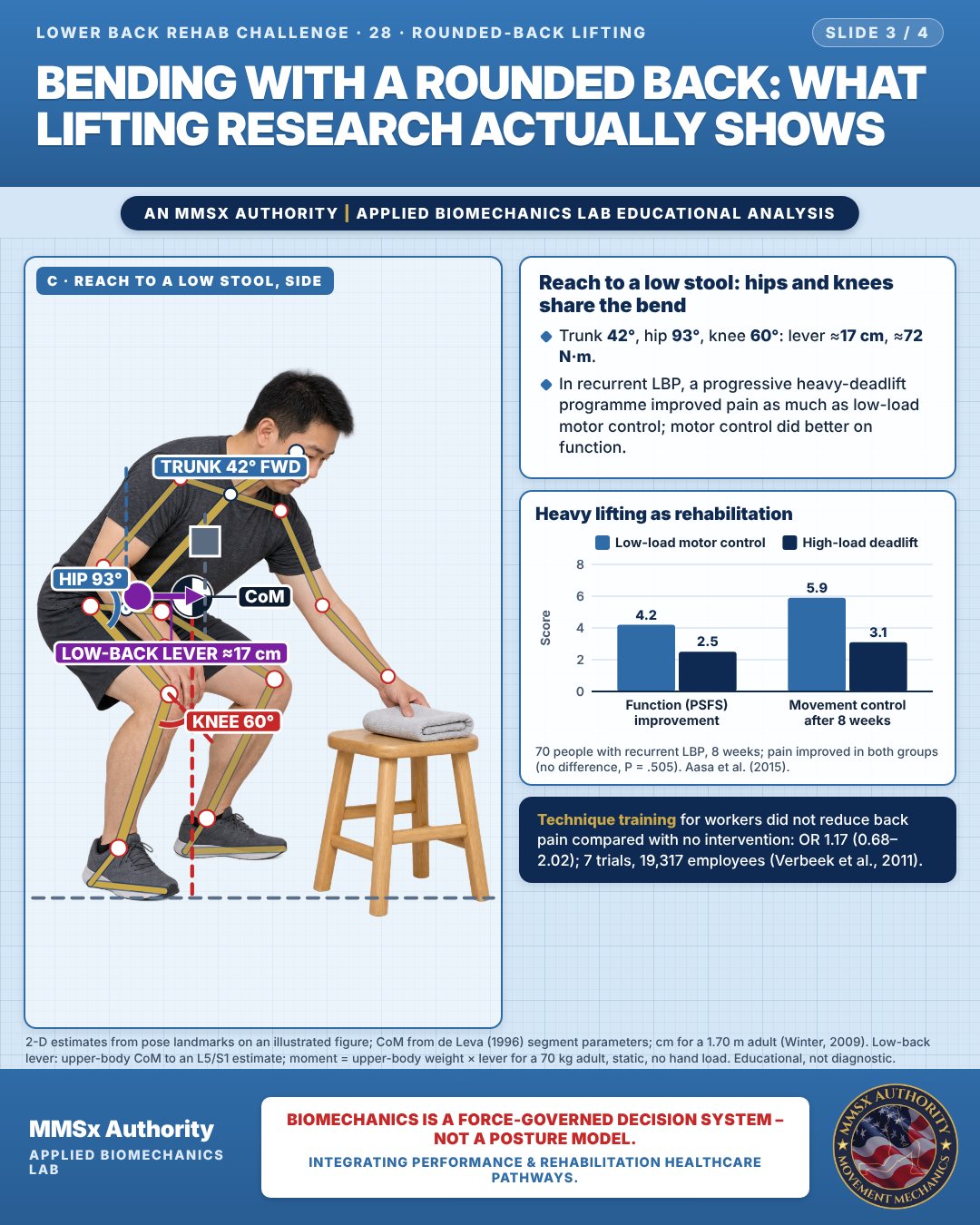
Reach to a low stool: hips and knees share the bend
Trunk 42°, hip 93°, knee 60°: lever ≈17 cm, ≈72 N·m.
In recurrent LBP, a progressive heavy-deadlift programme improved pain as much as low-load motor control; motor control did better on function.
Heavy lifting as rehabilitation
Decision pathway
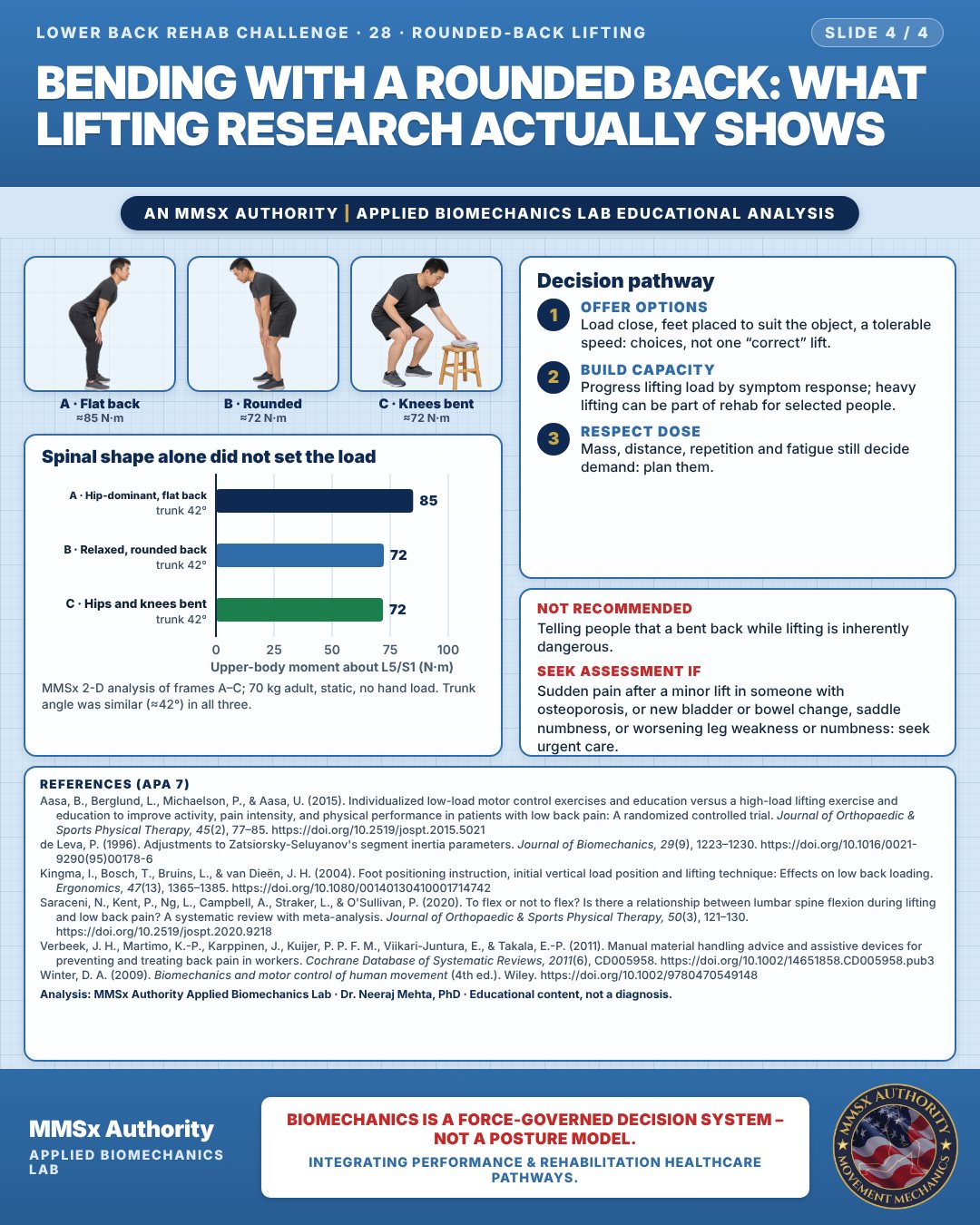
Spinal shape alone did not set the load
Offer options
Load close, feet placed to suit the object, a tolerable speed: choices, not one “correct” lift.
Build capacity
Progress lifting load by symptom response; heavy lifting can be part of rehab for selected people.
Respect dose
Mass, distance, repetition and fatigue still decide demand: plan them.
What the evidence supports
- Build lifting capacity progressively according to symptom response; heavy lifting can be part of rehabilitation in selected people (Aasa et al., 2015).
- Teach load-handling options (keep load close, feet placement, tolerable speed) as choices rather than a single "correct" technique; technique training alone does not prevent back pain (Verbeek et al., 2011; Kingma et al., 2004).
- Not recommended: telling people that bending the back while lifting is inherently dangerous (Saraceni et al., 2020). Equally, the evidence does not show that every load in every posture is safe — total load, repetition, fatigue and individual capacity still matter.
Myth and evidence
Myth“Never lift with a rounded back — always squat, back straight.”
EvidenceSquatting can raise lumbar moments and compression when the load is ahead of the knees (Kingma et al., 2004); flexion during lifting is not clearly linked to LBP, and people with LBP tend to flex less (Saraceni et al., 2020); technique training does not reduce back pain (Verbeek et al., 2011).
Cautions
Not recommended
Telling people that a bent back while lifting is inherently dangerous.
Seek assessment if
Sudden pain after a minor lift in someone with osteoporosis, or new bladder or bowel change, saddle numbness, or worsening leg weakness or numbness: seek urgent care.
Methods note
2-D estimates from pose landmarks on an illustrated figure; CoM from de Leva (1996) segment parameters; cm for a 1.70 m adult (Winter, 2009). Low-back lever: upper-body CoM to an L5/S1 estimate; moment = upper-body weight × lever for a 70 kg adult, static, no hand load. These are educational estimates, not a diagnosis.
References
- Aasa, B., Berglund, L., Michaelson, P., & Aasa, U. (2015). Individualized low-load motor control exercises and education versus a high-load lifting exercise and education to improve activity, pain intensity, and physical performance in patients with low back pain: A randomized controlled trial. Journal of Orthopaedic & Sports Physical Therapy, 45(2), 77–85. https://doi.org/10.2519/jospt.2015.5021
- de Leva, P. (1996). Adjustments to Zatsiorsky-Seluyanov's segment inertia parameters. Journal of Biomechanics, 29(9), 1223–1230. https://doi.org/10.1016/0021-9290(95)00178-6
- Kingma, I., Bosch, T., Bruins, L., & van Dieën, J. H. (2004). Foot positioning instruction, initial vertical load position and lifting technique: Effects on low back loading. Ergonomics, 47(13), 1365–1385. https://doi.org/10.1080/00140130410001714742
- Saraceni, N., Kent, P., Ng, L., Campbell, A., Straker, L., & O'Sullivan, P. (2020). To flex or not to flex? Is there a relationship between lumbar spine flexion during lifting and low back pain? A systematic review with meta-analysis. Journal of Orthopaedic & Sports Physical Therapy, 50(3), 121–130. https://doi.org/10.2519/jospt.2020.9218
- Verbeek, J. H., Martimo, K.-P., Karppinen, J., Kuijer, P. P. F. M., Viikari-Juntura, E., & Takala, E.-P. (2011). Manual material handling advice and assistive devices for preventing and treating back pain in workers. Cochrane Database of Systematic Reviews, 2011(6), CD005958. https://doi.org/10.1002/14651858.CD005958.pub3
- Winter, D. A. (2009). Biomechanics and motor control of human movement (4th ed.). Wiley. https://doi.org/10.1002/9780470549148
Cite this article
Mehta, N. (2026, October 23). Bending with a rounded back: what lifting research actually shows. MMSx Authority Applied Biomechanics Lab. https://mmsxauthority.org/edu/analysis/lower-back/28-bending-with-a-rounded-back-what-lifting-research-actually-shows/
Part of the collection
Mehta, N. (2026). Lower Back Rehabilitation: 50 Evidence-Based Biomechanics Analyses [Collection]. MMSx Authority Applied Biomechanics Lab. Zenodo. https://doi.org/10.5281/zenodo.23735778
All Lower Back Rehab Challenge articles · Rehabilitation Library