Lower Back Rehab Challenge · 27
Is there a perfect posture for a pain-free lower back?
"Posture" is the position the body adopts at a moment (standing, sitting, bending). Movement analysis, verified research data and a decision pathway from the
Key points
- Comfort first. Choose positions that feel comfortable for the task; there is no single correct shape.
- Vary often. Change position regularly; the ability to vary posture may matter more than any one posture.
- Cut total sitting. Break up long sitting bouts and add activity across the day.
What it is
"Posture" is the position the body adopts at a moment (standing, sitting, bending). Research has not identified one ideal static spinal posture that prevents back pain; current thinking emphasises comfort, the ability to vary position, and the total amount of time spent in any single position.
How we analysed the movement
Three movements relevant to this topic were analysed from illustrated reference figures. Joint centres were located with two-dimensional pose estimation; joint angles, the whole-body centre of mass and, where relevant, the low-back lever (the horizontal distance from the upper-body centre of mass to the L5/S1 joint) were then calculated from standard segment parameters. The figures are educational estimates that show how position changes mechanical demand; they are not measurements of a patient. Every research value quoted below comes from the published source cited beside it.
Movement A: Upright sitting
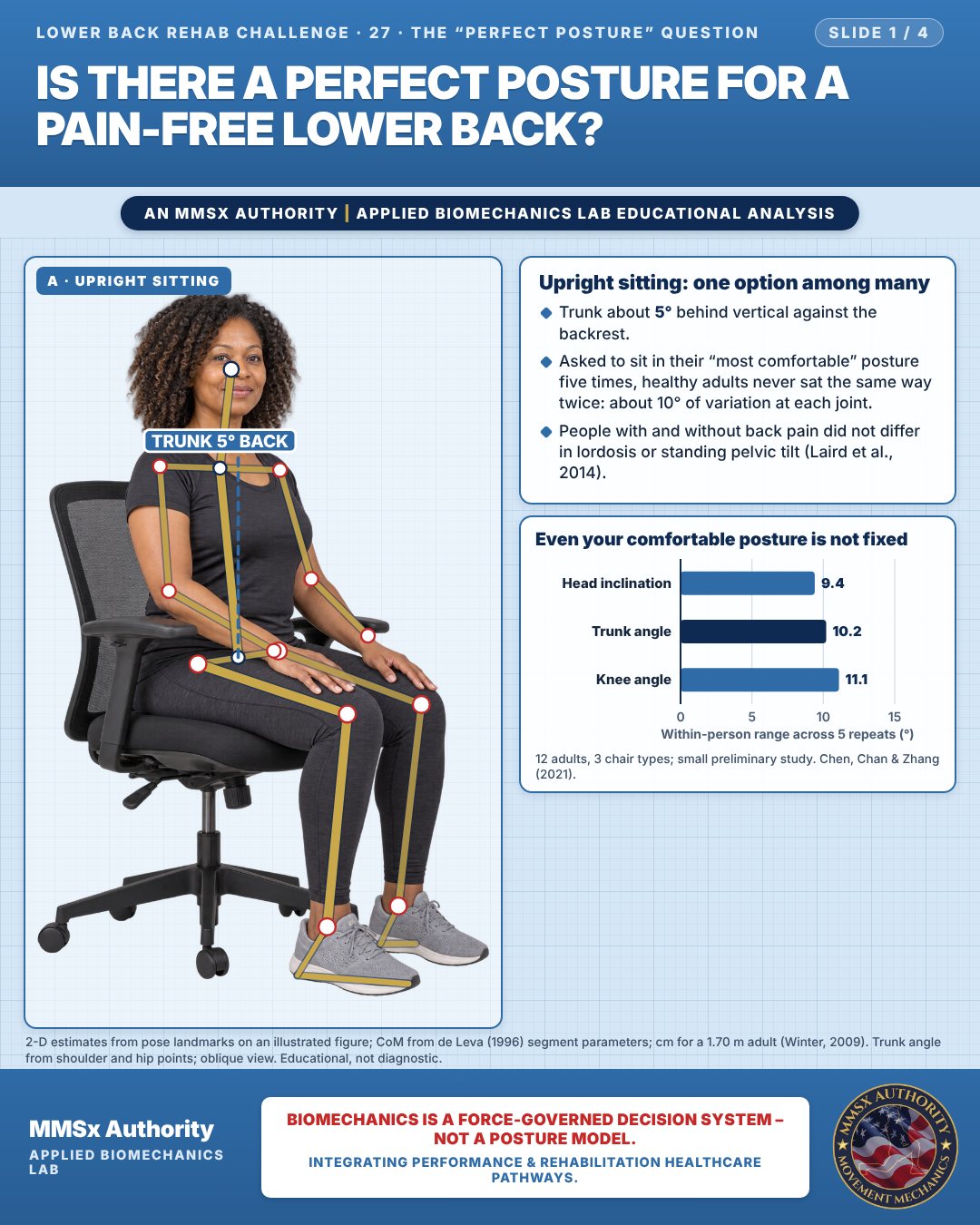
Upright sitting: one option among many
Trunk about 5° behind vertical against the backrest.
Asked to sit in their “most comfortable” posture five times, healthy adults never sat the same way twice: about 10° of variation at each joint.
People with and without back pain did not differ in lordosis or standing pelvic tilt (Laird et al., 2014).
Even your comfortable posture is not fixed
Movement B: Reclined sitting
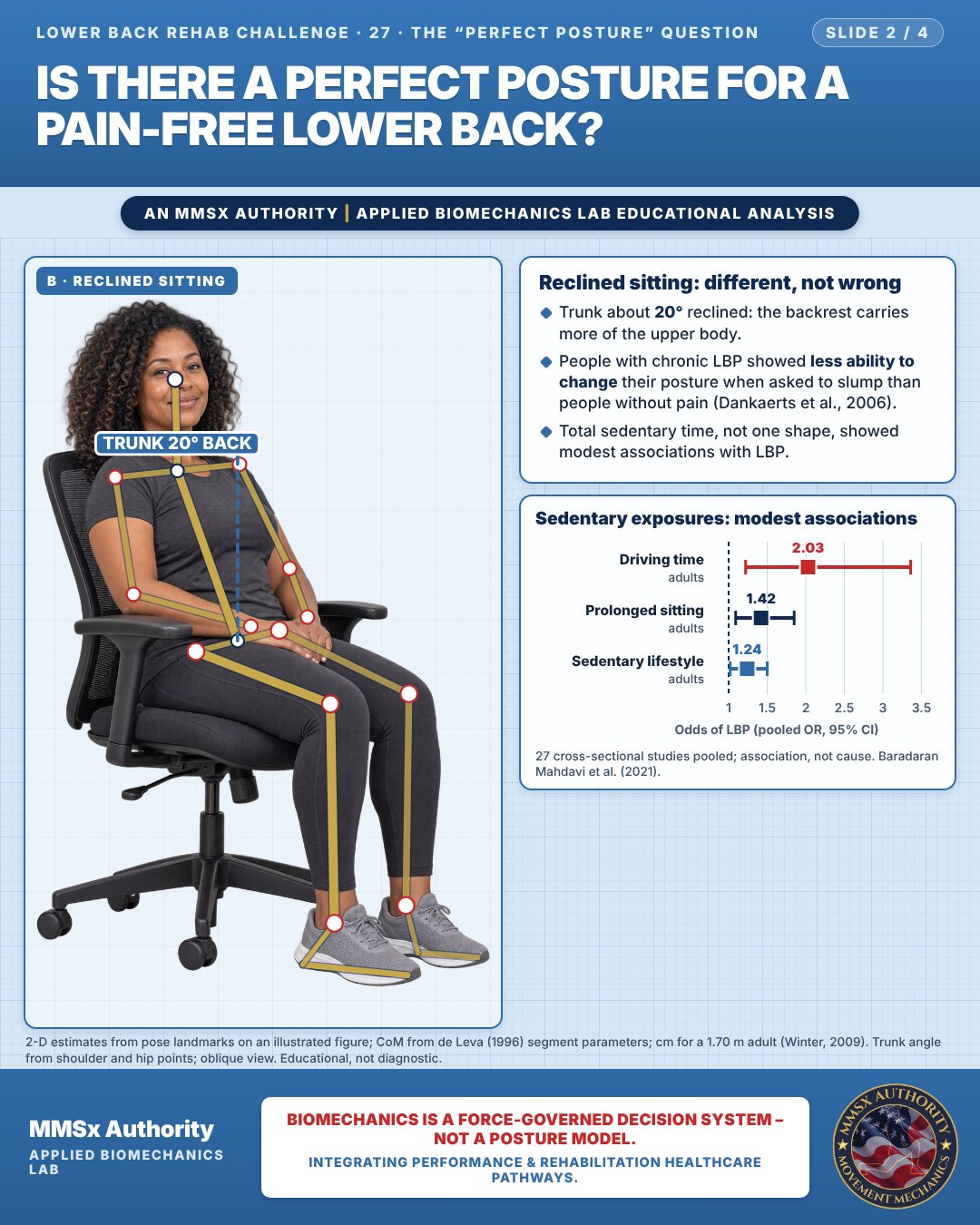
Reclined sitting: different, not wrong
Trunk about 20° reclined: the backrest carries more of the upper body.
People with chronic LBP showed less ability to change their posture when asked to slump than people without pain (Dankaerts et al., 2006).
Total sedentary time, not one shape, showed modest associations with LBP.
Sedentary exposures: modest associations
Movement C: Standing break (front view)
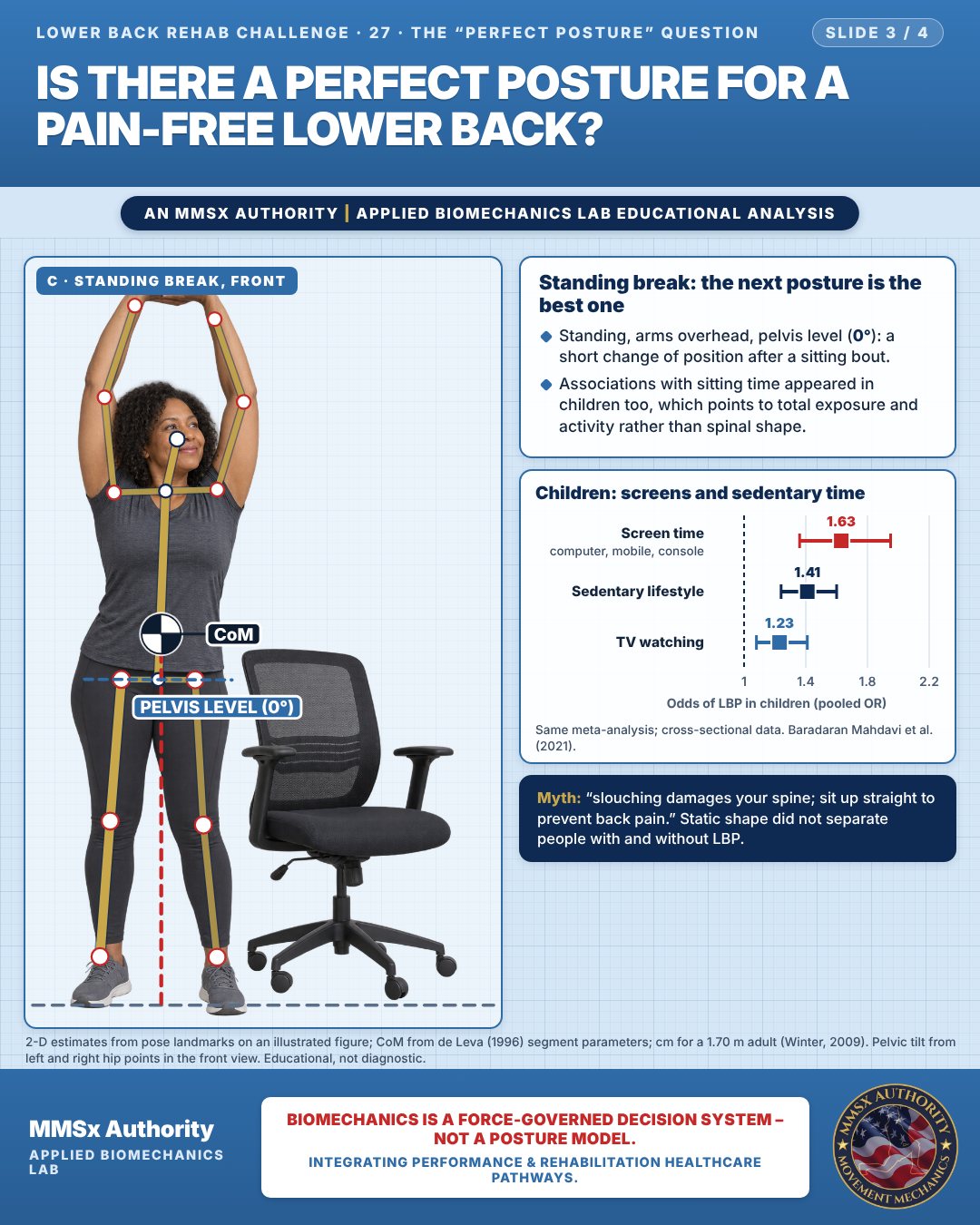
Standing break: the next posture is the best one
Standing, arms overhead, pelvis level (0°): a short change of position after a sitting bout.
Associations with sitting time appeared in children too, which points to total exposure and activity rather than spinal shape.
Children: screens and sedentary time
Decision pathway
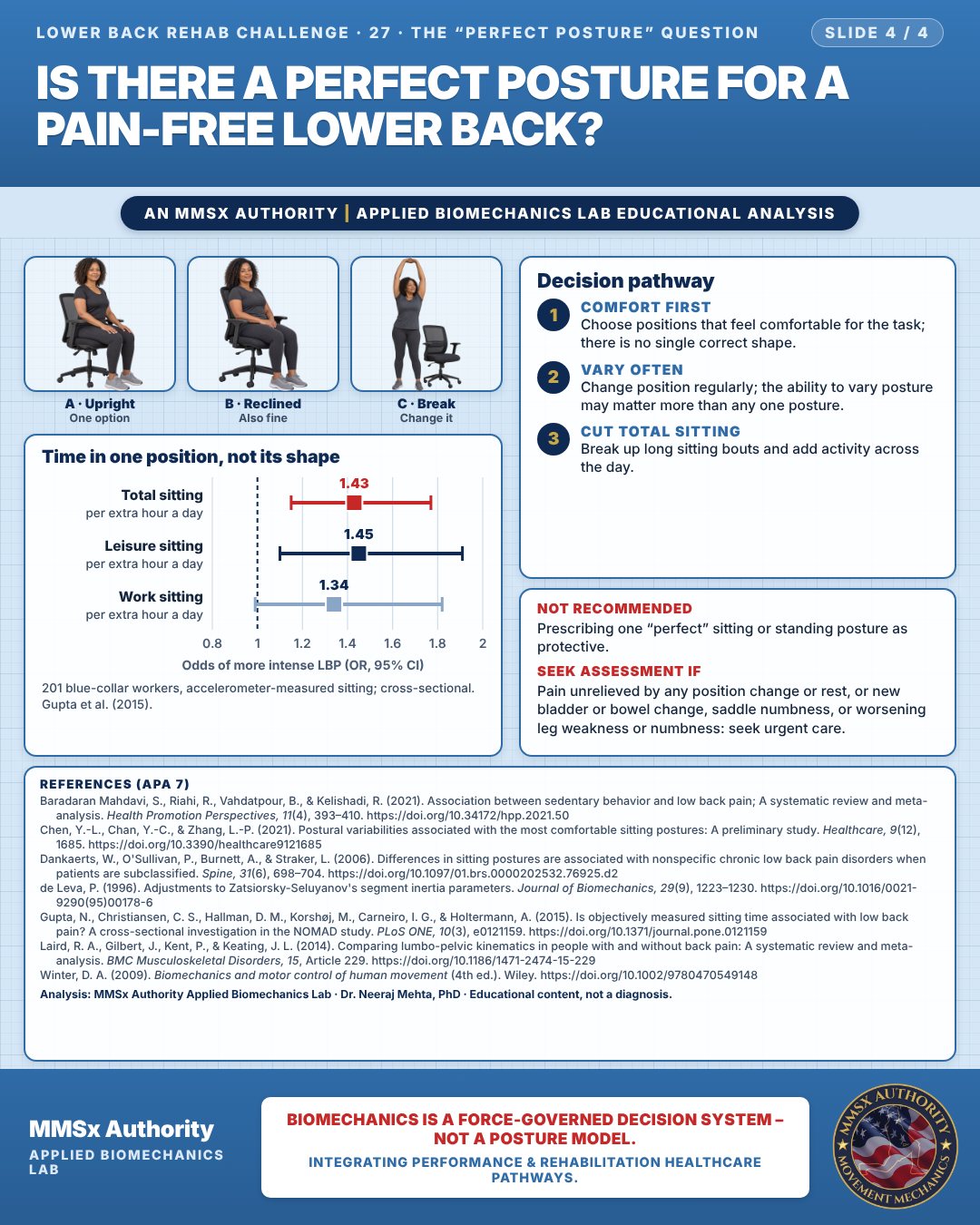
Time in one position, not its shape
Comfort first
Choose positions that feel comfortable for the task; there is no single correct shape.
Vary often
Change position regularly; the ability to vary posture may matter more than any one posture.
Cut total sitting
Break up long sitting bouts and add activity across the day.
What the evidence supports
- Address total sedentary exposure (breaks, activity) rather than policing one "correct" posture (Gupta et al., 2015; Baradaran Mahdavi et al., 2021 — associations).
Myth and evidence
Myth“Slouching damages your spine; sit up straight to prevent back pain.”
EvidenceStatic spinal shape does not differ between people with and without LBP (Laird et al., 2014); people with chronic LBP may vary their posture less (Dankaerts et al., 2006); healthy people's own comfortable posture varies by ~10° (Chen et al., 2021). The best posture is the next one.
Cautions
Not recommended
Prescribing one “perfect” sitting or standing posture as protective.
Seek assessment if
Pain unrelieved by any position change or rest, or new bladder or bowel change, saddle numbness, or worsening leg weakness or numbness: seek urgent care.
Methods note
2-D estimates from pose landmarks on an illustrated figure; CoM from de Leva (1996) segment parameters; cm for a 1.70 m adult (Winter, 2009). Trunk angle from shoulder and hip points; oblique view. Pelvic tilt from left and right hip points in the front view. These are educational estimates, not a diagnosis.
References
- Baradaran Mahdavi, S., Riahi, R., Vahdatpour, B., & Kelishadi, R. (2021). Association between sedentary behavior and low back pain; A systematic review and meta-analysis. Health Promotion Perspectives, 11(4), 393–410. https://doi.org/10.34172/hpp.2021.50
- Chen, Y.-L., Chan, Y.-C., & Zhang, L.-P. (2021). Postural variabilities associated with the most comfortable sitting postures: A preliminary study. Healthcare, 9(12), 1685. https://doi.org/10.3390/healthcare9121685
- Dankaerts, W., O'Sullivan, P., Burnett, A., & Straker, L. (2006). Differences in sitting postures are associated with nonspecific chronic low back pain disorders when patients are subclassified. Spine, 31(6), 698–704. https://doi.org/10.1097/01.brs.0000202532.76925.d2
- de Leva, P. (1996). Adjustments to Zatsiorsky-Seluyanov's segment inertia parameters. Journal of Biomechanics, 29(9), 1223–1230. https://doi.org/10.1016/0021-9290(95)00178-6
- Gupta, N., Christiansen, C. S., Hallman, D. M., Korshøj, M., Carneiro, I. G., & Holtermann, A. (2015). Is objectively measured sitting time associated with low back pain? A cross-sectional investigation in the NOMAD study. PLoS ONE, 10(3), e0121159. https://doi.org/10.1371/journal.pone.0121159
- Laird, R. A., Gilbert, J., Kent, P., & Keating, J. L. (2014). Comparing lumbo-pelvic kinematics in people with and without back pain: A systematic review and meta-analysis. BMC Musculoskeletal Disorders, 15, Article 229. https://doi.org/10.1186/1471-2474-15-229
- Winter, D. A. (2009). Biomechanics and motor control of human movement (4th ed.). Wiley. https://doi.org/10.1002/9780470549148
Cite this article
Mehta, N. (2026, October 23). Is there a perfect posture for a pain-free lower back? MMSx Authority Applied Biomechanics Lab. https://mmsxauthority.org/edu/analysis/lower-back/27-is-there-a-perfect-posture-for-a-pain-free-lower-back/
Part of the collection
Mehta, N. (2026). Lower Back Rehabilitation: 50 Evidence-Based Biomechanics Analyses [Collection]. MMSx Authority Applied Biomechanics Lab. Zenodo. https://doi.org/10.5281/zenodo.23735778
All Lower Back Rehab Challenge articles · Rehabilitation Library