Lower Back Rehab Challenge · 26
Anterior pelvic tilt and back pain: does everyone need “correction”?
Anterior pelvic tilt is a forward rotation of the pelvis in the sagittal plane, clinically estimated from the angle of a line joining the anterior…
Key points
- Assess in context. Posture is one observation; read it alongside symptoms, movement and function.
- Don’t label. Avoid “your pelvis is out” or “tilted” as the cause of pain.
- Train capacity. Choose exercise for strength, endurance and tolerance; alignment change is optional.
What it is
Anterior pelvic tilt is a forward rotation of the pelvis in the sagittal plane, clinically estimated from the angle of a line joining the anterior and posterior superior iliac spines (ASIS–PSIS) relative to the horizontal. Because bony landmarks vary between people, a "tilted" reading does not by itself mean an abnormal or painful pelvis.
How we analysed the movement
Three movements relevant to this topic were analysed from illustrated reference figures. Joint centres were located with two-dimensional pose estimation; joint angles, the whole-body centre of mass and, where relevant, the low-back lever (the horizontal distance from the upper-body centre of mass to the L5/S1 joint) were then calculated from standard segment parameters. The figures are educational estimates that show how position changes mechanical demand; they are not measurements of a patient. Every research value quoted below comes from the published source cited beside it.
Movement A: Natural standing (side view)
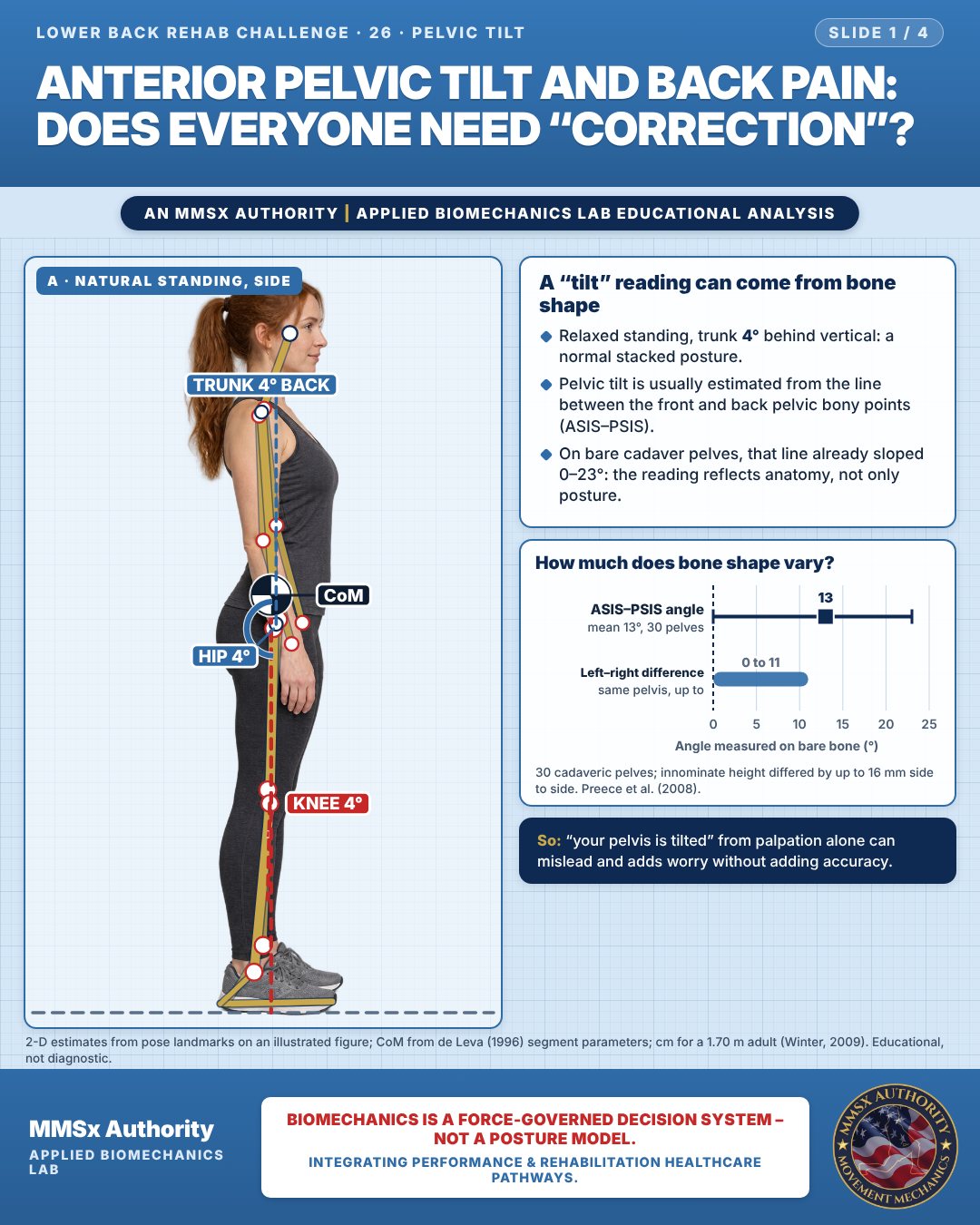
A “tilt” reading can come from bone shape
Relaxed standing, trunk 4° behind vertical: a normal stacked posture.
Pelvic tilt is usually estimated from the line between the front and back pelvic bony points (ASIS–PSIS).
On bare cadaver pelves, that line already sloped 0–23°: the reading reflects anatomy, not only posture.
How much does bone shape vary?
Movement B: Seated pelvic motion
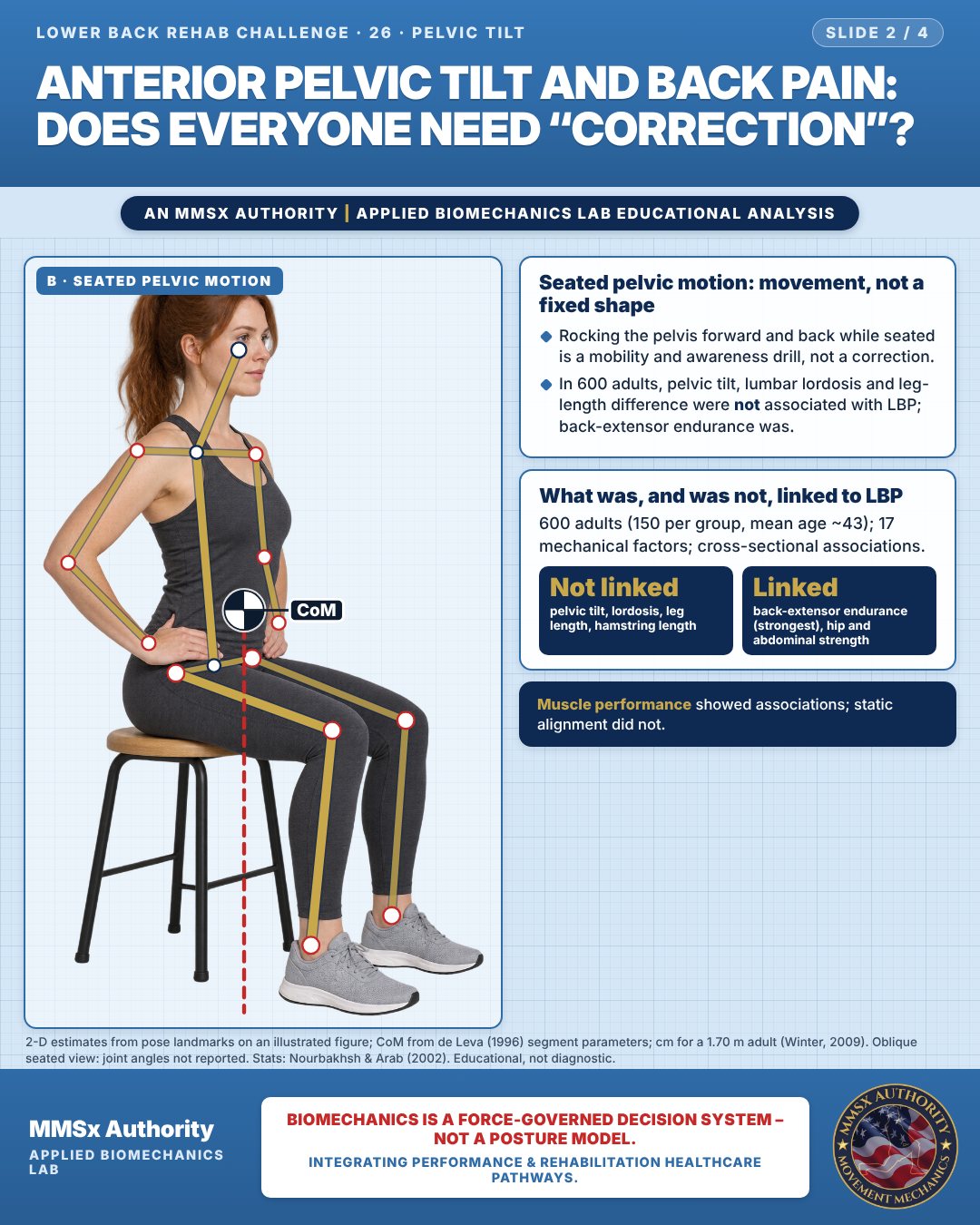
Seated pelvic motion: movement, not a fixed shape
Rocking the pelvis forward and back while seated is a mobility and awareness drill, not a correction.
In 600 adults, pelvic tilt, lumbar lordosis and leg-length difference were not associated with LBP; back-extensor endurance was.
What was, and was not, linked to LBP
600 adults (150 per group, mean age ~43); 17 mechanical factors; cross-sectional associations.
Movement C: Standing weight shift
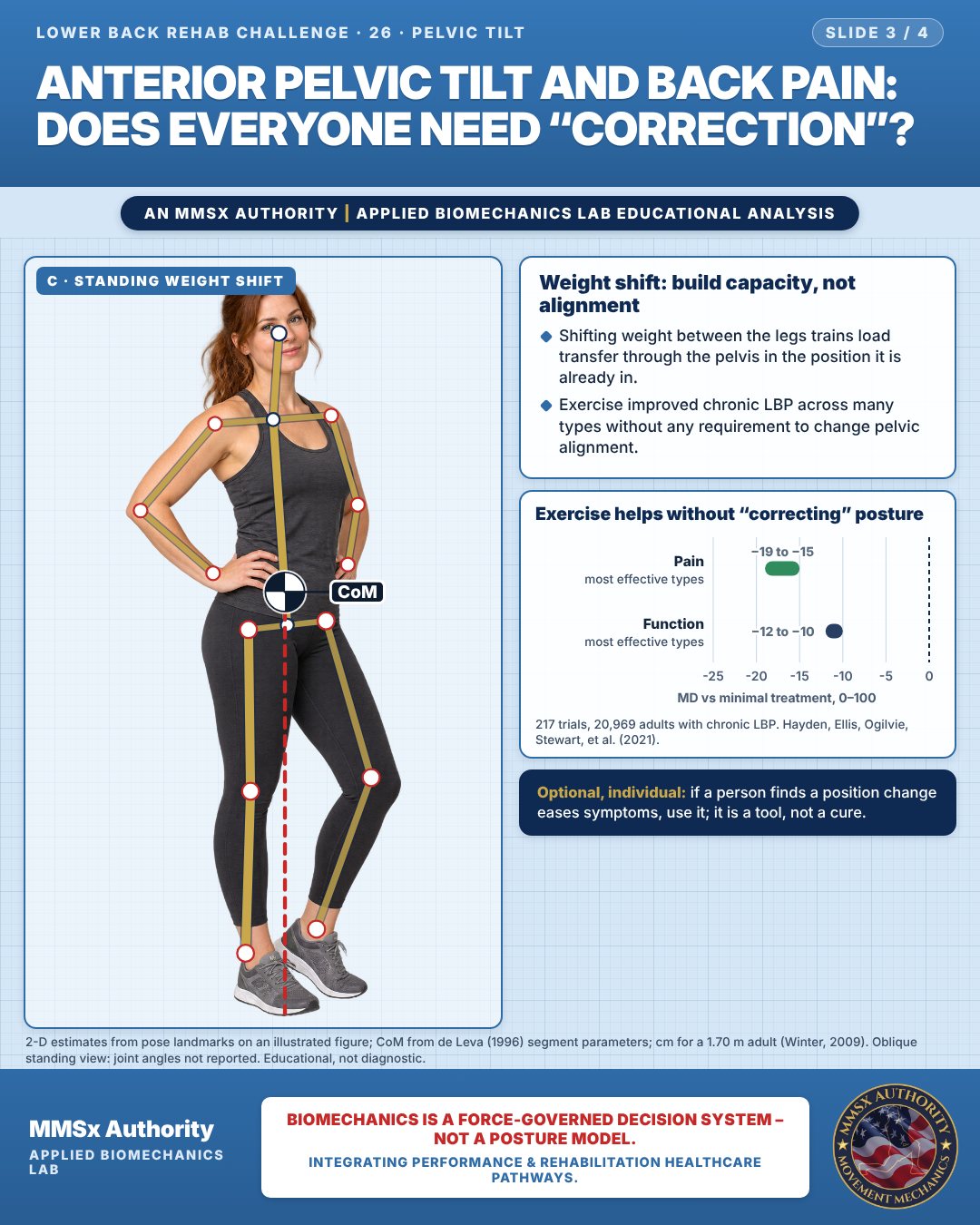
Weight shift: build capacity, not alignment
Shifting weight between the legs trains load transfer through the pelvis in the position it is already in.
Exercise improved chronic LBP across many types without any requirement to change pelvic alignment.
Exercise helps without “correcting” posture
Decision pathway
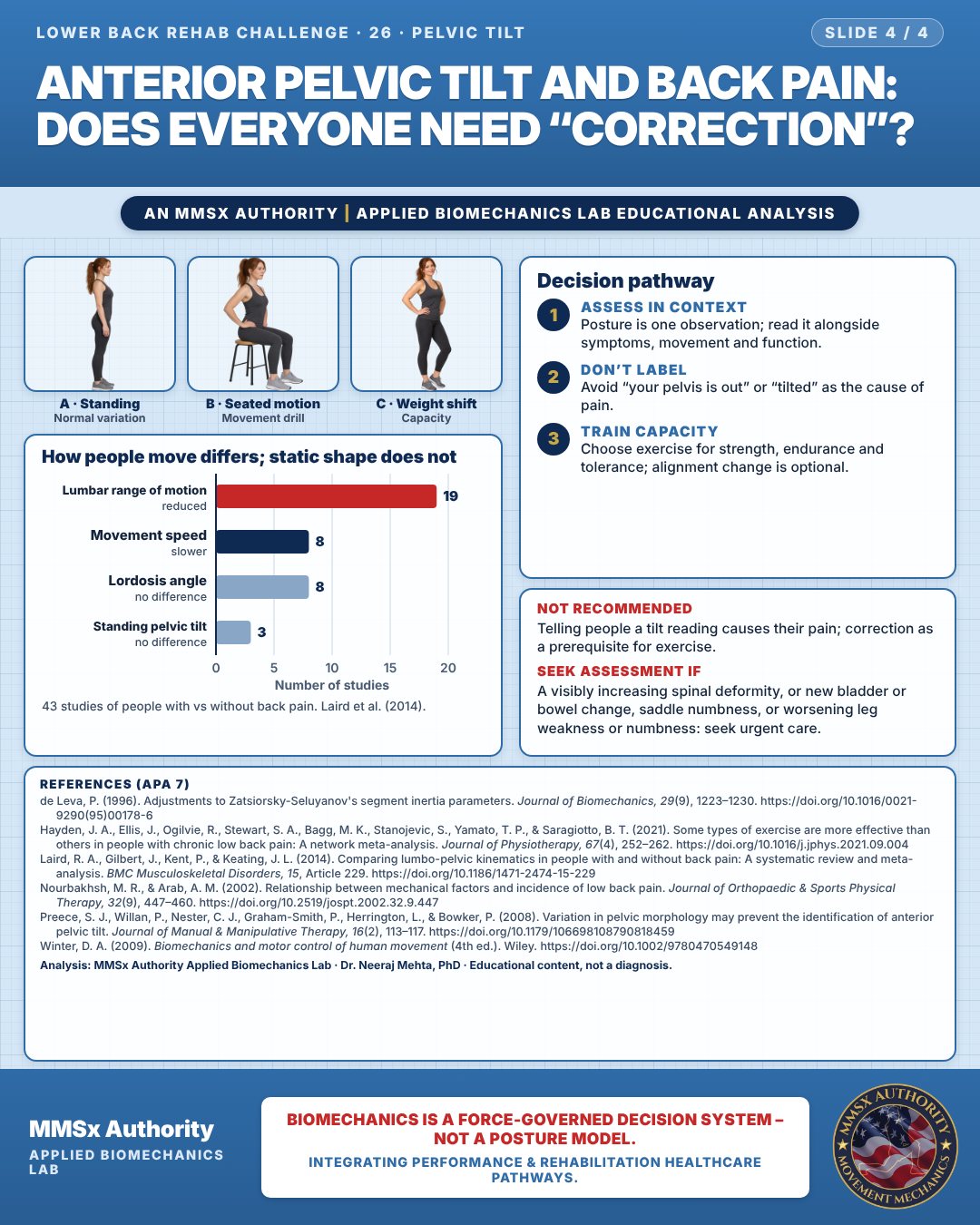
How people move differs; static shape does not
Assess in context
Posture is one observation; read it alongside symptoms, movement and function.
Don’t label
Avoid “your pelvis is out” or “tilted” as the cause of pain.
Train capacity
Choose exercise for strength, endurance and tolerance; alignment change is optional.
What the evidence supports
- Assess posture in context of symptoms and function; do not treat a tilt reading as a diagnosis (Preece et al., 2008; Laird et al., 2014).
- Not recommended: telling people their pelvis is "out" or "tilted" as the cause of pain — it can increase threat and is not supported (Laird et al., 2014; Nourbakhsh & Arab, 2002).
Myth and evidence
Myth“Anterior pelvic tilt causes back pain and must be corrected.”
EvidenceNo difference in standing pelvic tilt or lordosis between people with and without LBP (Laird et al., 2014; Nourbakhsh & Arab, 2002), and bony landmarks alone vary by 0–23° (Preece et al., 2008).
Cautions
Not recommended
Telling people a tilt reading causes their pain; correction as a prerequisite for exercise.
Seek assessment if
A visibly increasing spinal deformity, or new bladder or bowel change, saddle numbness, or worsening leg weakness or numbness: seek urgent care.
Methods note
2-D estimates from pose landmarks on an illustrated figure; CoM from de Leva (1996) segment parameters; cm for a 1.70 m adult (Winter, 2009). Oblique seated view: joint angles not reported. Stats: Nourbakhsh & Arab (2002). Oblique standing view: joint angles not reported. These are educational estimates, not a diagnosis.
References
- de Leva, P. (1996). Adjustments to Zatsiorsky-Seluyanov's segment inertia parameters. Journal of Biomechanics, 29(9), 1223–1230. https://doi.org/10.1016/0021-9290(95)00178-6
- Hayden, J. A., Ellis, J., Ogilvie, R., Stewart, S. A., Bagg, M. K., Stanojevic, S., Yamato, T. P., & Saragiotto, B. T. (2021). Some types of exercise are more effective than others in people with chronic low back pain: A network meta-analysis. Journal of Physiotherapy, 67(4), 252–262. https://doi.org/10.1016/j.jphys.2021.09.004
- Laird, R. A., Gilbert, J., Kent, P., & Keating, J. L. (2014). Comparing lumbo-pelvic kinematics in people with and without back pain: A systematic review and meta-analysis. BMC Musculoskeletal Disorders, 15, Article 229. https://doi.org/10.1186/1471-2474-15-229
- Nourbakhsh, M. R., & Arab, A. M. (2002). Relationship between mechanical factors and incidence of low back pain. Journal of Orthopaedic & Sports Physical Therapy, 32(9), 447–460. https://doi.org/10.2519/jospt.2002.32.9.447
- Preece, S. J., Willan, P., Nester, C. J., Graham-Smith, P., Herrington, L., & Bowker, P. (2008). Variation in pelvic morphology may prevent the identification of anterior pelvic tilt. Journal of Manual & Manipulative Therapy, 16(2), 113–117. https://doi.org/10.1179/106698108790818459
- Winter, D. A. (2009). Biomechanics and motor control of human movement (4th ed.). Wiley. https://doi.org/10.1002/9780470549148
Cite this article
Mehta, N. (2026, October 23). Anterior pelvic tilt and back pain: does everyone need “correction”? MMSx Authority Applied Biomechanics Lab. https://mmsxauthority.org/edu/analysis/lower-back/26-anterior-pelvic-tilt-and-back-pain-does-everyone-need-correction/
Part of the collection
Mehta, N. (2026). Lower Back Rehabilitation: 50 Evidence-Based Biomechanics Analyses [Collection]. MMSx Authority Applied Biomechanics Lab. Zenodo. https://doi.org/10.5281/zenodo.23735778
All Lower Back Rehab Challenge articles · Rehabilitation Library