Lower Back Rehab Challenge · 25
Tight hamstrings or sensitive nerves? Why leg symptoms need assessment
A "pulling" feeling behind the thigh during a straight leg raise or forward bend can come from muscle–tendon stretch tolerance (hamstrings) or from…
Key points
- Differentiate. Change ankle or neck position: if the symptom changes, the nerve is involved.
- Examine. Neurological testing for strength, sensation and reflexes; the slump test adds information.
- Match the care. Hamstring flexibility work for a muscle pattern; graded nerve-directed care for a nerve pattern.
What it is
A "pulling" feeling behind the thigh during a straight leg raise or forward bend can come from muscle–tendon stretch tolerance (hamstrings) or from mechanosensitive neural tissue (sciatic nerve and lumbosacral nerve roots). Clinicians use structural differentiation — changing a body part that alters nerve load but not hamstring length (e.g. ankle dorsiflexion, neck flexion in the slump test) — together with symptom location, neurological examination and history to tell them apart. No single test confirms nerve-root involvement.
How we analysed the movement
Three movements relevant to this topic were analysed from illustrated reference figures. Joint centres were located with two-dimensional pose estimation; joint angles, the whole-body centre of mass and, where relevant, the low-back lever (the horizontal distance from the upper-body centre of mass to the L5/S1 joint) were then calculated from standard segment parameters. The figures are educational estimates that show how position changes mechanical demand; they are not measurements of a patient. Every research value quoted below comes from the published source cited beside it.
Movement A: Seated hamstring position
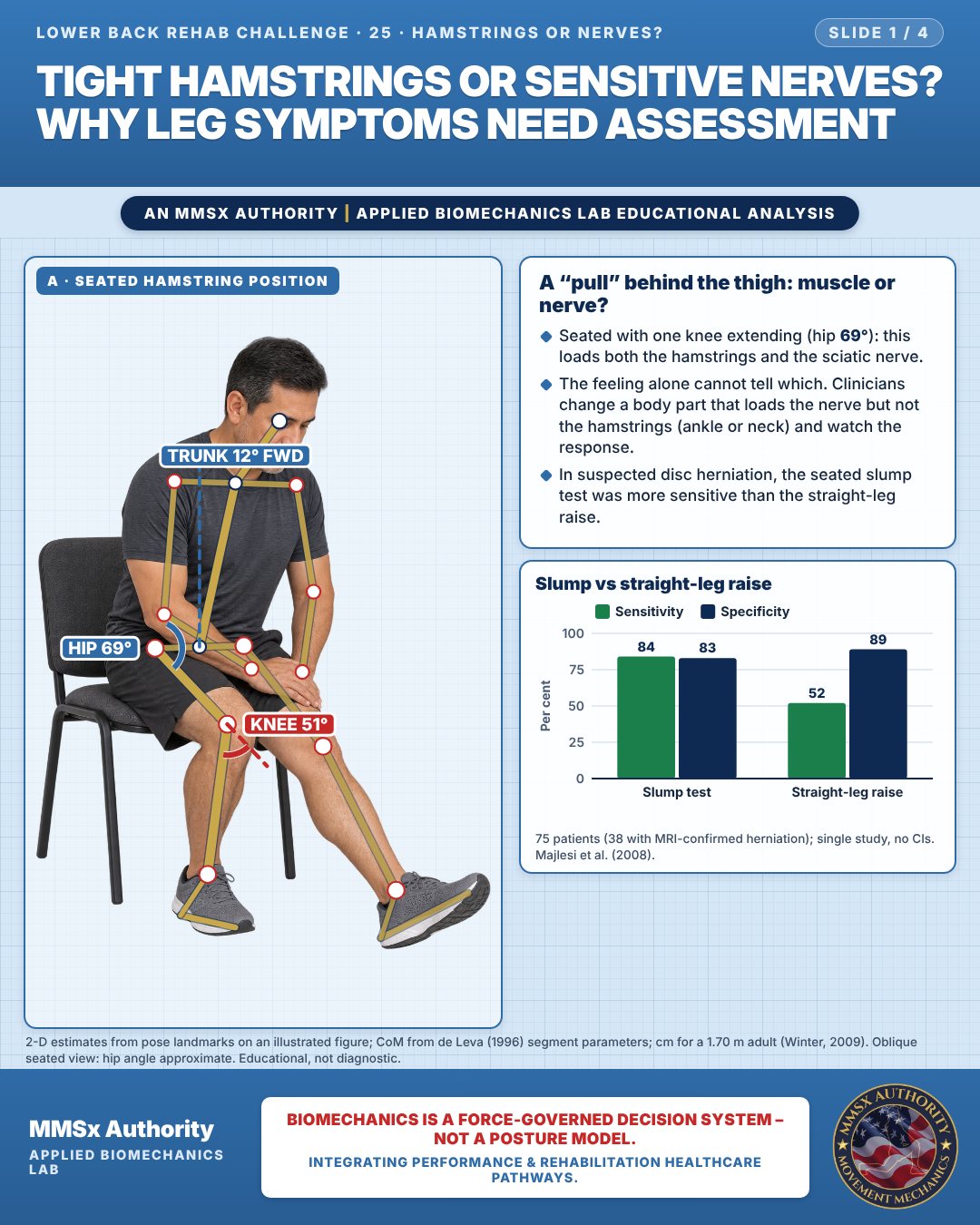
A “pull” behind the thigh: muscle or nerve?
Seated with one knee extending (hip 69°): this loads both the hamstrings and the sciatic nerve.
The feeling alone cannot tell which. Clinicians change a body part that loads the nerve but not the hamstrings (ankle or neck) and watch the response.
In suspected disc herniation, the seated slump test was more sensitive than the straight-leg raise.
Slump vs straight-leg raise
Movement B: Leg raise, knee bent (side view)
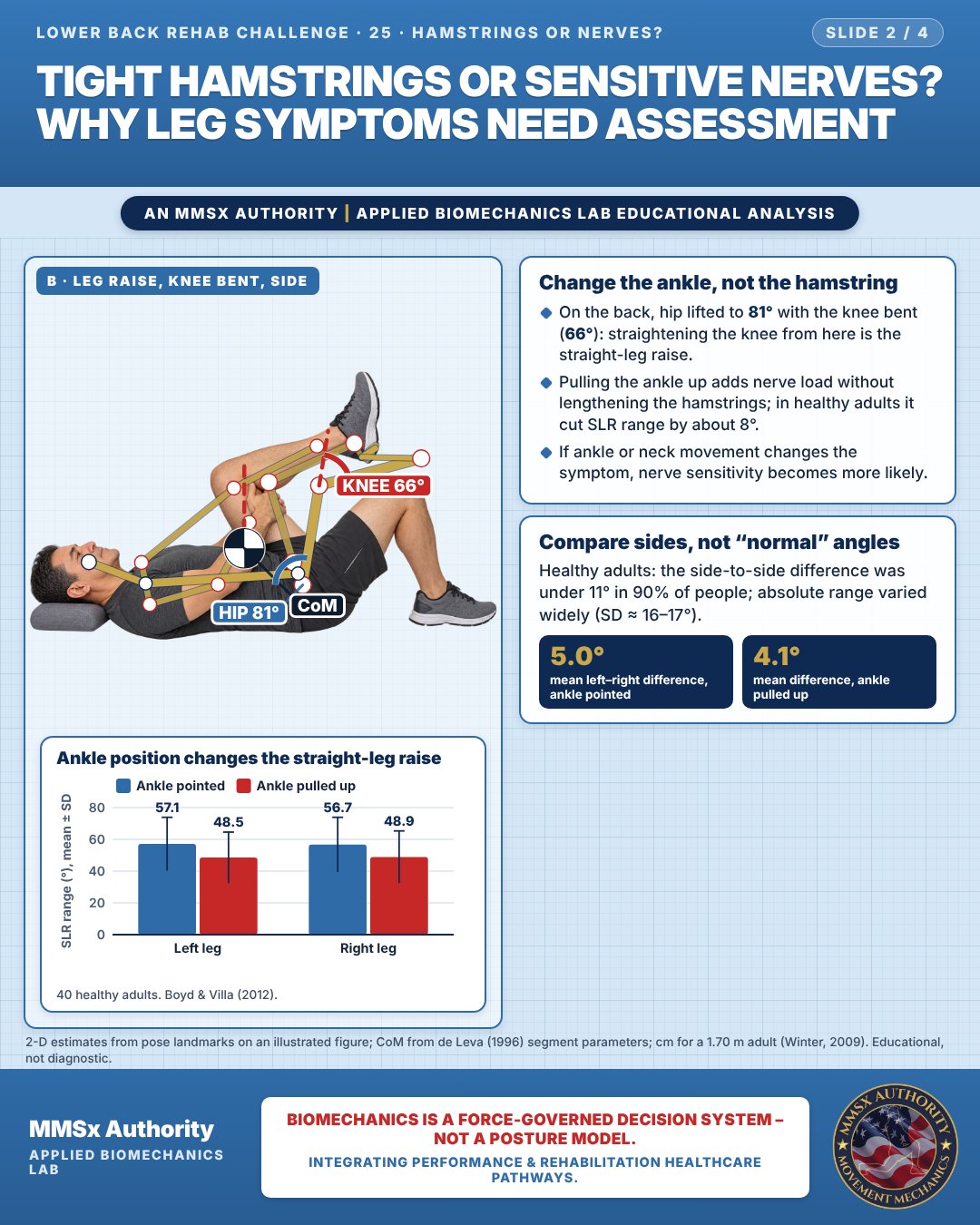
Ankle position changes the straight-leg raise
Change the ankle, not the hamstring
On the back, hip lifted to 81° with the knee bent (66°): straightening the knee from here is the straight-leg raise.
Pulling the ankle up adds nerve load without lengthening the hamstrings; in healthy adults it cut SLR range by about 8°.
If ankle or neck movement changes the symptom, nerve sensitivity becomes more likely.
Compare sides, not “normal” angles
Healthy adults: the side-to-side difference was under 11° in 90% of people; absolute range varied widely (SD ≈ 16–17°).
Movement C: Symptom review
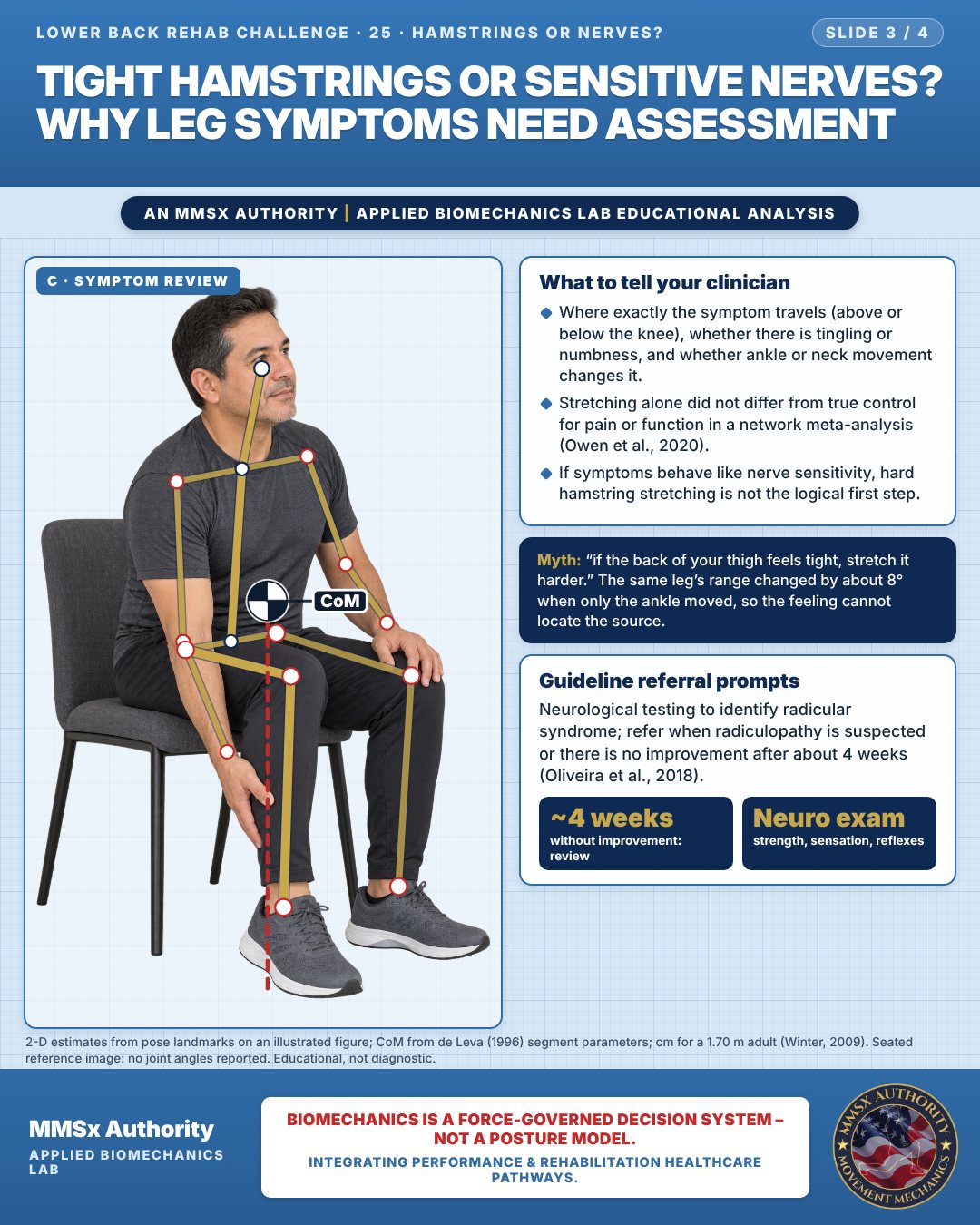
What to tell your clinician
Where exactly the symptom travels (above or below the knee), whether there is tingling or numbness, and whether ankle or neck movement changes it.
Stretching alone did not differ from true control for pain or function in a network meta-analysis (Owen et al., 2020).
If symptoms behave like nerve sensitivity, hard hamstring stretching is not the logical first step.
Guideline referral prompts
Neurological testing to identify radicular syndrome; refer when radiculopathy is suspected or there is no improvement after about 4 weeks (Oliveira et al., 2018).
Decision pathway
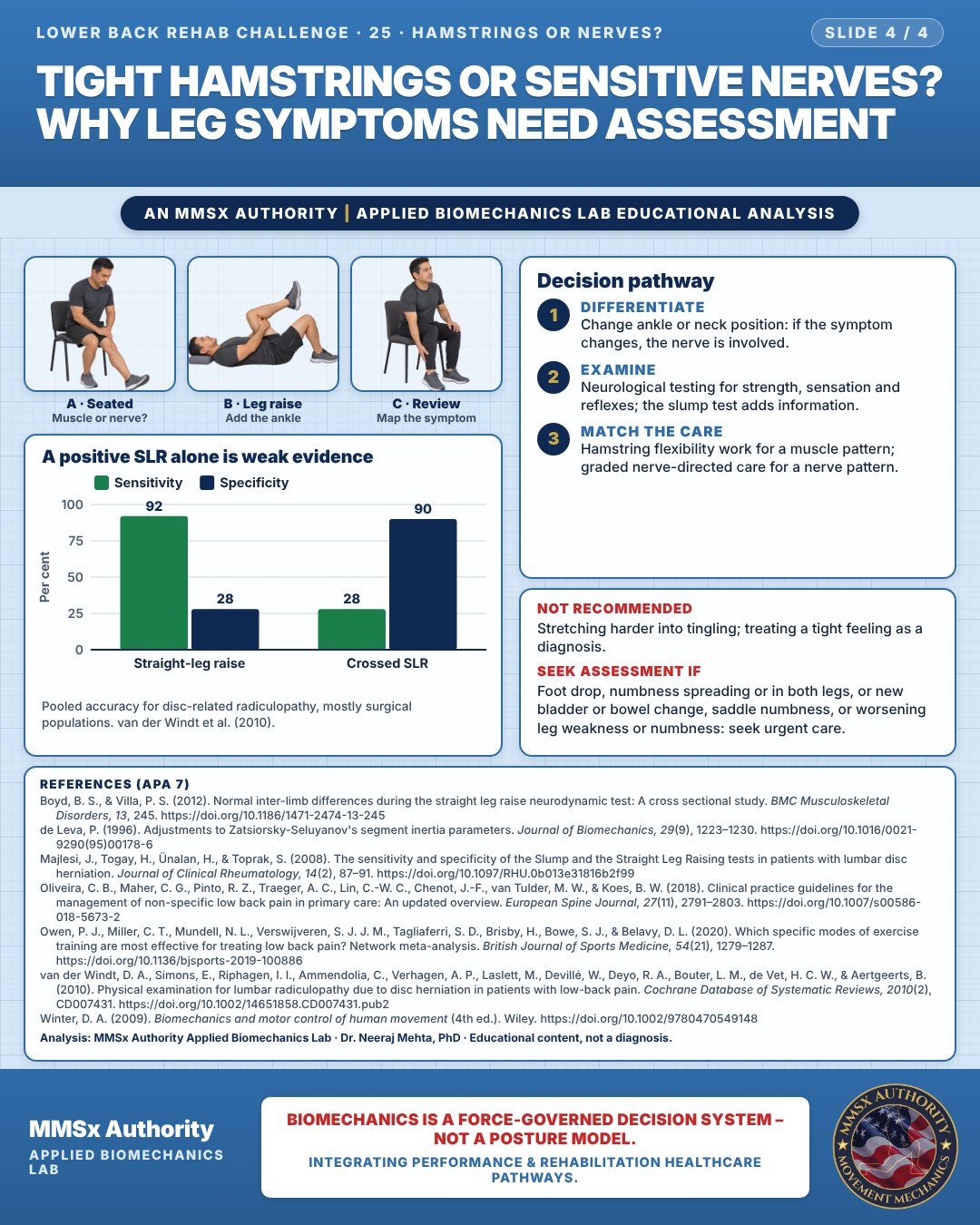
A positive SLR alone is weak evidence
Differentiate
Change ankle or neck position: if the symptom changes, the nerve is involved.
Examine
Neurological testing for strength, sensation and reflexes; the slump test adds information.
Match the care
Hamstring flexibility work for a muscle pattern; graded nerve-directed care for a nerve pattern.
What the evidence supports
- Guidelines advise neurological testing to identify radicular syndrome and referral for radiculopathy or no improvement after about 4 weeks (Oliveira et al., 2018).
- Not recommended: interpreting a "tight" feeling or a positive SLR alone as a diagnosis (van der Windt et al., 2010).
Myth and evidence
Myth“If the back of your thigh feels tight, your hamstrings are short — stretch them harder.”
EvidenceThe same leg's range changes by ~8° when only the ankle moves (Boyd & Villa, 2012), so sensation alone cannot locate the source; the SLR is sensitive but not specific (van der Windt et al., 2010).
Cautions
Not recommended
Stretching harder into tingling; treating a tight feeling as a diagnosis.
Seek assessment if
Foot drop, numbness spreading or in both legs, or new bladder or bowel change, saddle numbness, or worsening leg weakness or numbness: seek urgent care.
Methods note
2-D estimates from pose landmarks on an illustrated figure; CoM from de Leva (1996) segment parameters; cm for a 1.70 m adult (Winter, 2009). Oblique seated view: hip angle approximate. Seated reference image: no joint angles reported. These are educational estimates, not a diagnosis.
References
- Boyd, B. S., & Villa, P. S. (2012). Normal inter-limb differences during the straight leg raise neurodynamic test: A cross sectional study. BMC Musculoskeletal Disorders, 13, 245. https://doi.org/10.1186/1471-2474-13-245
- de Leva, P. (1996). Adjustments to Zatsiorsky-Seluyanov's segment inertia parameters. Journal of Biomechanics, 29(9), 1223–1230. https://doi.org/10.1016/0021-9290(95)00178-6
- Majlesi, J., Togay, H., Ünalan, H., & Toprak, S. (2008). The sensitivity and specificity of the Slump and the Straight Leg Raising tests in patients with lumbar disc herniation. Journal of Clinical Rheumatology, 14(2), 87–91. https://doi.org/10.1097/RHU.0b013e31816b2f99
- Oliveira, C. B., Maher, C. G., Pinto, R. Z., Traeger, A. C., Lin, C.-W. C., Chenot, J.-F., van Tulder, M. W., & Koes, B. W. (2018). Clinical practice guidelines for the management of non-specific low back pain in primary care: An updated overview. European Spine Journal, 27(11), 2791–2803. https://doi.org/10.1007/s00586-018-5673-2
- Owen, P. J., Miller, C. T., Mundell, N. L., Verswijveren, S. J. J. M., Tagliaferri, S. D., Brisby, H., Bowe, S. J., & Belavy, D. L. (2020). Which specific modes of exercise training are most effective for treating low back pain? Network meta-analysis. British Journal of Sports Medicine, 54(21), 1279–1287. https://doi.org/10.1136/bjsports-2019-100886
- van der Windt, D. A., Simons, E., Riphagen, I. I., Ammendolia, C., Verhagen, A. P., Laslett, M., Devillé, W., Deyo, R. A., Bouter, L. M., de Vet, H. C. W., & Aertgeerts, B. (2010). Physical examination for lumbar radiculopathy due to disc herniation in patients with low-back pain. Cochrane Database of Systematic Reviews, 2010(2), CD007431. https://doi.org/10.1002/14651858.CD007431.pub2
- Winter, D. A. (2009). Biomechanics and motor control of human movement (4th ed.). Wiley. https://doi.org/10.1002/9780470549148
Cite this article
Mehta, N. (2026, October 23). Tight hamstrings or sensitive nerves? Why leg symptoms need assessment. MMSx Authority Applied Biomechanics Lab. https://mmsxauthority.org/edu/analysis/lower-back/25-tight-hamstrings-or-sensitive-nerves-why-leg-symptoms-need-assessment/
Part of the collection
Mehta, N. (2026). Lower Back Rehabilitation: 50 Evidence-Based Biomechanics Analyses [Collection]. MMSx Authority Applied Biomechanics Lab. Zenodo. https://doi.org/10.5281/zenodo.23735778
All Lower Back Rehab Challenge articles · Rehabilitation Library