Lower Back Rehab Challenge · 24
Hip strength and lower back pain: who might benefit from hip-focused rehabilitation?
Hip-focused rehabilitation for LBP means adding hip-directed treatment (hip abductor/extensor strengthening, hip mobility work, hip manual therapy)…
Key points
- Find the subgroup. Older adult with chronic LBP plus hip pain or hip weakness: the best-studied group.
- Assess the hip. Abductor and extensor strength, hip range and pain on hip movement.
- Add, don’t replace. Hip work alongside back-focused exercise; not a universal fix for everyone.
What it is
Hip-focused rehabilitation for LBP means adding hip-directed treatment (hip abductor/extensor strengthening, hip mobility work, hip manual therapy) to, or instead of, spine-directed care, on the reasoning that hip impairments can raise demand on the lumbar spine in some people. The best-studied target group is older adults with chronic LBP who also have hip pain and hip weakness — not everyone with back pain.
How we analysed the movement
Three movements relevant to this topic were analysed from illustrated reference figures. Joint centres were located with two-dimensional pose estimation; joint angles, the whole-body centre of mass and, where relevant, the low-back lever (the horizontal distance from the upper-body centre of mass to the L5/S1 joint) were then calculated from standard segment parameters. The figures are educational estimates that show how position changes mechanical demand; they are not measurements of a patient. Every research value quoted below comes from the published source cited beside it.
Movement A: Standing hip abduction (front view)
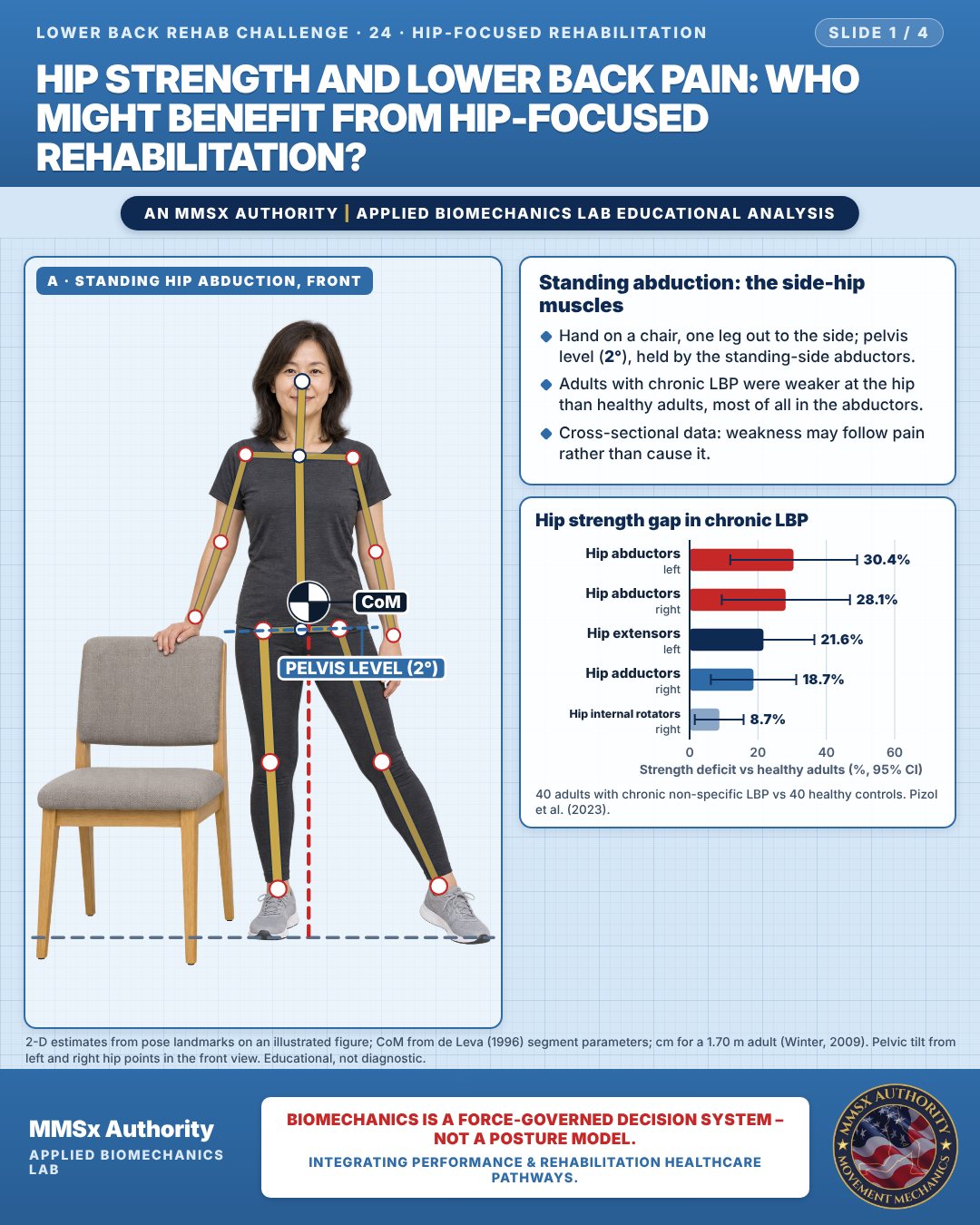
Standing abduction: the side-hip muscles
Hand on a chair, one leg out to the side; pelvis level (2°), held by the standing-side abductors.
Adults with chronic LBP were weaker at the hip than healthy adults, most of all in the abductors.
Cross-sectional data: weakness may follow pain rather than cause it.
Hip strength gap in chronic LBP
Movement B: Side-lying abduction
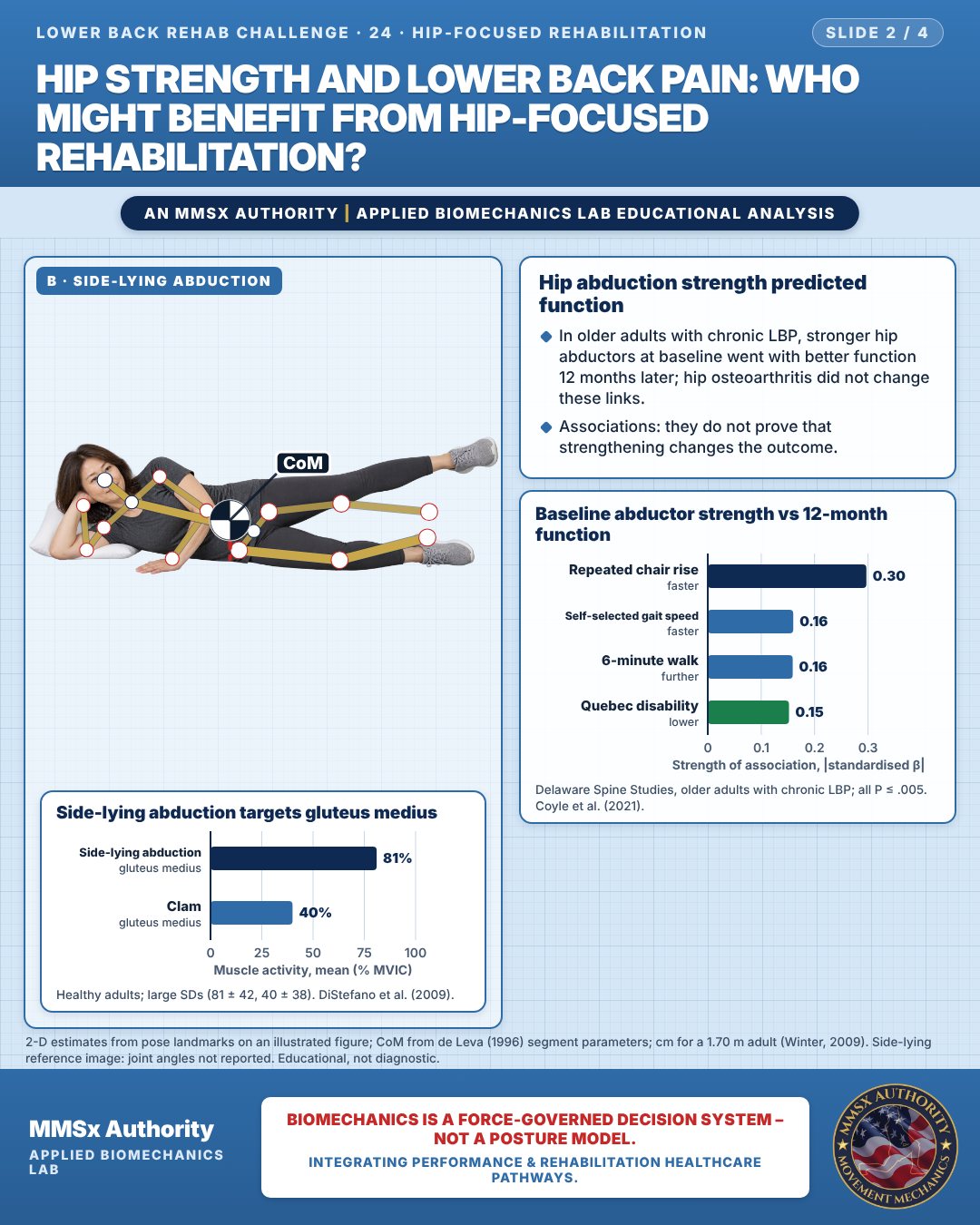
Side-lying abduction targets gluteus medius
Hip abduction strength predicted function
In older adults with chronic LBP, stronger hip abductors at baseline went with better function 12 months later; hip osteoarthritis did not change these links.
Associations: they do not prove that strengthening changes the outcome.
Baseline abductor strength vs 12-month function
Movement C: Low step-up (side view)
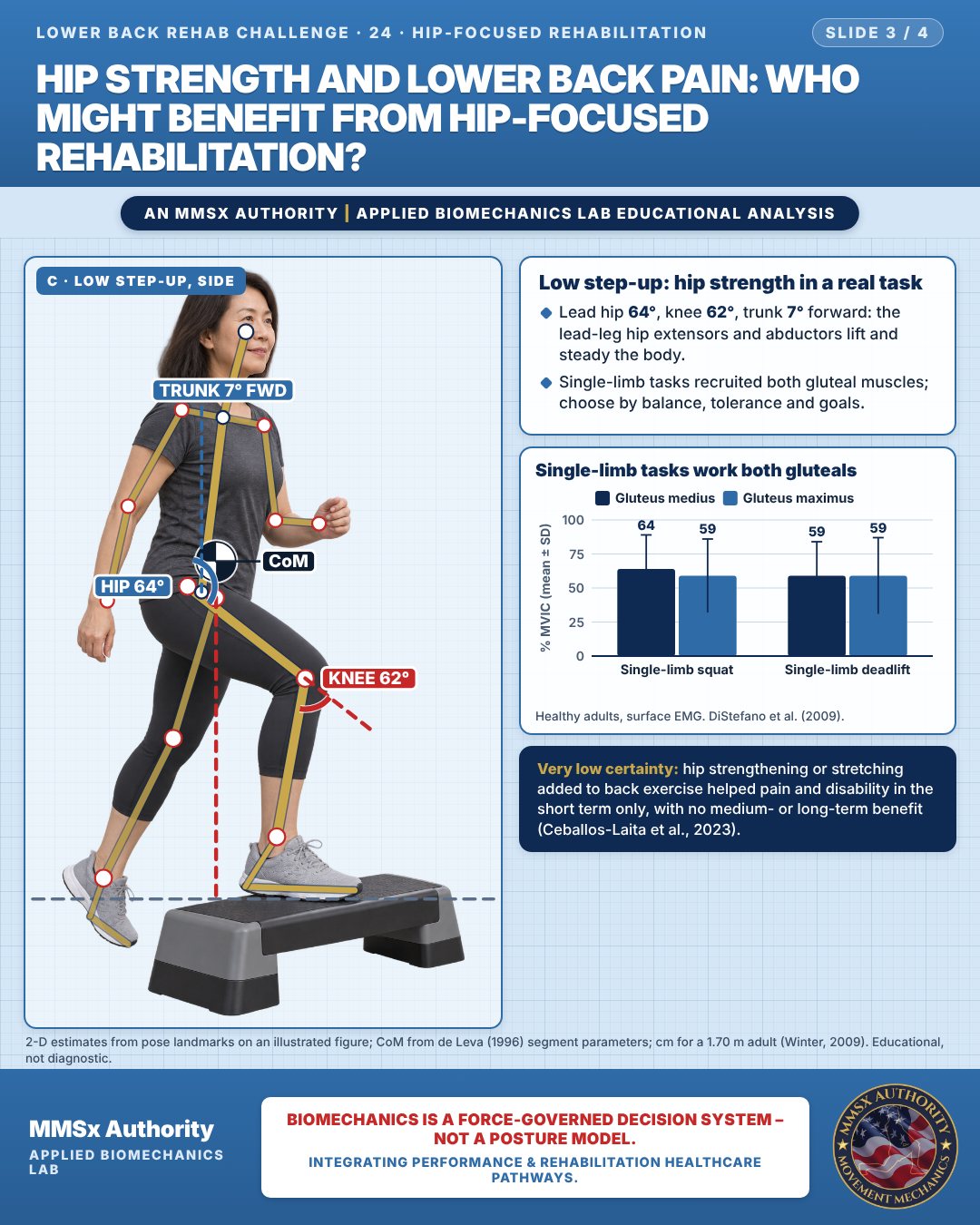
Low step-up: hip strength in a real task
Lead hip 64°, knee 62°, trunk 7° forward: the lead-leg hip extensors and abductors lift and steady the body.
Single-limb tasks recruited both gluteal muscles; choose by balance, tolerance and goals.
Single-limb tasks work both gluteals
Decision pathway
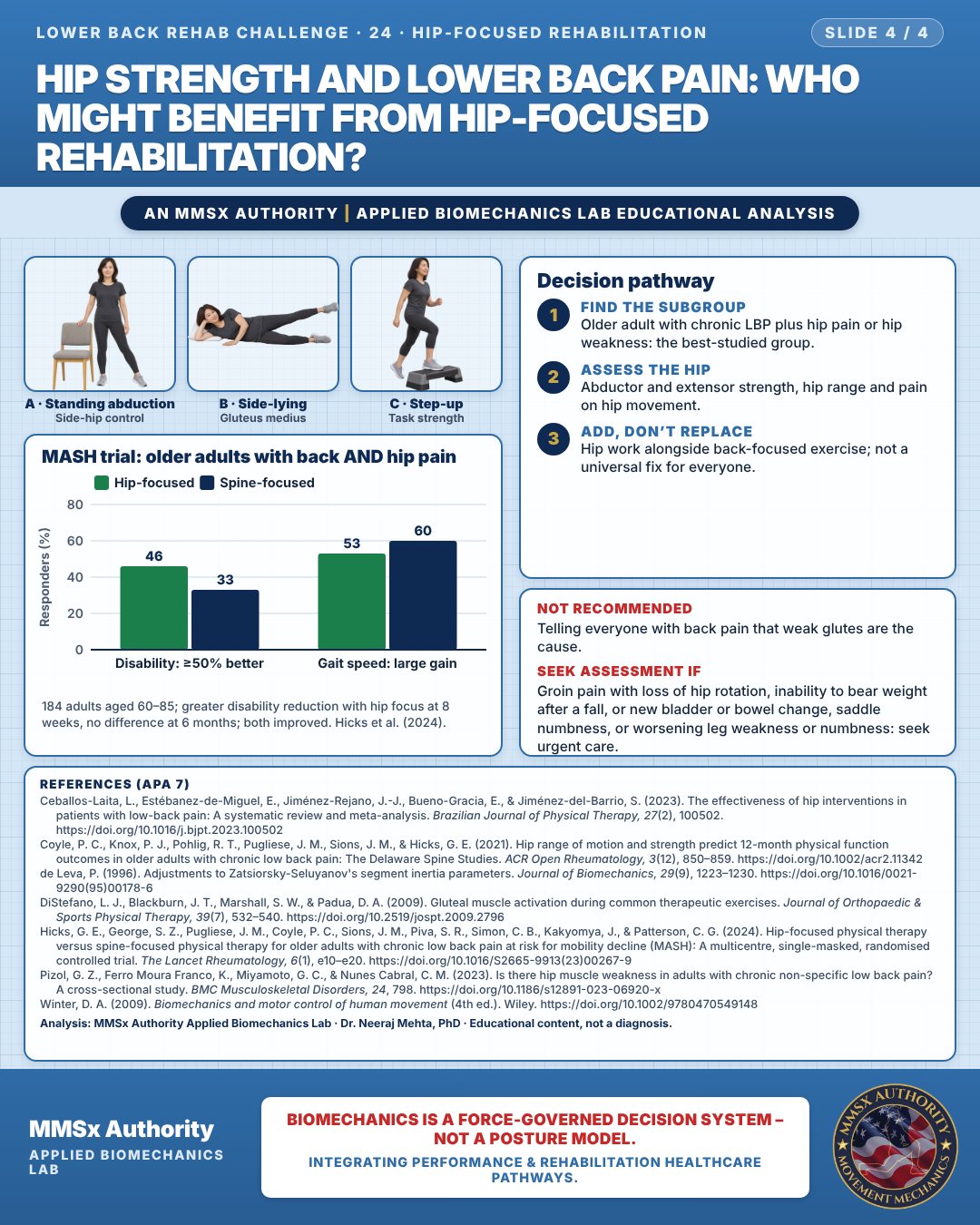
MASH trial: older adults with back AND hip pain
Find the subgroup
Older adult with chronic LBP plus hip pain or hip weakness: the best-studied group.
Assess the hip
Abductor and extensor strength, hip range and pain on hip movement.
Add, don’t replace
Hip work alongside back-focused exercise; not a universal fix for everyone.
What the evidence supports
- Evidence for hip interventions is very low certainty and short-term only (Ceballos-Laita et al., 2023). Avoid presenting hip strengthening as a universal fix.
- Exercise selection: higher-demand single-limb tasks recruit both gluteal muscles; side-lying abduction targets gluteus medius (DiStefano et al., 2009) — choose according to balance, tolerance and goals.
Cautions
Not recommended
Telling everyone with back pain that weak glutes are the cause.
Seek assessment if
Groin pain with loss of hip rotation, inability to bear weight after a fall, or new bladder or bowel change, saddle numbness, or worsening leg weakness or numbness: seek urgent care.
Methods note
2-D estimates from pose landmarks on an illustrated figure; CoM from de Leva (1996) segment parameters; cm for a 1.70 m adult (Winter, 2009). Pelvic tilt from left and right hip points in the front view. Side-lying reference image: joint angles not reported. These are educational estimates, not a diagnosis.
References
- Ceballos-Laita, L., Estébanez-de-Miguel, E., Jiménez-Rejano, J.-J., Bueno-Gracia, E., & Jiménez-del-Barrio, S. (2023). The effectiveness of hip interventions in patients with low-back pain: A systematic review and meta-analysis. Brazilian Journal of Physical Therapy, 27(2), 100502. https://doi.org/10.1016/j.bjpt.2023.100502
- Coyle, P. C., Knox, P. J., Pohlig, R. T., Pugliese, J. M., Sions, J. M., & Hicks, G. E. (2021). Hip range of motion and strength predict 12-month physical function outcomes in older adults with chronic low back pain: The Delaware Spine Studies. ACR Open Rheumatology, 3(12), 850–859. https://doi.org/10.1002/acr2.11342
- de Leva, P. (1996). Adjustments to Zatsiorsky-Seluyanov's segment inertia parameters. Journal of Biomechanics, 29(9), 1223–1230. https://doi.org/10.1016/0021-9290(95)00178-6
- DiStefano, L. J., Blackburn, J. T., Marshall, S. W., & Padua, D. A. (2009). Gluteal muscle activation during common therapeutic exercises. Journal of Orthopaedic & Sports Physical Therapy, 39(7), 532–540. https://doi.org/10.2519/jospt.2009.2796
- Hicks, G. E., George, S. Z., Pugliese, J. M., Coyle, P. C., Sions, J. M., Piva, S. R., Simon, C. B., Kakyomya, J., & Patterson, C. G. (2024). Hip-focused physical therapy versus spine-focused physical therapy for older adults with chronic low back pain at risk for mobility decline (MASH): A multicentre, single-masked, randomised controlled trial. The Lancet Rheumatology, 6(1), e10–e20. https://doi.org/10.1016/S2665-9913(23)00267-9
- Pizol, G. Z., Ferro Moura Franco, K., Miyamoto, G. C., & Nunes Cabral, C. M. (2023). Is there hip muscle weakness in adults with chronic non-specific low back pain? A cross-sectional study. BMC Musculoskeletal Disorders, 24, 798. https://doi.org/10.1186/s12891-023-06920-x
- Winter, D. A. (2009). Biomechanics and motor control of human movement (4th ed.). Wiley. https://doi.org/10.1002/9780470549148
Cite this article
Mehta, N. (2026, October 23). Hip strength and lower back pain: who might benefit from hip-focused rehabilitation? MMSx Authority Applied Biomechanics Lab. https://mmsxauthority.org/edu/analysis/lower-back/24-hip-strength-and-lower-back-pain-who-might-benefit-from-hip-focused/
Part of the collection
Mehta, N. (2026). Lower Back Rehabilitation: 50 Evidence-Based Biomechanics Analyses [Collection]. MMSx Authority Applied Biomechanics Lab. Zenodo. https://doi.org/10.5281/zenodo.23735778
All Lower Back Rehab Challenge articles · Rehabilitation Library