Lower Back Rehab Challenge · 23
Bird dog, dead bug, or bridge? Choosing and progressing trunk exercises
Bird dog (quadruped opposite arm/leg reach), dead bug (supine opposite arm/leg lowering), and bridge (supine hip lift) are low-load trunk/hip…
Key points
- Pick by demand. Bird dog for back extensors, dead bug for abdominals, bridge for hips; match to goals.
- Pick by tolerance. Start where symptoms stay steady during and the day after; swap if one aggravates.
- Progress one thing. Lever, range, hold time or load: change one at a time.
What it is
Bird dog (quadruped opposite arm/leg reach), dead bug (supine opposite arm/leg lowering), and bridge (supine hip lift) are low-load trunk/hip exercises used in "stabilisation" programmes. They differ in which muscles they emphasise (back extensors in bird dog; abdominals in dead bug/curl-up; hip extensors in bridging) rather than in being "safe" or "unsafe".
How we analysed the movement
Three movements relevant to this topic were analysed from illustrated reference figures. Joint centres were located with two-dimensional pose estimation; joint angles, the whole-body centre of mass and, where relevant, the low-back lever (the horizontal distance from the upper-body centre of mass to the L5/S1 joint) were then calculated from standard segment parameters. The figures are educational estimates that show how position changes mechanical demand; they are not measurements of a patient. Every research value quoted below comes from the published source cited beside it.
Movement A: Bird dog (side view)
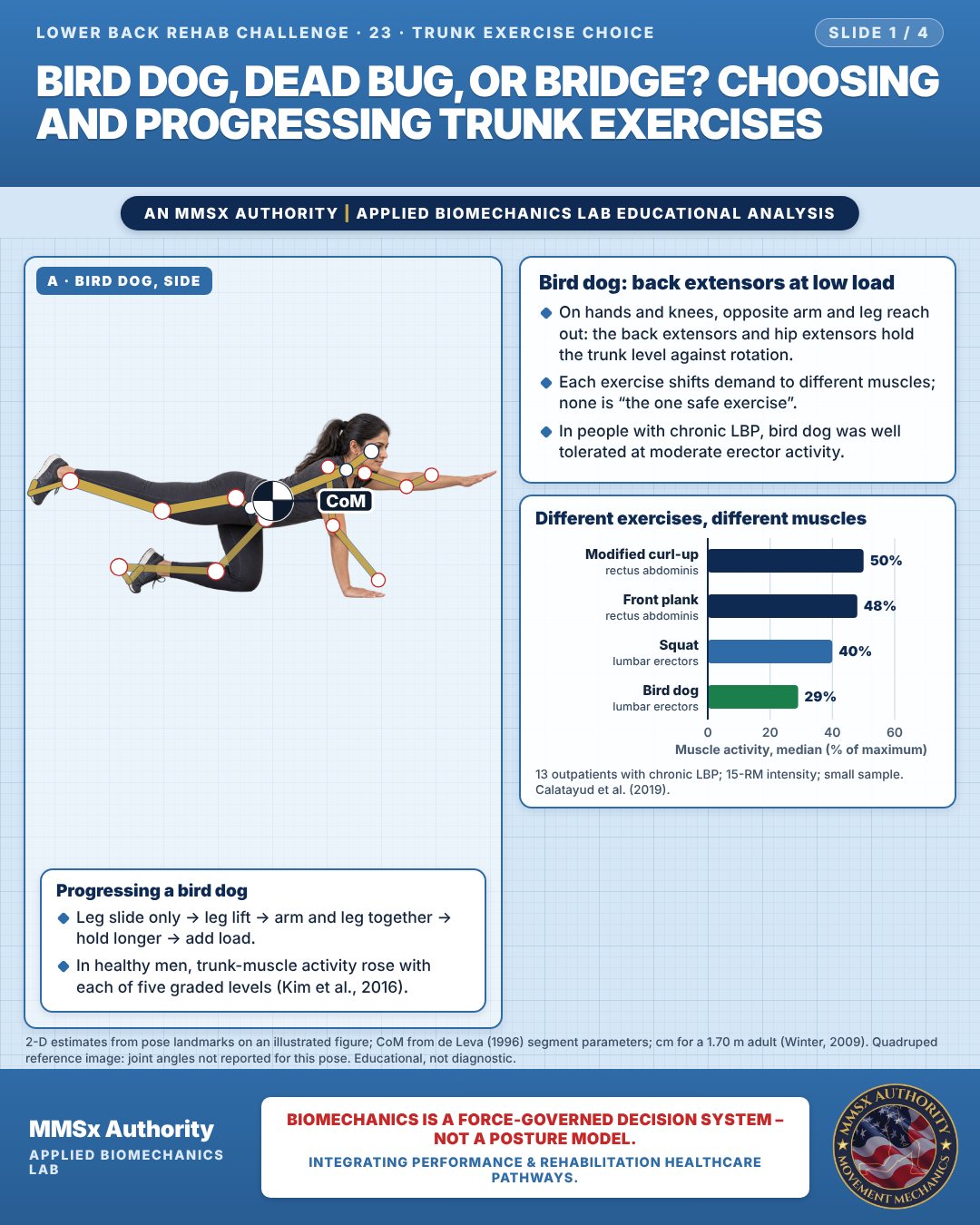
Progressing a bird dog
Leg slide only → leg lift → arm and leg together → hold longer → add load.
In healthy men, trunk-muscle activity rose with each of five graded levels (Kim et al., 2016).
Bird dog: back extensors at low load
On hands and knees, opposite arm and leg reach out: the back extensors and hip extensors hold the trunk level against rotation.
Each exercise shifts demand to different muscles; none is “the one safe exercise”.
In people with chronic LBP, bird dog was well tolerated at moderate erector activity.
Different exercises, different muscles
Movement B: Dead bug (side view)
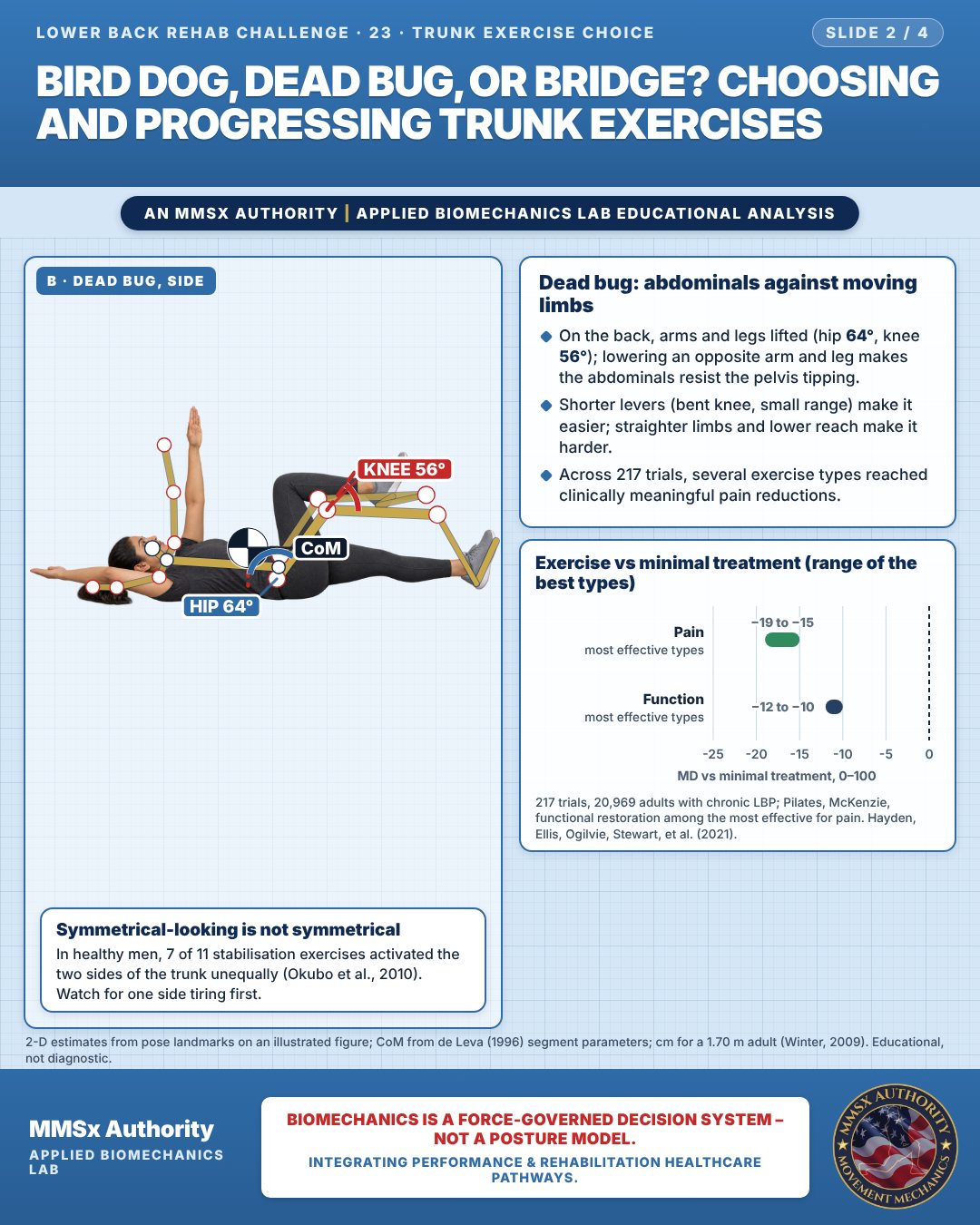
Symmetrical-looking is not symmetrical
In healthy men, 7 of 11 stabilisation exercises activated the two sides of the trunk unequally (Okubo et al., 2010). Watch for one side tiring first.
Dead bug: abdominals against moving limbs
On the back, arms and legs lifted (hip 64°, knee 56°); lowering an opposite arm and leg makes the abdominals resist the pelvis tipping.
Shorter levers (bent knee, small range) make it easier; straighter limbs and lower reach make it harder.
Across 217 trials, several exercise types reached clinically meaningful pain reductions.
Exercise vs minimal treatment (range of the best types)
Movement C: Bridge (side view)
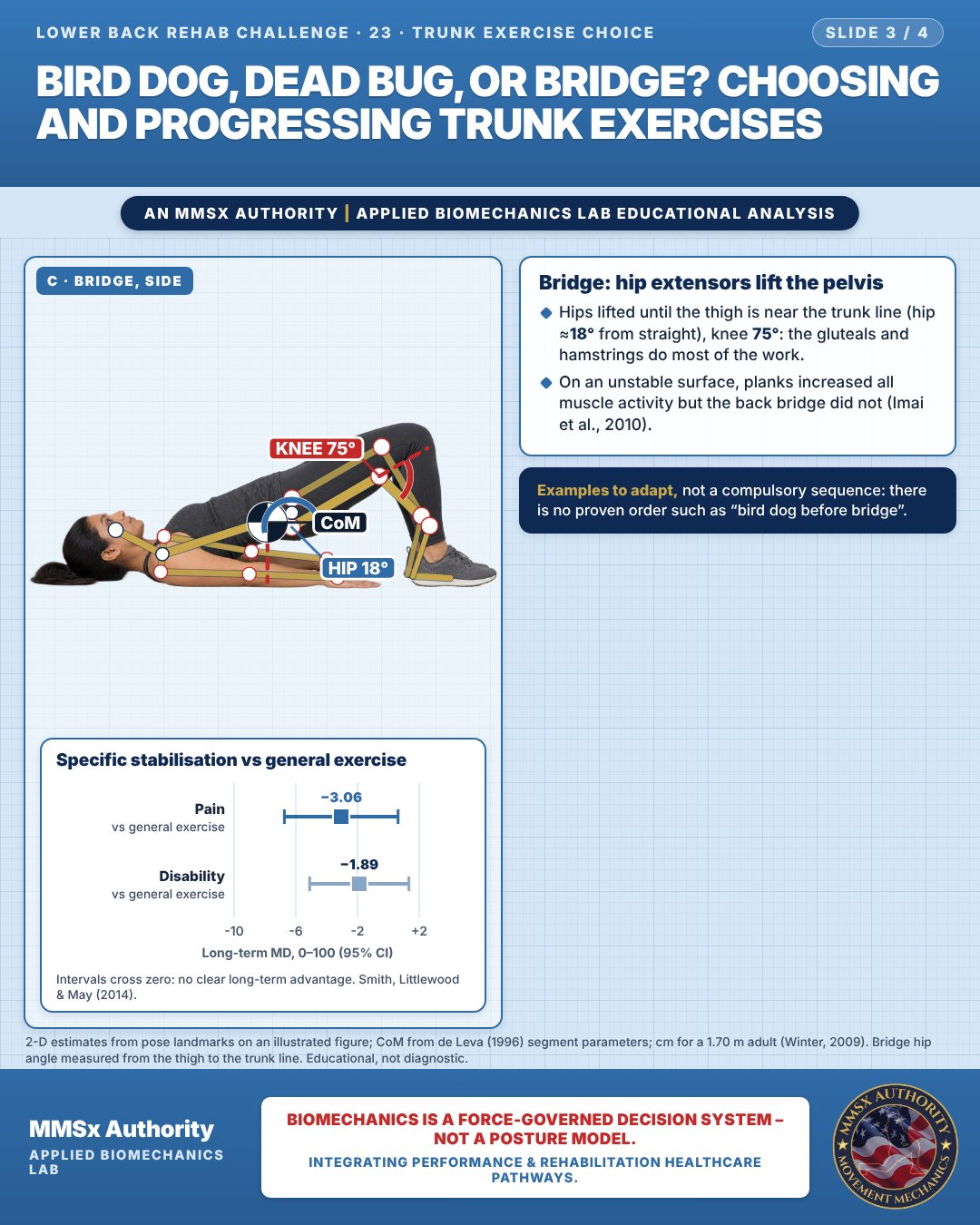
Specific stabilisation vs general exercise
Bridge: hip extensors lift the pelvis
Hips lifted until the thigh is near the trunk line (hip ≈18° from straight), knee 75°: the gluteals and hamstrings do most of the work.
On an unstable surface, planks increased all muscle activity but the back bridge did not (Imai et al., 2010).
Decision pathway
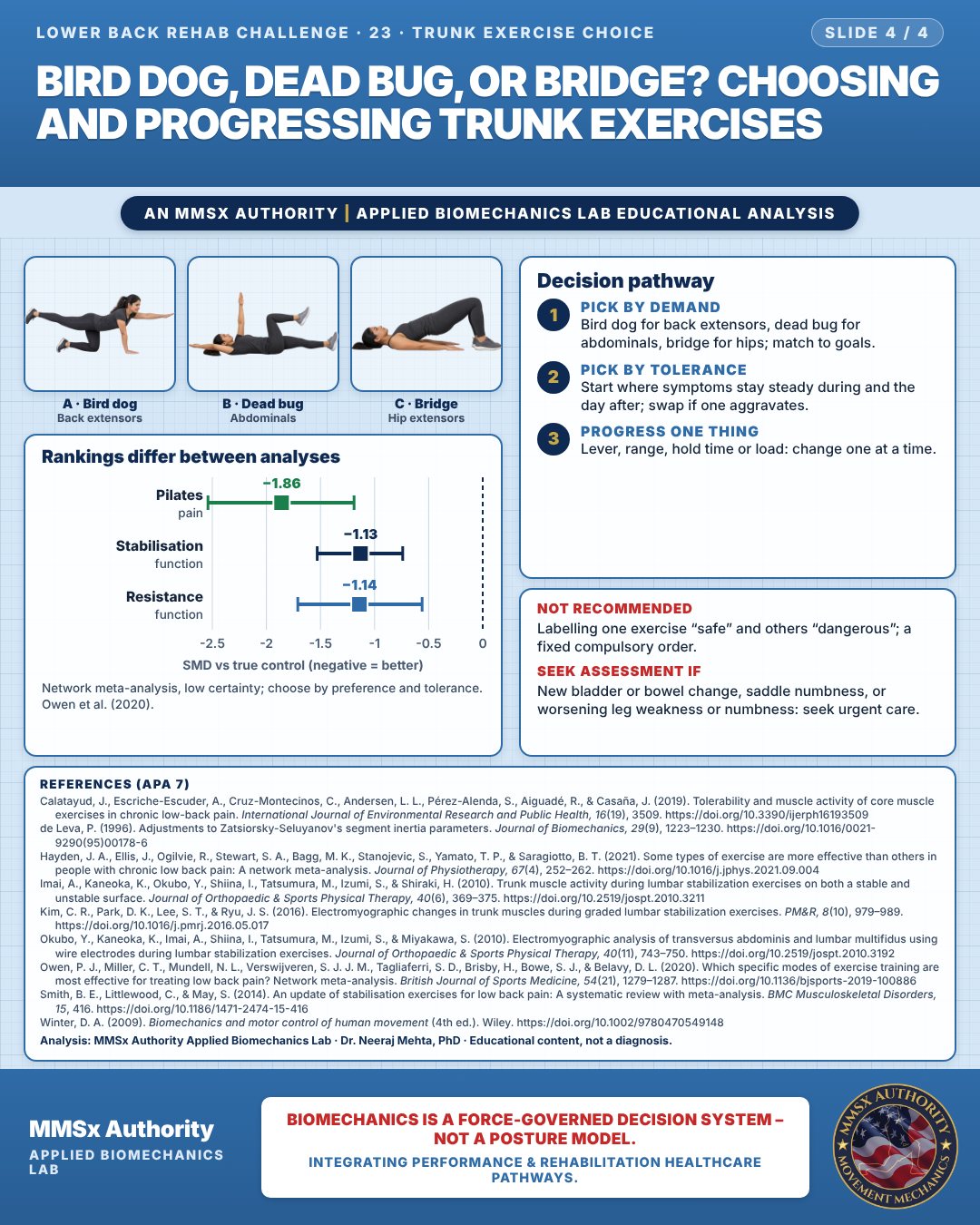
Rankings differ between analyses
Pick by demand
Bird dog for back extensors, dead bug for abdominals, bridge for hips; match to goals.
Pick by tolerance
Start where symptoms stay steady during and the day after; swap if one aggravates.
Progress one thing
Lever, range, hold time or load: change one at a time.
Myth and evidence
Myth“Bird dog is the one safe back exercise; bridges/crunch-type moves are dangerous.”
EvidenceEach exercise simply shifts demand to different muscles (Kim et al., 2016; Calatayud et al., 2019), all except the side plank were well tolerated by a small sample of people with chronic LBP (Calatayud et al., 2019), and exercise-type comparisons show broadly similar benefit with low certainty (Owen et al., 2020; Hayden et al., 2021).
Cautions
Not recommended
Labelling one exercise “safe” and others “dangerous”; a fixed compulsory order.
Seek assessment if
New bladder or bowel change, saddle numbness, or worsening leg weakness or numbness: seek urgent care.
Methods note
2-D estimates from pose landmarks on an illustrated figure; CoM from de Leva (1996) segment parameters; cm for a 1.70 m adult (Winter, 2009). Quadruped reference image: joint angles not reported for this pose. Bridge hip angle measured from the thigh to the trunk line. These are educational estimates, not a diagnosis.
References
- Calatayud, J., Escriche-Escuder, A., Cruz-Montecinos, C., Andersen, L. L., Pérez-Alenda, S., Aiguadé, R., & Casaña, J. (2019). Tolerability and muscle activity of core muscle exercises in chronic low-back pain. International Journal of Environmental Research and Public Health, 16(19), 3509. https://doi.org/10.3390/ijerph16193509
- de Leva, P. (1996). Adjustments to Zatsiorsky-Seluyanov's segment inertia parameters. Journal of Biomechanics, 29(9), 1223–1230. https://doi.org/10.1016/0021-9290(95)00178-6
- Hayden, J. A., Ellis, J., Ogilvie, R., Stewart, S. A., Bagg, M. K., Stanojevic, S., Yamato, T. P., & Saragiotto, B. T. (2021). Some types of exercise are more effective than others in people with chronic low back pain: A network meta-analysis. Journal of Physiotherapy, 67(4), 252–262. https://doi.org/10.1016/j.jphys.2021.09.004
- Imai, A., Kaneoka, K., Okubo, Y., Shiina, I., Tatsumura, M., Izumi, S., & Shiraki, H. (2010). Trunk muscle activity during lumbar stabilization exercises on both a stable and unstable surface. Journal of Orthopaedic & Sports Physical Therapy, 40(6), 369–375. https://doi.org/10.2519/jospt.2010.3211
- Kim, C. R., Park, D. K., Lee, S. T., & Ryu, J. S. (2016). Electromyographic changes in trunk muscles during graded lumbar stabilization exercises. PM&R, 8(10), 979–989. https://doi.org/10.1016/j.pmrj.2016.05.017
- Okubo, Y., Kaneoka, K., Imai, A., Shiina, I., Tatsumura, M., Izumi, S., & Miyakawa, S. (2010). Electromyographic analysis of transversus abdominis and lumbar multifidus using wire electrodes during lumbar stabilization exercises. Journal of Orthopaedic & Sports Physical Therapy, 40(11), 743–750. https://doi.org/10.2519/jospt.2010.3192
- Owen, P. J., Miller, C. T., Mundell, N. L., Verswijveren, S. J. J. M., Tagliaferri, S. D., Brisby, H., Bowe, S. J., & Belavy, D. L. (2020). Which specific modes of exercise training are most effective for treating low back pain? Network meta-analysis. British Journal of Sports Medicine, 54(21), 1279–1287. https://doi.org/10.1136/bjsports-2019-100886
- Smith, B. E., Littlewood, C., & May, S. (2014). An update of stabilisation exercises for low back pain: A systematic review with meta-analysis. BMC Musculoskeletal Disorders, 15, 416. https://doi.org/10.1186/1471-2474-15-416
- Winter, D. A. (2009). Biomechanics and motor control of human movement (4th ed.). Wiley. https://doi.org/10.1002/9780470549148
Cite this article
Mehta, N. (2026, October 23). Bird dog, dead bug, or bridge? Choosing and progressing trunk exercises. MMSx Authority Applied Biomechanics Lab. https://mmsxauthority.org/edu/analysis/lower-back/23-bird-dog-dead-bug-or-bridge-choosing-and-progressing-trunk-exercises/
Part of the collection
Mehta, N. (2026). Lower Back Rehabilitation: 50 Evidence-Based Biomechanics Analyses [Collection]. MMSx Authority Applied Biomechanics Lab. Zenodo. https://doi.org/10.5281/zenodo.23735778
All Lower Back Rehab Challenge articles · Rehabilitation Library