Lower Back Rehab Challenge · 22
Planks for lower back pain: finding the right starting level
A plank (prone bridge) is an isometric hold in which the trunk is kept roughly neutral while supported on forearms and toes (or knees, or an incline).
Key points
- Pick the support. Start at the incline or knee level that feels controlled and symptom-steady.
- Build duration. Short holds repeated, then longer holds; ignore fixed targets from healthy norms.
- Then lengthen. Lower the incline, move to toes, then reach the elbows forward; add side planks last.
What it is
A plank (prone bridge) is an isometric hold in which the trunk is kept roughly neutral while supported on forearms and toes (or knees, or an incline); the side plank (side bridge) is the lateral equivalent. Difficulty is altered mainly by base of support (knees vs toes, incline), lever length (elbows further forward of the shoulders) and hold duration.
How we analysed the movement
Three movements relevant to this topic were analysed from illustrated reference figures. Joint centres were located with two-dimensional pose estimation; joint angles, the whole-body centre of mass and, where relevant, the low-back lever (the horizontal distance from the upper-body centre of mass to the L5/S1 joint) were then calculated from standard segment parameters. The figures are educational estimates that show how position changes mechanical demand; they are not measurements of a patient. Every research value quoted below comes from the published source cited beside it.
Movement A: Incline plank (side view)
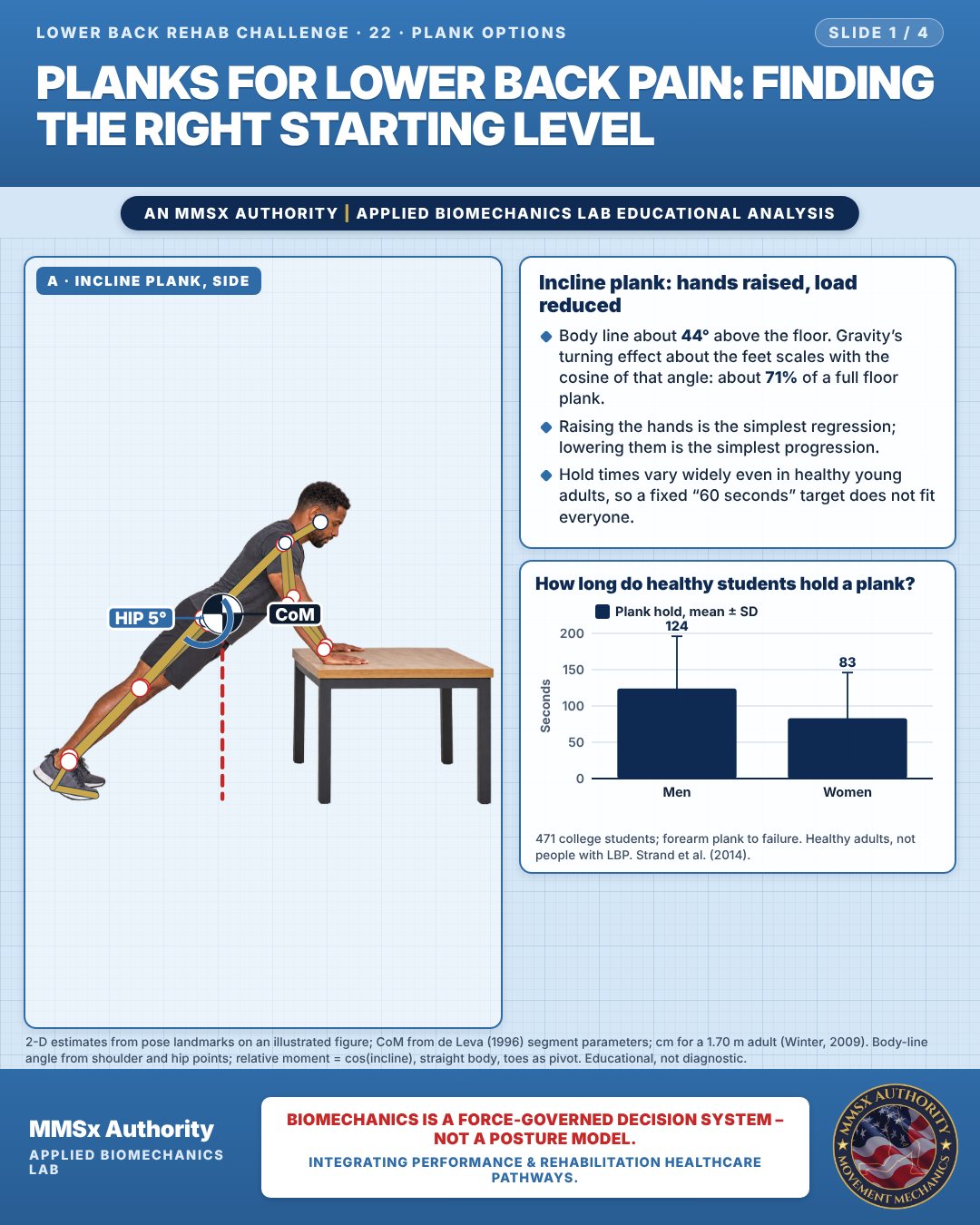
Incline plank: hands raised, load reduced
Body line about 44° above the floor. Gravity’s turning effect about the feet scales with the cosine of that angle: about 71% of a full floor plank.
Raising the hands is the simplest regression; lowering them is the simplest progression.
Hold times vary widely even in healthy young adults, so a fixed “60 seconds” target does not fit everyone.
How long do healthy students hold a plank?
Movement B: Kneeling plank (side view)
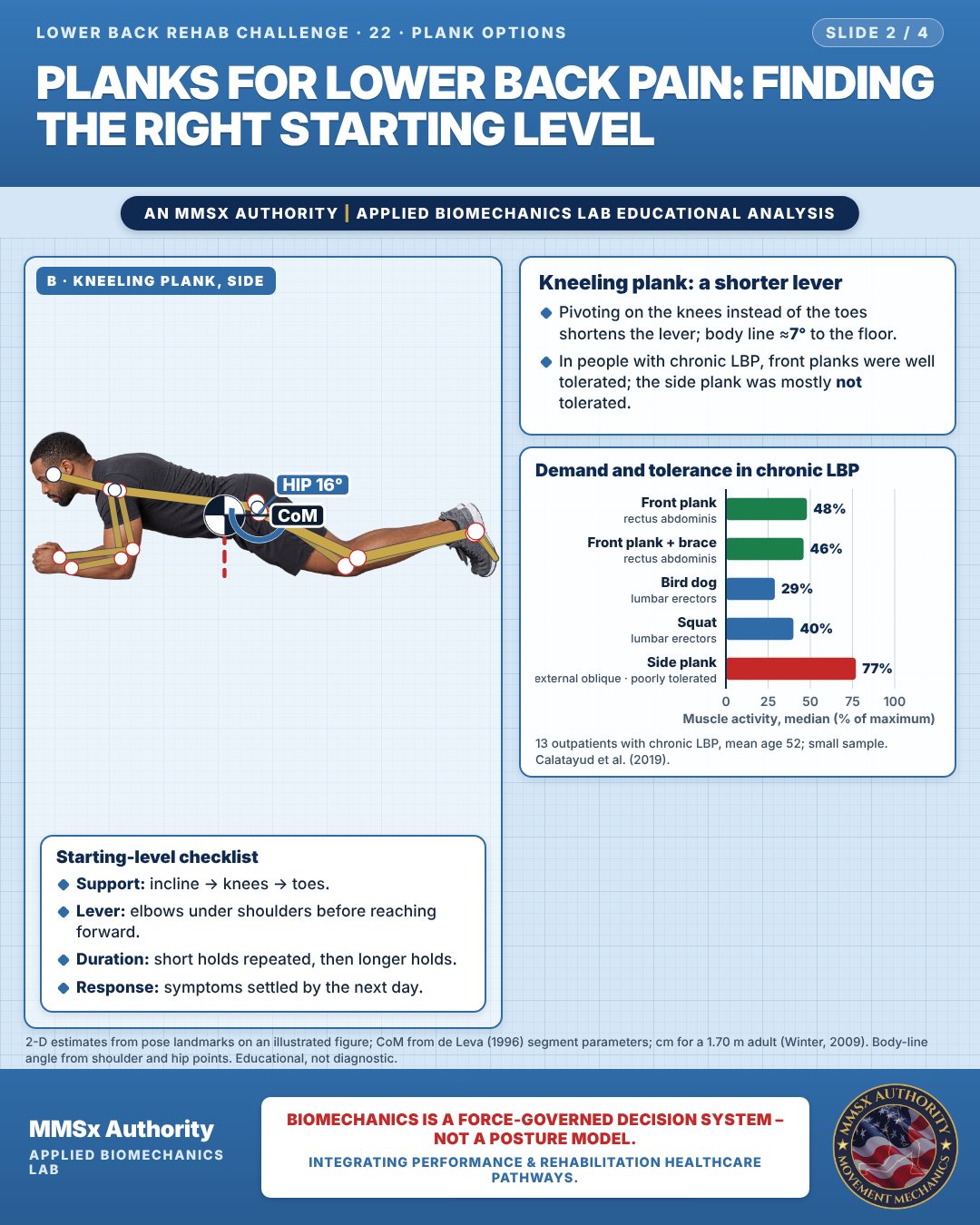
Starting-level checklist
Support: incline → knees → toes.
Lever: elbows under shoulders before reaching forward.
Duration: short holds repeated, then longer holds.
Response: symptoms settled by the next day.
Kneeling plank: a shorter lever
Pivoting on the knees instead of the toes shortens the lever; body line ≈7° to the floor.
In people with chronic LBP, front planks were well tolerated; the side plank was mostly not tolerated.
Demand and tolerance in chronic LBP
Movement C: Full plank (side view)
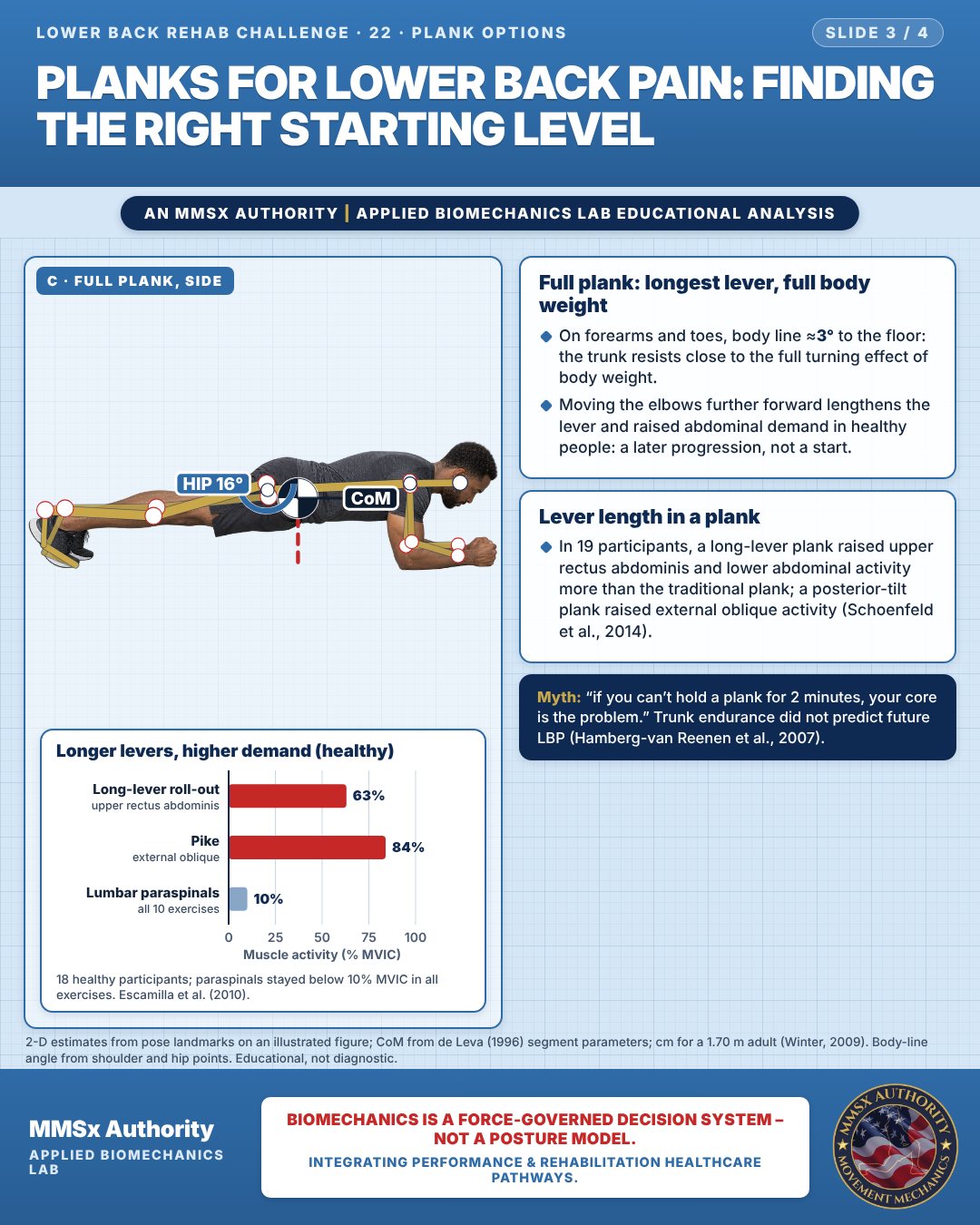
Longer levers, higher demand (healthy)
Full plank: longest lever, full body weight
On forearms and toes, body line ≈3° to the floor: the trunk resists close to the full turning effect of body weight.
Moving the elbows further forward lengthens the lever and raised abdominal demand in healthy people: a later progression, not a start.
Lever length in a plank
In 19 participants, a long-lever plank raised upper rectus abdominis and lower abdominal activity more than the traditional plank; a posterior-tilt plank raised external oblique activity (Schoenfeld et al., 2014).
Decision pathway
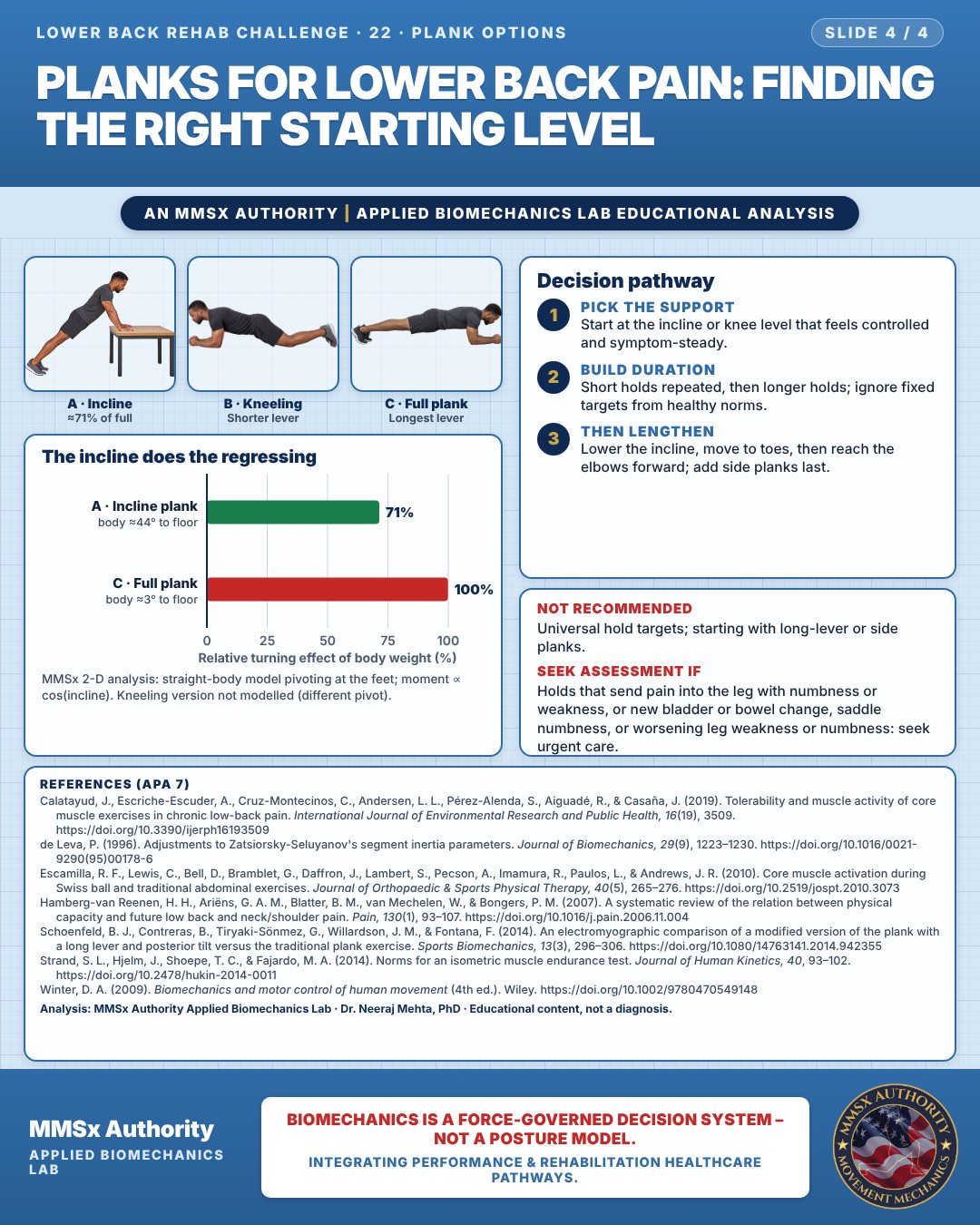
The incline does the regressing
Pick the support
Start at the incline or knee level that feels controlled and symptom-steady.
Build duration
Short holds repeated, then longer holds; ignore fixed targets from healthy norms.
Then lengthen
Lower the incline, move to toes, then reach the elbows forward; add side planks last.
What the evidence supports
- Practical progression consistent with the data: start with shorter lever/more support (incline or knees) and short holds; increase duration, then lever length; side plank may be poorly tolerated early in chronic LBP (Calatayud et al., 2019; Escamilla et al., 2010; Schoenfeld et al., 2014). These are reasoned progressions, not trial-tested protocols.
- Not recommended: fixed universal hold targets drawn from healthy norms (Strand et al., 2014).
Cautions
Not recommended
Universal hold targets; starting with long-lever or side planks.
Seek assessment if
Holds that send pain into the leg with numbness or weakness, or new bladder or bowel change, saddle numbness, or worsening leg weakness or numbness: seek urgent care.
Methods note
2-D estimates from pose landmarks on an illustrated figure; CoM from de Leva (1996) segment parameters; cm for a 1.70 m adult (Winter, 2009). Body-line angle from shoulder and hip points; relative moment = cos(incline), straight body, toes as pivot. Body-line angle from shoulder and hip points. These are educational estimates, not a diagnosis.
References
- Calatayud, J., Escriche-Escuder, A., Cruz-Montecinos, C., Andersen, L. L., Pérez-Alenda, S., Aiguadé, R., & Casaña, J. (2019). Tolerability and muscle activity of core muscle exercises in chronic low-back pain. International Journal of Environmental Research and Public Health, 16(19), 3509. https://doi.org/10.3390/ijerph16193509
- de Leva, P. (1996). Adjustments to Zatsiorsky-Seluyanov's segment inertia parameters. Journal of Biomechanics, 29(9), 1223–1230. https://doi.org/10.1016/0021-9290(95)00178-6
- Escamilla, R. F., Lewis, C., Bell, D., Bramblet, G., Daffron, J., Lambert, S., Pecson, A., Imamura, R., Paulos, L., & Andrews, J. R. (2010). Core muscle activation during Swiss ball and traditional abdominal exercises. Journal of Orthopaedic & Sports Physical Therapy, 40(5), 265–276. https://doi.org/10.2519/jospt.2010.3073
- Hamberg-van Reenen, H. H., Ariëns, G. A. M., Blatter, B. M., van Mechelen, W., & Bongers, P. M. (2007). A systematic review of the relation between physical capacity and future low back and neck/shoulder pain. Pain, 130(1), 93–107. https://doi.org/10.1016/j.pain.2006.11.004
- Schoenfeld, B. J., Contreras, B., Tiryaki-Sönmez, G., Willardson, J. M., & Fontana, F. (2014). An electromyographic comparison of a modified version of the plank with a long lever and posterior tilt versus the traditional plank exercise. Sports Biomechanics, 13(3), 296–306. https://doi.org/10.1080/14763141.2014.942355
- Strand, S. L., Hjelm, J., Shoepe, T. C., & Fajardo, M. A. (2014). Norms for an isometric muscle endurance test. Journal of Human Kinetics, 40, 93–102. https://doi.org/10.2478/hukin-2014-0011
- Winter, D. A. (2009). Biomechanics and motor control of human movement (4th ed.). Wiley. https://doi.org/10.1002/9780470549148
Cite this article
Mehta, N. (2026, October 23). Planks for lower back pain: finding the right starting level. MMSx Authority Applied Biomechanics Lab. https://mmsxauthority.org/edu/analysis/lower-back/22-planks-for-lower-back-pain-finding-the-right-starting-level/
Part of the collection
Mehta, N. (2026). Lower Back Rehabilitation: 50 Evidence-Based Biomechanics Analyses [Collection]. MMSx Authority Applied Biomechanics Lab. Zenodo. https://doi.org/10.5281/zenodo.23735778
All Lower Back Rehab Challenge articles · Rehabilitation Library