Lower Back Rehab Challenge · 21
Does a weak core cause lower back pain? What the evidence can tell us
"Core" training is an umbrella term for exercise that targets the trunk and lumbopelvic muscles (deep abdominal and back muscles, obliques, rectus…
Key points
- Reframe. Explain the core as a trainable system, not a weak link that caused the pain.
- Choose by preference. Motor control, Pilates, resistance or general exercise: pick what the person will do.
- Progress to tasks. Move from awareness drills to lifting, carrying and the person’s own activities.
What it is
"Core" training is an umbrella term for exercise that targets the trunk and lumbopelvic muscles (deep abdominal and back muscles, obliques, rectus abdominis, hip muscles); "motor control" or "stabilisation" exercise is a specific approach that first trains activation and control of deep trunk muscles and then progresses to functional tasks. "Weak core" is not a diagnosis.
How we analysed the movement
Three movements relevant to this topic were analysed from illustrated reference figures. Joint centres were located with two-dimensional pose estimation; joint angles, the whole-body centre of mass and, where relevant, the low-back lever (the horizontal distance from the upper-body centre of mass to the L5/S1 joint) were then calculated from standard segment parameters. The figures are educational estimates that show how position changes mechanical demand; they are not measurements of a patient. Every research value quoted below comes from the published source cited beside it.
Movement A: Abdominal awareness (front view)
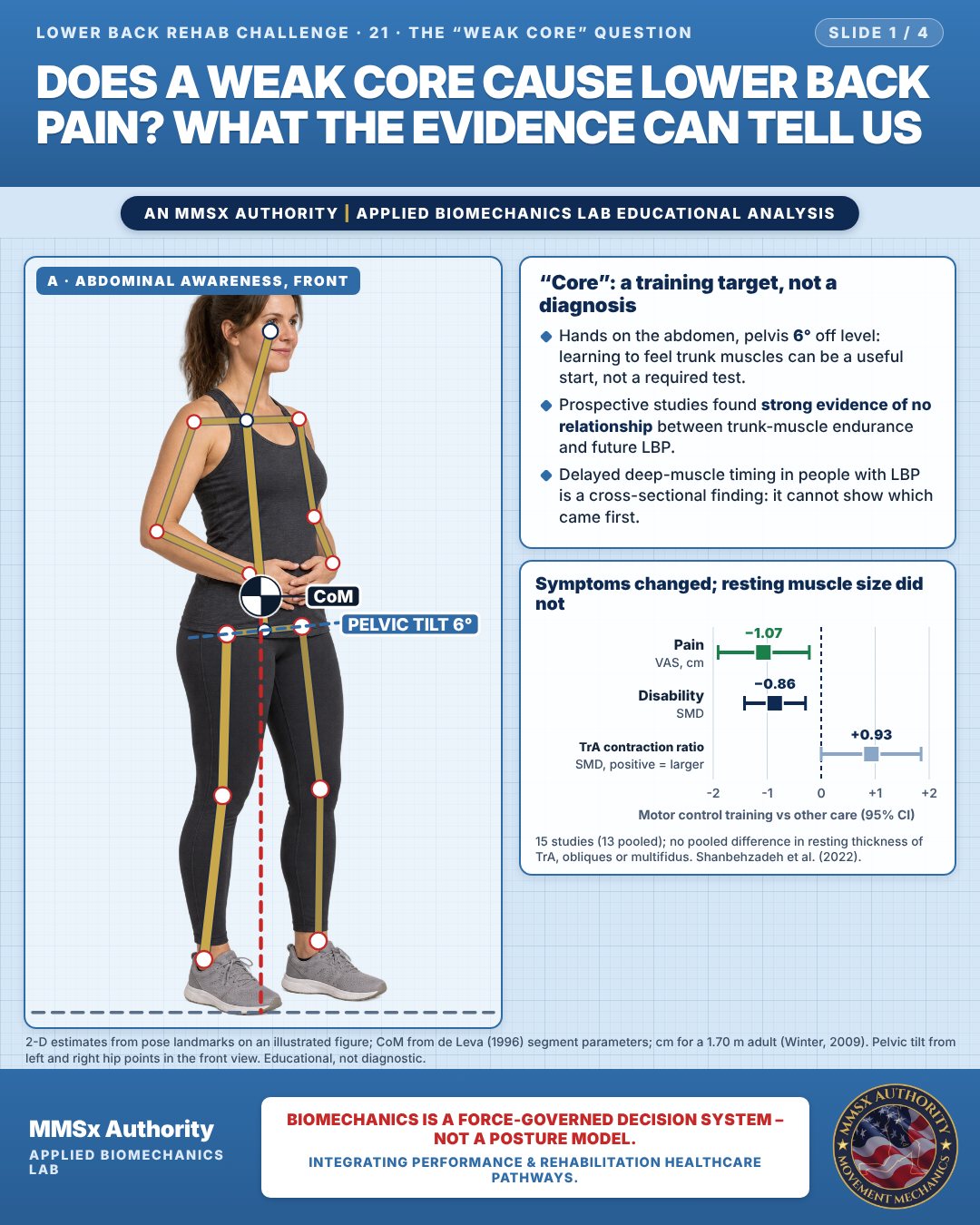
“Core”: a training target, not a diagnosis
Hands on the abdomen, pelvis 6° off level: learning to feel trunk muscles can be a useful start, not a required test.
Prospective studies found strong evidence of no relationship between trunk-muscle endurance and future LBP.
Delayed deep-muscle timing in people with LBP is a cross-sectional finding: it cannot show which came first.
Symptoms changed; resting muscle size did not
Movement B: Supine march (side view)
Myth to correct
“Your back hurts because your core is weak; switch on the deep core first.” Trunk endurance did not predict future LBP (Hamberg-van Reenen et al., 2007), and motor control training helped about as much as other exercise (Saragiotto et al., 2016).
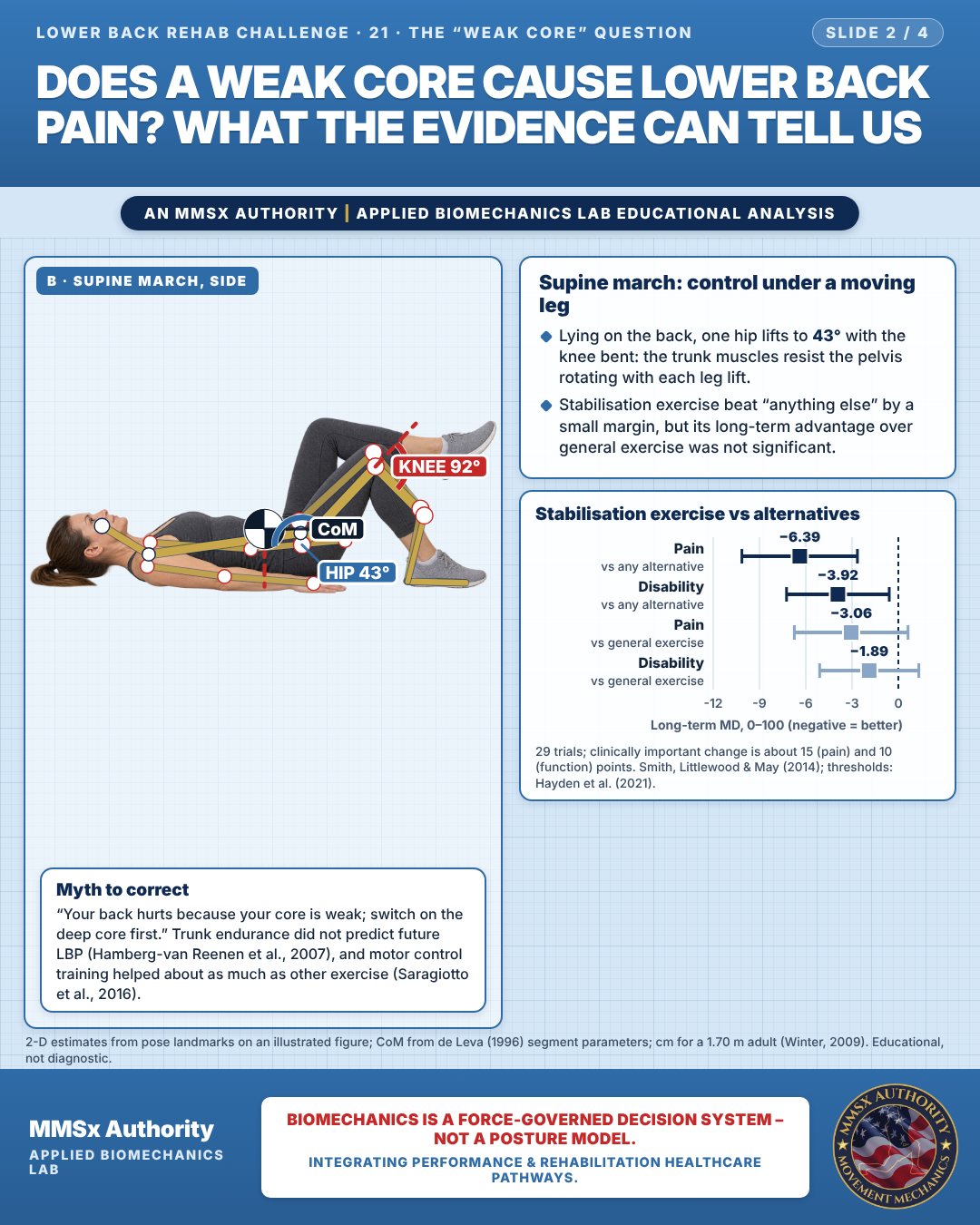
Supine march: control under a moving leg
Lying on the back, one hip lifts to 43° with the knee bent: the trunk muscles resist the pelvis rotating with each leg lift.
Stabilisation exercise beat “anything else” by a small margin, but its long-term advantage over general exercise was not significant.
Stabilisation exercise vs alternatives
Movement C: Loaded carry (front view)
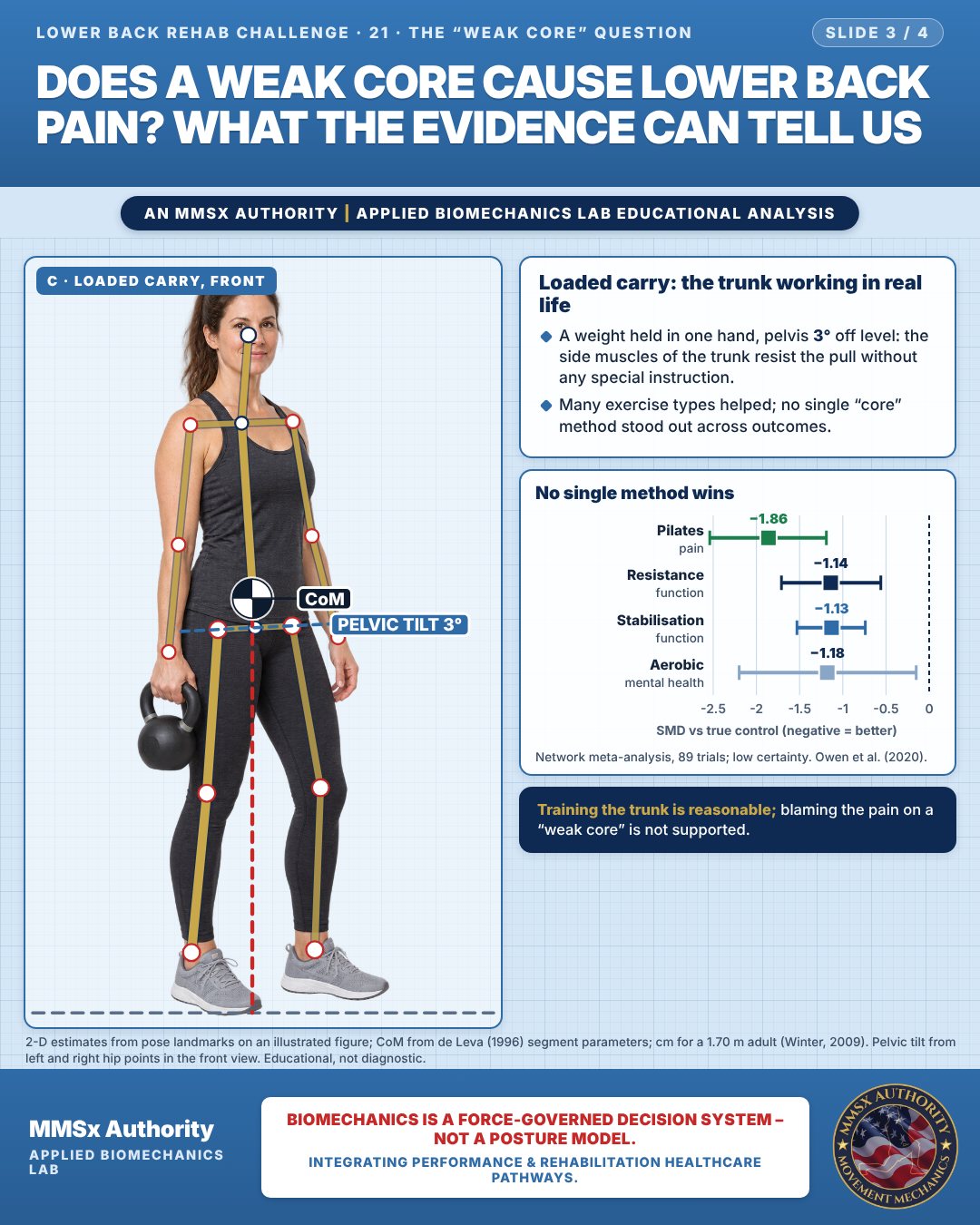
Loaded carry: the trunk working in real life
A weight held in one hand, pelvis 3° off level: the side muscles of the trunk resist the pull without any special instruction.
Many exercise types helped; no single “core” method stood out across outcomes.
No single method wins
Decision pathway
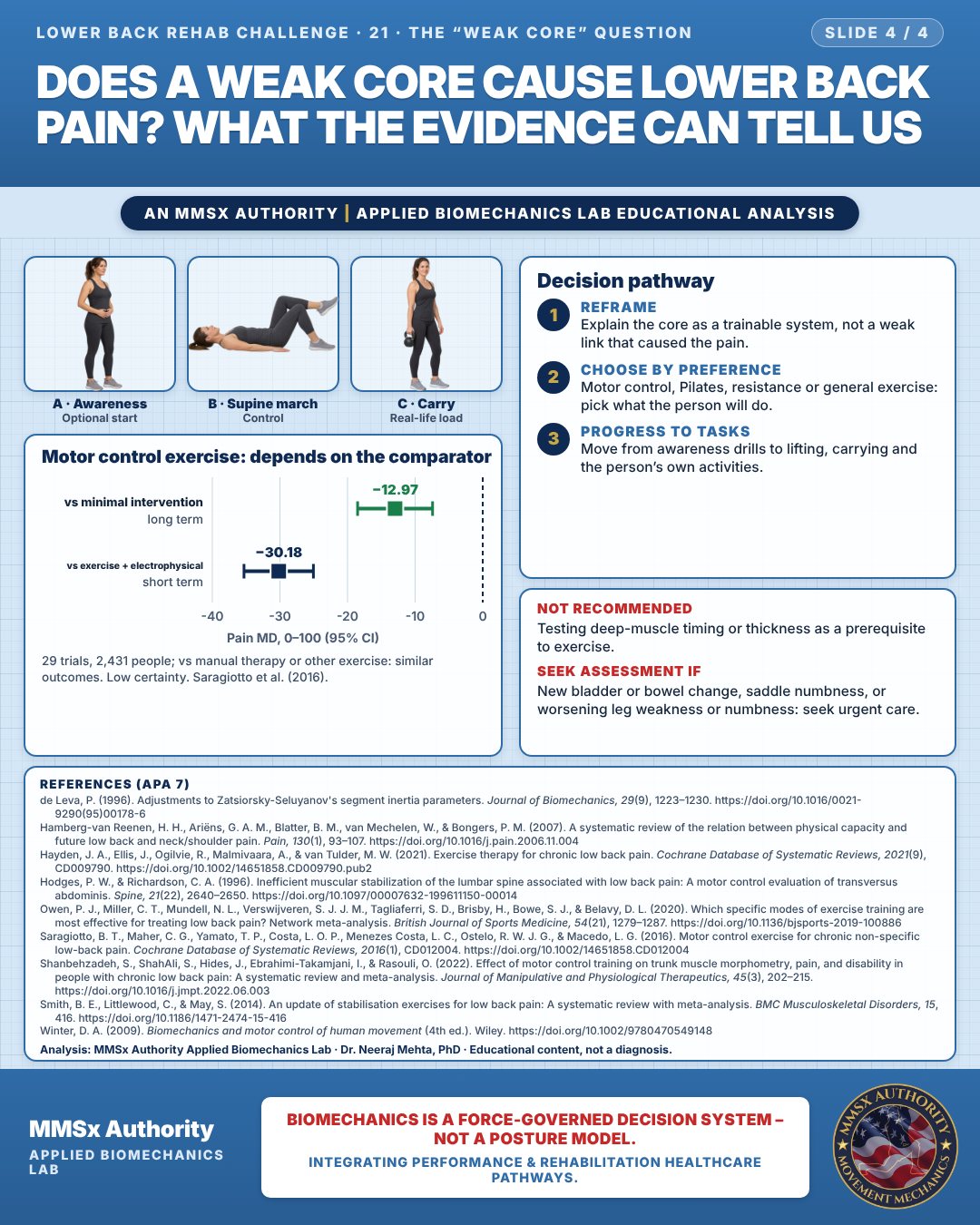
Motor control exercise: depends on the comparator
Reframe
Explain the core as a trainable system, not a weak link that caused the pain.
Choose by preference
Motor control, Pilates, resistance or general exercise: pick what the person will do.
Progress to tasks
Move from awareness drills to lifting, carrying and the person’s own activities.
What the evidence supports
- Choose by preference, ability and goals: stabilisation/motor control is not clearly better than general exercise in the long term (Smith et al., 2014; Saragiotto et al., 2016).
- Do not recommend: presenting "core weakness" as the established cause, or assessing deep-muscle timing/thickness as a prerequisite to exercise — not supported by prospective evidence (Hamberg-van Reenen et al., 2007).
Myth and evidence
Myth“Your back hurts because your core is weak; you must 'switch on' your deep core first.”
EvidenceProspective studies show strong evidence of no relationship between trunk endurance and future LBP (Hamberg-van Reenen et al., 2007); delayed muscle onset is a cross-sectional finding (Hodges & Richardson, 1996); motor control training helps about as much as other exercise (Smith et al., 2014; Saragiotto et al., 2016). The core is a reasonable training target, not a proven cause.
Cautions
Not recommended
Testing deep-muscle timing or thickness as a prerequisite to exercise.
Seek assessment if
New bladder or bowel change, saddle numbness, or worsening leg weakness or numbness: seek urgent care.
Methods note
2-D estimates from pose landmarks on an illustrated figure; CoM from de Leva (1996) segment parameters; cm for a 1.70 m adult (Winter, 2009). Pelvic tilt from left and right hip points in the front view. These are educational estimates, not a diagnosis.
References
- de Leva, P. (1996). Adjustments to Zatsiorsky-Seluyanov's segment inertia parameters. Journal of Biomechanics, 29(9), 1223–1230. https://doi.org/10.1016/0021-9290(95)00178-6
- Hamberg-van Reenen, H. H., Ariëns, G. A. M., Blatter, B. M., van Mechelen, W., & Bongers, P. M. (2007). A systematic review of the relation between physical capacity and future low back and neck/shoulder pain. Pain, 130(1), 93–107. https://doi.org/10.1016/j.pain.2006.11.004
- Hayden, J. A., Ellis, J., Ogilvie, R., Malmivaara, A., & van Tulder, M. W. (2021). Exercise therapy for chronic low back pain. Cochrane Database of Systematic Reviews, 2021(9), CD009790. https://doi.org/10.1002/14651858.CD009790.pub2
- Hodges, P. W., & Richardson, C. A. (1996). Inefficient muscular stabilization of the lumbar spine associated with low back pain: A motor control evaluation of transversus abdominis. Spine, 21(22), 2640–2650. https://doi.org/10.1097/00007632-199611150-00014
- Owen, P. J., Miller, C. T., Mundell, N. L., Verswijveren, S. J. J. M., Tagliaferri, S. D., Brisby, H., Bowe, S. J., & Belavy, D. L. (2020). Which specific modes of exercise training are most effective for treating low back pain? Network meta-analysis. British Journal of Sports Medicine, 54(21), 1279–1287. https://doi.org/10.1136/bjsports-2019-100886
- Saragiotto, B. T., Maher, C. G., Yamato, T. P., Costa, L. O. P., Menezes Costa, L. C., Ostelo, R. W. J. G., & Macedo, L. G. (2016). Motor control exercise for chronic non-specific low-back pain. Cochrane Database of Systematic Reviews, 2016(1), CD012004. https://doi.org/10.1002/14651858.CD012004
- Shanbehzadeh, S., ShahAli, S., Hides, J., Ebrahimi-Takamjani, I., & Rasouli, O. (2022). Effect of motor control training on trunk muscle morphometry, pain, and disability in people with chronic low back pain: A systematic review and meta-analysis. Journal of Manipulative and Physiological Therapeutics, 45(3), 202–215. https://doi.org/10.1016/j.jmpt.2022.06.003
- Smith, B. E., Littlewood, C., & May, S. (2014). An update of stabilisation exercises for low back pain: A systematic review with meta-analysis. BMC Musculoskeletal Disorders, 15, 416. https://doi.org/10.1186/1471-2474-15-416
- Winter, D. A. (2009). Biomechanics and motor control of human movement (4th ed.). Wiley. https://doi.org/10.1002/9780470549148
Cite this article
Mehta, N. (2026, October 23). Does a weak core cause lower back pain? What the evidence can tell us. MMSx Authority Applied Biomechanics Lab. https://mmsxauthority.org/edu/analysis/lower-back/21-does-a-weak-core-cause-lower-back-pain-what-the-evidence-can-tell-us/
Part of the collection
Mehta, N. (2026). Lower Back Rehabilitation: 50 Evidence-Based Biomechanics Analyses [Collection]. MMSx Authority Applied Biomechanics Lab. Zenodo. https://doi.org/10.5281/zenodo.23735778
All Lower Back Rehab Challenge articles · Rehabilitation Library